
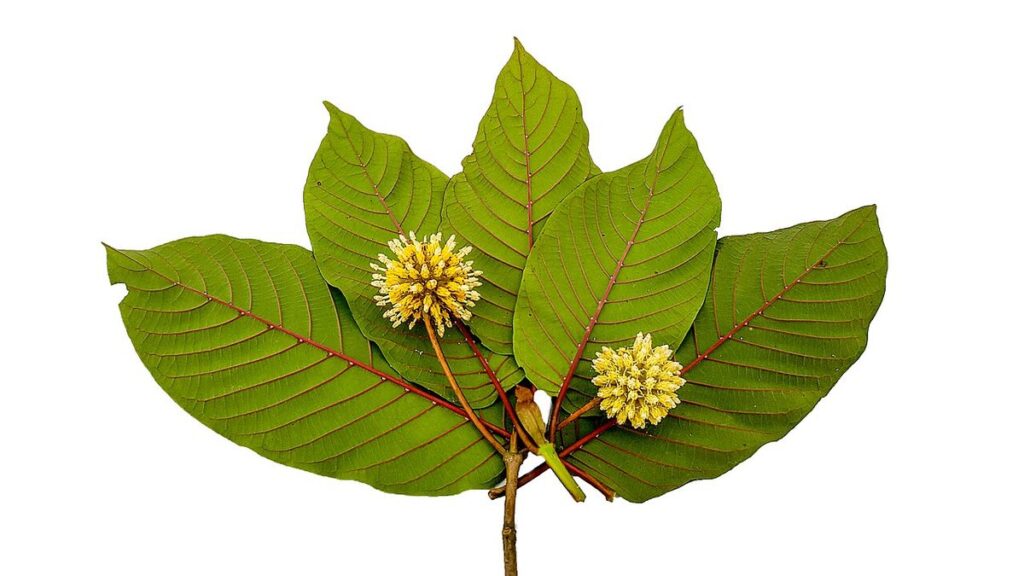
Kratom withdrawal is the set of symptoms that can follow stopping regular kratom use: muscle aches, poor sleep, runny eyes and nose, hot flushes, diarrhoea, restlessness, irritability and low mood. In studies of leaf users it is usually mild to moderate and settles within days, but frequent, heavy and long-term use makes it more likely and more intense.1,3,5,9
Concentrated 7-OH products are a different matter. Case reports describe faster, harsher, opioid-type withdrawal that doctors have often treated with buprenorphine.12,13 If you have been using 7-OH tablets, shots or films, our separate guide to 7-OH withdrawal symptoms and treatment is the better starting point. This article is about leaf kratom.
Below: what the Malaysian, Thai and US studies found, a realistic kratom withdrawal timeline, the symptoms that linger, why 7-OH changes the picture, the treatments described in the medical literature and when to get medical help. Our kratom research hub covers the plant more broadly. If you need support today, the free, confidential SAMHSA National Helpline is open 24 hours a day on 1-800-662-4357.21
At a glance
| Question | What the evidence shows |
|---|---|
| What it is | Physical dependence showing up as opioid-like, mood and sleep symptoms when regular use stops1,4 |
| How common | 25.5% of 2,061 US consumers met criteria for kratom use disorder; 68.0% of them reported withdrawal6 |
| Biggest risk factor | How often people dose, more than how much per dose5 |
| Typical severity | Mild to moderate in US and Malaysian studies3,5 |
| Typical duration | Resolved within 1 to 3 days for most users in Malaysian research; longer with heavier use9 |
| Lingering symptoms | Poor sleep, low mood and craving; poorly studied for kratom2,3,16 |
| Treatment guideline | None; experts advise against opioid medicines as routine first-line treatment for leaf withdrawal4,14 |
| 7-OH products | Earlier, more severe opioid-type withdrawal in case reports12 |
Kratom withdrawal symptoms: what the studies found
The most detailed data come from Southeast Asia, where kratom leaf is traditionally brewed as tea. A survey of 293 regular users in three northern states of Malaysia found that more than half had severe dependence scores and 45% moderate ones. Common physical withdrawal symptoms were muscle spasms and pain, difficulty sleeping, watery eyes and nose, hot flashes, fever, poor appetite and diarrhoea. Common psychological symptoms were restlessness, tension, anger, sadness and nervousness. People drinking three or more glasses a day had higher odds of severe dependence and withdrawal.1
In Thailand, researchers built a 20-item kratom withdrawal scale from interviews and surveys of 196 and 330 users. Symptoms fell into four clusters: craving and fatigue, muscle pain and insomnia, mood symptoms, and autonomic or general physical sickness. Withdrawal intensity was predicted by years of use, frequency and daily amount.11
US data look broadly similar but milder on average. In a 2022 study of 395 adults who had used kratom for a mean of 5.7 years, almost all of them whole-leaf products, scores on the Subjective Opiate Withdrawal Scale were mild to moderate (mean 13.5), and withdrawal tracked dose frequency more closely than dose size.5 In a larger 2023 online survey of 2,061 consumers, 25.5% met DSM-5-based criteria for kratom use disorder, mostly mild or moderate; tolerance (81.3%) and withdrawal (68.0%) were the criteria most often met.6 An earlier Johns Hopkins survey of 2,798 users found only 2% met criteria for a moderate or severe disorder.20
A 2023 expert forum summed it up: some symptoms resemble opioid withdrawal (runny nose, muscle pain, diarrhoea), while others look more like stopping a sedative or stimulant (lethargy, low mood, anxiety). Overall, it judged kratom withdrawal generally milder than withdrawal after frequent opioid, sedative or stimulant use, and usually self-manageable.4 Our explainer on how kratom tolerance develops covers the dependence side of this.
Restless legs and insomnia
Restless legs and weeks of broken sleep are among the most discussed symptoms in kratom recovery forums. US researchers now ask about restless legs in their cessation questionnaires,8 but no study has measured how often it occurs after kratom or how long it lasts. Sleep has been measured: in 170 Malaysian users, 46% reported more sleep problems during cessation, and those drinking four or more glasses a day had about twice the odds of sleep problems.2
How kratom withdrawal is measured
Most studies borrow opioid tools such as the Clinical Opiate Withdrawal Scale (COWS) and its self-rated equivalent. The expert forum noted these may miss kratom’s stimulant- and mood-related features and called for broader instruments.4 In a trial paid for by the maker of the leaf product tested, kratom-naive volunteers given low doses of leaf powder for 15 days did not reach clinically meaningful withdrawal on either scale, which says little about people who have used larger amounts for years.10,19
Kratom withdrawal timeline: how long does kratom withdrawal last?
No study has followed people hour by hour through stopping leaf kratom. Treat the timeline below as an estimate built from the best available pieces.
- Slow elimination. In a controlled study of encapsulated leaf powder, mitragynine’s mean half-life reached 43.4 hours after one dose and 67.9 hours after 15 daily doses.10 That is about 43 to 68 hours, so levels fall gradually, which may explain why leaf withdrawal often starts later and more gently than withdrawal from short-acting opioids.
- Skipping a day. In a 2016 US survey of 8,049 users, 57.5% reported no negative effects when they went 12, 24 or 48 hours without kratom.7,8
- The acute phase. A 2022 clinical guide, drawing on the Malaysian data, said withdrawal symptoms resolved within one to three days for most dependent users, while longer use and higher doses may extend and intensify them.9,1
- Pain and sleep. In the 170-person Malaysian study, 84% had moderate pain during cessation, but the authors judged it less prolonged than after opioid painkillers.2
| Phase | What tends to happen | Basis |
|---|---|---|
| First 12 to 48 hours | Many regular users notice little; others feel achy, restless or irritable | 57.5% reported no negative effects when skipping for 12 to 48 hours7,8 |
| Days 1 to 3 | Physical and mood symptoms most likely | Resolved within 1 to 3 days for most in Malaysian data9 |
| Rest of the first week | Heavier, longer-term users may still have aches, poor sleep and low mood | Severity rises with dose, frequency and years of use5,8,11 |
| Following weeks | Some report lingering insomnia, low mood, low energy and cravings | Not measured for kratom; well described after opioid withdrawal16 |
People who dose many times a day, use extracts, or also use opioids, alcohol or sedatives should not assume this timeline applies to them. Many published cases that needed medical treatment involved heavy use, 7-OH or co-existing opioid use disorder.12,13,14
Low mood, anhedonia and sleep after quitting kratom
Psychological symptoms have been measured once in a structured way. Among 150 regular Malaysian users, 70% had mild anxiety and 81% mild depression during cessation; heavier users (four or more glasses a day) had about 2.9 times the odds of moderate depression. The researchers found no association with high levels of anxiety or depression.3
Anhedonia, the flat feeling that nothing is enjoyable, has not been studied after kratom specifically. After opioid withdrawal, health services describe sleep disturbance and mood changes persisting for weeks, with cravings lasting longer still.16 Because kratom acts partly on opioid receptors, a similar but probably milder pattern is plausible, though unproven.
There is a second reason mood can dip. In a US survey, 91% of users said they took kratom for pain, 67% for anxiety and 65% for depression.20 Stopping can unmask the problem kratom was being used to manage. That is a reason to involve a doctor or therapist, not a sign that quitting has failed. If low mood turns into thoughts of self-harm, call or text 988.17
Why leaf kratom differs from 7-OH
Leaf kratom is dominated by mitragynine. The liver converts some of it, via the enzyme CYP3A, into 7-hydroxymitragynine (7-OH), a much more potent mu-opioid receptor agonist.22 After leaf powder, plasma 7-OH ran at roughly 15% to 31% of mitragynine levels, and its half-life was far shorter: 4.7 hours after one dose and 24.7 hours after 15 daily doses, or about 5 to 25 hours.10 Enhanced products deliver 7-OH directly and in much larger amounts. A 2026 potency analysis by a consultancy estimated morphine-equivalent values of 0.13 for mitragynine and 4.3 for 7-OH, a roughly 33-fold difference.23 See our comparison of mitragynine vs 7-hydroxymitragynine for the chemistry.
That shows up at the bedside. A 2026 case report described traditional kratom withdrawal as typically delayed and comparatively mild, then documented a man who had moved from leaf to 7-OH tablets and then to mitragynine pseudoindoxyl, a related semi-synthetic alkaloid. His COWS score reached 31, symptoms peaked in the first 24 hours, improved over 72 to 96 hours and had resolved by day five with inpatient symptom treatment.12 In a telehealth series of nine people using purified 7-OH, clinicians started buprenorphine in all of them and stabilised eight.13
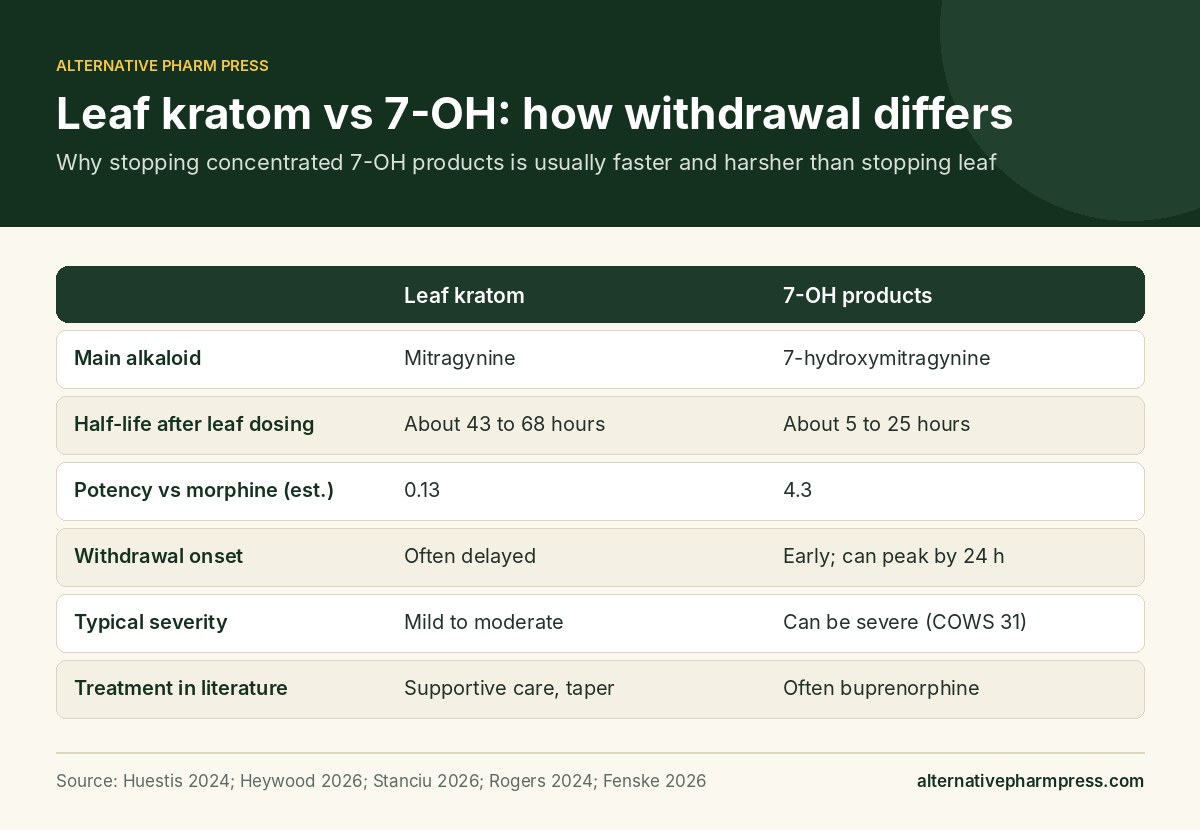
A common question in recovery forums is why stepping down from 7-OH to leaf felt easy at first, yet stopping leaf afterwards was still miserable. The pharmacology offers an explanation. Leaf retains real, if limited, opioid activity,23 so it can cover part of 7-OH withdrawal while keeping dependence going. Then, when leaf stops, the slower mitragynine withdrawal follows.
Labels add another layer of uncertainty. A 2026 laboratory analysis of tablets, films and shots found frequent mismatches between labelled and actual alkaloids, often including 7-OH.24 In Alabama, products sold as kava contained unlabelled kratom alkaloids and were linked to opioid-like withdrawal.25 The DEA’s October 2026 notice would treat products with more than 1 mg of 7-OH per gram, or a mitragynine-to-7-OH ratio below 100, temporarily in Schedule I; the order cannot be published before 13 November 2026, and plain leaf is not covered.26 Our explainers on how 7-OH products differ from traditional kratom and where 7-OH scheduling stands have the detail.
Treatments for kratom withdrawal described in the literature
There is no clinical guideline and no controlled treatment trial for kratom withdrawal.14 What follows describes what researchers and clinicians have reported, not a plan to follow without a prescriber. We do not give doses or taper schedules.
- Supportive care and gradual reduction. A 2022 guide for clinicians said many people stop without medical help and that a gradual taper is generally recommended.9 The expert forum called for formal testing of non-opioid options, including clonidine and lofexidine (FDA-approved for opioid withdrawal in 2018), and gradual dose reduction.4
- Buprenorphine. The most common medicine in US case reports.14 In a series of 28 patients with kratom use disorder, 20 were still in buprenorphine treatment at follow-up and 82% tested negative for mitragynine at 12 weeks.15 But no controlled study has tested it, and the expert forum warned that it should not be first-line for most people with leaf withdrawal, because it can create opioid dependence that was not there before.4,14 Reviewers recommend it more readily when someone also has opioid use disorder.14 Our article on Suboxone for kratom and 7-OH withdrawal covers the evidence and trade-offs.
- Naltrexone. Used by some clinicians as an opioid-free option, but it must start only after an opioid-free interval: a 2026 report described naltrexone triggering precipitated withdrawal in a patient with kratom use disorder.12,14,27
- Methadone. Reviewers say it should not be first-line for most people with kratom use disorder alone. A 2026 report described 14 patients treated in opioid treatment programmes, 64% of whom used both kratom and 7-OH.14,28
- Talking therapies. Cognitive behavioural therapy and contingency management are reasonable additions with low risk, though unproven for kratom specifically.14
A 2019 systematic review took a firmer line, advising an approach similar to opioid withdrawal with long-term maintenance to prevent relapse.30 A 2026 survey of Malaysian doctors found opioid agonists were commonly used, and the authors cautioned that opioid-based approaches may not fully address kratom’s distinct features.29 Experts still disagree.
A note on gabapentin and leftover medicines
Some people self-treat with gabapentin or other leftover prescriptions. The FDA warned in 2019 that gabapentin and pregabalin can cause serious breathing problems in people who also take opioids or other sedating drugs, and that misuse of these combinations is increasing.18 Our guide to kratom and drug interactions explains why combinations matter.
When to seek medical help
Most leaf withdrawal can be managed without hospital care, but get medical advice early, or call 911 in an emergency, if any of these apply:
- You cannot keep fluids down because of vomiting or diarrhoea.
- Chest pain, fainting, confusion or a seizure.
- Thoughts of self-harm. Call or text 988.17
- You have also been using 7-OH, opioids, alcohol or sedatives. Withdrawal from 7-OH or opioids can be faster and more severe,12 and alcohol or sedatives add their own risks; see our guide to kratom and alcohol.
- Previous attempts to stop have failed, or you are using many times a day.
Tell clinicians exactly what you use, how often and when you last did. Kratom alkaloids are not picked up by standard drug screens, so reviewers recommend confirmatory laboratory testing; our article on whether kratom shows up on a drug test explains why.12,14 After any opioid-type withdrawal, tolerance falls. MedlinePlus notes that most opioid overdose deaths occur in people who have just detoxed, so returning to a former dose, especially of 7-OH, carries real risk.17 We cover that risk in can you overdose on kratom or 7-OH?
Help is available through your doctor, an addiction clinic or the SAMHSA National Helpline (1-800-662-4357), which offers free, confidential treatment referral in English and Spanish around the clock.21 If you are worried that changing state or federal rules could cut off your supply, check our kratom laws by state; a planned, supported stop is safer than an unplanned one.
Frequently asked questions
How long does kratom withdrawal last?
For most regular leaf users in Malaysian research, acute symptoms resolved within one to three days.9 Heavier, more frequent and longer-term use can make withdrawal longer and more intense.5,11 Sleep problems, low mood and cravings may linger for weeks, although this has not been measured for kratom. Withdrawal from concentrated 7-OH products appears faster and more severe.12
What are the most common kratom withdrawal symptoms?
Studies of regular users report muscle aches and spasms, poor sleep, watery eyes and runny nose, hot flashes, fever, poor appetite and diarrhoea, along with restlessness, tension, irritability, sadness and nervousness.1 Mild anxiety and mild depression were common in one Malaysian study.3 Restless legs are widely reported online but have not been measured in research.
Is kratom withdrawal dangerous?
Leaf kratom withdrawal is generally described as uncomfortable rather than dangerous, and milder than withdrawal from frequent opioid use.4 Risks rise with dehydration from vomiting or diarrhoea, mixed use of 7-OH, opioids, alcohol or sedatives, and suicidal thoughts. The biggest danger often comes afterwards: lower tolerance raises overdose risk if heavy use restarts.17
Do you need Suboxone for kratom withdrawal?
Usually not for leaf alone. A 2023 expert forum advised that buprenorphine and methadone should not be first-line for most people with kratom withdrawal, because they can create new opioid dependence.4 Clinicians do use buprenorphine, especially for heavy use, 7-OH use or co-existing opioid use disorder, though no controlled trial has tested it.14 The decision belongs with a prescriber.
Why is quitting 7-OH harder than quitting leaf kratom?
Leaf is dominated by mitragynine, a weaker and longer-lasting alkaloid. 7-OH is a much more potent opioid with a shorter half-life, and enhanced products deliver far more of it.10,22 Case reports describe earlier, full opioid-type withdrawal from these products, while leaf withdrawal tends to be delayed and milder.12
Sources
- Singh D, Müller CP, Vicknasingam BK. Kratom (Mitragyna speciosa) dependence, withdrawal symptoms and craving in regular users. Drug Alcohol Depend. 2014;139:132-137. DOI: 10.1016/j.drugalcdep.2014.03.017. PMID: 24698080. pubmed.ncbi.nlm.nih.gov
- Singh D, Narayanan S, Vicknasingam BK, Prozialeck WC, Ramanathan S, Zainal H, et al. Severity of Pain and Sleep Problems during Kratom (Mitragyna speciosa Korth.) Cessation among Regular Kratom Users. J Psychoactive Drugs. 2018;50(3):266-274. DOI: 10.1080/02791072.2018.1443234. PMID: 29558272. pubmed.ncbi.nlm.nih.gov
- Singh D, Narayanan S, Müller CP, Swogger MT, Rahim AA, Leong Bin Abdullah MFI, et al. Severity of Kratom (Mitragyna speciosa Korth.) Psychological Withdrawal Symptoms. J Psychoactive Drugs. 2018;50(5):445-450. DOI: 10.1080/02791072.2018.1511879. PMID: 30152738. pubmed.ncbi.nlm.nih.gov
- Henningfield JE, Chawarski MC, Garcia-Romeu A, Grundmann O, Harun N, Hassan Z, et al. Kratom withdrawal: Discussions and conclusions of a scientific expert forum. Drug Alcohol Depend Rep. 2023;7:100142. DOI: 10.1016/j.dadr.2023.100142. PMID: 37397437. pubmed.ncbi.nlm.nih.gov
- Rogers JM, Weiss ST, Epstein DH, Grundmann O, Hill K, Smith KE. Kratom addiction per DSM-5 SUD criteria, and kratom physical dependence: Insights from dosing amount versus frequency. Drug Alcohol Depend. 2024;260:111329. DOI: 10.1016/j.drugalcdep.2024.111329. PMID: 38788532. pubmed.ncbi.nlm.nih.gov
- Hill K, Grundmann O, Smith KE, Stanciu CN. Prevalence of Kratom Use Disorder Among Kratom Consumers. J Addict Med. 2024;18(3):306-312. DOI: 10.1097/ADM.0000000000001290. PMID: 38441236. pubmed.ncbi.nlm.nih.gov
- Grundmann O. Patterns of Kratom use and health impact in the US: Results from an online survey. Drug Alcohol Depend. 2017;176:63-70. DOI: 10.1016/j.drugalcdep.2017.03.007. PMID: 28521200. pubmed.ncbi.nlm.nih.gov
- Smith KE, Rogers JM, Dunn KE, Grundmann O, McCurdy CR, Schriefer D, et al. Searching for a Signal: Self-Reported Kratom Dose-Effect Relationships Among a Sample of US Adults With Regular Kratom Use Histories. Front Pharmacol. 2022;13:765917. DOI: 10.3389/fphar.2022.765917. PMID: 35300296. pubmed.ncbi.nlm.nih.gov
- Swogger MT, Smith KE, Garcia-Romeu A, Grundmann O, Veltri CA, Henningfield JE, et al. Understanding Kratom Use: A Guide for Healthcare Providers. Front Pharmacol. 2022;13:801855. DOI: 10.3389/fphar.2022.801855. PMID: 35308216. pubmed.ncbi.nlm.nih.gov
- Huestis MA, Brett MA, Bothmer J, Atallah R. Human Mitragynine and 7-Hydroxymitragynine Pharmacokinetics after Single and Multiple Daily Doses of Oral Encapsulated Dried Kratom Leaf Powder. Molecules. 2024;29(5):984. DOI: 10.3390/molecules29050984. PMID: 38474495. pubmed.ncbi.nlm.nih.gov
- Saingam D, Assanangkornchai S, Geater AF, Lerkiatbundit S. Factor Analytical Investigation of Krathom (Mitragyna speciosa Korth.) Withdrawal Syndrome in Thailand. J Psychoactive Drugs. 2016;48(2):76-85. DOI: 10.1080/02791072.2016.1156791. PMID: 27015537. pubmed.ncbi.nlm.nih.gov
- Stanciu CN. Severe Early-Onset Withdrawal Following Intentional Use of Mitragynine Pseudoindoxyl: A Case Report and Emerging Clinical Considerations. Cureus. 2026;18(3):e105224. DOI: 10.7759/cureus.105224. PMID: 41982589. pubmed.ncbi.nlm.nih.gov
- Fenske E, Williams B, Hallock-Koppelman L, Buchheit BM. Buprenorphine for the Management of 7-Hydroxymitragynine (7-OH) Use: A Retrospective Case Series. J Addict Med. 2026 (published online 1 June 2026). DOI: 10.1097/ADM.0000000000001723. PMID: 42225057. pubmed.ncbi.nlm.nih.gov
- Smith KE, Epstein DH, Weiss ST. Controversies in Assessment, Diagnosis, and Treatment of Kratom Use Disorder. Curr Psychiatry Rep. 2024;26(9):487-496. DOI: 10.1007/s11920-024-01524-1. PMID: 39134892. pubmed.ncbi.nlm.nih.gov
- Broyan VR, Brar JK, Allgaier Student T, Allgaier JT. Long-term buprenorphine treatment for kratom use disorder: A case series. Subst Abus. 2022;43(1):763-766. DOI: 10.1080/08897077.2021.2010250. PMID: 35112990. pubmed.ncbi.nlm.nih.gov
- Drug and Alcohol Services South Australia, SA Health. Heroin withdrawal. April 2023. sahealth.sa.gov.au
- MedlinePlus, US National Library of Medicine. Opiate and opioid withdrawal. Reviewed 15 May 2026. medlineplus.gov
- US Food and Drug Administration. Neurontin, Gralise, Horizant (gabapentin) and Lyrica, Lyrica CR (pregabalin): Drug Safety Communication, Serious Breathing Problems. 19 December 2019. fda.gov
- Coe M, Huestis M, Wang D, Hudzik T, Bothmer J, Henningfield J. Assessment of Abuse Potential-Related Effects of Oral Dried Kratom Leaf Powder in Healthy Normal Participants Following Single and Multiple Daily Doses. Drug Test Anal. 2026;18(7):922-932. DOI: 10.1002/dta.70089. PMID: 42144893. pubmed.ncbi.nlm.nih.gov
- Garcia-Romeu A, Cox DJ, Smith KE, Dunn KE, Griffiths RR. Kratom (Mitragyna speciosa): User demographics, use patterns, and implications for the opioid epidemic. Drug Alcohol Depend. 2020;208:107849. DOI: 10.1016/j.drugalcdep.2020.107849. PMID: 32029298. pubmed.ncbi.nlm.nih.gov
- Substance Abuse and Mental Health Services Administration. SAMHSA’s National Helpline. samhsa.gov
- Kruegel AC, Uprety R, Grinnell SG, Langreck C, Pekarskaya EA, Le Rouzic V, et al. 7-Hydroxymitragynine Is an Active Metabolite of Mitragynine and a Key Mediator of Its Analgesic Effects. ACS Cent Sci. 2019;5(6):992-1001. DOI: 10.1021/acscentsci.9b00141. PMID: 31263758. pubmed.ncbi.nlm.nih.gov
- Heywood J, Farnham H, Jackson E, Steimel K, Brown S, Riordan A. Beyond kratom: Concentrated 7-hydroxymitragynine and mitragynine pseudoindoxyl products, an MME potency assessment. Regul Toxicol Pharmacol. 2026;173:106272. DOI: 10.1016/j.yrtph.2026.106272. PMID: 42838255. pubmed.ncbi.nlm.nih.gov
- Gour A, Kanumuri SRR, Mukhopadhyay S, Pullman MK, León F, Cutler SJ, et al. Mislabeling and Status of Semisynthetic Kratom-Derived Products in the US Market. Drug Test Anal. 2026;18(10):1286-1295. DOI: 10.1002/dta.70122. PMID: 42448619. pubmed.ncbi.nlm.nih.gov
- Marshall S, Leisch L, Scott KS, Rivera J, Whiddon J, Bradford D, et al. Unlabeled kratom alkaloids detected in products marketed as kava. Clin Toxicol (Phila). 2026;64(8):728-731. DOI: 10.1080/15563650.2026.2688238. PMID: 42374886. pubmed.ncbi.nlm.nih.gov
- Drug Enforcement Administration. Schedules of Controlled Substances: Temporary Placement of 7-Hydroxymitragynine and Mitragynine Pseudoindoxyl Above a Specified Threshold in Schedule I. 91 FR 65370, FR Doc. 2026-20943, Docket DEA-1570. 14 October 2026. federalregister.gov
- Williams JB, Erskine NA, Holt AG, Stepanek KD, Saha S. A Case of Precipitated Withdrawal From Naltrexone Treated With Buprenorphine in a Patient With Kratom Use Disorder. J Clin Psychopharmacol. 2026;46(2):229-231. DOI: 10.1097/JCP.0000000000002126. PMID: 41486738. pubmed.ncbi.nlm.nih.gov
- Sherrick RC. Treatment of Kratom Use Disorder With Methadone in an Opioid Treatment Program. J Addict Med. 2026 (published online 12 February 2026). DOI: 10.1097/ADM.0000000000001666. PMID: 41673921. pubmed.ncbi.nlm.nih.gov
- Singh D, Yee LC, Narayanan S. The assessment and treatment of kratom dependence: findings from a physician survey in Malaysia. Am J Drug Alcohol Abuse. 2026;52(4):498-505. DOI: 10.1080/00952990.2026.2677090. PMID: 42258633. pubmed.ncbi.nlm.nih.gov
- Stanciu CN, Gnanasegaram SA, Ahmed S, Penders T. Kratom Withdrawal: A Systematic Review with Case Series. J Psychoactive Drugs. 2019;51(1):12-18. DOI: 10.1080/02791072.2018.1562133. PMID: 30614408. pubmed.ncbi.nlm.nih.gov
Featured image: Kratom leaves by Thehealingeast, CC BY-SA 4.0. Cropped.
This article is for educational purposes only and is not medical or legal advice. Products discussed here are not intended to diagnose, treat, cure or prevent any disease. Laws vary by location and change often, so verify the rules that apply where you are. Always talk to a licensed healthcare provider before use, especially if you are under 21, pregnant or nursing, taking medication, or managing a health condition.