
This article is for educational purposes only and does not constitute medical advice.
Last updated: October 15, 2026. Added the first human drug-interaction study, corrected citations and updated U.S. legal status.
Quick answer: Kratom can change how other drugs work. Its main alkaloid, mitragynine, blocks the liver and gut enzymes CYP3A4 and CYP2D6 in lab tests, and the only human interaction study found that a low dose of kratom tea raised blood levels of the CYP3A drug midazolam by about 40%. Combining kratom with opioids, benzodiazepines, alcohol or other sedatives carries the greatest risk.
Introduction
Disclaimer: Educational content for adult readers. Not medical advice. US (FDA): Statements have not been evaluated by the FDA. Kratom is not approved by the FDA for any medical use and the agency has issued multiple public health advisories. UK: Supply of kratom is restricted under the Psychoactive Substances Act 2016. Canada: Health Canada has not authorized kratom for sale; see the Health Canada advisory on kratom. Consult a qualified healthcare professional before combining any substances.
Public interest in kratom (Mitragyna speciosa) has grown for years, and so has scrutiny from regulators. The plant has a long history of traditional use in Southeast Asia, but most modern users in the US, UK, and Canada take it alongside other substances – prescription medications, herbal supplements, alcohol – and that combination raises real safety questions. Existing research on kratom polypharmacy is limited and often case-report-based, so caution is the operative word.
How interactions occur: the CYP450 system
The cytochrome P450 (CYP450) family of liver enzymes metabolizes the majority of prescription drugs. When a substance inhibits or induces CYP enzymes, co-administered drugs can build up to toxic levels or be cleared too quickly to work.
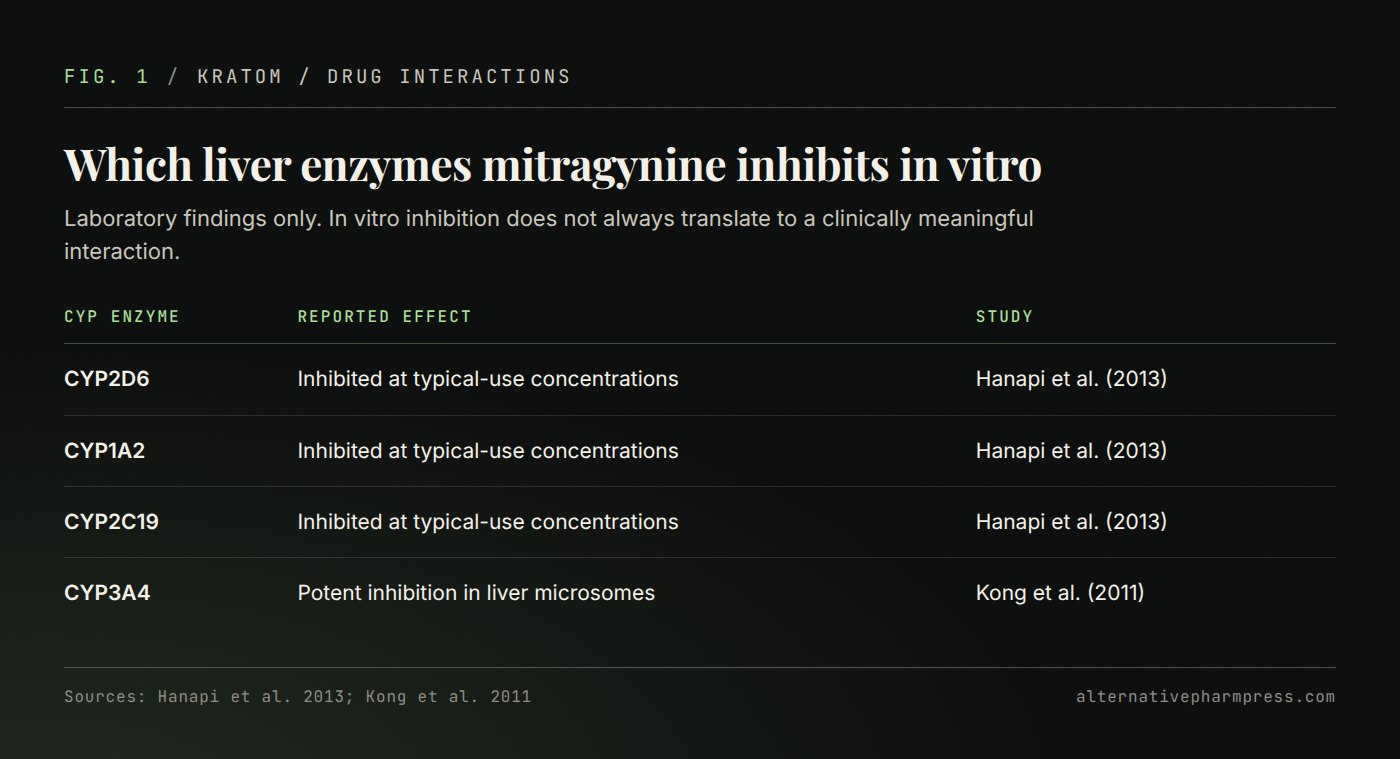
In vitro work has shown that mitragynine, kratom’s most abundant alkaloid, can inhibit several CYP isoforms. Hanapi et al. (2013) found that mitragynine inhibited CYP2D6 most strongly, followed by CYP2C9 and, more weakly, CYP3A4. Kong et al. (2011), testing a kratom alkaloid extract, reported potent inhibition of CYP3A4 and CYP2D6 and moderate inhibition of CYP1A2. Later work found that mitragynine is a time-dependent inhibitor of CYP3A, meaning its effect can build with exposure. In vitro inhibition does not always translate into a clinically meaningful interaction, but the signal is consistent enough that NCCIH and NIDA both flag pharmacokinetic interaction risk.
What the first human interaction study found
In 2023, researchers at Washington State University published the first clinical test of kratom drug interactions in Clinical Pharmacology & Therapeutics (Tanna et al.). Twelve healthy adults took a single low dose of kratom tea (2 g) together with two “probe” drugs that reveal enzyme activity.
- CYP3A (midazolam): kratom raised midazolam exposure (AUC) by about 39% and peak levels by about 50%. Because midazolam’s half-life did not change, the authors concluded kratom mainly inhibited CYP3A in the gut wall.
- CYP2D6 (dextromethorphan): no meaningful change at this low dose.
- Takeaway: even one modest serving measurably changed how a common drug was absorbed. Daily or higher-dose users, and people taking narrow-margin CYP3A drugs, could see larger effects.
The study was small and used a single low dose, so it cannot predict every interaction. It does move the CYP3A concern from theory to measured effect in people.
Substances reported to interact with kratom
Prescription medications
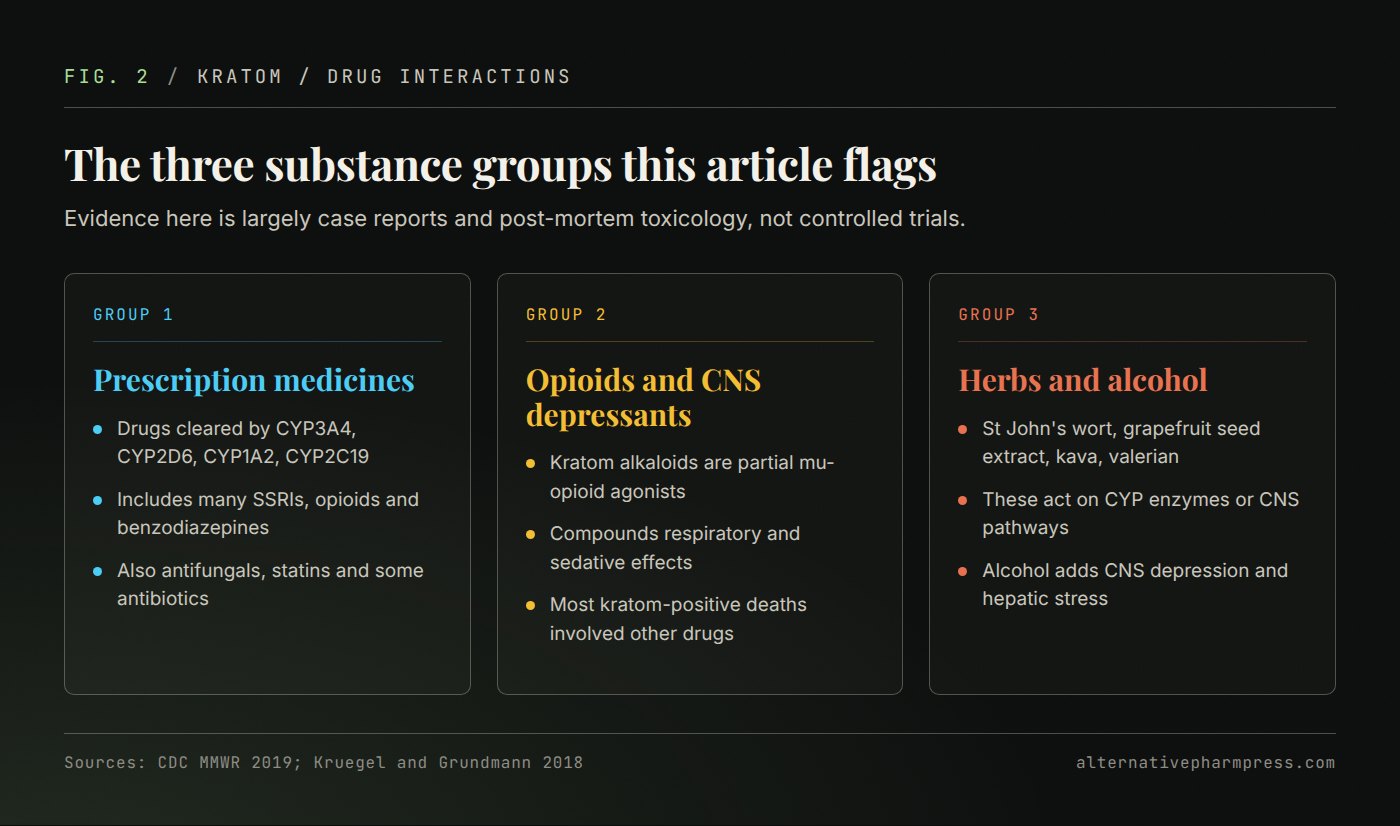
Drugs metabolized through CYP3A4, CYP2D6, CYP2C9 and CYP1A2 are potentially affected, with CYP3A the best-supported concern in humans. Examples of CYP3A substrates where higher blood levels can matter include several benzodiazepines (midazolam, alprazolam), opioids such as fentanyl and oxycodone, some statins (simvastatin, lovastatin), certain calcium channel blockers and immunosuppressants such as tacrolimus. That covers a wide list including many SSRIs, opioid analgesics, benzodiazepines, antifungals, statins, and certain antibiotics. The 2018 review by Kruegel and Grundmann in Neuropharmacology walks through the alkaloid pharmacology in detail.
Other opioids and CNS depressants
Mitragynine and 7-hydroxymitragynine are partial agonists at the mu-opioid receptor. Combining kratom with opioid medications, benzodiazepines, alcohol, or other CNS depressants compounds respiratory and sedative effects. The CDC’s Notes from the Field on kratom-detected overdose deaths reported that the overwhelming majority of kratom-positive deaths in the analyzed period also involved fentanyl, heroin, benzodiazepines, or cocaine. Polysubstance use is the dominant risk pattern in fatal cases.
Herbal supplements and alcohol
Many herbs (St John’s wort, grapefruit seed extract, kava, valerian) act on CYP enzymes or CNS pathways. Stacking kratom on top compounds the unpredictability. Alcohol adds CNS depression and hepatic stress. None of this is supported by controlled clinical trials in kratom users; the evidence base is largely case reports and post-mortem toxicology.
Why concentrated 7-OH products raise the stakes
Tablets and shots sold as “7-OH” contain far more 7-hydroxymitragynine than natural leaf. This alkaloid is a much stronger mu-opioid agonist than mitragynine, so stacking it with opioids, benzodiazepines, gabapentinoids or alcohol increases the risk of dangerous sedation and slowed breathing. These products are the main target of the FDA’s July 2025 scheduling recommendation and the DEA’s 2026 action.
Risk factors
- Higher intake increases plasma alkaloid concentrations and the chance of CYP-mediated effects.
- Frequent or daily use is associated with tolerance, dependence, and withdrawal in user surveys (Henningfield et al., 2018; Veltri and Grundmann, 2019).
- Existing liver or kidney disease changes drug clearance and is a flag for caution.
- Polypharmacy – the more substances on board, the harder interactions are to predict.
- Individual variability – age, genetics (CYP2D6 polymorphisms vary widely between populations), and overall health drive most of the response.
Why talking to a doctor matters
If you take prescription medication, a clinician can review your specific drug list against the CYP profiles described above. Be candid about kratom use; pharmacovigilance only works when both sides have full information. Most US poison control centers (AAPCC) accept anonymous queries.
Regional notes
- United States: Kratom leaf is not federally scheduled but is banned in nine states. On October 14, 2026 the DEA moved to temporarily place concentrated 7-OH above 1 mg/g in Schedule I, effective no earlier than November 13, 2026. See our state-by-state legal guide. The FDA continues to issue warnings about adulterated and contaminated kratom.
- United Kingdom: Sale and supply of kratom is restricted under the Psychoactive Substances Act 2016. Possession for personal use is generally not criminal, but importation and supply are.
- Canada: Kratom is not authorized for sale by Health Canada and is not approved as a Natural Health Product. See the Health Canada kratom advisory.
Conclusion
Kratom interacts with the same CYP450 enzymes that metabolize a long list of prescription medications, and its mu-opioid activity adds risk when combined with sedatives, opioids, or serotonergic drugs. Anyone taking maintenance medications should review their stack with a pharmacist or physician before starting kratom — and watch closely for sedation, mood changes, or breathing changes if they do.
Key takeaways
- Mitragynine inhibits multiple CYP450 enzymes in vitro; clinical translation is plausible but not fully characterized.
- The dominant fatal-outcome pattern in kratom-positive deaths is polysubstance use, not kratom alone.
- Prescription medications, opioids, benzodiazepines, alcohol, and CYP-active herbal products are the highest-attention categories.
- Talk to a clinician honestly. Risk is individual.
Frequently asked questions
Can I take kratom with antidepressants?
There are no controlled studies. Many antidepressants are processed by CYP2D6 or CYP3A4, and kratom also has some activity at serotonin and adrenergic receptors, so combining them could change drug levels or effects. Ask your prescriber or pharmacist first.
Is it safe to drink alcohol with kratom?
Combining them adds sedation and stress on the liver. Alcohol appears frequently in kratom-related poisoning and death reports, so it is best avoided.
Does kratom interact with grapefruit?
Grapefruit also inhibits intestinal CYP3A. Using both could add to the effect on CYP3A drugs, although this specific combination has not been studied.
Sources & Further Reading
- Hanapi NA, Ismail S, Mansor SM. Inhibitory effect of mitragynine on human cytochrome P450 enzyme activities. Pharmacognosy Res. 2013;5(4):241-246. PMC3807987
- Kong WM, et al. Evaluation of the effects of Mitragyna speciosa alkaloid extract on cytochrome P450 enzymes using a high throughput assay. Molecules. 2011;16(9):7344-7356. doi:10.3390/molecules16097344
- Tanna RS, et al. Clinical assessment of the drug interaction potential of the psychotropic natural product kratom. Clin Pharmacol Ther. 2023;113(6):1315-1325. PMID 36924284
- Kruegel AC, Grundmann O. Neuropharmacology. 2018;134:108-120. PMID 28830758
- Henningfield JE, et al. The abuse potential of kratom according the 8 factors of the Controlled Substances Act. Psychopharmacology. 2018. PMID 29273821
- Veltri C, Grundmann O. Subst Abuse Rehabil. 2019;10:23-31. PMID 31308789
- CDC. Notes from the Field: Unintentional Drug Overdose Deaths with Kratom Detected. MMWR. 2019. cdc.gov
- FDA. FDA and Kratom
- NIDA. Kratom DrugFacts
- NCCIH. Kratom: What You Need To Know