

This article is for educational purposes only and does not constitute medical advice.
Last updated: October 15, 2026. Added 2026 CDC poison-center and national survey data, the NIH’s MG001 trial, and corrected earlier descriptions of two studies.
Quick answer: Kratom research is small but growing fast. Lab studies show its main alkaloid, mitragynine, is a partial mu-opioid agonist that also acts on adrenergic and serotonin receptors. The first larger placebo-controlled human trial (2026) reported no serious adverse events at modest short-term doses, while CDC data show kratom-related poison-center reports hit a record in 2025, mostly involving other substances. Long-term safety remains largely unknown.
Kratom is derived from the Mitragyna speciosa tree. It has gained global attention in recent years. Traditionally used in Southeast Asia for generations, kratom is only now beginning to be studied by modern science. However, its popularity has not eliminated the gap between traditional knowledge and scientific understanding.
Researchers have started looking into kratom’s chemical makeup, possible effects, and how it’s used. But the data available is still limited, and many questions are unanswered. In this article we discuss the current state of kratom research, highlight some of the key academic studies, and discuss what scientists have learned so far and what is left to be explored.
State of Kratom Research: Limited But Growing
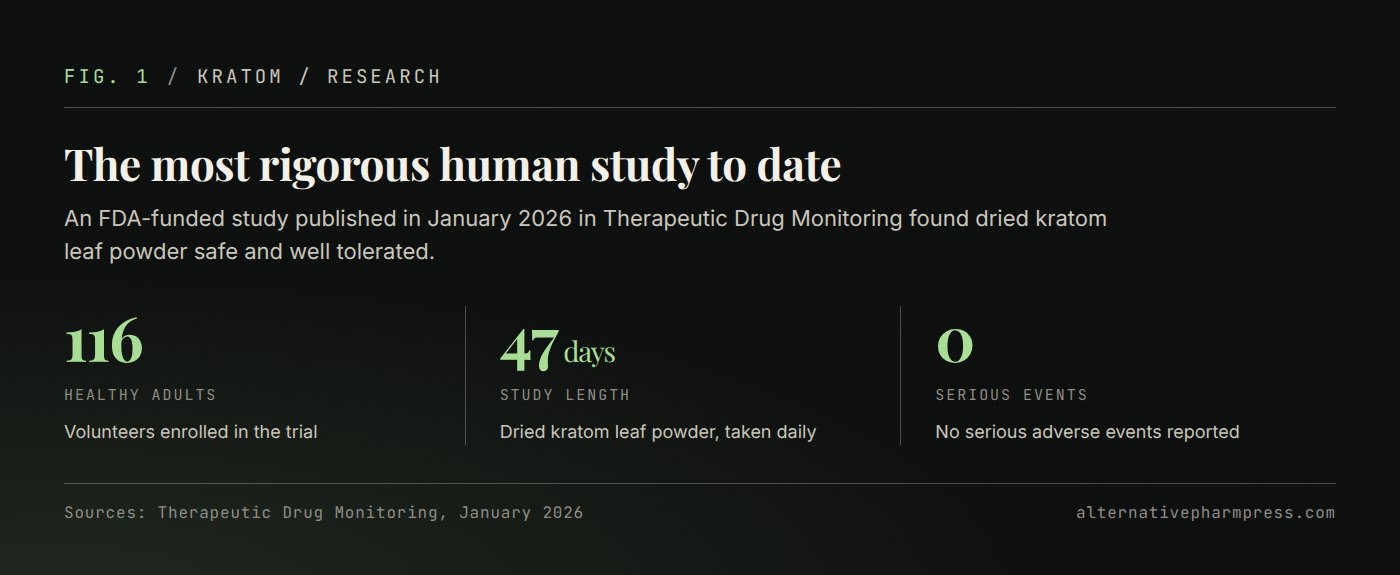
The scientific research on kratom is discussed as limited, but gradually it is expanding. There has been very little clinical research done on kratom compared to other botanical substances. Much of the current work is based on laboratory testing, surveys, and observational studies. The complexity of regulations is one reason for this constraint, which can prevent researchers from carrying out large-scale studies. Nevertheless, there is a growing interest in kratom, and over the past decade, there have been more and more papers published and discussed in academia. This trend has accelerated. In January 2026, a randomized, double-blind, placebo-controlled trial published in Therapeutic Drug Monitoring (Huestis et al.) gave a commercial kratom leaf powder or placebo to 116 healthy adults, including 15 consecutive daily doses. The researchers reported no serious adverse events, mostly mild dose-related side effects and no evidence of meaningful abuse potential or withdrawal at the doses tested. It is one of the largest controlled human kratom studies so far, though it tested a single product at modest doses in people who were not regular users.
At the same time, many studies focus on the chemical composition of kratom and the experience reported by users. They do not fully replace controlled clinical trials and provide valuable insights. Thus, present knowledge is better viewed as being evolving rather than definitive.
Key University Studies
Many universities have taken part in the growing body of kratom research and helped to shed light on its properties and patterns of use.
Researchers at the University of Florida have studied kratom’s chemical makeup and possible effects. Their research has helped in identifying key alkaloids and how they interact within the body. In 2025, University of Florida horticulture and pharmacy researchers also showed that harvest season, cultivar and post-harvest drying all change the alkaloid profile of kratom leaves (Zhang et al., Frontiers in Plant Science). A widely cited earlier finding, from Columbia University chemists in 2016 (Kruegel et al., Journal of the American Chemical Society), suggested mitragynine is a “G protein–biased” opioid agonist that recruits little beta-arrestin, a pathway once linked to respiratory depression. Later work (Gillis et al., Science Signaling, 2020) argued that low overall receptor activation, rather than bias, better explains the milder side-effect profile seen in animal studies. The question is still open, and neither finding has been confirmed in humans.
Additionally, Johns Hopkins University has performed survey studies of kratom users. Their studies provide insight into why people use kratom and how they perceive its effects. These academic efforts are necessary as they offer structured and peer-reviewed perspectives. But they often suffer from limited scale and are based on self-reported data, which may not always paint the full picture.
Receptors Activity Findings
One of the most common topics of investigation in kratom is how the active compounds in kratom interact with receptors in the body. Kratom contains a number of naturally occurring alkaloids, the most studied of which are mitragynine and 7-hydroxymitragynine. These compounds are believed to be key to how kratom affects the human system.
The research shows that these alkaloids may be interacting with opioid receptors, specifically mu-opioid receptors. The interaction is of considerable scientific interest because it may influence the processing of signals about pain, mood, and perception in general by the nervous system. However, it is important to understand that kratom doesn’t work exactly like traditional opioids. The receptor activity of kratom appears to be more complex and selective than that of usual opioid substances. Some studies suggest that its alkaloids may be partial agonists, which means they stimulate receptors but not as strongly as more potent substances. This could account for the different descriptions of its effects compared with classical opioids.
Scientists studied effects and other receptor systems besides opioid receptors that may be involved in kratom’s effects, including adrenergic and serotonergic systems. These interactions might help explain the wide range of reported effects and make the pharmacology of kratom an interesting topic for further study.
Another important aspect is that most of these findings are based on laboratory and preclinical studies rather than large-scale human clinical trials. The scientific studies at PubMed have examined kratom’s alkaloid interactions and receptor activity in controlled settings.
Survey Data on User Demographics
National data have improved. A 2026 analysis of the National Survey on Drug Use and Health (McCabe et al., Journal of Addiction Medicine) found that more than 5 million people in the U.S. have used kratom at some point, including more than 100,000 adolescents aged 12 to 17. Lifetime use among people aged 12 and older rose from 1.6% in 2021 to 1.9% in 2024, and adults aged 21 to 34 had the highest rates.
Safety surveillance is also clearer. A CDC report published in March 2026 counted 14,449 kratom exposure reports to U.S. poison centers between 2015 and 2025, with a record 3,434 in 2025. Of 233 kratom-associated deaths, 79% involved other substances, and opioids were involved in 62%. The CDC noted that its data cannot distinguish natural leaf from concentrated 7-OH products.
Survey-based research has played a significant role in understanding how kratom is used in modern contexts. Studies conducted by institutions such as Johns Hopkins University have provided valuable insights into who uses kratom and why. These surveys indicate that kratom users represent a broad spectrum of age groups, professions, and geographic locations.
A large number of survey respondents reported using kratom for personal or lifestyle reasons. However, it is important to note that these are self-reported motivations and may vary significantly from one individual to another. Another important finding from survey data is the variation in usage patterns. Some individuals report occasional use, while others describe more regular consumption.
Despite their limitations, surveys are an important tool at the current stage of kratom studies. They help researchers identify patterns, develop hypotheses, and guide future scientific investigation.
What Researchers Still Don’t Know
There is much we do know, but many questions about kratom remain unanswered. One major gap is the lack of long-term studies. The long-term effects of regular kratom use are not yet fully understood by researchers. This makes it hard to draw firm conclusions on safety and consistency.
Dosage standardization is another area of uncertainty. Kratom products may contain widely varying amounts of active ingredients. There is also limited data on interactions with other substances. The regulatory authorities like the FDA have emphasized the need for more research due to potential risks and limited clinical evidence.
Calls for Rescheduling & Research Expansion
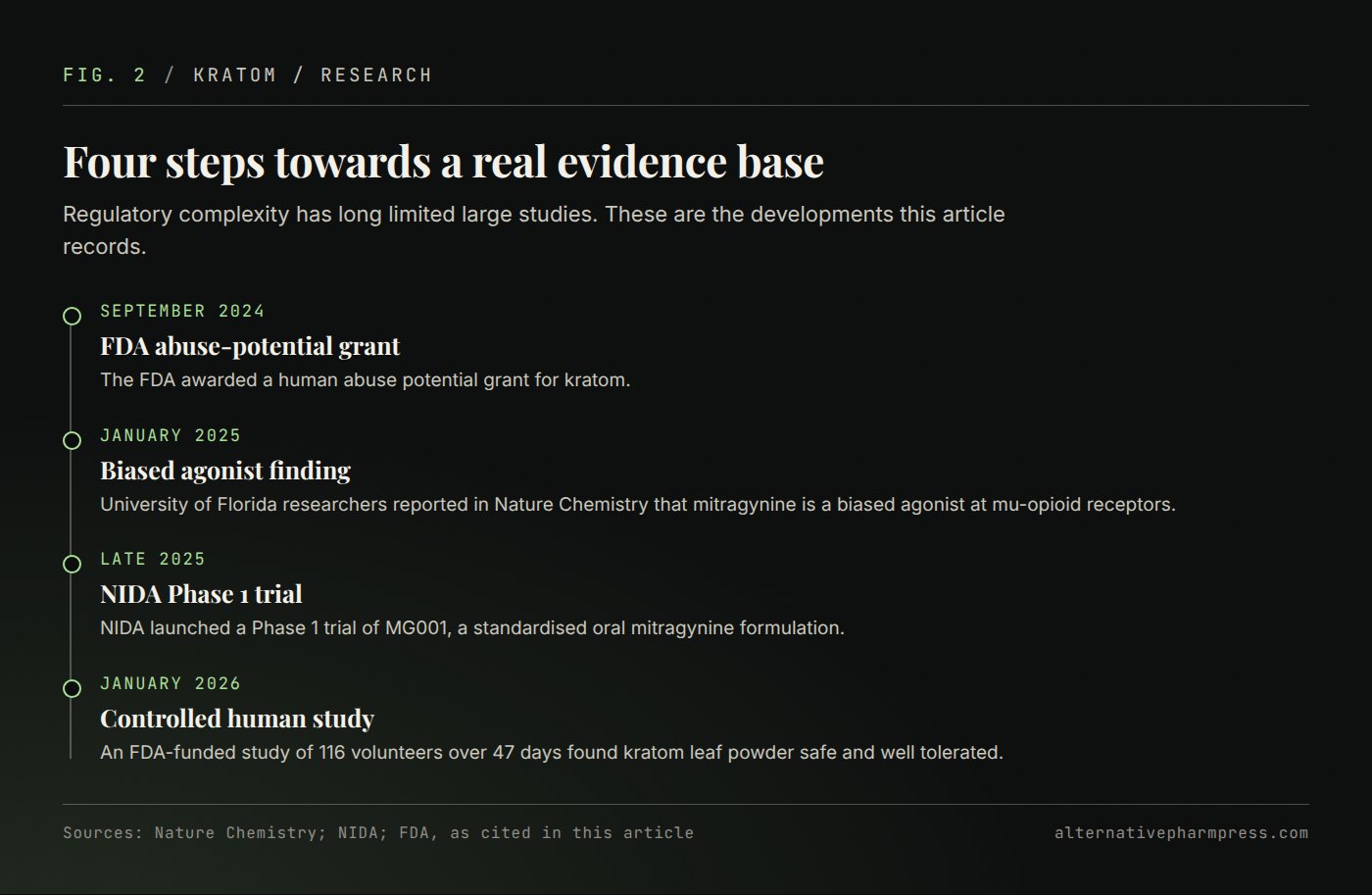
With increasing interest in kratom, there have been increasing calls for more research and clearer regulatory frameworks. Some experts say the change in regulatory categories would make it easier for scientists to conduct studies. The National Institutes of Health, through its HEAL Initiative, is running a Phase 1 trial of MG001, an oral mitragynine formulation developed with University of Florida researchers (ClinicalTrials.gov NCT07204171). After the FDA accepted an investigational new drug application, the double-blind, placebo-controlled study was cleared in 2026 to test single doses of 25 to 100 mg in about 32 healthy adults, as an early step toward evaluating mitragynine for opioid use disorder. Separately, the FDA issued a 2024 funding opportunity (RFA-FD-24-025) for a human abuse potential study of botanical kratom.
Regulators are moving at the same time. In July 2025 the FDA recommended scheduling concentrated 7-OH products, and on October 14, 2026 the DEA published notice that it will temporarily place 7-OH above 1 mg per gram in Schedule I. Natural leaf below that threshold is not covered, which lets leaf research continue while concentrated products face controls.
Conclusion
Research on kratom is still in its infancy, and much of what is known comes from preliminary studies and anecdotal user reports. Universities such as the University of Florida and Johns Hopkins have offered important insights, but more research is required. As scientific interest increases, more research on kratom will likely lead to greater clarity. Until then, approach the topic with a balanced perspective, acknowledging what is known and what is not.
Key Takeaways
There is little research on kratom, but research is growing as interest in the world grows.
Chemical analysis and user-based surveys from academic institutions such as the University of Florida and Johns Hopkins University have been instrumental in providing important insights.
Kratom’s alkaloids, including mitragynine, interact with receptors in complex ways that are not yet fully understood.
The survey data suggests a diverse user base, but most findings rely on self-reported experiences.
There are important gaps to be filled in research, such as long-term effects, consistency of dosage, and interactions with other substances.
A January 2026 placebo-controlled trial in 116 healthy adults reported no serious adverse events at modest short-term doses; long-term, high-dose and real-world safety remain unknown.
- Kratom Safety & Toxicology — Frontiers in Pharmacology (2024)
- PMC — Kratom Safety Review (2024)
- FDA and Kratom
- NIDA — Kratom Research Topics
- WHO ECDD Pre-Review Report on Kratom
- PubMed — Mitragynine Alkaloid Review
- CDC MMWR — Increases in Kratom-Related Reports to Poison Centers, 2015–2025 (March 2026)
- University of Michigan IHPI — National study finds kratom use is rising (McCabe et al., 2026)
- ClinicalTrials.gov — Phase 1 Study of Oral MG001 (NCT07204171)
- Kruegel AC, et al. J Am Chem Soc. 2016 (PMID 27192616)
- Gillis A, et al. Sci Signal. 2020 (PMID 32234959)
- Zhang M, et al. Front Plant Sci. 2025 (PMID 41090093)
- Huestis MA, et al. Ther Drug Monit. 2026