
The “hemp ban” is a change to the federal definition of hemp. From 11 December 2026, hemp is measured by total THC, including THCA, and finished products with more than 0.4 mg of total THC per container stop counting as hemp. Delta-8, THCA flower and most delta-9 hemp gummies fall outside it. Lab-made cannabinoids lose hemp status on 12 November.
Products that fall outside the definition are treated as marijuana under federal law. That raises the questions people are asking most in hemp forums: is delta-8 illegal now, what happens to products already bought, can anything still be shipped, and will stored products even keep their strength?
This is the broad consumer explainer for our THC and hemp coverage. For deeper dives, see is THCA legal after December 11 and what the federal THC limit means for CBD. Nothing here is legal advice.
At a glance
| Question | Short answer (as of 24 October 2026) |
|---|---|
| What changes? | Hemp is defined by total THC, with a 0.4 mg total-THC cap per container on finished products1,2 |
| When? | 12 November 2026 for cannabinoids the plant cannot make; 11 December 2026 for most other changes1,3 |
| Is delta-8 illegal now? | It is still sold as hemp until 11 December, when it falls outside the federal definition. Many states already restrict it1,3 |
| What stays legal federally? | Hemp fibre, grain and seed products; CBD products within the 0.4 mg cap2,4 |
| Products already owned | No grandfather clause we could find; excluded products are treated as marijuana2,4 |
| Licensed state cannabis | Not changed by the hemp law; still governed by state rules and the CSA16 |
| Could it still be delayed? | Bills exist but none has passed committee; the White House opposes another delay1 |
What the hemp ban law actually does
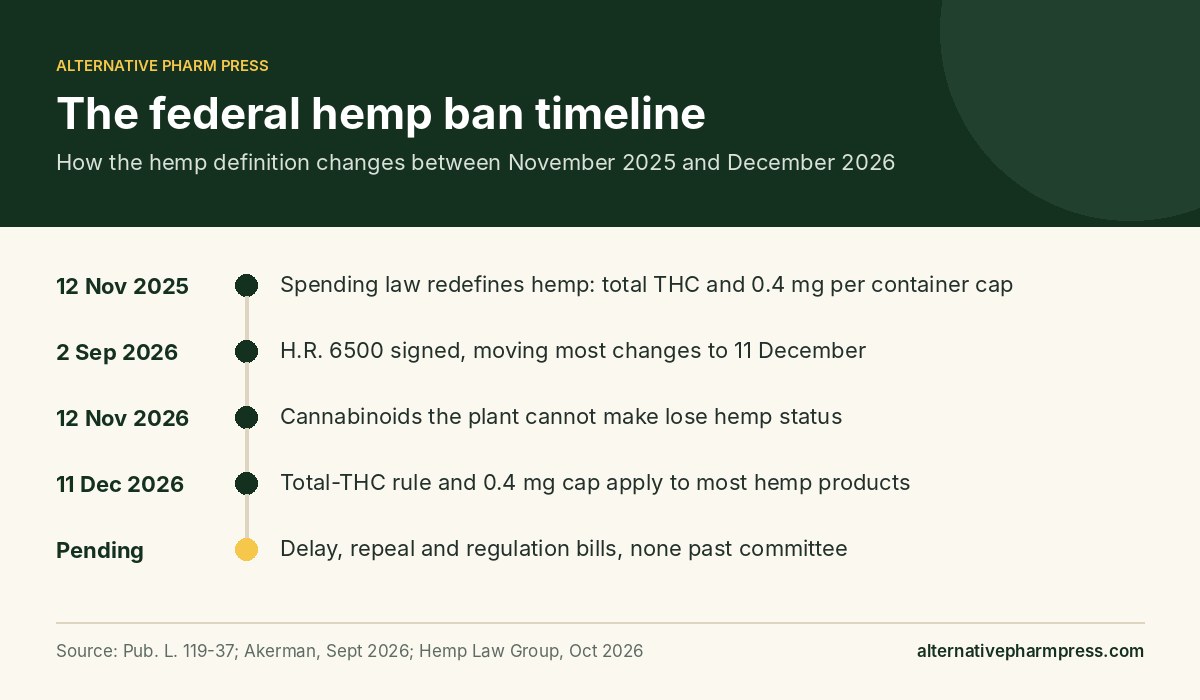
The change came in the FY2026 agriculture spending law signed on 12 November 2025 (Pub. L. 119-37, section 781). It rewrites the federal definition of hemp in three main ways.2,5
- Total THC, not just delta-9. Hemp must contain no more than 0.3% total tetrahydrocannabinols, explicitly including THCA, on a dry-weight basis.2 Under the 2018 farm bill only delta-9 THC was counted, which is how THCA flower and delta-8 products reached the market (our delta-8 vs delta-9 explainer covers that loophole).
- A per-container cap. A final hemp-derived cannabinoid product is excluded if it contains more than 0.4 mg combined total of THC and cannabinoids with similar effects per container. “Container” means the innermost packaging in direct contact with the product, such as the jar, bottle or bag.2,4
- No lab-made cannabinoids. Products containing cannabinoids the plant cannot naturally produce, or natural cannabinoids synthesised or manufactured outside the plant, are excluded.2
Anything excluded is “not to be deemed” hemp and instead falls under the Controlled Substances Act as marijuana, according to the Congressional Research Service.4 One law firm analysis estimated that, without further legislation, about 95% of existing hemp-derived cannabinoid products would become federally unlawful.7
Hemp ban dates: 12 November vs 11 December
The law originally took effect 365 days after enactment, on 12 November 2026.2 On 2 September 2026, the stopgap spending bill H.R. 6500 moved most of it to 11 December 2026. The delay does not cover cannabinoids that are not capable of being naturally produced by the cannabis plant, which still lose hemp status on 12 November.1,3
The FDA was meant to publish lists of naturally occurring cannabinoids, THC-class cannabinoids and similar-effect cannabinoids, plus guidance on “container”, within 90 days of enactment. As of mid-October 2026, none had appeared.1,4 That leaves some grey areas, especially for semi-synthetic cannabinoids.
Which hemp products are out, and which stay
| Product | Federal status after 11 December 2026 |
|---|---|
| Delta-8 THC gummies, vapes and distillate | Out. Delta-8 counts towards total THC, and commercial delta-8 is usually made by chemically converting CBD, which the synthesis rule targets2,18 |
| THCA flower and pre-rolls | Out in almost all cases, because THCA now counts towards the 0.3% total-THC limit2 |
| Delta-9 hemp gummies and drinks | Out if the whole container holds more than 0.4 mg total THC2 |
| THC-O and other non-natural cannabinoids | Out from 12 November 20261,3 |
| HHC and similar semi-synthetics | Likely out under the synthesis rule; awaiting FDA lists1,2 |
| Full-spectrum CBD | Out if the container holds more than 0.4 mg total THC2 |
| CBD isolate or broad spectrum with no detectable THC | Can remain hemp if within the cap2 |
| Hemp seed, hemp seed oil, fibre, grain | Stay; industrial hemp uses are expressly included4 |
| State-licensed cannabis | Not affected by the hemp change16 |
To see how tight the 0.4 mg cap is: a single 5 mg delta-9 gummy is more than 12 times the limit for a whole pack. Even some CBD gummies may fail. A 2025 laboratory study of 56 CBD gummy products found delta-9 THC in 39% of them, and 9 products contained more than 0.4 mg in a single gummy.17 For more on CBD specifically, including whether trace THC makes CBD feel intoxicating, see does CBD get you high. Hemp seed oil, which contains little or no cannabinoid content, is a different product altogether; our hemp oil vs CBD oil guide explains the labels.
On the semi-synthetics, our comparisons of HHC vs delta-8 and delta-8, delta-9 and THC-O explain how each is made.
Is it illegal to have delta-8 after the ban? Possession vs sale
This is the hardest question, and the honest answer is that federal law gives no special treatment to products bought before the deadline. We could not find any grandfather or transition clause for consumer-held products in the amended statute.2 Hemp Law Group describes the change as scheduled rather than retroactive: products on shelves before the effective date have not been redefined yet, but the new definition applies from that date.1
From 11 December, a product outside the hemp definition is treated as marijuana under the Controlled Substances Act.4 Federal law makes it an offence to knowingly possess a controlled substance without a prescription, with a first offence punishable by up to a year in prison and a minimum $1,000 fine.6 On paper, therefore, possessing a delta-8 vape or THCA flower after that date carries the same federal risk as possessing marijuana.
How that is enforced is far less clear. The Congressional Research Service says it is “unclear if and how federal law enforcement will enforce the new prohibitions”, that the DEA and FDA may lack the resources to enforce them broadly, and that the federal government has largely left marijuana enforcement to the states.5 One law firm noted that the 12-month lead-in gave businesses time to “sell off products”, which suggests the law was written with sellers’ inventory in mind rather than consumers’ cupboards.8
Two practical points follow. First, low enforcement priority is not legality, and state police apply state law, which may be stricter. Second, the risk is not only arrest. CRS notes that intoxicating hemp products left on the market “could be subject to the same criminal and collateral issues as marijuana”,5 which can matter for probation conditions, workplace drug policies or a professional licence. Anyone facing one of those situations should speak to a lawyer licensed in their state, not rely on a forum thread or this article.
Shipping and buying online after the deadline
The 2018 farm bill protects transporting hemp across state lines, but that protection only applies to hemp. Once a product falls outside the definition, it is federally treated as marijuana4 and that protection no longer reaches it.
Carriers are adjusting. UPS has updated its policy effective 11 December 2026: raw hemp is accepted only from pre-approved shippers with a certificate of analysis showing total THC, including THCA, of no more than 0.3%, and synthetic cannabinoids and all vaping products are prohibited. As of 20 October, USPS and FedEx had not issued similar updates, but carriers generally refuse shipments that do not comply with federal law.9 Expect online sellers of excluded products to stop shipping to many addresses, and treat any seller who promises otherwise with caution.
Do stored THC products lose potency? What the stability studies show
Some forum users are buying in bulk on the belief that flower and concentrates keep indefinitely. The chemistry says otherwise, and this is not a reason to stockpile: products may not stay legal or stable.
- THC breaks down into CBN. In a classic UNODC study of cannabis stored sealed, in the dark, at 20–22°C, THC fell by an average of 16.6% after one year, 26.8% after two, 34.5% after three and 41.4% after four.10
- Light and warmth speed it up. A four-year forensic study found that at room temperature, in light or dark, almost all the THC in high-potency samples had degraded after four years, with light changing both the speed and the products of the reaction. Refrigeration and freezing slowed the change.11
- THCA converts first. In stored herbal cannabis, high temperatures caused faster and more complete conversion of THCA to THC, while freezer storage produced little change.13 For THCA flower, that means warm storage first shifts the profile towards THC and then, over time, towards CBN.
- CBD is sturdier than THC. A 2026 University of Mississippi study found that room temperature accelerated THC degradation into CBN in most cannabis products, whereas CBD-only products stayed stable even at room temperature. THC-rich products kept best at −20°C.12
We found no published shelf-life studies of commercial delta-8 gummies or vape cartridges, so potency claims for those products are guesswork. Degraded products are also harder to dose predictably, which matters for anyone using them. Our THCA vs delta-9 guide explains how heat changes THCA.
State laws still apply on top of the federal change
The federal delay never overrode stricter state rules.3 Several states had already moved:
- Tennessee banned the sale of THCA and most of its popular hemp-derived products from 1 July 2026, enforced by the Alcoholic Beverage Commission.15
- Texas reinstated rules in 2026 that made high-THCA flower and concentrates non-compliant for sale, and authorities give conflicting answers on possession. One district attorney warned that “the risk for arrest is real”.14
- Other states may “toe the federal line” with their own laws, as one law firm put it.8
Our state-by-state guide to where delta-8 is legal or banned tracks these changes. A few states may try to keep regulated intoxicating hemp markets under state law, but that does not remove federal exposure.
Licensed cannabis is a separate system. In April 2026 the DEA moved FDA-approved marijuana products and state-licensed medical marijuana to Schedule III; broader rescheduling is still pending after a DEA hearing.16 Adult-use and medical dispensaries continue to operate under state law, and the hemp change does not alter that.
Could the hemp ban still be delayed or reversed?
Possibly, but time is short. As of 19 October 2026, none of the pending bills had passed committee:1
- H.R. 7024 / S. 3686 would delay the effective date to 12 November 2028.
- H.R. 6209 would repeal the change and restore the 2018 definition.
- H.R. 9830, the Lawful Hemp Protection Act, would create a federal framework for consumable hemp with a 21-and-over rule and a synthetics ban.
- H.R. 10079 would regulate hemp THC drinks more like alcohol.
The White House has told Senate Republicans that the 30-day delay to 11 December is the last extension it will support.1 A December 2025 executive order acknowledged that the ban language could inadvertently recriminalise full-spectrum, non-intoxicating CBD, and urged Congress to preserve access to CBD products.7 11 December is also the next federal funding deadline, so a last-minute change in a spending bill cannot be ruled out.3
What to do now if you use hemp THC products
- Check your state’s rules first. They may already be stricter than federal law.
- Read the label in milligrams per container. Under 0.4 mg total THC per pack is the federal line from 11 December.
- Do not rely on a “grandfather” rumour. We found none in the law.
- Think about drug testing. Hemp THC can trigger a positive cannabis test; see can CBD make you fail a drug test.
- If you use daily and want to cut back, talk to a clinician, or call the free, confidential SAMHSA National Helpline on 1-800-662-4357.
- If you have a legal concern, such as probation, a professional licence or travel, speak to a local lawyer.
Frequently asked questions
What is the hemp ban?
It is a change to the federal definition of hemp in the FY2026 spending law. From 11 December 2026, hemp is measured by total THC, including THCA, and finished products with more than 0.4 mg of total THC per container are excluded. Excluded products are treated as marijuana under the Controlled Substances Act. Lab-made cannabinoids lose hemp status on 12 November 2026.
Is delta-8 illegal now?
Not under the new federal definition until 11 December 2026. Until then, hemp-derived delta-8 is still sold as hemp in many places, although many states already restrict or ban it. From 11 December it falls outside the federal hemp definition, because it counts towards total THC and is usually made by chemically converting CBD. Check your state’s law.
Is it illegal to have delta-8 after the ban?
On paper, yes. After 11 December 2026, delta-8 products outside the hemp definition are treated as marijuana federally, and knowingly possessing a controlled substance is a federal offence. We found no grandfather clause for products bought earlier. Enforcement against individual consumers is uncertain, and state law may be stricter. This is not legal advice.
Will CBD still be legal after December 11?
CBD products can remain hemp if the whole container holds no more than 0.4 mg of total THC, which usually means isolate or broad-spectrum products with no detectable THC. Many full-spectrum CBD products exceed that cap. Hemp seed, fibre and grain products are not affected. Check the certificate of analysis for THC in milligrams per container.
Do THC products lose potency in storage?
Yes. In a UNODC study of cannabis stored sealed and dark at room temperature, THC fell by about 16.6% after one year and 41.4% after four. Light and warmth speed the conversion of THC into CBN, while freezing slows it. CBD-only products appear far more stable. No shelf-life studies of commercial delta-8 products were found.
Sources
- Hemp Law Group. Federal hemp law in 2026: the ban, the deadline, and every bill trying to change it. Current as of 19 October 2026. hemplawgroup.com
- Legal Information Institute, Cornell Law School. 7 U.S. Code § 1639o: Definitions (as amended by Pub. L. 119-37, § 781). law.cornell.edu
- Robbins JS. Congress approves one-month delay of federal hemp THC restrictions. Akerman LLP. 2 September 2026. akerman.com
- Congressional Research Service. Changes to the statutory definition of hemp and implications for agricultural policy. IF13136. Updated 28 September 2026. everycrsreport.com
- Congressional Research Service. Change to federal definition of hemp and implications for federal enforcement. IN12620. 3 December 2025. congress.gov
- Legal Information Institute, Cornell Law School. 21 U.S. Code § 844: Penalties for simple possession. law.cornell.edu
- George A, Todeschi J. 2026 federal hemp ban: what it means for the future of consumable hemp products. Vicente LLP. 7 May 2026. vicentellp.com
- Sliwoski V. Notes on the federal prohibition of intoxicating hemp. Harris Sliwoski LLP, Canna Law Blog. 14 November 2025. harris-sliwoski.com
- Lange T. UPS updates hemp, hemp-derivatives shipping policies around federal ban. Cannabis Business Times. 20 October 2026. cannabisbusinesstimes.com
- Ross SA, ElSohly MA. CBN and Δ9-THC concentration ratio as an indicator of the age of stored marijuana samples. Bulletin on Narcotics. 1997;49(1). United Nations Office on Drugs and Crime. unodc.org
- Zamengo L, Bettin C, Badocco D, Di Marco V, Miolo G, Frison G. The role of time and storage conditions on the composition of hashish and marijuana samples: a four-year study. Forensic Sci Int. 2019;298:131-137. PMID: 30901710. pubmed.ncbi.nlm.nih.gov
- Majumdar CG, Radwan MM, Chandra S, et al. Stability of cannabinoids in cannabis: plant material, extracts, oil formulations, and isolates (CBD and Δ9-THC) under different storage conditions. Cannabis Cannabinoid Res. Published online 11 August 2026. PMID: 42576671. pubmed.ncbi.nlm.nih.gov
- Taschwer M, Schmid MG. Determination of the relative percentage distribution of THCA and Δ9-THC in herbal cannabis seized in Austria: impact of different storage temperatures on stability. Forensic Sci Int. 2015;254:167-171. PMID: 26247127. pubmed.ncbi.nlm.nih.gov
- Bernier N. Is possessing smokable hemp flower and concentrate legal in Texas? No one knows. KUT 90.5. 15 September 2026. kut.org
- Tennessee Lookout. Tennessee finalizes hemp rules banning the sale of THCA starting July 1. 28 May 2026. tennesseelookout.com
- Berman JR, Buenafe ML, Chesnick K. High time for a change? Post-DEA hearing, broader marijuana rescheduling questions remain. Morgan Lewis. 24 September 2026. morganlewis.com
- Johnson ED, Kilgore MW, Stafford M, Randolph M, Glover M, Babalonis S. Cannabidiol gummy products: LC-MS/MS assessment of cannabinoid concentrations. Cannabis Cannabinoid Res. 2025;10(6):710-718. PMID: 40454463. pubmed.ncbi.nlm.nih.gov
- US Food and Drug Administration. 5 things to know about delta-8 tetrahydrocannabinol (delta-8 THC). Content current as of 4 May 2022. fda.gov
Featured image: Windy day in the hemp field by sebilden, CC BY 2.0. Cropped.
This article is for educational purposes only and is not medical or legal advice. Products discussed here are not intended to diagnose, treat, cure or prevent any disease. Laws vary by location and change often, so verify the rules that apply where you are. Always talk to a licensed healthcare provider before use, especially if you are under 21, pregnant or nursing, taking medication, or managing a health condition.