
Kratom is legal in most of the United States as of October 2026. The leaf and its main alkaloid, mitragynine, are not federally scheduled controlled substances. Nine states prohibit it outright, a growing group regulates sales under a Kratom Consumer Protection Act, and a scattering of counties and cities ban it locally.
That summary hides the part that matters to buyers and retailers. There is no single national rule, and the map has moved more than once in the past year. Federal activity in 2026 has concentrated on 7-hydroxymitragynine, the minor alkaloid, rather than on ordinary leaf material.1
What follows is the structure of the law rather than a claim about every jurisdiction. This guide was last updated on 15 October 2026 to reflect the DEA’s revised 7-hydroxymitragynine notice and the 2026 bans in Tennessee and Massachusetts. Laws vary by location and change often, so confirm the rules where you are before you buy, sell or ship anything.
Federal status: not scheduled, not approved
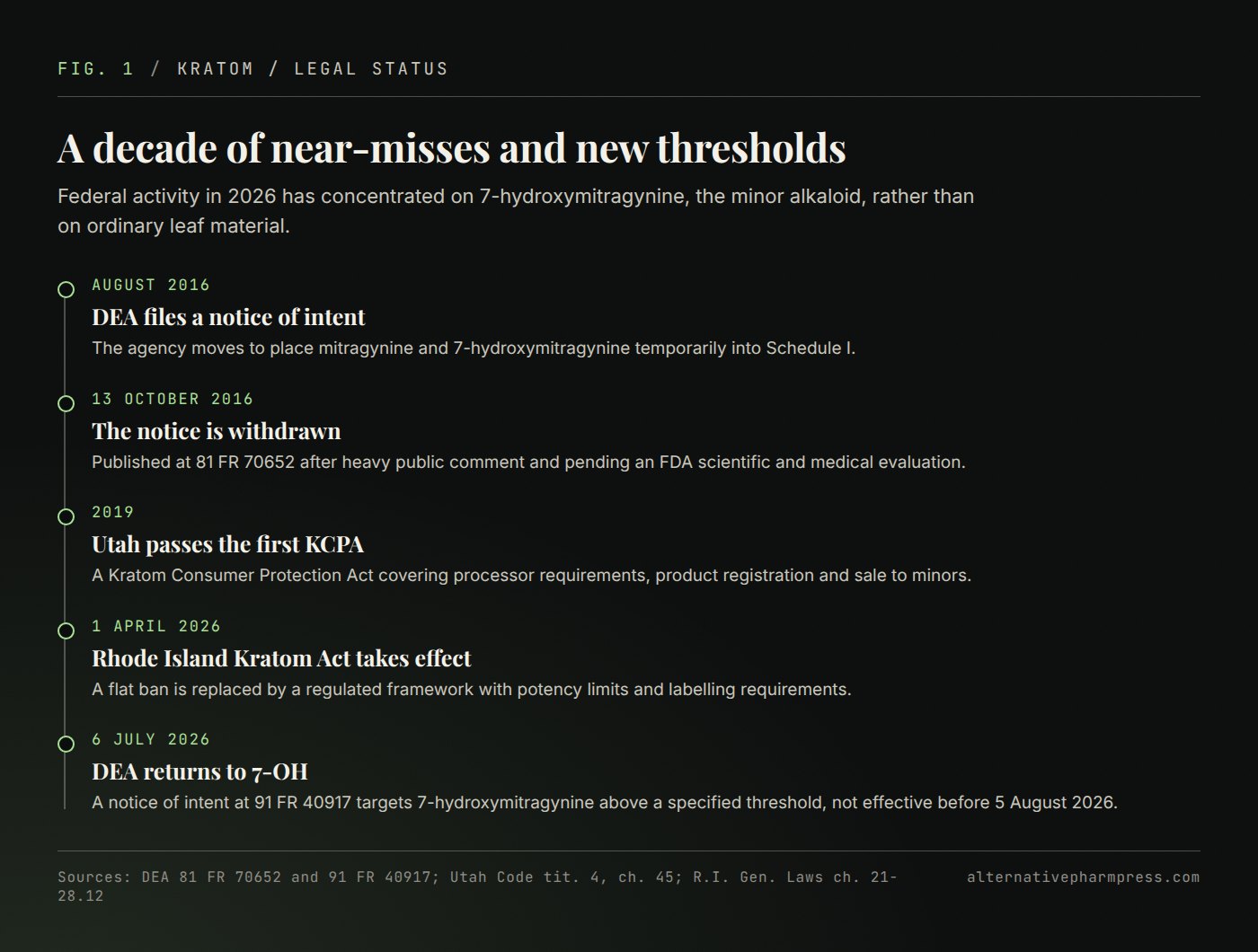
Mitragynine and 7-hydroxymitragynine are not listed in the federal drug schedules as of August 2026. The Drug Enforcement Administration tried to place both into Schedule I on a temporary basis in August 2016, then withdrew that notice of intent on 13 October 2016 after a large volume of public comment and while awaiting a scientific and medical evaluation from the Food and Drug Administration.2 That withdrawal, published at 81 FR 70652, is the reason kratom has remained federally uncontrolled for a decade.
The picture changed for concentrates. On 6 July 2026 the DEA published a notice of intent to temporarily place 7-hydroxymitragynine above a 0.050 percent threshold into Schedule I (91 FR 40917). On 14 October 2026 the agency withdrew that notice and replaced it with a revised one (Federal Register document 2026-20943) covering both 7-hydroxymitragynine and mitragynine pseudoindoxyl.1
Under the October notice, either substance falls into Schedule I when it exceeds 1 milligram per gram of a solid product or 1 milligram per millilitre of a liquid, or when the mass ratio of mitragynine to those substances is below 100. The order cannot issue before 13 November 2026, would last two years, and can be extended by one year if permanent scheduling begins. It does not schedule mitragynine itself or leaf material below the threshold, although the DEA still describes kratom as a drug of concern. A separate 26 August 2026 order placing mitragynine pseudoindoxyl in Schedule I without a threshold stays in force until the new order replaces it.1 Anyone handling concentrated 7-OH products should check whether the final order has published.
Being unscheduled is not the same as being approved. The FDA states that kratom is not lawfully marketed in the United States as a drug, as a dietary supplement, or as a food additive in conventional food, and that no prescription or over the counter drug product containing kratom is legally available.3 Kratom has not been evaluated or approved by the FDA for any medical use.
What the FDA does instead of scheduling
The agency works through import controls and enforcement letters. Import Alert 54-15 authorises detention without physical examination of dietary supplements and bulk dietary ingredients that are or contain Mitragyna speciosa. The stated basis is that kratom is a new dietary ingredient without adequate evidence of safety, which makes the product adulterated under federal food law.4 Shipments from listed firms can be held at the border without the agency proving anything about the individual consignment.
The FDA has also issued warning letters to companies selling unapproved kratom drug products or making disease claims, and has pursued seizures of concentrated 7-hydroxymitragynine products.3 The practical effect is that a product can be legal to possess in a given state while its seller is still exposed to federal enforcement over how it is labelled and marketed.
States that prohibit kratom alkaloids
A handful of states place mitragynine and 7-hydroxymitragynine in a controlled substance schedule or an equivalent list. Alabama is the clearest example. Alabama Code section 20-2-23 lists both mitragynine and hydroxymitragynine among Schedule I substances.5 Indiana reaches the same result through a different route, defining both compounds as synthetic drugs at Indiana Code section 35-31.5-2-321.6
Full state bans as of October 2026
- Long-standing bans: Alabama, Arkansas, Indiana, Vermont and Wisconsin.
- Louisiana: statewide ban effective 1 August 2025.
- Connecticut: kratom and 7-hydroxymitragynine placed in Schedule I by regulation in 2026.
- Tennessee: ban effective 1 July 2026 (Public Chapter 950). Possession is a Class A misdemeanour; manufacture, delivery or sale is a Class C felony.10
- Massachusetts: an emergency order announced 13 August 2026 temporarily placed all forms of kratom in Schedule I for up to one year.11
Partial restrictions to watch
Ohio made its ban on synthetic and processed kratom products permanent on 14 May 2026, after a December 2025 emergency order. The Board of Pharmacy has said the rule does not cover raw leaf, but it is pursuing a separate rule that would ban natural kratom, and a legal challenge is set for trial in June 2027.12 Several other states without full bans now cap 7-hydroxymitragynine content under their KCPA laws.
Prohibition is not permanent. Rhode Island prohibited kratom for years, then reversed course. The Rhode Island Kratom Act, chapter 21-28.12 of the General Laws, takes effect on 1 April 2026 and replaces a flat ban with a regulated framework.7 Any list of banned states written more than a year ago should be treated as stale.
Kratom Consumer Protection Act states
The alternative model is a Kratom Consumer Protection Act, usually shortened to KCPA. Utah passed the first one in 2019. Utah Code title 4, chapter 45 is titled the Kratom Consumer Protection Act and covers processor requirements, a factual basis requirement for any claim that a product is a kratom product, a prohibition on sale to minors with a criminal penalty, product registration with the state department, and a private right of civil action.8
Later acts have added potency limits. The Rhode Island statute prohibits a kratom product containing more than 0.5 milligrams of 7-hydroxymitragynine per gram, more than 1 milligram per serving, or 7-hydroxymitragynine amounting to more than one percent of total kratom alkaloids. It also bars synthetic alkaloids, combustible and vaporised forms, injectable forms, and packaging or advertising designed to appeal to people under 21, and it requires labelling that declares mitragynine and 7-hydroxymitragynine content.7 The details differ state to state, which is why a product compliant in one KCPA state may not be compliant in the next. Our overview of the KCPA model covers the common provisions in more depth.
How to read your own state’s status
Rather than memorising a list that will be wrong in six months, work out which category your state falls into and then read the underlying text.
| Category | What it means in practice | Verified example, August 2026 |
|---|---|---|
| Prohibited by controlled substance schedule | Possession and sale of the alkaloids are criminal offences under state drug law | Alabama, Ala. Code § 20-2-23 |
| Prohibited through a synthetic drug definition | Same effect, reached through a separate statutory list rather than the drug schedules | Indiana, Ind. Code § 35-31.5-2-321 |
| Regulated under a Kratom Consumer Protection Act | Sale is lawful subject to registration, labelling, purity and minimum age rules | Utah, Utah Code tit. 4, ch. 45 |
| Moving from prohibition to regulation | A ban is being replaced by a licensing and potency framework on a set date | Rhode Island, R.I. Gen. Laws ch. 21-28.12, effective 1 April 2026 |
| No kratom specific statute | General food, labelling and consumer protection law applies, plus any local ordinance | The majority of states |
The last row is the one people misread. No specific statute does not mean no rules. It means the product is governed by general law, that state agencies retain enforcement discretion, and that a county or city can still restrict it.
Local ordinances and why the map keeps moving
Several counties and municipalities have adopted their own kratom restrictions, usually age limits or outright sale bans. Municipal codes are not collected in any central national database, so the only reliable check is the ordinance text published by the city or county itself. A state level guide, including this one, cannot substitute for that.
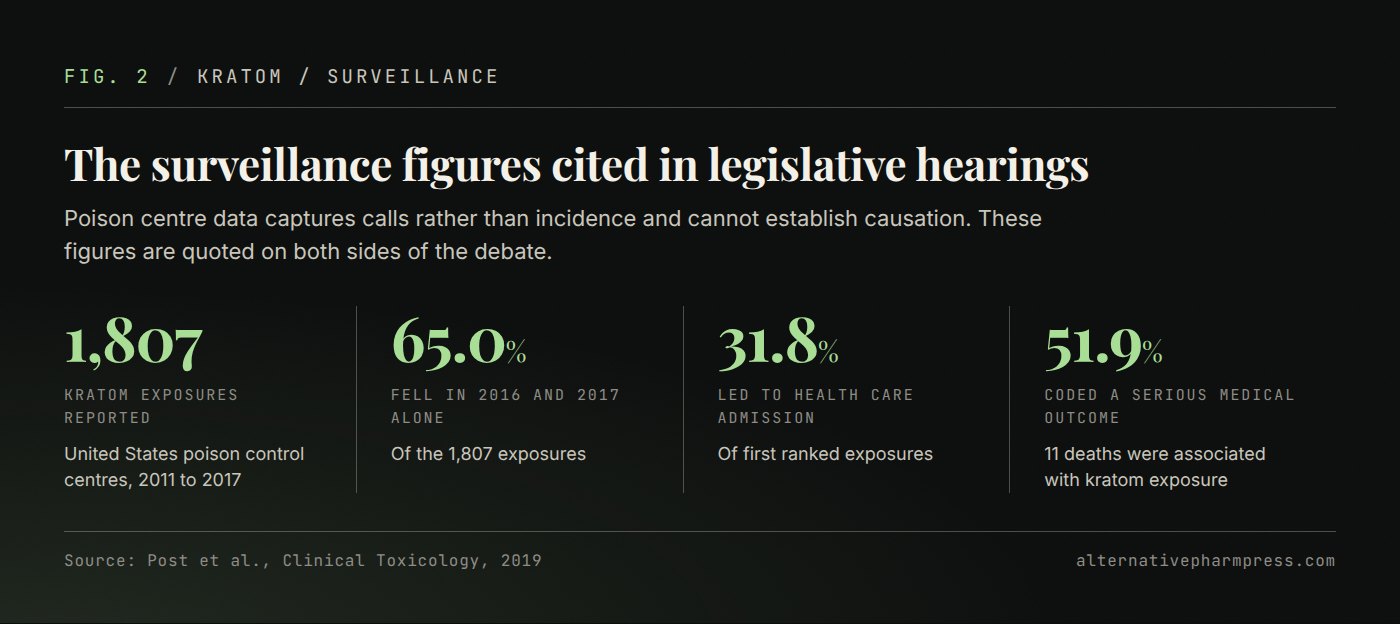
Three forces keep the picture unstable. The first is federal action on concentrates, which pushes states to write potency limits into their own statutes. The second is safety surveillance. An analysis of National Poison Data System records found 1,807 kratom exposures reported to United States poison control centres between 2011 and 2017, with 65.0 percent of those occurring in 2016 and 2017 alone; 31.8 percent of first ranked exposures led to admission to a health care facility and 51.9 percent were coded as a serious medical outcome, and 11 deaths were associated with kratom exposure, two of them after kratom only exposure.9 Figures like these are cited in legislative hearings on both sides. The third is industry lobbying for KCPA bills as an alternative to prohibition.
Uncertainty here is real and worth stating plainly. Poison centre data captures calls, not incidence, and cannot establish causation. The federal threshold approach to 7-hydroxymitragynine is new and untested in court. Nobody should assume the August 2026 position is settled.
Kratom laws outside the United States
Travellers should not assume that U.S. rules apply abroad. Carrying kratom across a border can be a criminal offence even when it is legal at home. A few examples:
- Thailand: removed kratom from its narcotics list in 2021 and now regulates it under the Kratom Plant Act of 2022, with limits on sale to minors and on mixing it into other products.
- Malaysia: controlled under the Poisons Act 1952, which makes sale illegal.
- Australia: listed as a prohibited substance under the Poisons Standard.
- United Kingdom: producing, supplying or importing kratom for human consumption is illegal under the Psychoactive Substances Act 2016.
- Canada: Health Canada has not authorised kratom for ingestion, so it cannot legally be sold as a food or natural health product.
Several European countries, including Denmark, Ireland, Poland, Romania and Sweden, also control kratom. Check the destination country’s official guidance before you travel.
Frequently asked questions
Is kratom legal at the federal level?
Yes, in the narrow sense that mitragynine and kratom leaf are not federally scheduled as of October 2026. The DEA withdrew its 2016 scheduling notice and has not scheduled the leaf since. Concentrated 7-hydroxymitragynine and mitragynine pseudoindoxyl above 1 mg/g, or with a mitragynine ratio below 100, are the subject of a DEA notice published on 14 October 2026 that can take effect on or after 13 November 2026.
Does the FDA approve any kratom product?
No. The FDA states that kratom is not lawfully marketed as a drug, a dietary supplement or a food additive, and no kratom drug product has been approved. Kratom has not been evaluated by the FDA to diagnose, treat, cure or prevent any disease.
Which states have banned kratom?
As of October 2026, nine states ban kratom outright: Alabama, Arkansas, Connecticut, Indiana, Louisiana, Massachusetts (temporary emergency order), Tennessee, Vermont and Wisconsin. Ohio bans synthetic and processed kratom products but not raw leaf, and Rhode Island lifted its ban on 1 April 2026. Laws change quickly, so check your own state code before you buy.
What does a Kratom Consumer Protection Act actually do?
It permits sale subject to conditions. Typical provisions include registration of processors or products with a state agency, mandatory labelling of alkaloid content, limits on 7-hydroxymitragynine, a minimum purchase age, and penalties for adulterated or misbranded products. The specific requirements vary by state.
Can a city ban kratom if my state allows it?
Yes, in states that do not preempt local regulation. Several counties and cities have their own ordinances. The only way to confirm is to read the local code.
Sources
- Drug Enforcement Administration. Schedules of Controlled Substances: Temporary Placement of 7-Hydroxymitragynine and Mitragynine Pseudoindoxyl Above a Specified Threshold in Schedule I. FR Doc. 2026-20943, 14 October 2026 (withdrawing 91 FR 40917, 6 July 2026). federalregister.gov
- Drug Enforcement Administration. Withdrawal of Notice of Intent To Temporarily Place Mitragynine and 7-Hydroxymitragynine Into Schedule I. 81 FR 70652, 13 October 2016. federalregister.gov
- US Food and Drug Administration. FDA and Kratom. fda.gov
- US Food and Drug Administration. Import Alert 54-15: Detention Without Physical Examination of Dietary Supplements and Bulk Dietary Ingredients That Are or Contain Mitragyna Speciosa or Kratom. accessdata.fda.gov
- Alabama Code § 20-2-23, Schedule I controlled substances.
- Indiana Code § 35-31.5-2-321, definition of synthetic drug.
- Rhode Island General Laws § 21-28.12-3, Kratom and kratom product limitations, effective 1 April 2026. rilegislature.gov
- Utah Code title 4, chapter 45, Kratom Consumer Protection Act, enacted by S.B. 58 (2019).
- Post S, Spiller HA, Chounthirath T, Smith GA. Kratom exposures reported to United States poison control centers: 2011-2017. Clinical Toxicology (Philadelphia). 2019;57(10):847–854. PMID 30786220. pubmed.ncbi.nlm.nih.gov
- Tennessee Public Chapter 950 (HB1649/SB1656), effective 1 July 2026, as summarised by Restoration Recovery, Kratom Laws by State 2026.
- GBH News. Emergency order issued to crack down on kratom products in Mass. 13 August 2026. wgbh.org
- Statehouse News Bureau. Ban on synthetic kratom in effect in Ohio, but more action could be coming. 19 May 2026; and Signal Ohio, Kratom to remain illegal in Ohio, judge rules, 7 August 2026. statenews.org
Editorial note: This article is for general information only and is not medical or legal advice. Kratom has not been evaluated by the FDA to diagnose, treat, cure or prevent any disease. Laws vary by location and change often, so verify the rules that apply where you are. Always talk to a licensed healthcare provider before use, especially if you are under 21, pregnant or nursing, taking medication, or managing a health condition.