
Usually not. Standard five and ten panel workplace urine tests do not screen for kratom alkaloids, and mitragynine does not reliably cross-react with the opiate immunoassay. 7-hydroxymitragynine is not on those panels either. Kratom goes undetected unless a laboratory is specifically asked to run an assay that targets it.12
Specialised liquid chromatography tandem mass spectrometry assays do detect mitragynine, 7-hydroxymitragynine and several mitragynine metabolites in urine at low nanogram concentrations. These are ordered deliberately, most often in clinical toxicology, addiction treatment monitoring and forensic casework, and they are not part of routine pre-employment screening.2
This article covers detection science and the sources of variability in it. Published detection windows differ widely between individuals for reasons that are measurable but not predictable, and nothing here should be read as a way to influence a test result.
What a standard panel actually tests for
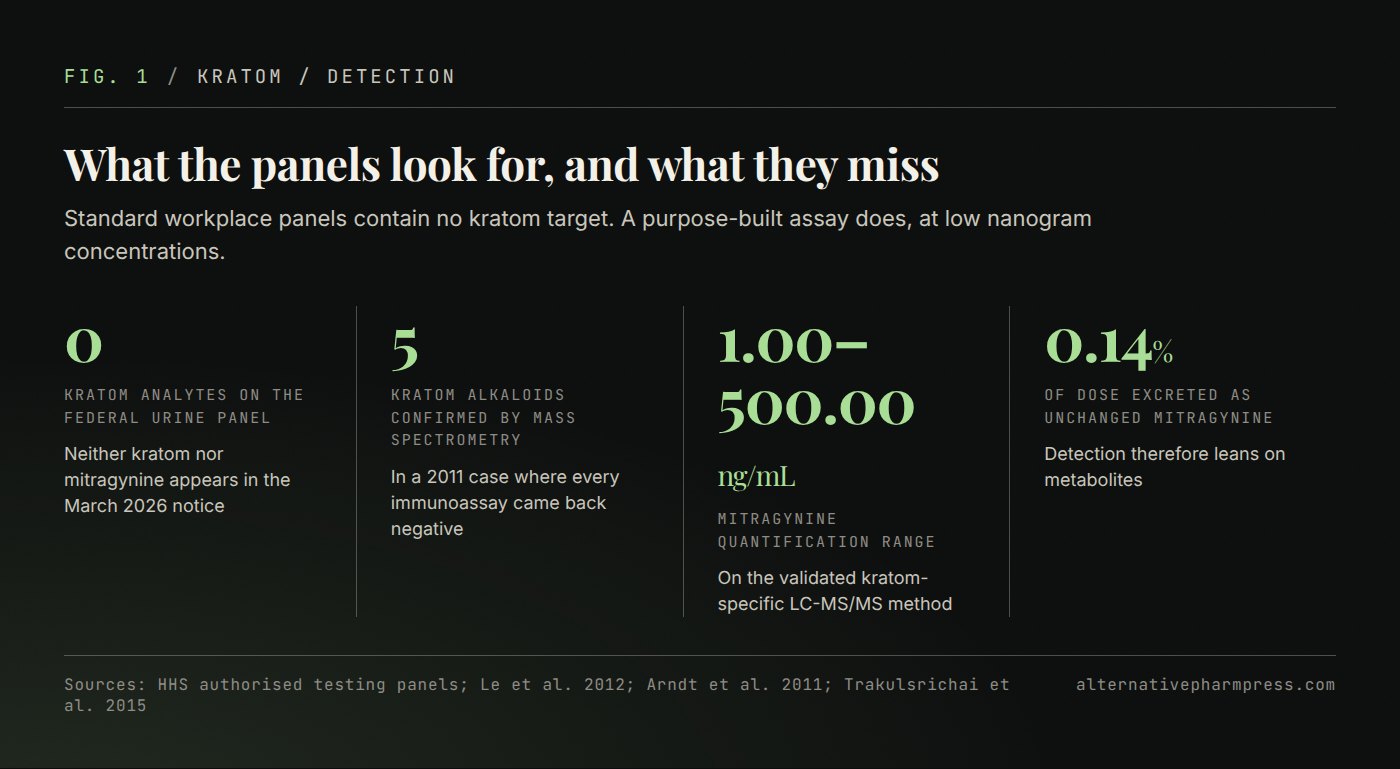
Federal workplace drug testing sets the template that most private five and ten panel tests follow. The Department of Health and Human Services published the authorized testing panels for federal workplace programs in the Federal Register on 13 March 2026, with an effective date of 7 July 2025. The urine panel covers marijuana metabolite, cocaine metabolite, codeine and morphine, hydrocodone and hydromorphone, oxycodone and oxymorphone, 6-acetylmorphine, phencyclidine, fentanyl, and the amphetamine group including methamphetamine, MDMA and MDA. Oral fluid panels cover similar analytes at different cutoffs. Kratom and mitragynine are not mentioned anywhere in the notice.1
The omission is not an oversight. Those panels are built around Schedule I and II controlled substances. Kratom leaf is not federally scheduled in the United States, so there is no regulatory driver to include it in a compliance panel.
The second reason is chemical. Immunoassay screening relies on antibodies raised against a defined structural target. Mitragynine is a corynanthe-type indole alkaloid. It is not a morphinan and shares little structural resemblance with the opiates that opiate immunoassays are designed to bind, despite acting at the mu-opioid receptor. Pharmacological similarity does not produce immunoassay cross-reactivity; structural similarity does.
A 2011 forensic case demonstrates the point directly. A patient who had consumed a kratom-containing herbal mixture returned negative immunoassay results for amphetamines, barbiturates, benzodiazepines, benzoylecgonine, buprenorphine, ethyl glucuronide, methadone metabolite, opiates, oxycodone and THC-COOH. Mass spectrometry on the same specimen identified five kratom alkaloids: mitragynine, speciociliatine, speciogynine, mitraciliatine and paynantheine.3 The screening panel was blind to a substantial alkaloid load.
The kratom-specific assay and what it detects
Methods for detecting kratom use in urine have been published and validated since 2012, when Le, Goggin and Janis described ultra-high-performance liquid chromatography and HPLC tandem mass spectrometry methods in the Journal of Analytical Toxicology. Mitragynine is quantified from 1.00 to 500.00 ng/mL using mitraphylline as an internal standard. Two metabolites, 5-desmethylmitragynine and 17-desmethyldihydromitragynine, are monitored qualitatively alongside 7-hydroxymitragynine. Identification is confirmed by full fragmentation data rather than retention time alone. The authors state the method has been used for clinical and forensic urine analysis.2
That paper is the practical answer to whether 7-OH shows up on a drug test. It does, on an assay built to find it, at low nanogram concentrations. It does not on a panel that never looks.
| Feature | Standard 5 or 10 panel | Kratom-specific assay |
|---|---|---|
| Method | Immunoassay screen, mass spectrometry confirmation only for presumptive positives | LC-MS/MS or UHPLC-MS/MS as the primary method |
| Targets mitragynine | No | Yes, quantified |
| Targets 7-hydroxymitragynine | No | Yes, monitored qualitatively in the published method |
| Targets mitragynine metabolites | No | Yes, 5-desmethylmitragynine and 17-desmethyldihydromitragynine |
| Typical reason ordered | Employment, federal compliance, safety-sensitive roles | Clinical toxicology, treatment monitoring, forensic casework |
| Included by default | Yes, in most testing programs | No, must be requested separately |
| Cost and turnaround | Low, often same day for the screen | Higher, laboratory turnaround |
Why reported detection windows vary so much
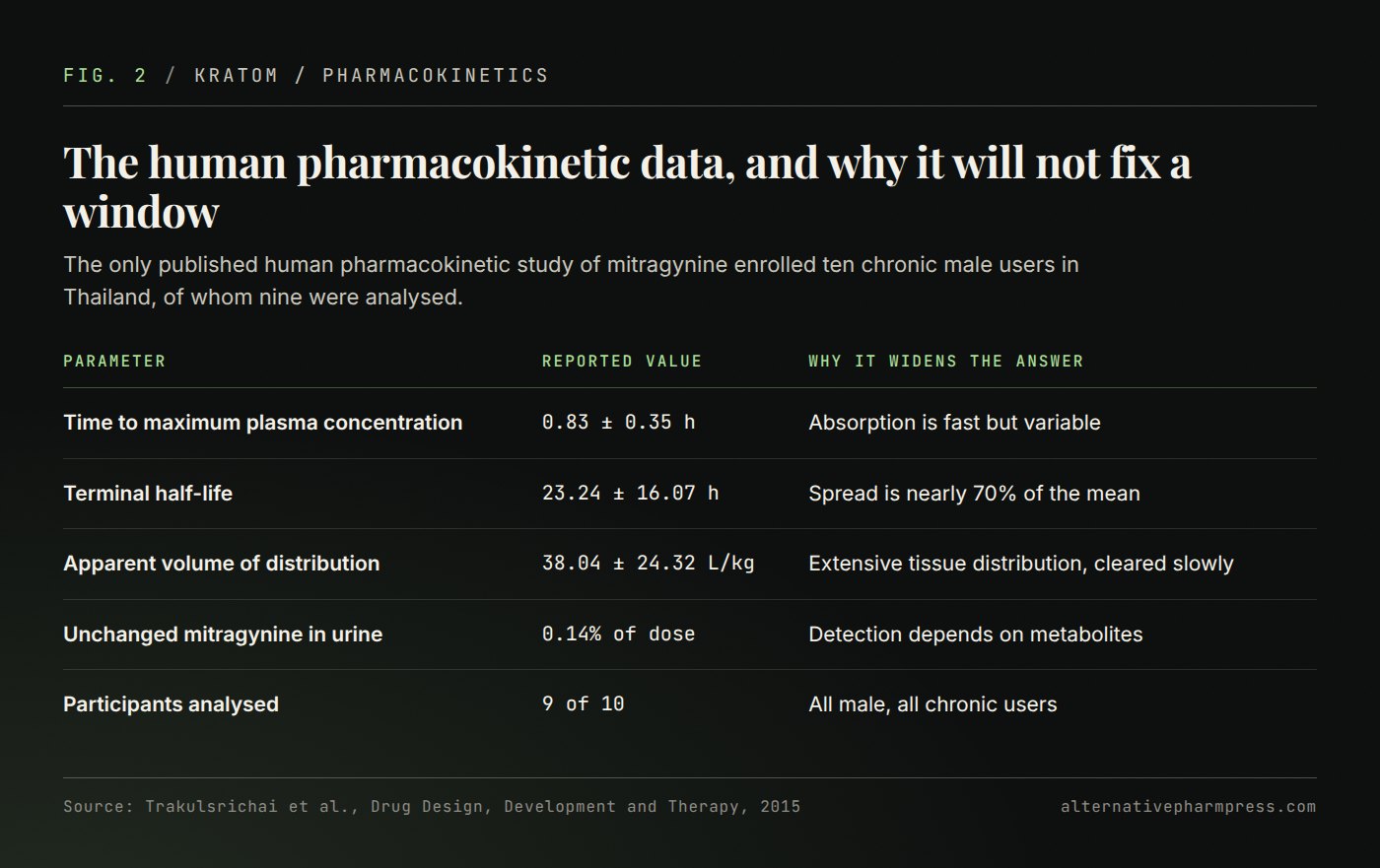
The only published human pharmacokinetic study of mitragynine enrolled ten chronic male users in Thailand, of whom nine were analysed. It reported a time to maximum plasma concentration of 0.83 plus or minus 0.35 hours, a terminal half-life of 23.24 plus or minus 16.07 hours, and an apparent volume of distribution of 38.04 plus or minus 24.32 L/kg. Urinary excretion of unchanged mitragynine accounted for 0.14 percent of the dose.4
Three things in those numbers explain why detection windows are quoted so inconsistently.
The standard deviation on the half-life is nearly 70 percent of the mean. Across nine people given known doses under controlled conditions, elimination varied by a wide margin. A population estimate with that much spread cannot support a confident individual prediction.
The apparent volume of distribution is very large and also highly variable. A compound that distributes extensively into tissue accumulates with repeated exposure and clears back into plasma slowly, which lengthens the tail of detectability in regular users relative to single exposures. That is a mechanistic expectation from the reported parameters rather than a measured window, and no controlled study has established detection windows in either group.
Almost no unchanged mitragynine reaches urine. Detection therefore depends heavily on metabolites, and metabolite formation runs through enzymes with known interindividual variation. Laboratory cutoff concentrations differ between providers, and alkaloid content differs between leaf powder and concentrated kratom extract. The sample size behind the human data is ten people, all male, all chronic users. Extrapolating a fixed number of days from that base is not supportable, and this publication does not do so.
False positives and misread screening results
One documented cross-reactivity report exists. Pierre, Gineste and Bazydlo presented data in a 2020 American Journal of Clinical Pathology supplement showing that mitragynine and 7-hydroxymitragynine produced false positive results on the Thermo Scientific CEDIA methadone metabolite (EDDP) immunoassay, an effect they observed particularly after enzymatic hydrolysis of urine specimens.5 The finding is specific to one assay platform and was published as a meeting abstract rather than a full paper, so it should be treated as a signal for laboratories to check on their own instruments, not as a general property of kratom.
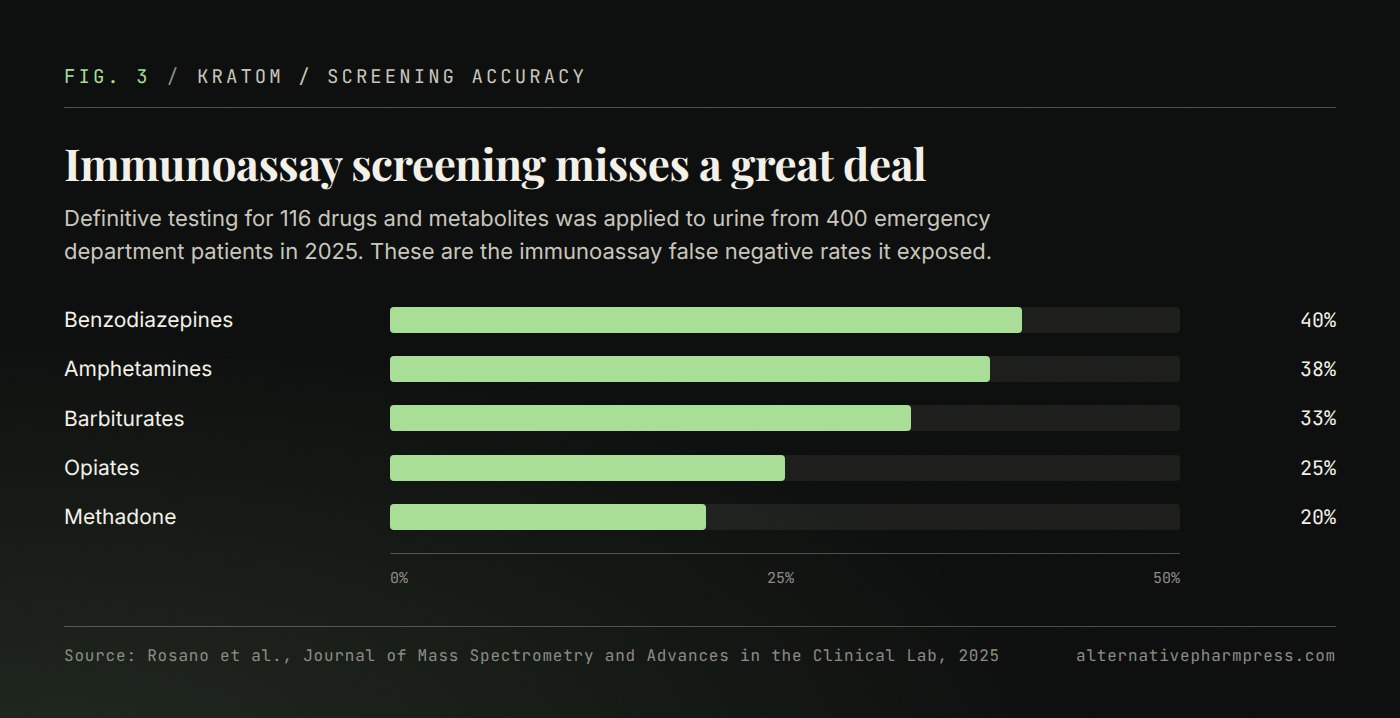
The broader point is that immunoassay screening is imprecise in both directions. A 2025 study applying definitive testing for 116 drugs and metabolites to urine from 400 emergency department patients found immunoassay false negative rates of 40 percent for benzodiazepines, 38 percent for amphetamines, 33 percent for barbiturates, 25 percent for opiates, 20 percent for methadone and 16 percent for cocaine. Immunoassay missed 890 of the 1,350 findings identified by definitive testing, through a combination of high cutoffs and limited scope.6 Any presumptive positive, including one on a methadone screen in someone who uses kratom, requires mass spectrometry confirmation before it means anything.
Product contents add a further layer. The 2011 Krypton case found approximately 9 mg/L of O-desmethyltramadol, a synthetic opioid, in the urine of someone who believed they were consuming a botanical product, with no parent tramadol present.3 A result attributed to a botanical may reflect something that was added to it.
Why a kratom-specific panel exists
Demand comes from settings where knowing about kratom exposure changes clinical or legal decisions: emergency toxicology, substance use disorder treatment programs monitoring adherence, pain management practices, medical examiner casework and some safety-sensitive employers who add non-standard analytes by contract.
Regulatory movement is a further driver. On 6 July 2026 the DEA published a notice of intent at 91 FR 40917 to place 7-hydroxymitragynine above a specified threshold into Schedule I on a temporary basis, defined as above 0.050 percent on a dry weight basis or more than 1.00 milligram in the article, with effect on or after 5 August 2026 for two years.7 Scheduling decisions of that kind tend to create testing demand, because controlled status makes an analyte relevant to compliance programs that previously ignored it. As of August 2026, kratom leaf itself remains federally uncontrolled, kratom is not FDA approved for any use, and state law varies.8
Frequently asked questions
Will 7OH show up on a drug test?
Not on a standard five or ten panel, which contains no target for it. It is detected by kratom-specific LC-MS/MS assays, where 7-hydroxymitragynine is monitored alongside mitragynine and two mitragynine metabolites. Detection requires that the assay be ordered.
Does kratom register as an opiate on a screen?
Not reliably. Opiate immunoassays are raised against morphinan structures, and mitragynine is an indole alkaloid. In the published forensic case where five kratom alkaloids were confirmed by mass spectrometry, the opiate immunoassay on the same specimen was negative.
How long does mitragynine stay detectable?
No defensible single figure exists. The only human pharmacokinetic study reported a terminal half-life of 23.24 plus or minus 16.07 hours in nine chronic users, a spread wide enough that individual prediction is unreliable. Cutoff concentrations, product alkaloid content and metabolism all shift the answer.
Can a kratom assay distinguish leaf from a concentrated extract?
Not directly. The published method quantifies mitragynine and monitors metabolites and 7-hydroxymitragynine. Relative concentrations may differ between exposures, but the assay reports analyte concentrations, not product type.
What should a laboratory do with an unexpected methadone screen result?
Confirm it. The single published report of mitragynine cross-reactivity involves one specific EDDP immunoassay platform, and mass spectrometry confirmation is the accepted standard for resolving any presumptive positive.
Sources
- Substance Abuse and Mental Health Services Administration, Department of Health and Human Services. Mandatory Guidelines for Federal Workplace Drug Testing Programs: Authorized Testing Panels. Federal Register, 13 March 2026, document 2026-04981. https://www.federalregister.gov/documents/2026/03/13/2026-04981/
- Le D, Goggin MM, Janis GC. Analysis of mitragynine and metabolites in human urine for detecting the use of the psychoactive plant kratom. Journal of Analytical Toxicology. 2012;36(9):616–625. doi:10.1093/jat/bks073. https://pubmed.ncbi.nlm.nih.gov/23024321/
- Arndt T, Claussen U, Güssregen B, Schröfel S, Stürzer B, Werle A, Wolf G. Kratom alkaloids and O-desmethyltramadol in urine of a “Krypton” herbal mixture consumer. Forensic Science International. 2011;208(1–3):47–52. doi:10.1016/j.forsciint.2010.10.025. https://pubmed.ncbi.nlm.nih.gov/21112167/
- Trakulsrichai S, Sathirakul K, Auparakkitanon S, et al. Pharmacokinetics of mitragynine in man. Drug Design, Development and Therapy. 2015;9:2421–2429. doi:10.2147/DDDT.S79658. https://pubmed.ncbi.nlm.nih.gov/25995615/
- Pierre C, Gineste C, Bazydlo L. A kratom metabolite causes false positive urine drug screening results for methadone. American Journal of Clinical Pathology. 2020;154(Supplement 1):S19–S20. doi:10.1093/ajcp/aqaa137.035. https://academic.oup.com/ajcp/article/154/Supplement_1/S19/5942516
- Rosano TG, Islam SMT, Rumberger JM, et al. Definitive urine drug testing in emergency medicine: recreational and psychiatric drug findings. Journal of Mass Spectrometry and Advances in the Clinical Lab. 2025;37:16–27. doi:10.1016/j.jmsacl.2025.04.008. https://pubmed.ncbi.nlm.nih.gov/40470103/
- Drug Enforcement Administration. Schedules of Controlled Substances: Temporary Placement of 7-Hydroxymitragynine Above a Specified Threshold in Schedule I. 91 FR 40917, 6 July 2026. https://www.federalregister.gov/documents/2026/07/06/2026-13580/
- US Food and Drug Administration. FDA and Kratom. https://www.fda.gov/news-events/public-health-focus/fda-and-kratom
Editorial note: This article is for general information only and is not medical or legal advice. Kratom has not been evaluated by the FDA to diagnose, treat, cure or prevent any disease. Laws vary by location and change often, so verify the rules that apply where you are. Always talk to a licensed healthcare provider before use, especially if you are under 21, pregnant or nursing, taking medication, or managing a health condition.