

 This article is for educational purposes only and does not constitute medical advice. The information is a summary of current scientific knowledge and is not to be taken as advice for the use of any substance. Research on 7-hydroxymitragynine (7-OH) is still ongoing, and many questions about its long-term effects, tolerance development, and potential for dependence remain unanswered.
A familiar phenomenon in pharmacology is tolerance. This happens when you have been exposed to a substance many times and your response to it decreases over time. Then the same amount of a compound will be less effective than when you first experienced it. Many medications, recreational substances, and naturally occurring plant alkaloids have been observed to develop tolerance.
7-hydroxymitragynine (7-OH) is often given special attention in discussions of compounds derived from kratom due to its pharmacological activity and interaction with opioid receptors. It is naturally present in kratom leaves in very small amounts, but concentrated 7-OH products have become increasingly common. This raises questions about tolerance development and long-term use patterns.
There is a lack of scientific research that directly examines tolerance to isolated 7-OH. But further understanding can be gained from receptor pharmacology, animal studies, kratom studies, and broader opioid receptor science. Learning how tolerance develops may help explain why repeated exposure to receptor-active compounds can result in changes in responsiveness over time.
This article reviews the current literature on tolerance mechanisms, reported time frames, possible cross-tolerance with kratom products, concepts of tolerance management, and when professional help might be beneficial.
How Tolerance Develops: Understanding Receptor Theory
In order to understand tolerance, you need to understand how receptors work. Receptors are specialized proteins found on cells all over the body. “These are communication points that respond to certain molecules. The compound then attaches to the receptor and can initiate biological responses that cause different physiological effects. 7-OH is known to interact with opioid receptors, especially the mu-opioid receptor. Researchers believe that this interaction is significant in the pharmacological profile of the compound. The body might try to compensate for repeated activation of receptors by adapting. This process is commonly known as homeostasis. Several changes can take place:-
Receptor Desensitization
-
Receptor Internalization
-
Cellular Adaptation
-
Neurochemical Adjustments
- Frequency of exposure
- Duration of use
- Individual genetics
- Metabolic differences
- Overall health status
- Concurrent medication use
- Product potency
Reported Tolerance Timelines
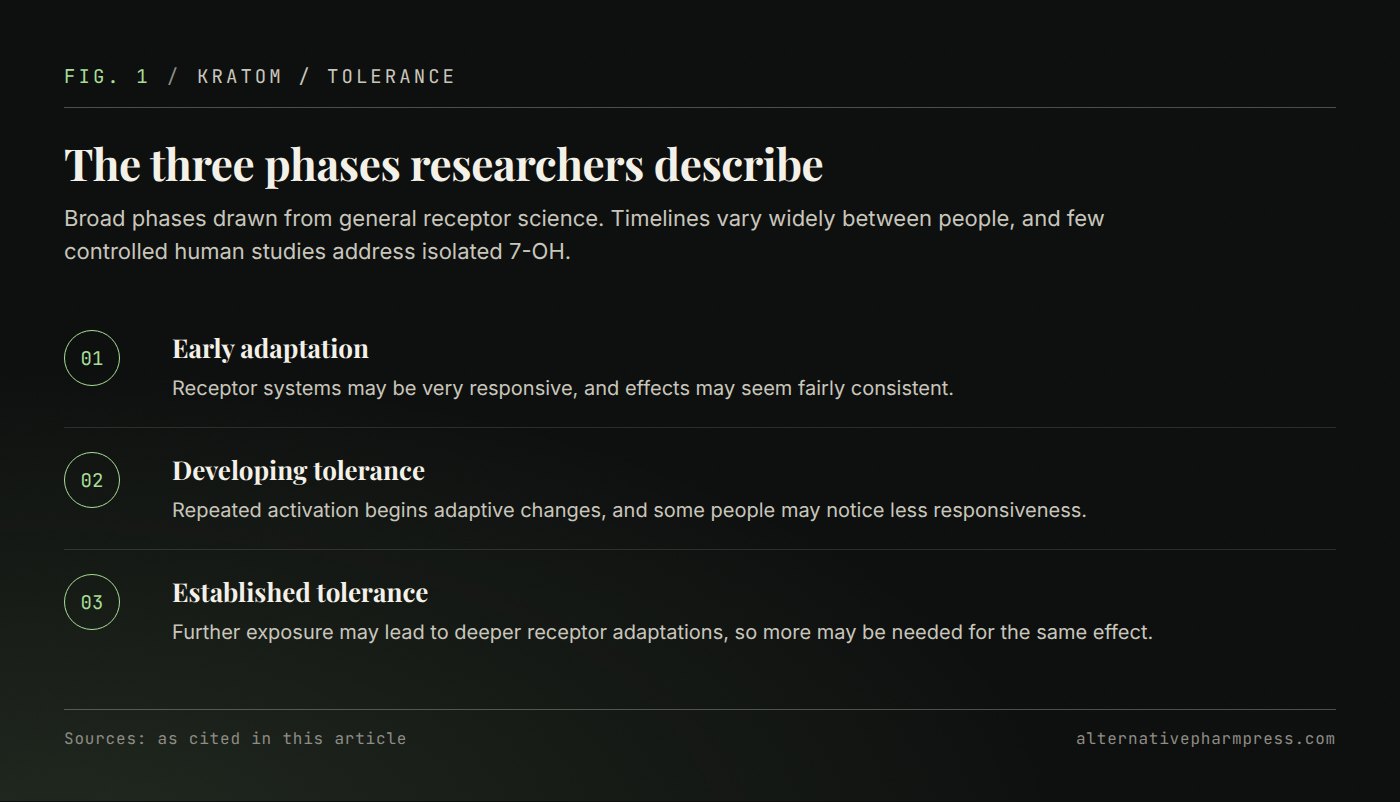
The question of how fast tolerance develops is one of the most frequent ones. The answer is complicated because there is a limited amount of available scientific data specifically looking at isolated 7-OH. Most of the evidence is based on studies of opioid receptors in general or animal studies and observational reports of products derived from kratom. Tolerance does not usually develop instantaneously. Instead, it is gradual, the result of biological adaptations accumulating over time. Researchers typically distinguish three broad phases:-
Early Adaptation
-
Developing Tolerance
-
Established Tolerance
Cross-Tolerance With Kratom
Cross-tolerance is another important topic. Cross-tolerance is a decreased responsiveness to one compound following exposure to another compound that acts on similar biological systems. Since mitragynine and 7-OH both act on the opioid receptors, studies on the potential of cross-tolerance between the two compounds have been conducted. There are theoretical reasons for possible cross-tolerance, e.g.,-
Shared Receptor Activity
-
Similar Pharmacological Pathways
-
Metabolic Relationships
- Traditional kratom leaf products
- Standardized extracts
- High-mitragynine formulations
- Concentrated 7-OH products
Tolerance Management Strategies
Researchers and health care providers often discuss ways to reduce the chances that tolerance develops quickly. Note that no approach can guarantee to prevent tolerance. But there are a number of ideas that are regularly raised in scientific debates.-
Avoiding Frequent Exposure
-
Maintaining Consistent Patterns
-
Monitoring Changes Over Time
-
Understanding Product Composition
-
Avoiding Product Confusion
-
Professional Consultation
Seeking Professional Support
Sometimes tolerance gets confused with other issues. For instance, a decrease in responsiveness may be caused by the following:- Physiological adaptation
- Changes in health status
- Medication interactions
- Product variability
- Psychological factors
- Measurement errors
-
Effects Change Unexpectedly
-
Dependence Concerns Arise
-
Other Medications Are Involved
-
Health Conditions Are Present
-
Questions About Safety Develop

Current Research Limitations
However, scientific interest in 7-OH has increased dramatically, but important gaps in knowledge remain.-
Limited Human Studies
-
Product Variability
-
Evolving Regulatory Environment
-
Long-Term Data Gaps
-
Individual Differences
Conclusion
Tolerance is a complex biological process representing the ability of the body to adapt to repeated receptor stimulation. As for 7-hydroxymitragynine, researchers believe that tolerance is most likely related to desensitization of the receptor, cellular adaptation, and more widespread neurochemical changes in a similar way to other compounds active at receptors. There is little human research in this area but some evidence that repeated exposure may result in decreased responsiveness over time. 7-OH shares receptor pathways with other kratom alkaloids, which also supports the possibility of cross-tolerance, but further studies are needed to determine the degree of this relationship. Tolerance cannot be understood without understanding the role played by individual variability, product composition, patterns of exposure, and underlying biology. As the scientific body of knowledge continues to grow, researchers will be able to better understand the development of tolerance and the factors that play a role in its progression. I think we should treat current discussions as part of a growing body of research rather than hard conclusions, for now. Further investigation will help to increase understanding of tolerance, dependence, receptor adaptation, and long-term pharmacology.Key Takeaways
- Reduced response to repeated drug administration is tolerance.
- 7-OH binds to opioid receptors, and the adaptation of these receptors is under active investigation.
- Tolerance is associated with mechanisms such as receptor desensitization and cellular adaptation.
- How long you can tolerate them varies from person to person.
- Tolerance development may depend on genetics, metabolism, how often one is exposed, and general health.
- It is biologically plausible for kratom alkaloids and 7-OH to be cross-tolerant given the shared receptor pathways.
- There are still only a few human studies, and many questions remain to be answered.
- Discussions of tolerance may be affected by differences in product composition.
- When there are concerns about tolerance or dependence, professional medical advice may be helpful.
- Additional studies are needed for evaluation of long-term effects and tolerance.