
Walk into any vape shop or scroll a kratom site in 2026 and you’ll see two very different things sold under the same broad banner. One is a bag of green powder ground from kratom leaf. The other is a small tablet or a little shot bottle labeled “7-OH.” They look related, and the marketing often blurs the line, but they are not the same product, and treating them as interchangeable is how people get into trouble.
We’ll lay out five differences that actually matter when you’re deciding what to buy. The short version is that traditional leaf and concentrated 7-OH sit at opposite ends of a potency scale, carry different risk profiles, and get treated very differently under the law. If you only remember one thing: these are not two flavors of the same thing.
The quick background
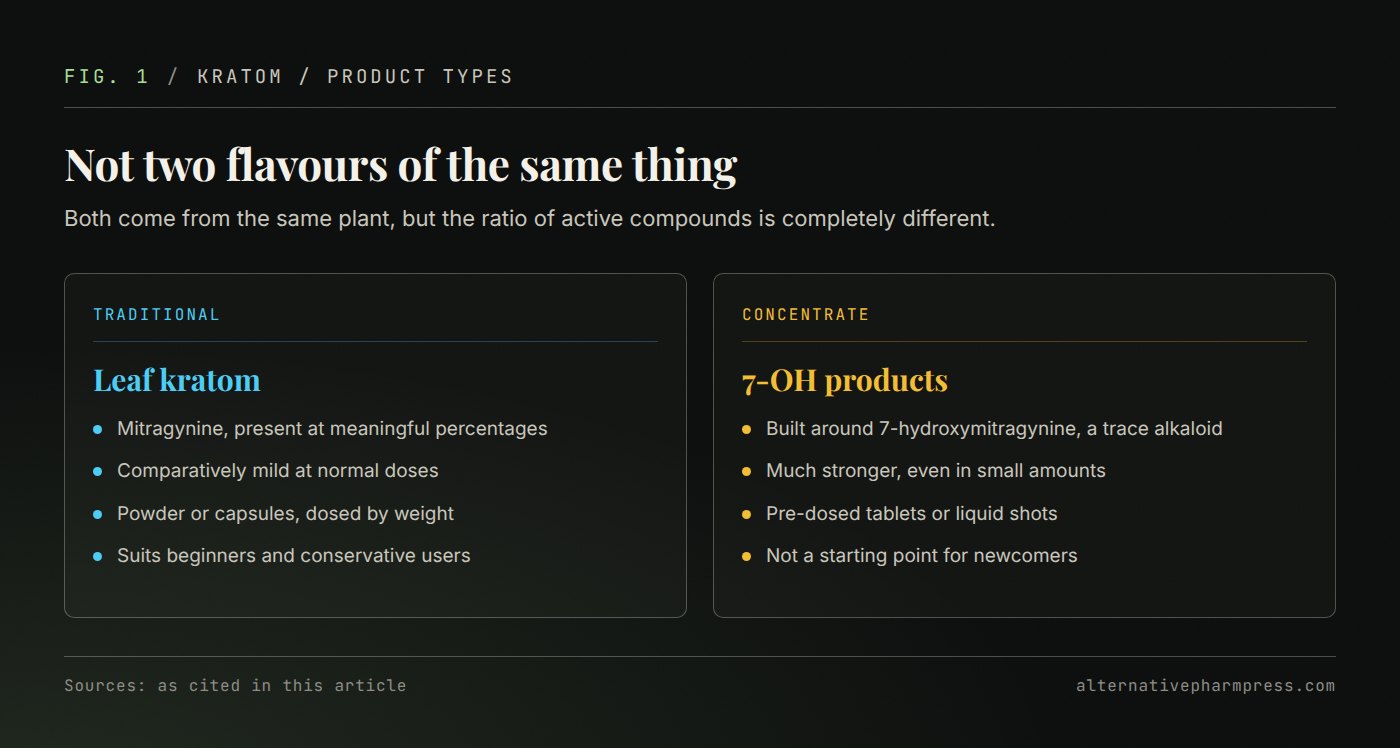
Traditional kratom is ground leaf from the Mitragyna speciosa tree. Its main active alkaloid is mitragynine, which is present at meaningful percentages in the leaf and produces relatively mild effects at normal doses. There’s a second alkaloid, 7-hydroxymitragynine, that’s far more potent but occurs only in trace amounts in natural leaf.
Modern “7-OH products” flip that ratio on its head. They’re concentrated or enriched so that 7-hydroxymitragynine, the trace compound, becomes the headline ingredient. That makes them dramatically stronger than the leaf they came from. If you want the chemistry in more depth, our mitragynine versus 7-hydroxymitragynine breakdown goes deeper than we will here.
1. Potency
This is the headline difference. Leaf kratom delivers a blend of alkaloids dominated by mitragynine, and at typical doses the effect is comparatively mild. Concentrated 7-OH products isolate and boost the alkaloid that’s most potent, so a small tablet can hit far harder than a much larger amount of powder.
That gap is easy to underestimate, because the 7-OH product is physically smaller. People assume small means gentle. Here it’s the opposite: the small format exists precisely because the active compound is so concentrated. A spoonful of leaf and a single 7-OH tablet are not in the same league, even if both came from the same plant originally.
2. Tolerance and dependence
Higher potency tends to come with a steeper tolerance curve and a higher dependence risk, and that pattern shows up here. With concentrated 7-OH, users can build tolerance faster, which often means reaching for more to get the same effect, which feeds a cycle. Plain leaf isn’t risk-free, but the milder alkaloid profile generally makes that escalation slower.
We’ve written about how this plays out in our how kratom tolerance develops piece, and there’s a more focused look at the concentrated side in our 7-OH tolerance overview. The practical point for a buyer: the stronger the product, the more carefully you have to watch the pattern of how often and how much you’re using. With 7-OH, that vigilance matters sooner.
3. Legal status
Leaf and extract are not treated the same under the law, and the gap is widening. Regulators have moved against concentrated 7-OH products faster and more aggressively than against plain leaf. So you can easily find yourself in a state where powder is legal but a 7-OH shot is restricted, banned, or sitting in regulatory limbo.
This catches people off guard because they assume “kratom is legal here” covers everything on the shelf. It doesn’t. The extract category moves on its own timeline. Our guide to where kratom is banned in 2026 walks through which states prohibit leaf outright, and notes that 7-OH concentrates often face stricter rules even in otherwise-legal states. Before buying a concentrated product, check both your state and your local code using our legal status tracker.
4. Product format and dosing
Format follows potency. Traditional kratom shows up as loose powder or capsules, where you measure a dose by weight and effects build relatively gently. Concentrated 7-OH comes as pre-dosed tablets or liquid shots, each carrying a large, fixed amount of the strong alkaloid in a small package.
That difference changes how easy it is to control intake. With powder, you can scale a dose up or down in small increments. With a fixed-dose tablet, your smallest unit is already potent, so there’s less room to ease in. For anyone trying to stay conservative, the powder format simply gives you more control, and the leaf’s milder profile gives more margin for error.
5. Best-fit user
Put the first four together and the audience splits. Traditional leaf suits beginners and anyone who wants a milder, more controllable experience with a slower tolerance curve. Concentrated 7-OH is a high-potency product that carries higher tolerance and dependence risk, and it is not where a newcomer should start.
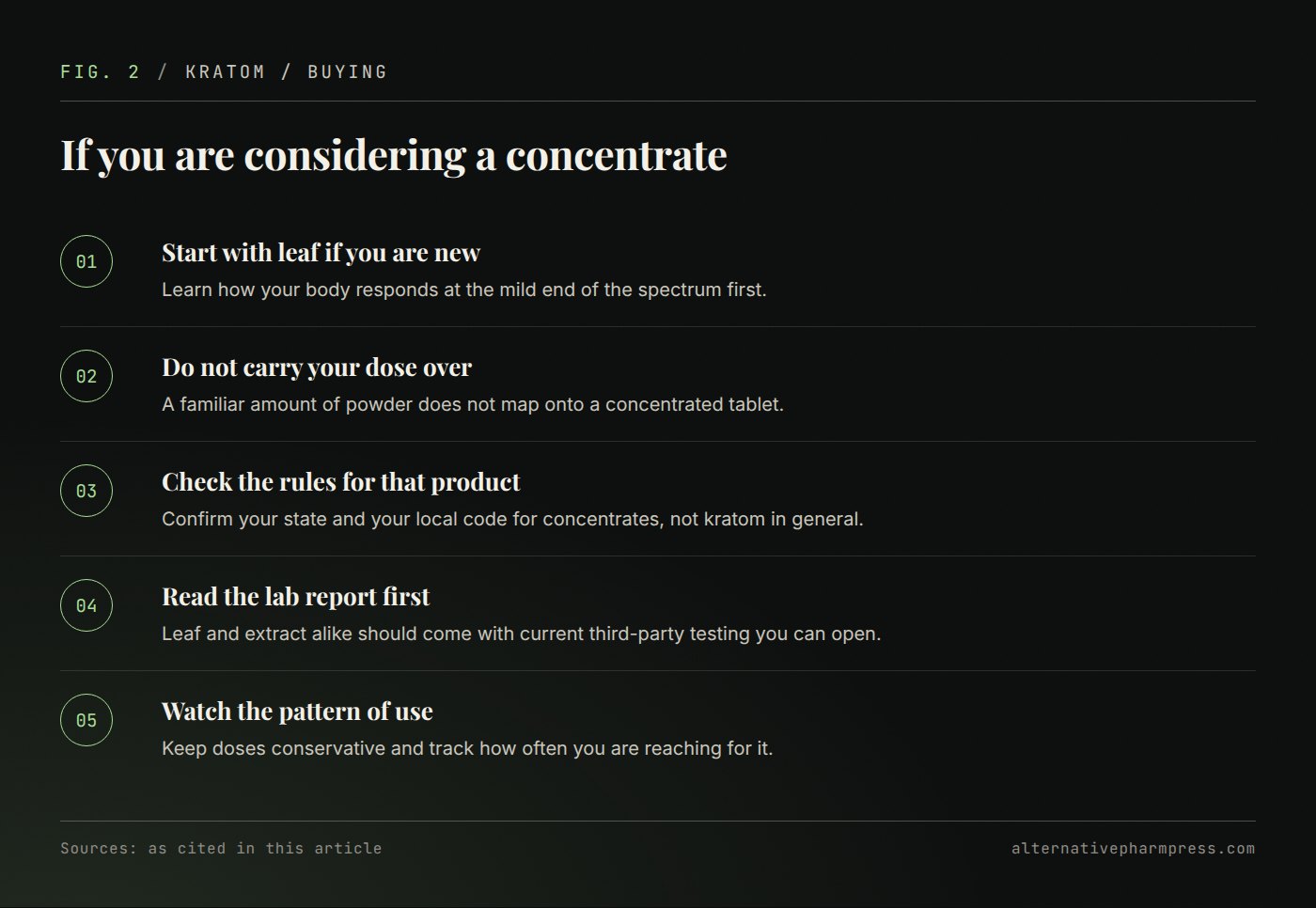
Our blunt recommendation for first-timers: start with leaf. Learn how your body responds to the mild end of the spectrum before going anywhere near a concentrate. Our kratom guide for beginners covers how to do that sensibly, and our strains explained guide helps you understand the leaf options first.
Side-by-side comparison
| Factor | Traditional kratom (leaf) | Concentrated 7-OH |
|---|---|---|
| Main active compound | Mitragynine, at meaningful percentages | 7-hydroxymitragynine, concentrated/enriched |
| Potency | Milder at normal doses | Much stronger, even in small amounts |
| Tolerance and dependence | Slower to build, lower relative risk | Builds faster, higher relative risk |
| Legal treatment | Legal in most states | Stricter, faster-moving bans |
| Format | Powder or capsules, dose by weight | Pre-dosed tablets or shots |
| Best for | Beginners, conservative users | Not a starting point |
Which should you choose?
If you’re new, the answer is leaf, full stop. It gives you a gentler introduction, more dosing control, and broader legality. You can learn how your body reacts without jumping straight to the strongest version of the product.
If you’re an experienced user considering 7-OH, go in with eyes open. Understand that you’re dealing with a much more potent product, that tolerance can climb quickly, that dependence risk is higher, and that the legal ground can shift under you faster than it does for leaf. Watch your frequency, keep doses conservative, and don’t let the small format fool you into thinking it’s a small effect.
Whatever you choose, source it carefully. Both leaf and extract products should come with current third-party lab testing, and you should be able to read the report before you buy. Our best kratom brands of 2026 shortlist and our COA red flags guide will help you separate transparent sellers from the rest. For background on what the science does and doesn’t say, see our kratom research overview. The American Kratom Association also runs a GMP standards program that some vendors participate in, which is one signal among several worth checking.
Frequently asked questions
Is 7-OH just stronger kratom?
Not exactly. It’s a concentrated or enriched product built around 7-hydroxymitragynine, an alkaloid that occurs only in trace amounts in natural leaf. So while it comes from the same plant, the ratio of active compounds is completely different, which is why it behaves so differently.
Can I switch from leaf to 7-OH at the same dose?
No, and trying to would be risky. Because 7-OH is far more potent, the amount that feels mild as leaf does not map onto a concentrated product. The two are not interchangeable by weight or by feel, so never assume a familiar dose carries over.
Why does 7-OH get banned when regular kratom doesn’t?
Regulators tend to focus on concentrated and enriched products because of their higher potency and risk profile. That means 7-OH extracts often face stricter and faster-moving restrictions than plain leaf, even in states where powder remains legal. Always check both your state and local rules for the specific product.
Does 7-OH build tolerance faster than leaf?
Generally yes. The more potent the product, the steeper the tolerance curve tends to be, and concentrated 7-OH sits at the strong end. That can mean needing more over time to get the same effect, which is part of why dependence risk runs higher.
I’m a first-time buyer. What should I get?
Start with traditional leaf powder or capsules. It gives you control over dosing and a milder experience to learn from, and it’s legal in more places. Our beginner guide walks through how to begin conservatively before you ever consider a concentrate.
Editorial note: This article is for general information only and is not medical or legal advice. These products have not been evaluated by the FDA to diagnose, treat, cure, or prevent any disease. Laws vary by location and change often, so verify the rules that apply to you. Always talk to a licensed healthcare provider before use, especially if you are under 21, pregnant or nursing, taking medication, or managing a health condition.
More comparisons
-
Green Malay vs Green Maeng Da Kratom: What the Labels Really Tell You
-
Borneo vs Bali Kratom: What the Labels Mean and What Lab Data Shows
-
Kratom vs Kanna: Two Botanicals With Very Different Mechanisms
-
Kratom Capsules vs Powder: Same Leaf, Different Trade-offs
-
Red vs White Kratom: Relaxing vs Energising, and What Tests Show