
Delta-8 THC is not the same as regular THC. Delta-9 THC is the compound normally meant by the word THC. Delta-8 differs by the position of a single double bond in its ring structure, sitting at the eighth carbon rather than the ninth. It is intoxicating, and it is a chemically distinct molecule.
The second difference matters more in practice. Delta-9 THC is extracted from plant material. Almost all delta-8 THC sold in the United States is manufactured, by acid catalysed isomerisation of CBD in a reactor, because cannabis produces delta-8 only in trace amounts. That production route brings reaction byproducts and residual reagents with it, and independent testing has repeatedly found impurities that certificates of analysis did not declare.3
The legal position differs too, and as of August 2026 it is unsettled and actively changing at both federal and state level. A statutory rewrite of the federal hemp definition takes effect on 12 November 2026.7 Several states have already banned or restricted these products regardless.
One double bond apart
Both molecules share the same formula, C21H30O2, and the same carbon skeleton. The only structural difference is where one carbon to carbon double bond sits in the cyclohexene ring. In delta-9 THC the bond lies between carbons 9 and 10. In delta-8 THC it lies between carbons 8 and 9.
That small change has two consequences. First, delta-8 is the thermodynamically more stable of the two isomers, which is why acidic conditions tend to push delta-9 THC and CBD toward delta-8 rather than the other way round. Second, the altered geometry changes how the molecule sits in the CB1 receptor binding pocket. Delta-8 is still a CB1 partial agonist and still intoxicating, but its affinity and efficacy differ from delta-9.
The widely repeated claim that delta-8 is “about half as potent” as delta-9 rests on thin evidence. Modern controlled human comparisons of the two are scarce. The largest published dataset is a 2022 online survey of 521 delta-8 consumers, in which respondents reported relaxation, euphoria and pain relief, along with lower rates of anxiety and paranoia than they associated with delta-9, and generally preferred delta-8.4 That is self-reported preference data from a convenience sample recruited partly through manufacturer channels. It is a signal about user experience, not a potency measurement.
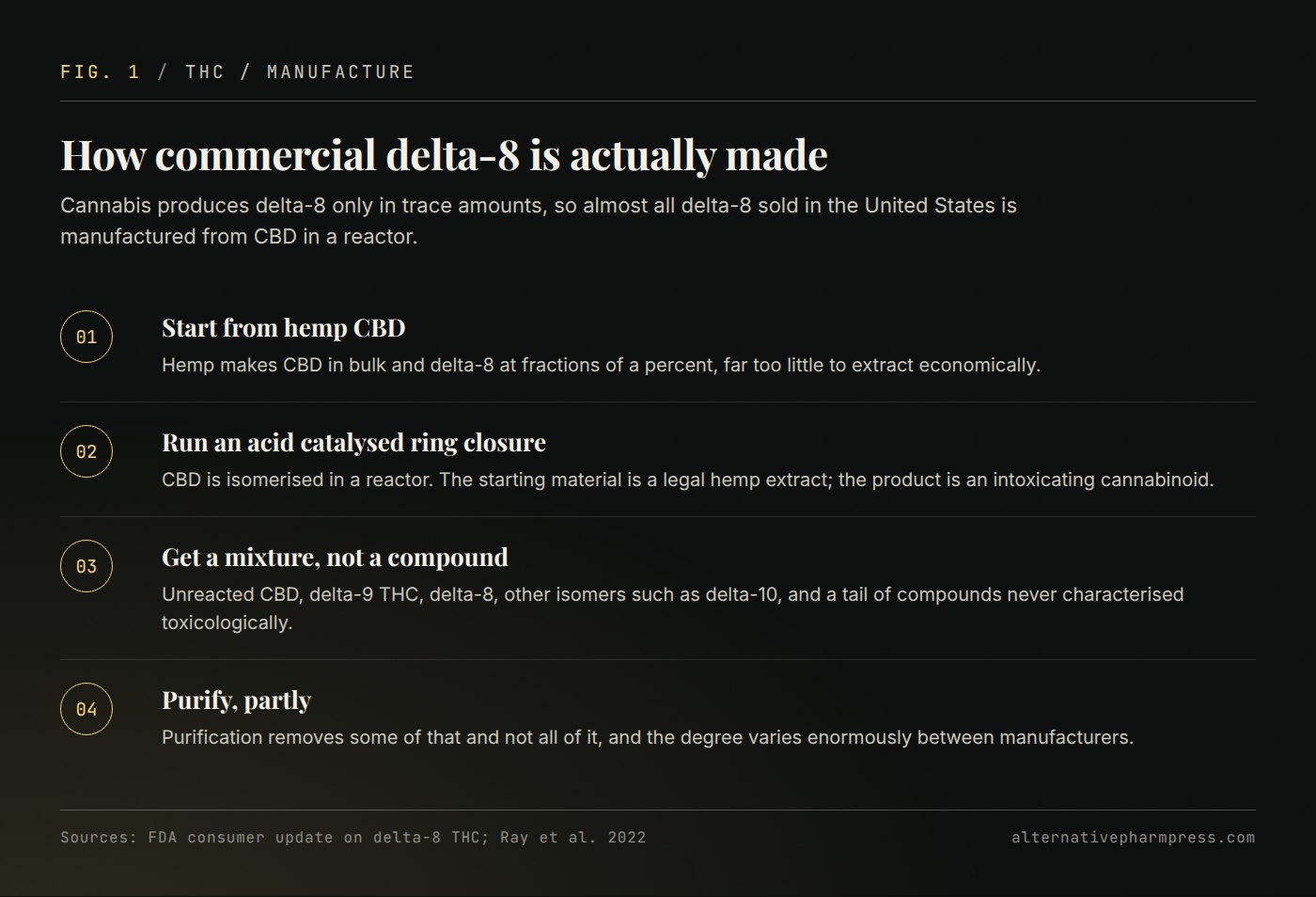
Most delta-8 on the market is manufactured, not extracted
Hemp contains delta-8 THC at fractions of a percent, far too little to extract economically. Commercial delta-8 is instead produced from CBD, which hemp does make in bulk, through an acid catalysed ring closure and isomerisation. The starting material is a legal hemp extract. The product is an intoxicating cannabinoid. Our explainer on cannabinoid conversion covers the general principle, and hemp isomerisation covers the reaction class in more detail.
This is the origin of most of the safety and legal argument. The reaction is not clean. It produces a mixture: unreacted CBD, delta-9 THC, delta-8 in varying proportion, other double bond isomers such as delta-10, and a tail of related compounds never characterised toxicologically. Purification removes some of that, not all of it, and the degree of purification varies enormously between manufacturers. The same chemistry underlies delta-10 THC and the isomer products that followed.
FDA made the point bluntly in its consumer update on delta-8. The agency noted that manufacturers convert cannabinoids such as CBD into concentrated delta-8 THC, that “some manufacturers may use potentially unsafe household chemicals to make delta-8 THC through this chemical synthesis process,” and that the final product may contain harmful byproducts.1
Purity and byproducts: what testing has found
Independent analysis supports that concern. A 2022 study in Molecules examined ten delta-8 THC products, five distillates and five vaporiser cartridges, using nuclear magnetic resonance, high performance liquid chromatography and mass spectrometry. Impurities appeared in every sample, at concentrations the authors described as far beyond what the accompanying certificates of analysis declared.3
The identified compounds included cannabidihexol, tetrahydrocannabihexol, cannabidivarin, hydroxylated cannabinoid analogues, and unknown substances that appeared to contain amine groups. One product advertised as 93.43 percent pure contained more than 15 percent non-target material by NMR integration. Only one of the ten samples was labelled close to accurately. The authors attributed the discrepancies to inadequate testing by producers and by the independent laboratories serving them.3
Two points follow. The toxicology of most of these byproducts is unknown, so their presence is a data gap rather than a demonstrated harm. And a certificate showing a delta-8 percentage tells a buyer nothing about what makes up the remainder.
FDA warnings, adverse events and poison centre reports
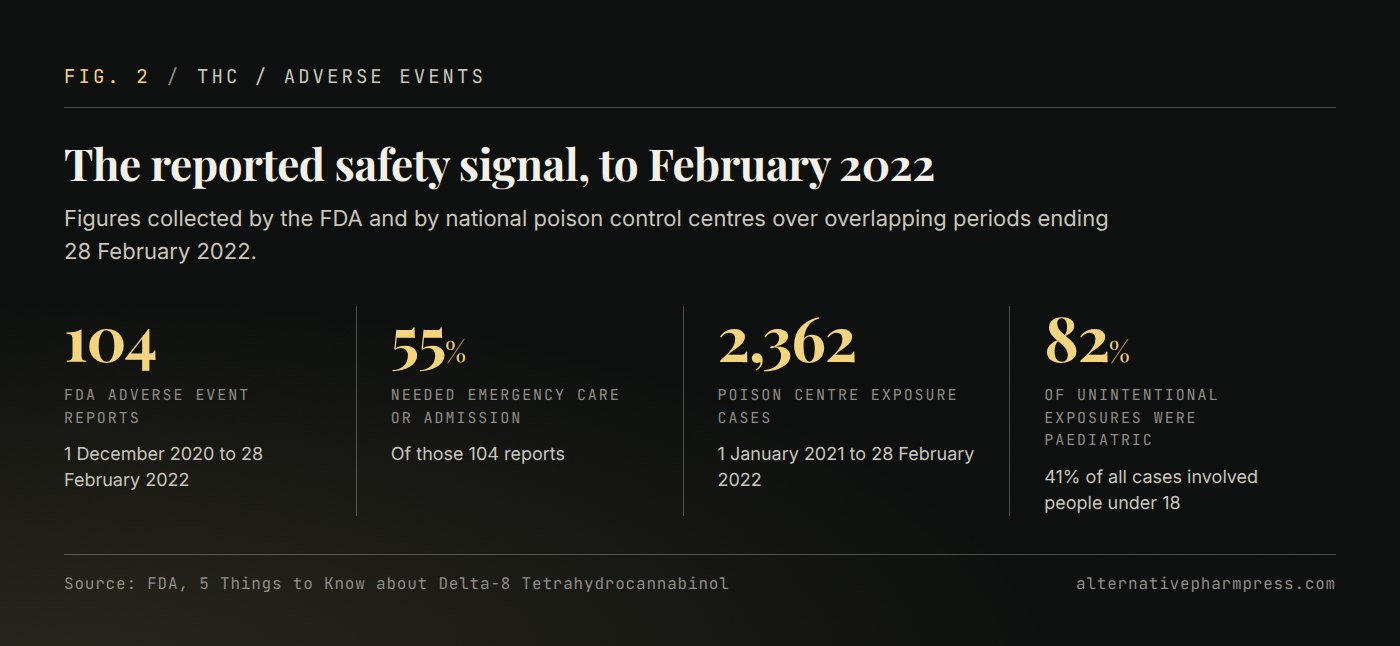
FDA has stated that delta-8 THC products “have not been evaluated or approved by the FDA for safe use in any context.”1 Between 1 December 2020 and 28 February 2022, the agency received 104 adverse event reports involving delta-8 THC products. Fifty-five percent of those reports involved people who required emergency intervention or hospital admission.1
National poison control centres recorded 2,362 delta-8 THC exposure cases between 1 January 2021 and 28 February 2022. Forty-one percent involved people under 18. Among unintentional exposures, 82 percent were paediatric.1 FDA linked this to packaging and labelling that may appeal to children, naming gummies, chocolates, cookies and candies, and to sale through convenience stores and online outlets without consistent age verification.1
CDC issued a health advisory on the same subject on 14 September 2021, warning that variation in product content, manufacturing practices and labelling, together with consumer misunderstanding of delta-8’s psychoactive properties, could produce unexpected effects, and noting adverse event reports that led to emergency department treatment.2
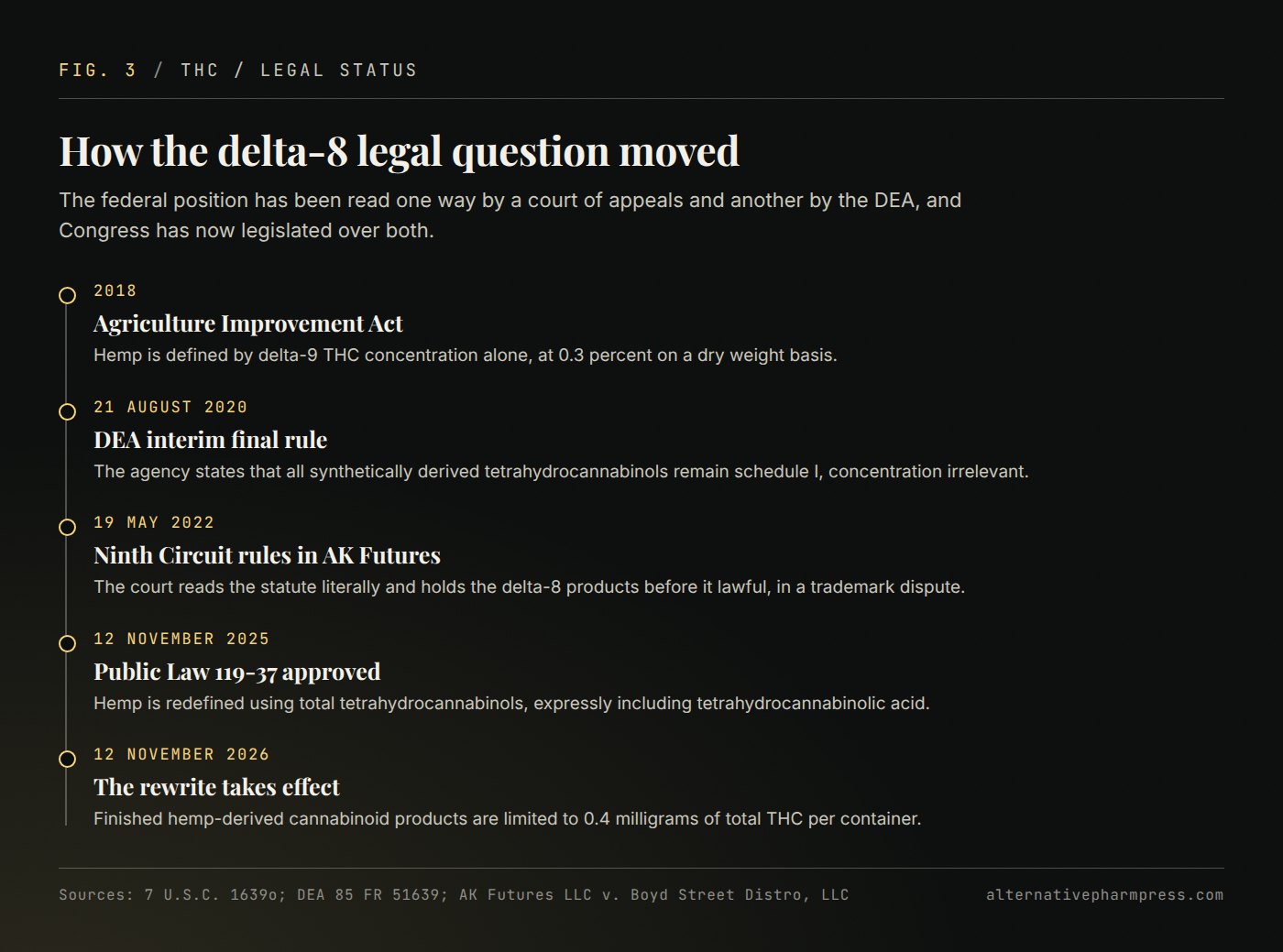
Legal status is contested and changing
The 2018 Agriculture Improvement Act defined hemp by delta-9 THC concentration alone, at 0.3 percent on a dry weight basis.7 Delta-8 is not delta-9, so hemp derived delta-8 fell outside the numeric test. In AK Futures LLC v. Boyd Street Distro, LLC, decided 19 May 2022, the Ninth Circuit read the statute literally, holding that “the plain and unambiguous text of the Farm Act compels the conclusion that the delta-8 THC products before us are lawful,” and adding that if a loophole existed, “it is for Congress to fix its mistake.”6 That was a trademark dispute, not a criminal case, and it binds only the Ninth Circuit.
DEA has taken a narrower line. Its 2020 interim final rule states that the 2018 Act “does not impact the control status of synthetically derived tetrahydrocannabinols” and that “all synthetically derived tetrahydrocannabinols remain schedule I controlled substances,” with concentration irrelevant to that determination.5 Whether delta-8 produced by isomerising a plant derived CBD molecule counts as synthetically derived has never been resolved by rulemaking or by a controlling court decision. That unresolved question sat under the entire market.
Congress has now legislated. Public Law 119-37, approved 12 November 2025, redefines hemp using total tetrahydrocannabinols, expressly including tetrahydrocannabinolic acid, at 0.3 percent, and limits finished hemp derived cannabinoid products to 0.4 milligrams of total THC and similar acting cannabinoids per container. The change takes effect 365 days after enactment, on 12 November 2026.7 As of August 2026 the earlier definition still applies at federal level.
State law is separate and often stricter. California’s emergency regulations, issued 6 September 2024, require industrial hemp food, beverage and dietary products to contain no detectable THC or other intoxicating cannabinoids per serving, set a minimum purchase age of 21, and cap packages at five servings.8 Other states have banned intoxicating hemp cannabinoids outright, routed them into licensed cannabis channels, or imposed potency caps, and several have reversed course more than once since 2021. None of this establishes that delta-8 is legal for you. Check the current law in your own state, and expect it to move. Our overview of delta-8 THC tracks the position.
Delta-8 and delta-9 THC compared
| Factor | Delta-8 THC | Delta-9 THC |
|---|---|---|
| Structure | C21H30O2; double bond between carbons 8 and 9; thermodynamically more stable isomer | C21H30O2; double bond between carbons 9 and 10 |
| Origin of commercial supply | Almost entirely manufactured by acid catalysed isomerisation of hemp CBD1 | Extracted from cannabis or hemp plant material, or formed by heating THCA |
| Natural abundance | Trace amounts only | Principal intoxicating cannabinoid after decarboxylation |
| Potency evidence | Sparse; controlled human comparisons are limited, and the main dataset is a self-report survey4 | Extensively characterised in controlled human pharmacology |
| Purity concerns | Reaction byproducts, residual reagents and undeclared analogues found in all ten products in one 2022 analysis3 | Contaminant profile depends on cultivation and extraction rather than synthesis |
| Safety signal | 104 FDA adverse event reports and 2,362 poison centre cases to February 2022; 41 percent of exposures under 181 | Well documented acute effects; regulated dosing in licensed cannabis markets |
| Federal status before 12 Nov 2026 | Contested; outside the delta-9 numeric test, but DEA treats synthetically derived THC as schedule I5 | Schedule I above 0.3 percent dry weight; hemp below that threshold |
| Federal status from 12 Nov 2026 | Captured by total tetrahydrocannabinols and the 0.4 mg per container product limit7 | Captured by the same total and the same product limit |
Frequently asked questions
Is delta-8 THC the same as regular THC?
No. Regular THC means delta-9 THC. Delta-8 is a separate isomer with the same atoms arranged slightly differently, one double bond moved by a single position. Both bind the CB1 receptor and both are intoxicating, but they are distinct compounds with distinct pharmacology, distinct supply chains and, at present, distinct legal treatment.
Is delta-8 natural or synthetic?
Delta-8 occurs in cannabis at trace levels, so it is natural in the narrow sense. Commercially it is almost always made in a reactor from CBD.1 Whether that makes it “synthetically derived” for the purposes of the Controlled Substances Act is the central unresolved legal question, and it has not been settled by rulemaking or by a controlling court decision.
Is delta-8 weaker than delta-9?
The evidence is weaker than the claim. Controlled human comparisons are scarce, and the frequently cited figure of roughly half the potency is not supported by robust modern trials. Survey respondents report a milder experience with less anxiety.4 That is self-reported and subject to bias. Treat potency comparisons as uncertain.
Why do poison centre figures matter here?
Because they capture a specific failure mode. Of unintentional delta-8 exposures reported to United States poison centres through February 2022, 82 percent were paediatric, and FDA connected that pattern to confectionery style packaging and inconsistent age controls at the point of sale.1 The signal concerns product presentation and distribution as much as the molecule.
Is delta-8 legal?
As of August 2026 there is no single answer. Federal law is mid transition, with the rewritten hemp definition taking effect 12 November 2026,7 and state law ranges from outright prohibition to licensed sale. This article does not tell you that any product is legal where you are. Verify your current state law before assuming anything.
Sources
- U.S. Food and Drug Administration. 5 Things to Know about Delta-8 Tetrahydrocannabinol. Consumer update. fda.gov
- Centers for Disease Control and Prevention, Health Alert Network. Increases in Availability of Cannabis Products Containing Delta-8 THC and Reported Cases of Adverse Events. CDCHAN-00451, 14 September 2021. stacks.cdc.gov
- Ray CL, Bylo MP, Pescaglia J, Gawenis JA, Greenlief CM. Delta-8 Tetrahydrocannabinol Product Impurities. Molecules. 2022;27(20):6924. DOI: 10.3390/molecules27206924.
- Kruger JS, Kruger DJ. Delta-8-THC: Delta-9-THC’s nicer younger sibling? Journal of Cannabis Research. 2022;4(1):4. DOI: 10.1186/s42238-021-00115-8. PMID: 34980292.
- Drug Enforcement Administration. Implementation of the Agriculture Improvement Act of 2018. Interim final rule, 85 FR 51639, 21 August 2020. federalregister.gov
- AK Futures LLC v. Boyd Street Distro, LLC, No. 21-56133 (9th Cir. 19 May 2022). ca9.uscourts.gov
- 7 U.S.C. 1639o, definition of hemp, including amendment notes for Public Law 119-37 (approved 12 November 2025, effective 365 days after enactment). uscode.house.gov
- Office of the Governor of California. Governor Newsom issues regulations to protect kids from dangerous and intoxicating hemp products. 6 September 2024. gov.ca.gov
Editorial note: This article is for general information only and is not medical or legal advice. Delta-8 THC has not been evaluated by the FDA to diagnose, treat, cure or prevent any disease. Laws vary by location and change often, so verify the rules that apply where you are. Always talk to a licensed healthcare provider before use, especially if you are under 21, pregnant or nursing, taking medication, or managing a health condition.
More comparisons
-
Distillate vs Live Resin: Refining, Terpenes and What Carts Contain
-
Live Resin vs Live Rosin: Extraction Chemistry and Solvent Testing
-
Indica vs Sativa: What Genetic and Terpene Research Actually Shows
-
THCA vs CBD: Why Heat, Drug Tests and the Law Split Them Apart
-
Delta-8 vs CBD: Intoxication, Evidence, Drug Tests and the 2026 Law