
If you’ve tried to figure out whether delta-8 is legal where you live, you already know the answer is annoying: it depends, and it keeps moving. Some states ban it outright. Some allow it but wrap it in age limits, licensing, and testing rules. And a few have flipped positions more than once. We’ll lay out where things stand for 2026, but the headline you can’t ignore is at the federal level, and it could override every state list below.
So we’ll put that first, then get into the state-by-state picture.
The federal change that sits above every state rule
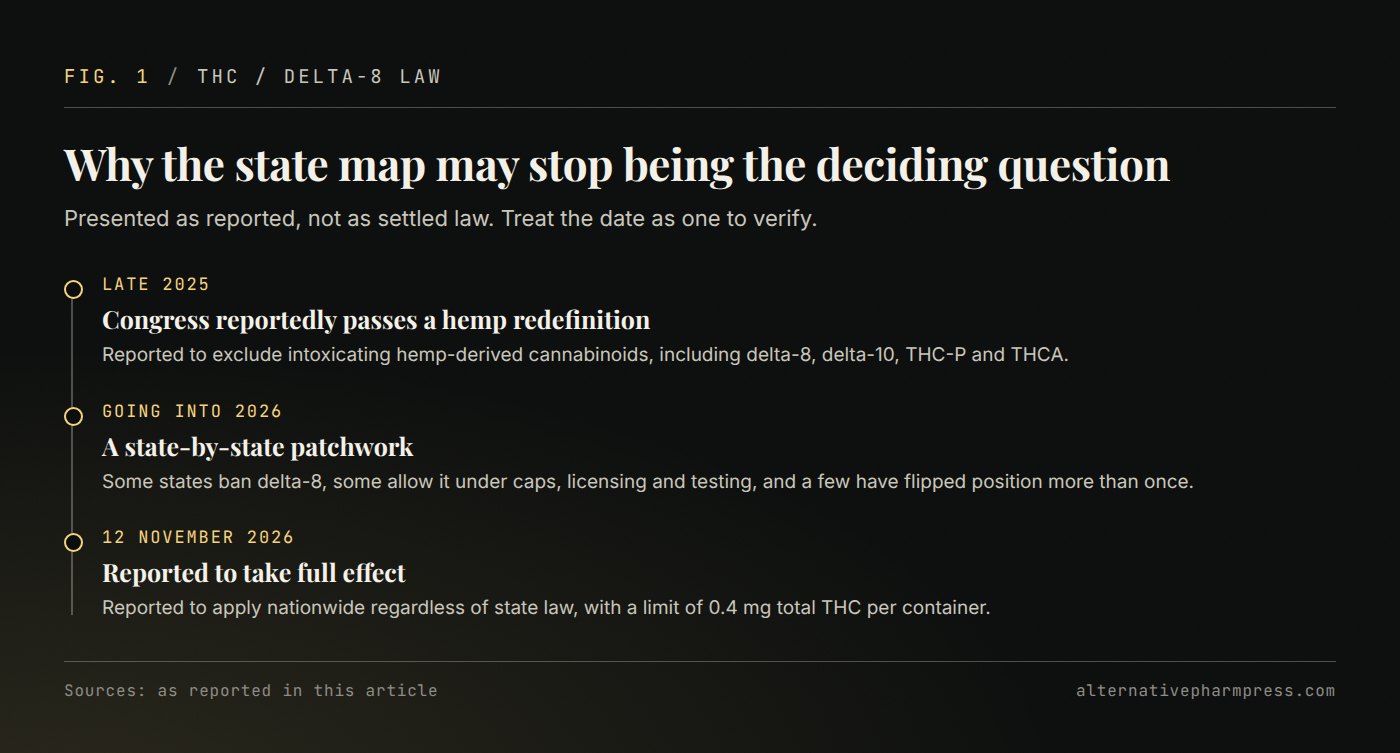
According to industry and news reporting, in late 2025 the US Congress passed a measure that redefines hemp to exclude intoxicating hemp-derived cannabinoids. That reportedly includes delta-8 THC, delta-10, THC-P, THCA, and similar compounds, along with a limit of 0.4 mg total THC per container. The change is reported to take full effect on November 12, 2026, and it would apply nationwide regardless of state law.
Read that last part twice. Right now, “is delta-8 legal in my state?” is the question that decides whether you can buy it. After the reported federal deadline, the question changes: even in a state that has happily allowed delta-8 for years, a federal redefinition that excludes intoxicating hemp cannabinoids would put those products on a different footing across the whole country. We’re presenting this as reported rather than as a statute you can cite by number, so treat November 12, 2026 as a hard date to verify, not as gospel. Confirm the current federal rule and your state’s response before you rely on either. You can follow the federal side through the USDA hemp program and general guidance from the FDA.
States that ban or heavily restrict delta-8 in 2026
Based on the rules in place going into 2026, the following states ban or heavily restrict delta-8 THC. “Restrict” is doing real work in that sentence, because a few of these states technically allow some products under tight conditions while effectively shutting down the open retail market. Treat this as a snapshot, not a permanent record, and verify your own state before buying.
| State | Status | Note |
|---|---|---|
| Alaska | Banned or heavily restricted | Treated alongside other restricted THC isomers |
| Arkansas | Banned | Banned via Act 629; has faced legal challenges |
| Colorado | Banned or heavily restricted | Regulator guidance treats hemp-derived isomers as not allowed |
| Delaware | Banned or heavily restricted | Limited under state cannabis framework |
| Hawaii | Banned or heavily restricted | State health rules limit intoxicating hemp products |
| Idaho | Banned | Among the strictest THC rules in the country |
| Iowa | Banned or heavily restricted | Tight limits on consumable hemp THC |
| Kansas | Banned or heavily restricted | Treated as a controlled isomer in practice |
| Louisiana | Heavily restricted | Permits some products with caps and licensing |
| Massachusetts | Banned or heavily restricted | Routed through the regulated cannabis system |
| Michigan | Heavily restricted | Regulated through licensed cannabis channels |
| Minnesota | Heavily restricted | Allows limited products under strict caps and testing |
| Mississippi | Banned or heavily restricted | Limits intoxicating hemp cannabinoids |
| Montana | Banned | Prohibits delta-8 and similar isomers |
| Nevada | Banned or heavily restricted | Restricted outside the regulated market |
| New Hampshire | Banned or heavily restricted | Limited under state controlled-substance rules |
| New York | Banned or heavily restricted | State rules restrict hemp-derived intoxicants |
| North Dakota | Banned | Prohibits delta-8 and converted isomers |
| Oregon | Heavily restricted | Tight rules on artificially derived cannabinoids |
| Rhode Island | Banned or heavily restricted | Limited under state cannabis law |
| Utah | Banned or heavily restricted | Strict limits on intoxicating hemp products |
| Vermont | Banned | Prohibits delta-8 made from hemp via conversion |
| Virginia | Heavily restricted | Caps total THC and limits THC-to-CBD ratios |
| Washington | Banned or heavily restricted | Restricts converted cannabinoids outside the licensed market |
| West Virginia | Banned or heavily restricted | Limits intoxicating hemp cannabinoids |
A note on Arkansas specifically: the state moved to ban delta-8 through Act 629, and that law has been the subject of court fights, which is a good reminder that even a clear-looking ban can be contested and can change. We keep the moving pieces updated, and the related comparison in delta-8 vs delta-9 vs THC-O explains why these isomers get treated so differently under the law.
“Allowed” rarely means “anything goes”
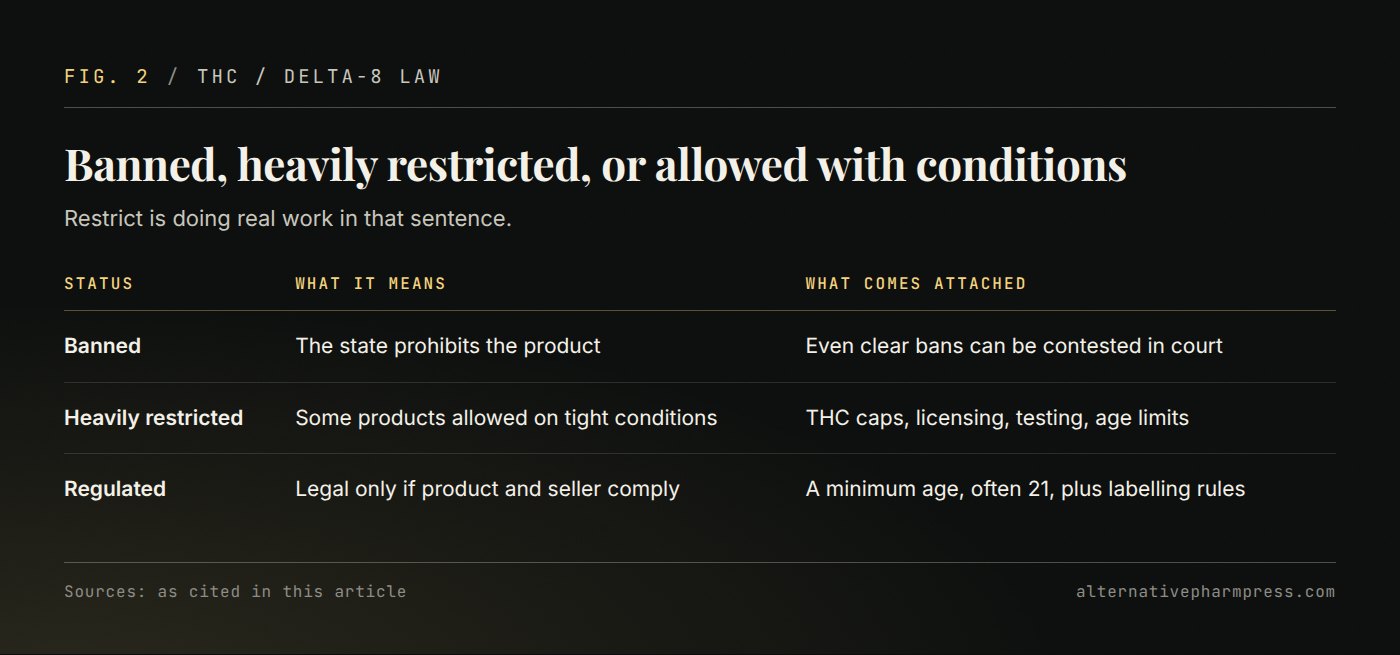
Plenty of states aren’t on the banned list, and that’s where people get a false sense of security. Outside of full bans, a large group of states regulate delta-8 rather than prohibit it. That regulation can include a minimum purchase age (often 21), licensing requirements for sellers, mandatory lab testing, packaging and labeling rules, and caps on how much total THC a product can contain. So “legal in my state” can still mean “legal only if the product and the seller meet a list of conditions.”
This matters for shoppers because a compliant product in a regulated state is usually a better-documented product. If a state requires testing and clear labeling, the brands that want to keep selling there tend to publish the lab work. That overlaps neatly with how we tell good sellers from sketchy ones in the signs a brand is genuinely third-party tested, and it’s the logic behind our delta-8 brand roundup.
Why legal-in-your-state can still change after the deadline
Here’s the trap. Say you live in a state with no delta-8 ban and reasonable rules. Today you can walk into a shop and buy a tested product. It’s easy to assume that arrangement is stable. But the reported federal change doesn’t ask your state’s permission. If hemp gets redefined federally to exclude intoxicating cannabinoids, the products themselves lose their federal footing, and a friendly state law can’t put that footing back. A state can be more restrictive than the federal government, but it generally can’t make a federally excluded product federally legal again.
That’s the whole reason we keep hammering the date. State legality answers “can I buy this today.” The reported November 12, 2026 change answers “will this category still exist nationwide after that.” Both questions matter, and the second one has a deadline. If you want the background on how hemp and THC are defined in the first place, our hemp glossary, cannabis glossary, and CBD glossary are good starting points, and you can browse our full coverage under THC topics.
How to use this list responsibly
First, verify your own state directly, because these lists shift as legislatures meet and courts rule. Second, don’t read “not banned” as “unregulated.” Third, factor in the federal deadline before you make any bulk purchase or build a habit around easy access. A product that’s perfectly legal in your state in June may sit in a very different spot once the federal redefinition takes effect.
And whatever your state allows, the same buying discipline applies: a current, batch-matched third-party Certificate of Analysis that you can actually open and read. Our COA reading guide walks through the parts that matter, and our brand directory and coupon page are there once you’ve decided a product clears that bar.
Frequently asked questions
Is the banned-states list final for 2026?
No. State rules on delta-8 change frequently as legislatures pass new laws and courts weigh in, and Arkansas is a clear example with ongoing litigation around Act 629. Treat the list as a snapshot and confirm your own state directly before buying.
If my state allows delta-8, can I ignore the federal change?
No. The reported federal change effective November 12, 2026 would apply nationwide regardless of state law. A state can be more restrictive than the federal government, but it generally cannot restore the federal legal footing of a product that has been excluded federally.
What does “heavily restricted” mean compared with “banned”?
A ban means the state prohibits the product. “Heavily restricted” usually means some products are allowed only under tight conditions, such as caps on total THC, licensing for sellers, mandatory testing, and age limits. In practice, heavy restriction can shut down most of the open retail market.
Do age limits apply even where delta-8 is legal?
Often, yes. Many states that allow delta-8 set a minimum purchase age, commonly 21, along with labeling and testing rules. “Legal in my state” frequently means “legal under specific conditions,” so check the details rather than assuming open access.
Should I stock up before the deadline?
We won’t tell you to stockpile. The smarter move is to verify both your state’s current rules and the federal status as the date approaches, and to talk to a licensed healthcare provider before use. Buying ahead of a legal change carries its own risks and doesn’t guarantee future legality of possession or use.
Editorial note: This article is for general information only and is not medical or legal advice. These products have not been evaluated by the FDA to diagnose, treat, cure, or prevent any disease. Laws vary by location and change often, so verify the rules that apply to you. Always talk to a licensed healthcare provider before use, especially if you are under 21, pregnant or nursing, taking medication, or managing a health condition.