
THCA and delta-9 THC are not the same compound. THCA, or tetrahydrocannabinolic acid, is the acidic precursor that the cannabis plant actually makes, and it does not produce a high in raw plant material. Heat removes a carboxyl group from THCA and converts it into delta-9 THC, which is intoxicating. One reaction separates the two.
So the plain answer to “does THCA cause a high” is: not as it sits in unheated plant material, but yes once the material is heated, because heating is how almost all of these products are consumed. The answer to “are delta-9 and THCA the same thing” is no. They are two distinct molecules with different molecular weights, different behaviour at cannabinoid receptors, and, for several years, different federal treatment.
That last difference is closing. As of August 2026, federal and state law on hemp derived cannabinoids is unsettled and actively changing, and a statutory amendment that folds THCA into the federal THC calculation takes effect in November 2026.3 What follows is the chemistry, the testing arithmetic, and where the law currently sits.
The carboxyl group and what heat removes
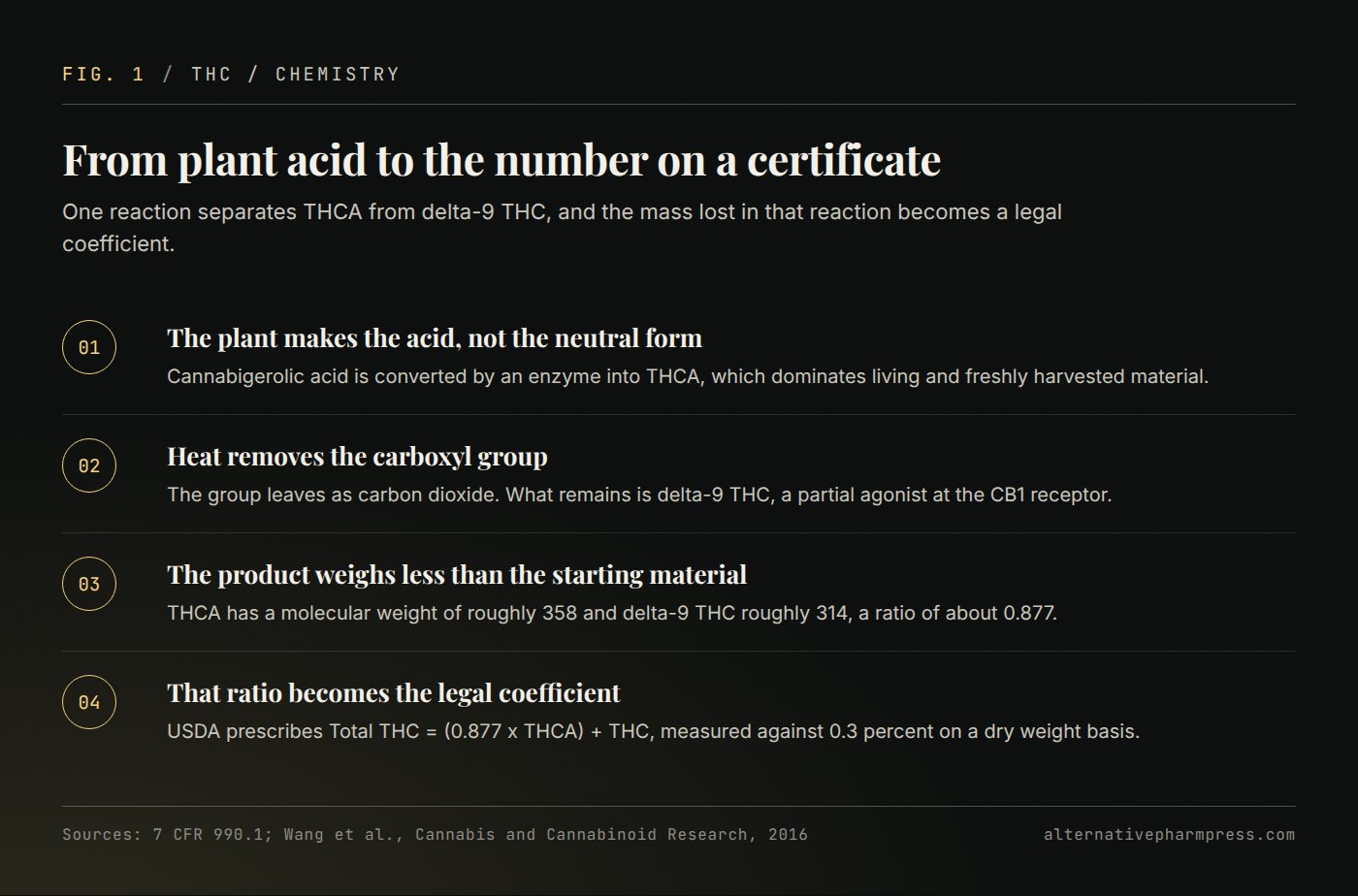
Cannabis does not biosynthesise delta-9 THC directly. The plant produces cannabigerolic acid, which an enzyme converts into THCA. In living and freshly harvested material, the overwhelming majority of the “THC” present is actually THCA, and delta-9 THC is a small fraction of the total.
THCA carries a carboxylic acid group on its aromatic ring, and that group is the reason it behaves differently in the body. Delta-9 THC is a partial agonist at the CB1 receptor, and CB1 activation in the central nervous system is what produces intoxication. THCA binds CB1 poorly. Published human pharmacology on THCA itself is thin: most of what is known comes from in vitro receptor work and analytical chemistry, not controlled human trials.
Decarboxylation is the loss of that carboxyl group as carbon dioxide. The USDA hemp rule defines it in exactly those terms: “the removal or elimination of carboxyl group from a molecule or organic compound.”1 What remains is delta-9 THC. Because a CO2 molecule leaves, the product weighs less than the starting material. THCA has a molecular weight of roughly 358, delta-9 THC roughly 314. The ratio is about 0.877, and that number reappears later as a legal coefficient.
The reaction is driven by heat and is dependent on both temperature and time. A 2016 study in Cannabis and Cannabinoid Research used supercritical fluid chromatography with mass spectrometry to track acidic cannabinoids as they converted, and found that conversion follows first order kinetics and is frequently incomplete under real conditions.2 Complete conversion is the exception, not the rule. Our explainer on decarboxylation covers the mechanism in more detail.
Why the total THC calculation matters legally
The 2018 Agriculture Improvement Act defined hemp by reference to “delta-9 tetrahydrocannabinol concentration of not more than 0.3 percent on a dry weight basis.”3 It named one molecule. It did not name THCA.
USDA’s hemp production rule closed that gap for regulated crops. The rule sets an “acceptable hemp THC level” measured after decarboxylation, and where a laboratory uses liquid chromatography, which leaves THCA intact, the rule prescribes the arithmetic: Total THC = (0.877 x THCA) + THC.1 The 0.877 is the molecular weight ratio described above. It converts a measured mass of acid into the mass of neutral THC that acid could yield.
A crop testing at 0.2 percent delta-9 THC but 20 percent THCA is therefore not hemp under the USDA testing standard. It is far over the line. The same material, tested by a laboratory reporting delta-9 THC alone on an unheated sample, can appear compliant. That gap between the statutory text and the testing standard is where the THCA product category was built. See our coverage of the 2018 Farm Bill and of hemp derived THC for wider context.
Congress has now addressed the point directly. Public Law 119-37, approved on 12 November 2025, rewrites the federal definition of hemp to use total tetrahydrocannabinols, expressly including tetrahydrocannabinolic acid, at the same 0.3 percent threshold. It also imposes a limit of 0.4 milligrams of total THC and similar acting cannabinoids per container on finished hemp derived cannabinoid products. The amendment takes effect 365 days after enactment, which is 12 November 2026.3 As of August 2026 the older definition still governs at federal level, and the new one has not yet bitten.
Why THCA flower exists as a product category
THCA flower is sold as hemp. The commercial logic is straightforward: cultivars are grown and harvested so that measured delta-9 THC stays under 0.3 percent while THCA content remains high, and the material is then marketed under the hemp definition rather than as marijuana. Nothing about the plant is unusual. What is unusual is the measurement convention applied to it.
This is a different mechanism from the isomerised cannabinoids sold as delta-8 or delta-10, which are made by chemical conversion in a reactor. THCA flower involves no conversion step at the point of sale. The conversion happens later, through heat. That distinction is why THCA flower and hemp delta-9 products raise different regulatory questions.
DEA has been consistent on one adjacent point. In its 2020 interim final rule implementing the 2018 Act, the agency stated that material containing more than 0.3 percent delta-9 THC on a dry weight basis “remains controlled in schedule I,” and that all synthetically derived tetrahydrocannabinols remain schedule I regardless of concentration.4 The rule did not resolve how THCA in unheated plant material should be counted, which is the ambiguity the 2025 amendment targets.
Testing and regulation are inconsistent
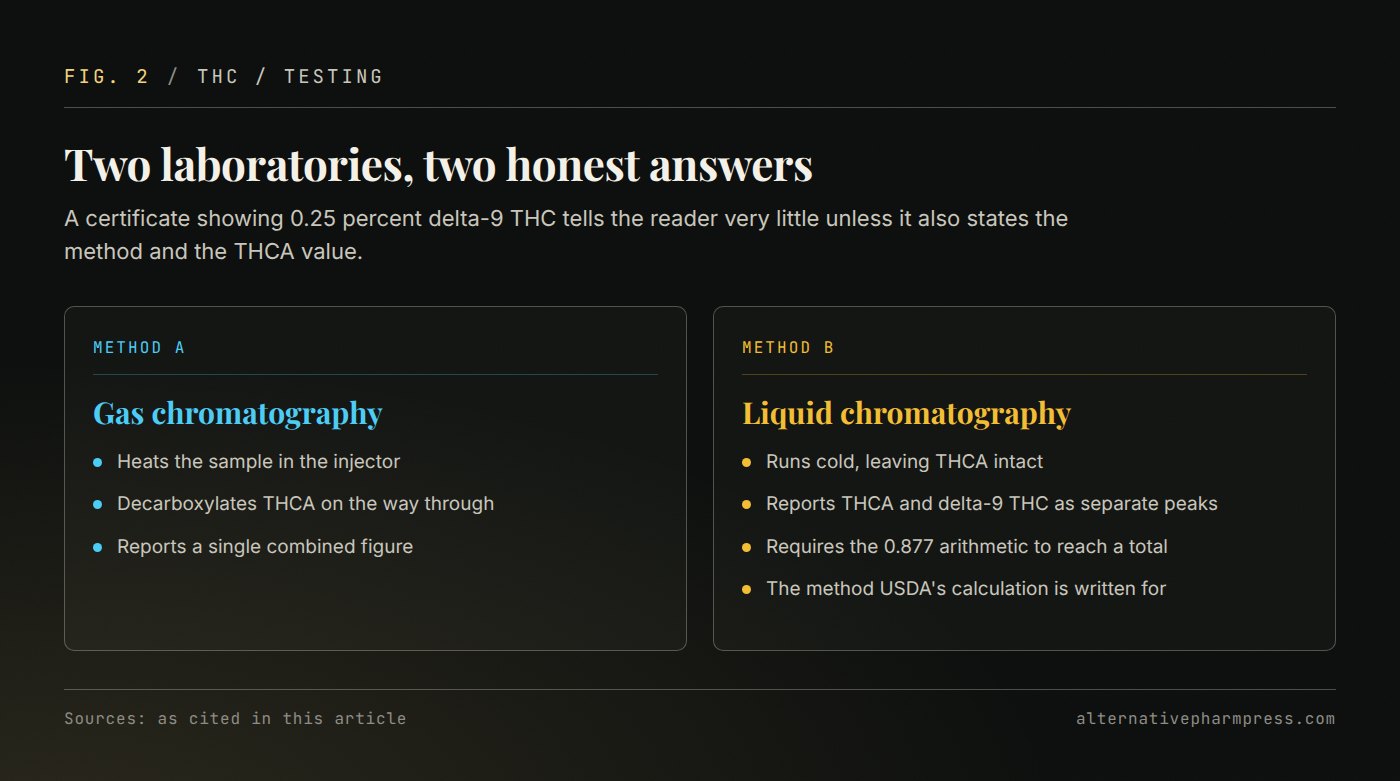
Two laboratories can test the same flower and issue certificates that look contradictory, without either being fraudulent. Gas chromatography heats the sample in the injector, which decarboxylates THCA on the way through and reports a combined figure. High performance liquid chromatography runs cold and reports THCA and delta-9 THC as separate peaks. A certificate showing 0.25 percent delta-9 THC tells the reader very little unless it also states the method and the THCA value.
State law compounds the variation. California’s emergency regulations, issued on 6 September 2024, require industrial hemp food, beverage and dietary products to contain no detectable THC or other intoxicating cannabinoids per serving, set a minimum purchase age of 21, and cap packages at five servings.6 Other states have written total THC standards into their own hemp statutes, restricted sales to licensed cannabis retailers, or banned intoxicating hemp products outright. Several have changed position more than once since 2023.
Courts have added further variation. In AK Futures LLC v. Boyd Street Distro, LLC, decided 19 May 2022, the Ninth Circuit held that “the plain and unambiguous text of the Farm Act compels the conclusion that the delta-8 THC products before us are lawful,” and added that if Congress had inadvertently created a loophole, “it is for Congress to fix its mistake.”5 That reasoning concerned delta-8 rather than THCA, and it was a trademark decision rather than a criminal one, but it shaped how the industry read the statute. Congress has since acted. Nothing here establishes that any THCA product is legal where you live. Check your current state law, and expect it to change.
THCA and delta-9 THC compared
| Property | THCA | Delta-9 THC |
|---|---|---|
| Intoxicating | No meaningful CB1 activation in unheated material; human data are limited | Yes; partial agonist at CB1 |
| Where it occurs | Dominant form in living and fresh cannabis | Minor component of fresh plant material |
| Molecular weight | Approximately 358 | Approximately 314 |
| Stability | Degrades to delta-9 THC with heat, and slowly with time, light and storage | More stable to heat; oxidises to CBN over time |
| How conversion happens | Loses CO2 on heating; conversion is temperature and time dependent and often incomplete2 | Endpoint of the reaction, not a starting material for it |
| Federal treatment before 12 Nov 2026 | Not named in the 2018 statutory definition; counted under USDA total THC testing1 | Named directly; 0.3 percent dry weight threshold |
| Federal treatment from 12 Nov 2026 | Expressly included in total tetrahydrocannabinols under Pub. L. 119-373 | Included in the same total, plus a 0.4 mg per container product limit |
| Testing method sensitivity | Reported separately by liquid chromatography; converted by gas chromatography | Reported by both, but the figure differs depending on method |
Frequently asked questions
Does THCA cause a high?
Not in raw, unheated plant material. THCA binds the CB1 receptor poorly, and the intoxicating effect associated with cannabis comes from delta-9 THC acting at that receptor. Once THCA is heated it converts to delta-9 THC, and the resulting material is intoxicating. Human research on THCA itself is limited, so claims about what the acid form does in the body should be read cautiously.
Are delta-9 and THCA the same thing?
No. They are separate molecules. THCA carries a carboxylic acid group that delta-9 THC does not, and weighs about 44 atomic mass units more as a result. They are related as precursor and product, not as synonyms, even though certificates and marketing often blur the two.
What is total THC and why is 0.877 used?
Total THC is the potential delta-9 THC content of a sample, calculated as (0.877 x THCA) + delta-9 THC.1 The coefficient is the ratio of the molecular weight of delta-9 THC to that of THCA. It accounts for the carbon dioxide lost when the acid decarboxylates, so the figure reflects mass that could actually be produced.
Is THCA flower federally legal?
As of August 2026 the answer is contested rather than settled. The 2018 definition names delta-9 THC only, USDA’s testing rule uses a post-decarboxylation figure, and enforcement has varied. From 12 November 2026, Public Law 119-37 replaces the delta-9 standard with a total tetrahydrocannabinols standard that names THCA.3 State law is separate and in many places stricter. This article does not tell you that any product is legal where you are.
Will a THCA product affect a drug test?
Standard workplace immunoassays target a delta-9 THC metabolite rather than the parent compound or the acid. Heated material has already converted to delta-9 THC, so the general expectation is that it is not distinguishable from cannabis on a routine screen. Testing programmes vary, and this is not a guarantee about any specific panel.
Sources
- U.S. Department of Agriculture, Agricultural Marketing Service. Domestic Hemp Production Program: Meaning of terms. 7 CFR 990.1. ecfr.gov
- Wang M, Wang YH, Avula B, Radwan MM, Wanas AS, van Antwerp J, Parcher JF, ElSohly MA, Khan IA. Decarboxylation Study of Acidic Cannabinoids: A Novel Approach Using Ultra-High-Performance Supercritical Fluid Chromatography/Photodiode Array-Mass Spectrometry. Cannabis and Cannabinoid Research. 2016;1(1):262–271. DOI: 10.1089/can.2016.0020. PMID: 28861498.
- 7 U.S.C. 1639o, definition of hemp, including amendment notes for Public Law 119-37 (approved 12 November 2025, effective 365 days after enactment). uscode.house.gov
- Drug Enforcement Administration. Implementation of the Agriculture Improvement Act of 2018. Interim final rule, 85 FR 51639, 21 August 2020. federalregister.gov
- AK Futures LLC v. Boyd Street Distro, LLC, No. 21-56133 (9th Cir. 19 May 2022). ca9.uscourts.gov
- Office of the Governor of California. Governor Newsom issues regulations to protect kids from dangerous and intoxicating hemp products. 6 September 2024. gov.ca.gov
Editorial note: This article is for general information only and is not medical or legal advice. THCA has not been evaluated by the FDA to diagnose, treat, cure or prevent any disease. Laws vary by location and change often, so verify the rules that apply where you are. Always talk to a licensed healthcare provider before use, especially if you are under 21, pregnant or nursing, taking medication, or managing a health condition.
More comparisons
-
Distillate vs Live Resin: Refining, Terpenes and What Carts Contain
-
Live Resin vs Live Rosin: Extraction Chemistry and Solvent Testing
-
Indica vs Sativa: What Genetic and Terpene Research Actually Shows
-
THCA vs CBD: Why Heat, Drug Tests and the Law Split Them Apart
-
Delta-8 vs CBD: Intoxication, Evidence, Drug Tests and the 2026 Law