
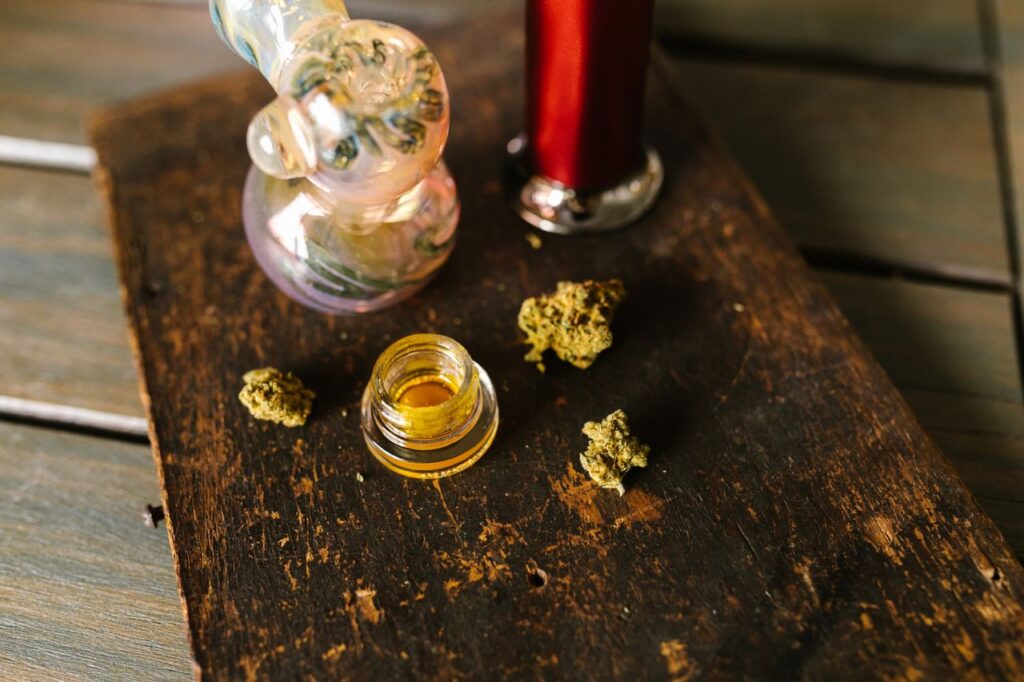
Live resin and live rosin are both cannabis concentrates made from plants frozen straight after harvest instead of being dried. The difference is the extraction method. Live resin is pulled out with hydrocarbon solvents such as butane or propane, which are then purged. Live rosin uses no added solvent: resin glands are separated in ice water, dried, then pressed with heat and pressure.
That single difference drives most of the others, from what residues a lab should look for to why rosin is often scarcer. Both are high-THC products for inhalation, and neither method ensures a clean or consistent product.
Below we set out the extraction chemistry, what is and is not known about effects, the safety evidence on solvent residues and heated terpenes, the legal picture as of September 2026, and what to check on a certificate of analysis.
At a glance
| Property | Live resin | Live rosin |
|---|---|---|
| Starting material | Fresh-frozen flower | Fresh-frozen flower, washed into ice water hash |
| Extraction agent | Butane, propane or a blend | Ice water, then heat and pressure |
| Added solvent? | Yes, purged afterwards | No |
| Residual solvent risk | Present; tested against limits3 | No process solvent to leave behind |
| Wax carry-over | Rises with warmer extraction2 | Depends on wash and filter quality |
| Common textures | Sauce, badder, sugar, diamonds, vape oil | Badder, jam, cold cure, fresh press |
| Yield from starting material | Higher | Lower |
| Controlled effect studies | None comparing the two | None comparing the two |
| Main shared risk | High THC; pesticides concentrate4,9 | High THC; pesticides concentrate4,9 |
What ‘live’ means and how each is made
“Live” means the plant was frozen at harvest rather than dried first. Makers argue this keeps more of the volatile aroma compounds. The peer-reviewed support is thinner than the marketing suggests: an older University of Mississippi study found that air-drying did not change which volatile compounds were present or whether experienced users recognised the aroma, and we found little published work quantifying how much fresh-freezing preserves.8
Live resin
Frozen plant material is packed into a closed-loop system and washed with chilled liquid butane, propane or a blend. The solvent dissolves cannabinoids and terpenes; it is then recovered and the extract is purged under vacuum and gentle heat to drive off what remains. Different handling after purging gives sauce, badder or THCA “diamonds”. Our live resin glossary entry covers the formats.
Live rosin
Frozen flower is agitated in ice water so the brittle trichome heads snap off. The water is filtered through a series of micron mesh bags, and the collected resin (ice water hash, or bubble hash) is usually freeze-dried. That hash is then pressed between heated plates inside a fine filter bag, and the oil that seeps out is live rosin. See our rosin glossary entry for the non-live version pressed from dried flower.
Extraction chemistry: what ends up in the jar
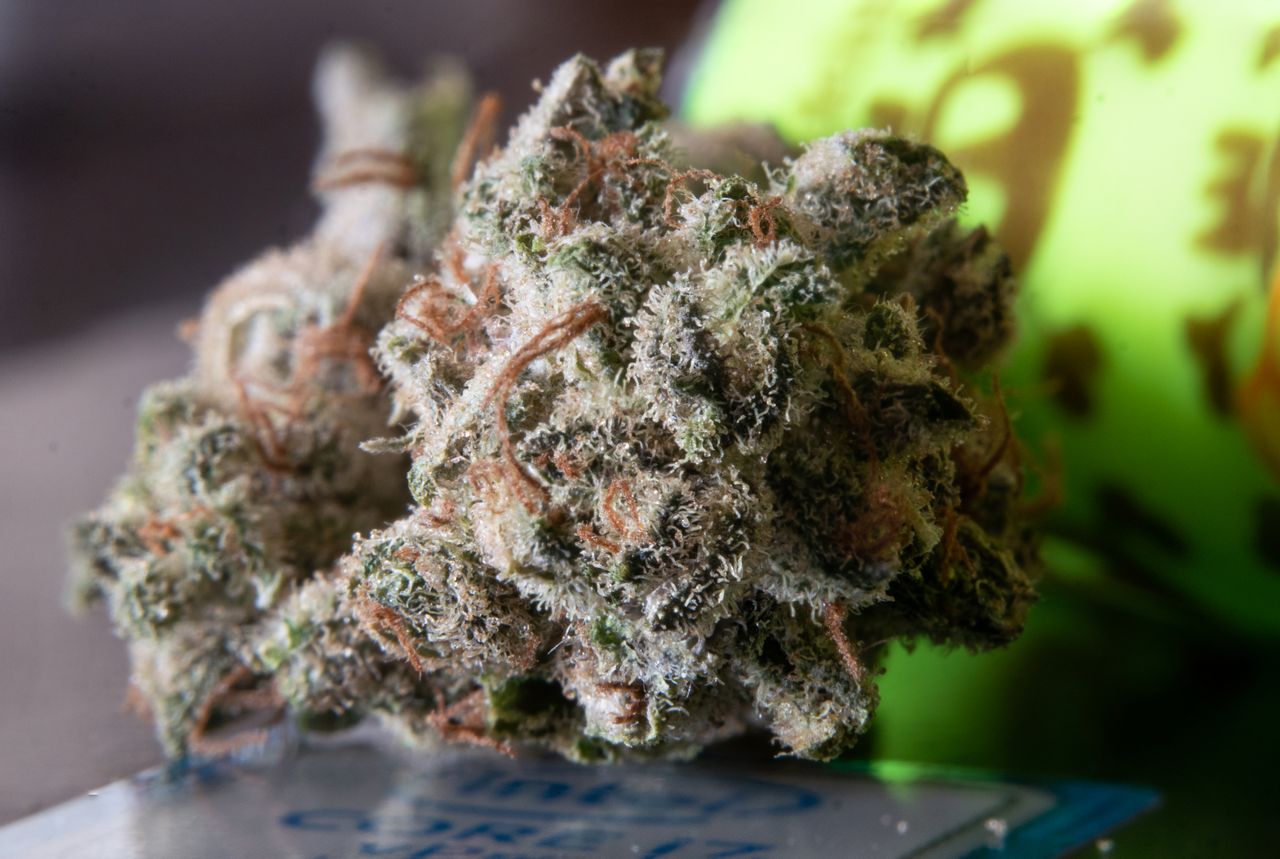
Hydrocarbons are non-polar solvents, which suits cannabinoids and terpenes but also pulls out plant waxes. A 2026 study run by a terpene and extraction company extracted two cultivars with n-butane at -46 °C to -9 °C.2 Long-chain n-alkanes from plant wax rose steadily with extraction temperature while cannabinoid and aroma levels stayed fairly constant, and those waxes transferred efficiently into the inhaled aerosol. Colder runs cut wax content by up to about three-fold.2 The study was industry-funded and covered only two cultivars, but it shows that process choices change what a user inhales.
Rosin chemistry is simpler to describe and far less studied. No solvent is added, so what reaches the jar is whatever resin heads, plant fragments and contaminants passed the mesh bags and filter. Pressing temperature and time affect terpene retention and texture; we found no peer-reviewed study that measured this systematically for rosin.
Both methods concentrate whatever was on the plant. That matters for pesticide residues and, for rosin, for any contamination picked up during the wash and drying stages.
Why textures differ
Most of the THC in both products is present as THCA, the acid form, which converts to THC when heated in a dab rig or vaporiser. That is why lab reports give total THC, calculated as THC plus 0.877 times THCA. Resin “diamonds” are largely crystallised THCA that has separated from a terpene-rich liquid, sold as “sauce”. Rosin makers get a similar separation by letting rosin rest in a cold cure or by whipping it into badder. Texture reflects how crystals and liquid have separated, not purity or safety.
Effects and flavour: what is and is not known
No controlled human study has compared live resin with live rosin. Claims that rosin gives a “cleaner” or “fuller” experience, or that resin is “harsher”, come from sellers and user reports. They may reflect real differences in terpene balance between batches, but they have not been tested blind.
The biggest influence on effects is almost certainly dose. Both products are typically far stronger than flower. In a 2015 analysis of 57 concentrates from the California medical market, THC ran from about 24% to 76%, and inhalation experiments suggested up to 40% of the available THC could reach the vapour stream of a single dab.4 A 2022 systematic review found higher-potency cannabis associated with greater risk of psychosis and cannabis use disorder than lower-potency products.9
Terpene-driven differences are plausible but unproven. The strongest human data on a single cannabis terpene come from small laboratory studies rather than comparisons of concentrate types, and the terpene content of any jar varies with cultivar and process more than with the word “resin” or “rosin”.
Safety: solvent residue, heated terpenes and home extraction
Residual solvents
Regulated markets set limits for solvent residue. California, for example, requires labs to test cannabis products for residual solvents and processing chemicals, with action levels of 5,000 µg/g each for butane and propane, 290 µg/g for hexane and 1 µg/g for benzene.3 A properly purged live resin should sit well below those limits. The unregulated picture is different: the 2015 California analysis, done before statewide testing rules, found over 80% of 57 concentrate samples contaminated with residual solvents or pesticides in some form.4
Heating terpene-rich concentrates
Dabbing and vaping expose terpenes to high heat. Laboratory work simulating dabbing found myrcene and other terpenes degraded into compounds of concern, including methacrolein and benzene.5 A follow-up found added terpenes raised gas-phase degradation products compared with THC alone, though overall levels were lower than in cannabis smoke.6 This applies to both products: rosin is solventless, not heat-proof. Lower device temperatures are the practical harm-reduction step.
Home extraction
Making hydrocarbon extracts at home is dangerous. A Colorado burn centre admitted 29 people with butane hash oil burns between 2008 and August 2014; the median burn covered 10% of the body and 19 needed skin grafts.7 Reviews contrast amateur open “blasting”, where heavier-than-air butane can pool and ignite, with the enclosed systems used by licensed processors.1
Who should be most cautious
Concentrates are a poor starting point for people new to cannabis, anyone with a personal or family history of psychosis, and anyone pregnant or breastfeeding. A small amount delivers a large dose quickly, and inhaled effects begin within minutes, so waiting between inhalations before taking more is the simplest way to limit an unexpectedly strong reaction.
Drug testing
Both are THC products and will produce THC metabolites on standard tests. Extraction method makes no difference.
Legal status in September 2026
United States. Marijuana concentrates follow marijuana’s federal status. Since 28 April 2026, marijuana covered by a state medical marijuana licence and FDA-approved marijuana products sit in Schedule III; everything else, including adult-use concentrates, remains in Schedule I pending a DEA decision on broader rescheduling.10 Sale is legal only under state programmes, and states set their own testing rules.
Hemp-derived “live resin” and “live rosin” made from high-THCA hemp are a separate case. The federal hemp redefinition moves to total THC and caps finished products at 0.4 mg of total THC per container from 11 December 2026, which removes such concentrates from the hemp category.12 Our glossary entries on hemp live resin and hemp rosin cover those products.
United Kingdom. Cannabis concentrates are controlled as Class B drugs; there is no legal recreational market.
Canada. Licensed cannabis extracts, including resin and rosin products, are legal for adults. Each immediate container may hold no more than 1,000 mg of THC.11
How to read the label and COA
A lab report tells you more than the word “live”. For either product, look for:
- Extraction method stated plainly. “Solventless” or “ice water hash rosin” versus “hydrocarbon” or “BHO”. Vague terms such as “premium extract” are not enough.
- A residual solvent panel. Essential for live resin, where butane and propane results should be well under the local limit. Some labs also run it on rosin, which should show no process solvents.
- Pesticide, heavy metal and microbial or mycotoxin results. Concentration magnifies anything on the starting plant, whichever method is used.4
- Total THC and a terpene panel, with the batch number matching the jar. Check whether any terpenes were added back, which would undercut a “live” claim.
- Harvest, extraction and test dates. Terpenes are volatile and concentrates change texture over time.
Our guide to reading a hemp COA walks through the panels line by line.
Frequently asked questions
Is live rosin cleaner than live resin?
Live rosin has no added solvent, so it cannot carry butane or propane residue. That is a real difference. It does not make rosin contaminant-free: pesticides and other residues on the plant are concentrated by any extraction method,4 and heating either product produces degradation compounds from terpenes.5 A properly purged, fully tested live resin can be low in residue too, so the COA matters more than the method.
Does live resin contain butane?
It can contain small residual amounts. Licensed processors purge the solvent under vacuum, and regulated markets set limits; California’s action level is 5,000 µg/g for butane and for propane.3 Unregulated products are a different matter: a 2015 analysis of 57 California concentrates found most contaminated with residual solvents or pesticides.4 Ask for a batch-matched residual solvent result.
Is live rosin stronger than live resin?
Not as a rule. Potency varies more between batches and cultivars than between the two methods, and both are usually far stronger than flower. A 2015 analysis of California concentrates found THC ranging from about 24% to 76%.4 Check total THC on the batch certificate, and start with a small amount, since higher-potency cannabis is linked to higher risk of psychosis and dependence.9
Why is live rosin harder to find than live resin?
Ice water extraction captures less material from each batch of frozen flower than hydrocarbon extraction, and the washing, drying and pressing steps take more labour and time. Rosin quality also depends heavily on the starting plant, because resin heads must separate cleanly in cold water. The result is smaller batches and less shelf space, not a proven difference in effects.
Is it safe to make live resin at home?
No. Butane and propane are highly flammable and heavier than air, so amateur open extraction can fill a room with vapour that ignites from a spark. One Colorado burn centre recorded 29 butane hash oil burn admissions between 2008 and 2014, most needing skin grafts.7 Home extraction is also illegal in many places even where cannabis use is legal.
Sources
- Al-Zouabi I, Stogner JM, Miller BL, Lane ES. Butane hash oil and dabbing: insights into use, amateur production techniques, and potential harm mitigation. Subst Abuse Rehabil. 2018;9:91-101. DOI: 10.2147/SAR.S135252. PMID: 30464676. pubmed.ncbi.nlm.nih.gov
- Sosa ME, Paryani TR, Reed RJ, Siegel AW, Ai Q, Lee E, et al. Temperature Control Minimizes Wax-Derived Alkane Carryover in Hydrocarbon Cannabis Extraction. ACS Omega. 2026;11(27):39743-39752. DOI: 10.1021/acsomega.5c13451. PMID: 42518476. pubmed.ncbi.nlm.nih.gov (Funded by and largely authored by employees of Abstrax Tech.)
- California Code of Regulations, Title 4, § 15718. Residual Solvents and Processing Chemicals Testing. law.cornell.edu
- Raber JC, Elzinga S, Kaplan C. Understanding dabs: contamination concerns of cannabis concentrates and cannabinoid transfer during the act of dabbing. J Toxicol Sci. 2015;40(6):797-803. DOI: 10.2131/jts.40.797. PMID: 26558460. pubmed.ncbi.nlm.nih.gov
- Meehan-Atrash J, Luo W, Strongin RM. Toxicant Formation in Dabbing: The Terpene Story. ACS Omega. 2017;2(9):6112-6117. DOI: 10.1021/acsomega.7b01130. PMID: 28983528. pubmed.ncbi.nlm.nih.gov
- Meehan-Atrash J, Luo W, McWhirter KJ, Strongin RM. Aerosol Gas-Phase Components from Cannabis E-Cigarettes and Dabbing: Mechanistic Insight and Quantitative Risk Analysis. ACS Omega. 2019;4(14):16111-16120. DOI: 10.1021/acsomega.9b02301. PMID: 31592479. pubmed.ncbi.nlm.nih.gov
- Bell C, Slim J, Flaten HK, Lindberg G, Arek W, Monte AA. Butane Hash Oil Burns Associated with Marijuana Liberalization in Colorado. J Med Toxicol. 2015;11(4):422-425. DOI: 10.1007/s13181-015-0501-0. PMID: 26289652. pubmed.ncbi.nlm.nih.gov
- Ross SA, ElSohly MA. The volatile oil composition of fresh and air-dried buds of Cannabis sativa. J Nat Prod. 1996;59(1):49-51. DOI: 10.1021/np960004a. PMID: 8984153. pubmed.ncbi.nlm.nih.gov
- Petrilli K, Ofori S, Hines L, Taylor G, Adams S, Freeman TP. Association of cannabis potency with mental ill health and addiction: a systematic review. Lancet Psychiatry. 2022;9(9):736-750. DOI: 10.1016/S2215-0366(22)00161-4. PMID: 35901795. pubmed.ncbi.nlm.nih.gov
- Drug Enforcement Administration. Marijuana Rescheduling Regulatory Actions (including the final rule published 28 April 2026). dea.gov
- Health Canada. Guide on composition requirements for cannabis products. canada.ca
- Hemp Law Group. Federal hemp ban 2026: where things stand. September 2026. hemplawgroup.com
Editorial note: This article is for general information only and is not medical or legal advice. Cannabis concentrates such as live resin and live rosin have not been evaluated by the FDA to diagnose, treat, cure or prevent any disease. Laws vary by location and change often, so verify the rules that apply where you are. Always talk to a licensed healthcare provider before use, especially if you are under 21, pregnant or nursing, taking medication, or managing a health condition.
More comparisons
-
Distillate vs Live Resin: Refining, Terpenes and What Carts Contain
-
Indica vs Sativa: What Genetic and Terpene Research Actually Shows
-
THCA vs CBD: Why Heat, Drug Tests and the Law Split Them Apart
-
Delta-8 vs CBD: Intoxication, Evidence, Drug Tests and the 2026 Law
-
THC-P vs Delta-8: Potency Claims, Evidence and Legal Status