
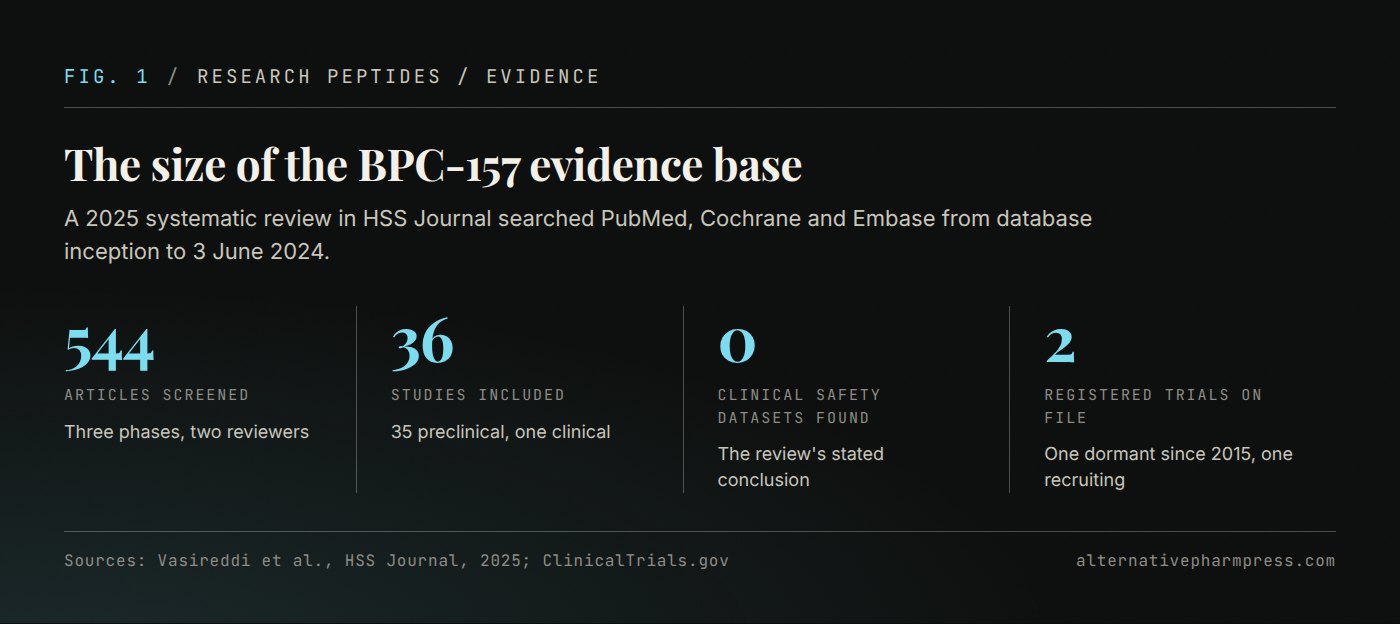
Nobody can give an evidence based list of BPC-157 side effects in humans, because the human safety data barely exists. A 2025 systematic review in HSS Journal screened 544 articles and included 36: 35 preclinical and one clinical. Its authors reported that no clinical safety data were found.1
That absence is the finding. It is not a hint of a clean safety record, and it is not a hint of a dangerous one. It means the studies that would detect an adverse effect at any meaningful rate have not been done. BPC-157 is not approved by the FDA for human use in any form, for any condition.
What follows is what the record does contain: the preclinical literature, the thin human trial register, the FDA’s assessment of BPC-157 as a compounding ingredient, its anti-doping status, and the identity and purity problem in gray market supply.
What the published record actually contains
BPC-157 is a synthetic 15 amino acid sequence derived from a protein found in gastric juice. The overwhelming majority of published work on it is in rats. The HSS Journal systematic review searched PubMed, Cochrane and Embase from database inception to 3 June 2024, screened in three phases with two reviewers, and ended with 36 studies of which 35 were preclinical.1 A separate 2025 narrative review in Current Reviews in Musculoskeletal Medicine reached the same position, stating that human data are extremely limited and that BPC-157 should be considered investigational until well designed clinical trials are conducted.2
Animal work reports effects on angiogenesis pathways, fibroblast activity and inflammatory signalling in injury models.12 Those are preclinical observations in animals. They are not evidence of benefit in people, and rodent findings routinely fail to reproduce in human trials. Vendor pages that describe healing in humans are describing rat experiments without saying so. Our overview of BPC-157 covers the mechanism claims separately.
The table sets out what each tier of evidence can and cannot support.
| Evidence tier | What exists for BPC-157 | What it can support |
|---|---|---|
| Rodent and other animal studies | The large majority of the literature; 35 of 36 studies in the 2025 systematic review.1 | Hypotheses about mechanism. Nothing about human safety or human effect. |
| Human pilot and retrospective reports | Very few. One review identified three small human reports covering knee pain, interstitial cystitis and intravenous safety and pharmacokinetics.2 | Feasibility signals only. Sample sizes are too small to detect uncommon harms. |
| Registered controlled trials | A 42 participant Phase 1 safety and pharmacokinetics study registered in 2015 with no posted results, and a Phase 2 trial that began recruiting in 2026.34 | Nothing yet. Neither has reported outcome data. |
| Post-marketing surveillance | None. There is no approved product, so there is no adverse event reporting system attached to it. | Nothing. Harms occurring now are largely invisible to any register. |
The human trial record is close to empty
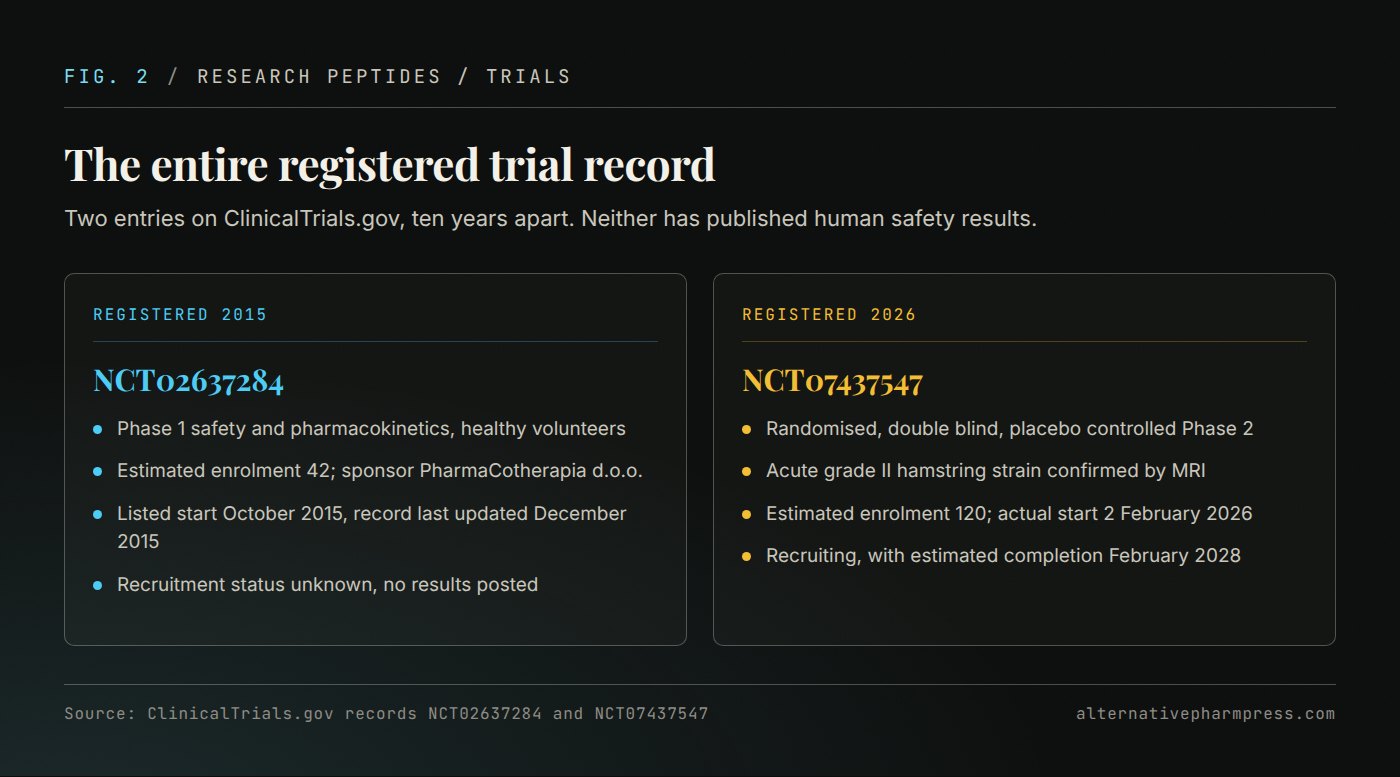
Searching ClinicalTrials.gov for BPC-157 returns very little. NCT02637284, sponsored by PharmaCotherapia d.o.o., was a Phase 1 study in healthy volunteers to assess the safety and pharmacokinetics of PCO-02, whose active ingredient is BPC-157. Estimated enrolment was 42, the listed start was October 2015, estimated completion was March 2016, and the record was last updated in December 2015. Its recruitment status is listed as unknown and no results have been posted.3
The second entry is recent. NCT07437547 is a randomised, double blind, placebo controlled Phase 2 trial of pentadecapeptide BPC 157 for repair of acute grade II hamstring strain confirmed by MRI, sponsored by Hudson Biotech, with an estimated enrolment of 120 and an actual start date of 2 February 2026. Estimated completion is February 2028.4 It is recruiting. It has produced no data.
That is the register. USADA has described the position in similar terms, noting a lack of published clinical trial data because studies appear to have been cancelled or stopped, and that no one knows whether there is a safe dose.5 Two registered trials, one dormant since 2015, one ongoing, and no published human safety results between them.
What the FDA concluded when it reviewed BPC-157
BPC-157 was nominated as a bulk drug substance for use in pharmacy compounding, which forced the FDA to evaluate it. The agency placed it in Category 2, its designation for bulk drug substances that may present significant safety risks. The nomination was subsequently withdrawn by the nominator, so BPC-157 now appears on the FDA’s list of substances previously in Category 2 that were withdrawn. The agency’s stated concerns remain published on that page.6
The FDA’s wording is worth reading exactly. Compounded drugs containing BPC-157 “may pose risk for immunogenicity for certain routes of administration and may have complexities with regard to peptide-related impurities and active pharmaceutical ingredient (API) characterization.” The agency then states that it “has identified no, or only limited, safety-related information for the proposed routes of administration. Therefore, the agency lacks sufficient information to know whether the drug would cause harm when administered to humans.”6
Three distinct concerns sit in that passage. Immunogenicity means the body may mount an immune response against the peptide or against aggregates in the preparation. Peptide-related impurities are the by-products of synthesis, which can carry their own biological activity. API characterisation refers to whether the manufacturer can demonstrate that the substance is what it claims to be. The FDA applied comparable language to several other peptides reviewed in the same period, including GHRP-2, GHRP-6, ipamorelin acetate and kisspeptin-10, which were added to Category 2 on 29 September 2023 and remain there.6
The withdrawal of the nomination does not amount to a safety clearance. It removed the substance from active consideration for the compounding list. Nothing about the underlying evidence changed.
Prohibited in sport at all times
BPC-157 is named in the World Anti-Doping Agency Prohibited List under S0, Non-Approved Substances, the class covering pharmacological substances not currently approved by any governmental regulatory health authority for human therapeutic use. S0 substances are prohibited at all times, in and out of competition. The 2026 List states that the class “covers many different substances including but not limited to BPC-157”.7
BPC-157 was added to the List with effect from 1 January 2022. USADA notes that because BPC-157 is not an approved therapeutic agent anywhere, a therapeutic use exemption is not available for it.5 For any athlete in a tested pool, the practical consequence is straightforward: a positive finding is a sanctionable anti-doping rule violation with no route to authorisation. The same reasoning applies to TB-500 and other unapproved peptides.
The purity problem sits underneath everything
Even setting the biology aside, there is a supply problem. Material sold as BPC-157 is distributed as a research chemical rather than as a medicine, which means no agency verifies its identity, purity, sterility or endotoxin content before it is shipped.
Analytical work on illegally traded peptide preparations is instructive. A Belgian Official Medicines Control Laboratory group publishing in Talanta in 2015 developed a screening method for counterfeit and illegal injectable peptide preparations, noting that the trade includes substances still in preclinical and clinical development and that these “could imply severe health threats”.8 The HSS Journal reviewers made the same point in plainer language: adverse effects are possible due to unregulated manufacturing, contamination, or unknown clinical safety.1
This compounds the evidence gap rather than sitting beside it. If a study reports an outcome after administering a characterised research grade peptide, that result says nothing about what happens after an uncharacterised vial from an unverified seller. Our notes on source documentation and on what research peptides are deal with the paperwork side of this.
Frequently asked questions
What are the side effects of BPC-157?
No reliable human side effect profile exists. The 2025 HSS Journal systematic review found no clinical safety data at all.1 Preclinical animal studies have reported no adverse effects across several organ systems, but animal toxicology does not establish a human profile, and the trials that would detect uncommon harms in people have not been run.
Is BPC-157 FDA approved?
No. BPC-157 is not approved by the FDA for any use in humans. It also sits on the FDA’s list of bulk drug substances previously placed in Category 2 for compounding, the category the agency uses for substances that may present significant safety risks.6
Has BPC-157 been tested in a large human trial?
Not one that has reported. ClinicalTrials.gov lists a 2015 Phase 1 study with an estimated 42 participants that posted no results, and a Phase 2 trial of an estimated 120 participants that began recruiting in February 2026 with estimated completion in 2028.34
Can athletes use BPC-157?
Not within anti-doping rules. BPC-157 is named under S0 of the WADA Prohibited List and is banned at all times, in and out of competition, and no therapeutic use exemption is available because it is not approved anywhere.57
Why do vendors describe BPC-157 as safe?
Because they are citing animal studies and small uncontrolled reports without labelling them as such. Absence of reported harm in rodent experiments is not evidence of human safety, and no post-marketing surveillance system exists for an unapproved substance.
Sources
- Vasireddi N, Hahamyan H, Salata MJ, Karns M, Calcei JG, Voos JE, Apostolakos JM. Emerging Use of BPC-157 in Orthopaedic Sports Medicine: A Systematic Review. HSS Journal. 2025. doi:10.1177/15563316251355551. PMID 40756949. pubmed.ncbi.nlm.nih.gov
- McGuire FP, Martinez R, Lenz A, Skinner L, Cushman DM. Regeneration or Risk? A Narrative Review of BPC-157 for Musculoskeletal Healing. Current Reviews in Musculoskeletal Medicine. 2025;18(12):611–619. doi:10.1007/s12178-025-09990-7. PMID 40789979. pubmed.ncbi.nlm.nih.gov
- ClinicalTrials.gov. NCT02637284. Phase I, Pilot Study in Healthy Volunteers, to Assess the Safety and Pharmacokinetics of PCO-02, Which Active Ingredient is BPC-157. clinicaltrials.gov
- ClinicalTrials.gov. NCT07437547. A Randomized, Double-Blind, Placebo-Controlled Phase 2 Trial of Pentadecapeptide BPC 157 for Accelerated Repair of Acute Grade II Hamstring Strain Confirmed by MRI. clinicaltrials.gov
- U.S. Anti-Doping Agency. BPC-157: Experimental Peptide Creates Risk for Athletes. usada.org
- U.S. Food and Drug Administration. Certain Bulk Drug Substances for Use in Compounding that May Present Significant Safety Risks. fda.gov
- World Anti-Doping Agency. The 2026 Prohibited List, International Standard, section S0 Non-Approved Substances. wada-ama.org
- Vanhee C, Janvier S, Desmedt B, Moens G, Deconinck E, De Beer JO, Courselle P. Analysis of illegal peptide biopharmaceuticals frequently encountered by controlling agencies. Talanta. 2015;142:1–10. doi:10.1016/j.talanta.2015.04.022. PMID 26003685.
Editorial note: This article is for general information only and is not medical or legal advice. BPC-157 has not been evaluated by the FDA to diagnose, treat, cure or prevent any disease. Laws vary by location and change often, so verify the rules that apply where you are. Always talk to a licensed healthcare provider before use, especially if you are under 21, pregnant or nursing, taking medication, or managing a health condition.