
Full spectrum CBD retains the plant’s whole cannabinoid profile, including THC below the legal hemp threshold. Broad spectrum is processed to strip THC while keeping other cannabinoids and terpenes. Isolate is purified cannabidiol on its own. None of the three terms is legally defined, and the human evidence that whole-plant extracts outperform isolate is thin.
The question “what is better, full spectrum or broad spectrum CBD” therefore has no clean answer. The comparison that matters is between a buyer’s constraints and what a given batch actually contains. Someone subject to workplace testing and someone with no such exposure are not evaluating the same trade-off.
What follows sets out how each type is produced, what the entourage effect literature does and does not support, why the labels carry no regulatory weight, and what a certificate of analysis needs to show before any of these categories can be treated as meaningful.
What the three terms actually mean
Full spectrum describes an extract in which the cannabinoids, terpenes and other plant constituents present in the source hemp are carried through into the finished product. THC is among them. Under the current federal standard, hemp is cannabis containing no more than 0.3 percent delta-9 THC on a dry weight basis, so a full spectrum extract contains THC by design, at a concentration intended to sit below that limit.
Broad spectrum describes a full spectrum extract that has undergone an additional step to remove THC while retaining the other cannabinoids. The intent is a multi-cannabinoid product with no detectable THC. Whether that intent is achieved depends on the remediation method and on the detection limit of the laboratory that checks it.
CBD isolate is cannabidiol purified to a crystalline or powdered solid, typically stated at 98 percent or higher. Other cannabinoids and terpenes are removed. Isolate is the only one of the three whose composition is defined by a single number that a laboratory can verify directly.
How extraction and remediation produce each type
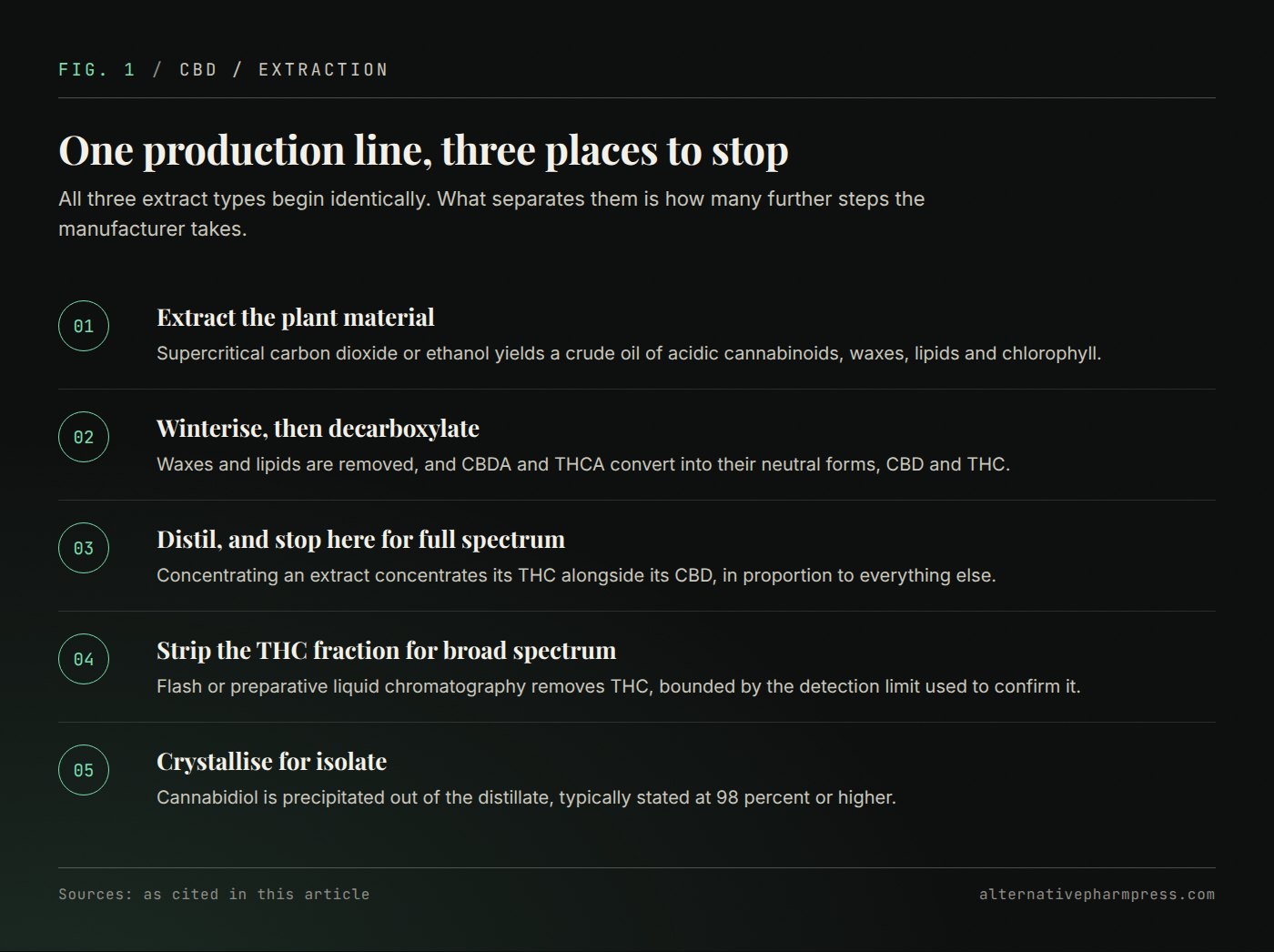
All three start from the same place. Plant material is extracted, most commonly with supercritical carbon dioxide or with ethanol, producing a crude oil containing cannabinoids in acid form together with waxes, lipids and chlorophyll. Winterisation removes waxes and lipids. Decarboxylation converts cannabinoid acids such as CBDA and THCA into their neutral forms, CBD and THC. Distillation concentrates the result.
A full spectrum product stops near this point, standardised for CBD content and formulated into a carrier. The THC that was present in the plant remains, concentrated in proportion to everything else. This is the step buyers most often misunderstand: concentrating an extract concentrates its THC alongside its CBD.
Broad spectrum requires a further separation. Chromatographic methods, most often flash or preparative liquid chromatography, are used to remove the THC fraction. The output can be very low in THC, but “removed” is a relative statement bounded by the analytical method used to confirm it. A result reported as non-detect at a limit of quantitation of 0.01 percent is a different claim from non-detect at 0.1 percent, and the two are frequently presented in identical marketing language.
Isolate goes further still, using crystallisation to precipitate cannabidiol out of the distillate. What remains is a single compound. The purity is straightforward to test, which is why isolate is the easiest of the three to verify and the hardest to misrepresent.
What the entourage effect evidence supports
The argument for full spectrum rests on the entourage effect, the proposition that cannabis constituents act together to produce effects that isolated cannabidiol does not. The term was popularised in this context by Russo’s 2011 review in the British Journal of Pharmacology, which set out a mechanistic case for phytocannabinoid and terpenoid interactions across pain, inflammation, anxiety and other targets.1 That paper is a hypothesis-generating review, not a clinical trial, and it is often cited as though it were the latter.
Subsequent work has tested parts of the hypothesis and has not confirmed it. Finlay and colleagues examined five cannabis terpenes, alone and in mixtures, in a 2020 study in Frontiers in Pharmacology. With the possible exception of a weak interaction between beta-caryophyllene and CB2, the terpenes showed no direct activity at CB1 or CB2 and did not alter the binding or functional effects of THC, CBD or 2-arachidonoylglycerol. The authors concluded that the putative entourage effect cannot be explained by direct action at cannabinoid receptors.2
Two reviews reached similar conclusions about the state of the literature as a whole. Christensen and colleagues, writing in Biomedicines in 2023, described the field as “in its infancy”, with pre-clinical and clinical studies that are methodologically simplistic and contradictory, and clinical support resting largely on anecdotal and real-world evidence.3 Simei and colleagues, in a 2024 narrative scoping review in Cannabis and Cannabinoid Research, found limited evidence for clinical efficacy attributable to the effect and noted its adoption by marketing.4
The defensible position is narrow. Interactions between cannabis constituents are biologically plausible and partly demonstrated in laboratory models. Whether they produce a clinically meaningful advantage for full spectrum products over isolate in humans has not been established by trials designed to answer that question. Anyone stating the matter more strongly in either direction is going beyond the data.
The three types compared
| Type | THC content | Cannabinoid range | Drug-test risk | Label reliability |
|---|---|---|---|---|
| Full spectrum | Present by design, intended to stay below the legal hemp threshold | Widest: CBD plus minor cannabinoids, terpenes and other plant compounds | Highest of the three; rises with amount consumed and frequency | Moderate. THC presence is at least disclosed rather than denied |
| Broad spectrum | Intended to be non-detectable; residual traces possible | Wide, minus THC. Composition varies by remediation method | Low to moderate, and dependent on the detection limit used to verify removal | Low. “THC free” has no legal definition or required test method |
| CBD isolate | None by definition; cross-contamination in manufacture is the residual concern | Narrowest: cannabidiol alone | Lowest | Highest, because a single-compound purity claim is directly testable |
The table describes intent. It does not describe any individual product, because no federal body verifies which of these three descriptions a given bottle earns.
These are marketing terms, not regulatory categories
No federal statute or regulation defines full spectrum, broad spectrum or isolate. There is no standardised test that distinguishes them, no required minimum number of cannabinoids for a spectrum claim, and no mandated detection limit for a THC free claim. A manufacturer may use any of the three words without meeting an external standard.
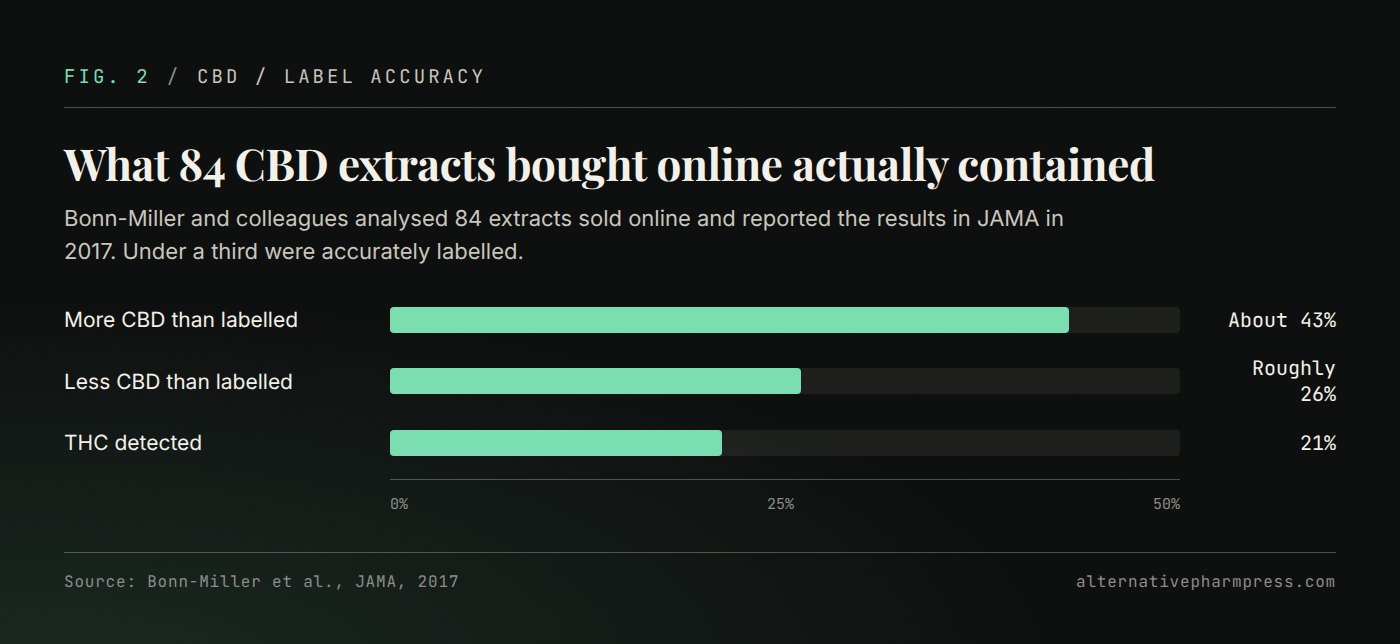
Product testing shows what follows from that. Bonn-Miller and colleagues analysed 84 CBD extracts sold online and reported in JAMA in 2017 that roughly 26 percent contained less CBD than labelled and about 43 percent contained more, leaving under a third accurate. THC was detected in 21 percent of samples.5 A 2022 survey of 105 hemp-derived topical products in JAMA Network Open found 24 percent accurately labelled for CBD, with THC detected in 37 products; 4 of those 37 were labelled THC free and 19 made no mention of THC at all.6
The regulatory position reinforces the point. As of August 2026, the FDA has approved one cannabidiol drug product, Epidiolex, and no other CBD product is FDA approved. The agency holds that CBD may not lawfully be added to food or marketed as a dietary supplement, and in January 2023 concluded that the existing food and supplement frameworks are not appropriate for CBD.7 The definition of hemp itself is also changing: Division B of P.L. 119-37, enacted 12 November 2025, moves from a delta-9 THC standard to a total THC standard of less than 0.3 percent dry weight and excludes final hemp-derived cannabinoid products containing more than 0.4 milligrams of THC per container, effective 12 November 2026.8 Full spectrum formulations are the most exposed to that change.
What a certificate of analysis needs to show
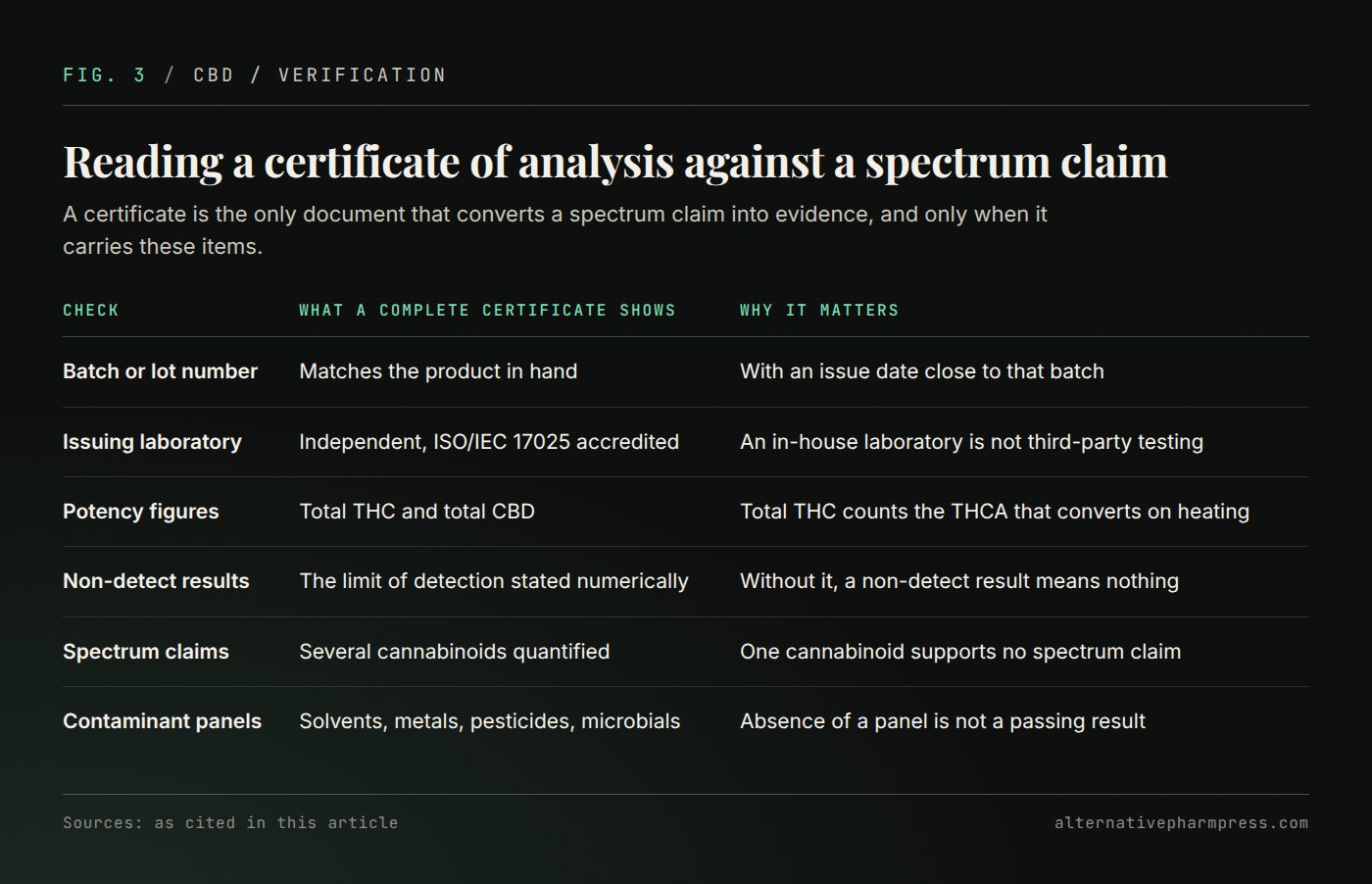
A certificate of analysis is the only document that converts a spectrum claim into evidence, and only under conditions. It should carry a batch or lot number matching the product in hand, an issue date close to that batch, and the name of an independent laboratory holding ISO/IEC 17025 accreditation for the relevant methods. A certificate issued by the manufacturer’s own laboratory is not third-party testing.
On the potency panel, the useful figures are total THC and total CBD, not delta-9 THC alone, because total THC accounts for the THCA that converts on heating. Where THC is reported as not detected, the limit of detection or quantitation should be stated numerically; without it, the result means nothing. Full spectrum certificates should show several cannabinoids quantified rather than a single CBD figure with the rest left blank, since a spectrum claim supported by one measured cannabinoid is not supported at all.
Contaminant panels are separate from potency and are frequently absent. Residual solvents, heavy metals, pesticides and microbial testing appear on complete certificates and not on partial ones. The absence of a panel is not a passing result.
Frequently asked questions
Is full spectrum stronger than broad spectrum or isolate?
Not in any way that has been demonstrated in controlled human research. Full spectrum contains more compounds, which is a compositional fact rather than an efficacy finding. Reviews of the entourage effect describe the clinical evidence as limited and contradictory.34
Can broad spectrum products contain THC?
Yes. Remediation reduces THC rather than guaranteeing its absence, and results depend on the analytical method used to confirm removal. Product surveys have repeatedly found THC in items marketed as THC free.6
Why does the same product test differently at different laboratories?
Cannabinoid testing is not fully harmonised. Laboratories differ in sample preparation, calibration standards, instrumentation and reported limits of detection. Two laboratories analysing the same batch can return figures that differ by more than the labelled tolerance, which is one reason a single certificate should be read as one measurement rather than a settled value.
Do these categories affect legality?
They have no legal standing on their own. Legality turns on the THC content of the finished product and on state law, both of which are measured independently of what the marketing calls the extract. The federal definition of hemp changes on 12 November 2026, and several states already impose stricter limits than the federal standard.8
Which type carries the least uncertainty?
Isolate, in the narrow sense that a single-compound purity claim is the easiest to verify and the least dependent on how a manufacturer interprets an undefined term. That is a statement about verifiability, not about therapeutic value, and it does not settle which product suits any particular reader.
Sources
- Russo EB. Taming THC: potential cannabis synergy and phytocannabinoid-terpenoid entourage effects. British Journal of Pharmacology. 2011;163(7):1344–1364. PMID 21749363. PubMed
- Finlay DB, Sircombe KJ, Nimick M, Jones C, Glass M. Terpenoids From Cannabis Do Not Mediate an Entourage Effect by Acting at Cannabinoid Receptors. Frontiers in Pharmacology. 2020;11:359. PMID 32269529. PubMed
- Christensen C, Rose M, Cornett C, Allesø M. Decoding the Postulated Entourage Effect of Medicinal Cannabis: What It Is and What It Isn’t. Biomedicines. 2023;11(8):2323. PMID 37626819. PubMed
- Simei JLQ, Souza JDR, Lisboa JR, Campos AC, Guimarães FS, Zuardi A, Crippa JAS. Does the “Entourage Effect” in Cannabinoids Exist? A Narrative Scoping Review. Cannabis and Cannabinoid Research. 2024;9(5):1202–1216. PMID 37535820. PubMed
- Bonn-Miller MO, Loflin MJE, Thomas BF, Marcu JP, Hyke T, Vandrey R. Labeling Accuracy of Cannabidiol Extracts Sold Online. JAMA. 2017;318(17):1708–1709. PMID 29114823. PubMed
- Spindle TR, Sholler DJ, Cone EJ, Murphy TP, ElSohly M, Winecker RE, Flegel RR, Bonn-Miller MO, Vandrey R. Cannabinoid Content and Label Accuracy of Hemp-Derived Topical Products Available Online and at National Retail Stores. JAMA Network Open. 2022;5(7):e2223019. PMID 35857320. PubMed
- US Food and Drug Administration. FDA Regulation of Cannabis and Cannabis-Derived Products, Including Cannabidiol (CBD). fda.gov
- Congressional Research Service. Change to Federal Definition of Hemp and Implications for Federal Enforcement. Insight IN12620. congress.gov
Editorial note: This article is for general information only and is not medical or legal advice. CBD has not been evaluated by the FDA to diagnose, treat, cure or prevent any disease. Laws vary by location and change often, so verify the rules that apply where you are. Always talk to a licensed healthcare provider before use, especially if you are under 21, pregnant or nursing, taking medication, or managing a health condition.
None of these forms change whether CBD is habit-forming. See our answer to is CBD addictive for what the research actually shows.
More comparisons
-
CBD Gummies vs CBD Oil: Absorption, Onset and Label Accuracy
-
CBN vs Melatonin: What Sleep Trials and Regulators Actually Say
-
CBD Isolate vs Full Spectrum: Drug Tests, Entourage Claims and Law
-
CBD Oil vs Hemp Oil: Seed Oil, Flower Extract and Label Traps
-
CBN vs CBD: Sleep Claims, Trial Results and Key Differences