
People throw these three names around like they’re interchangeable. They’re not. Delta-9, delta-8, and THC-O sit at very different places on the map: one grows in the plant, one gets converted from hemp in a lab, and one is a synthetic ester that regulators have flagged. If you’re shopping for any of them, the differences matter for how strong the product feels, how it’s made, what’s actually in the bottle, and whether it’s legal where you live. They also matter a lot more now because of a federal change scheduled to land in late 2026.
Let’s start with the big legal point, because it reshapes everything below.
The federal deadline that changes the whole conversation
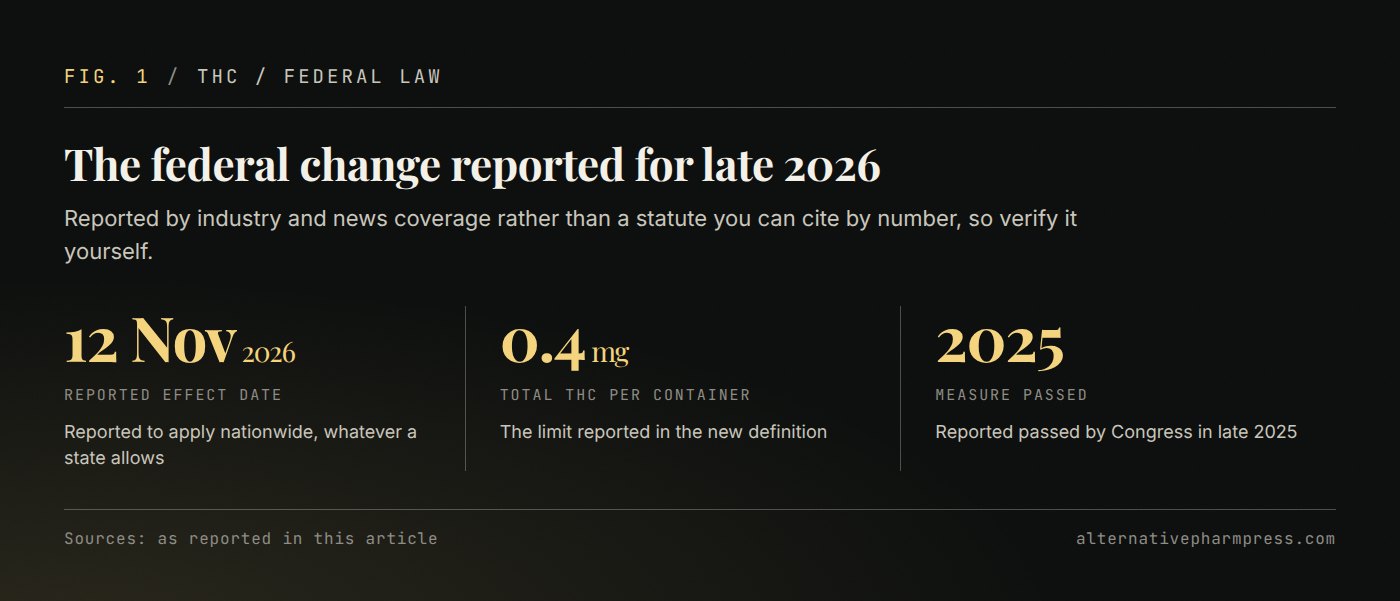
According to industry and news reporting, in late 2025 the US Congress passed a measure that redefines hemp to exclude intoxicating hemp-derived cannabinoids. That language is reported to sweep in delta-8 THC, delta-10, THC-P, THCA, and similar compounds, and to set a limit of 0.4 mg total THC per container. The change is reported to take full effect on November 12, 2026, and it would apply nationwide regardless of what any individual state allows.
We’re presenting that as reported, not as settled law you can quote chapter and verse on, so treat the date as a hard deadline to verify rather than a footnote. Don’t lean on a specific statute number you saw on a forum. Check the current federal rule and your own state’s rules before you spend money, and read it again closer to the date, because guidance and enforcement timelines can shift. You can track the federal side through the USDA hemp program and general product guidance from the FDA. We cover the moving pieces in our state-by-state delta-8 guide for 2026.
Delta-9 THC: the original
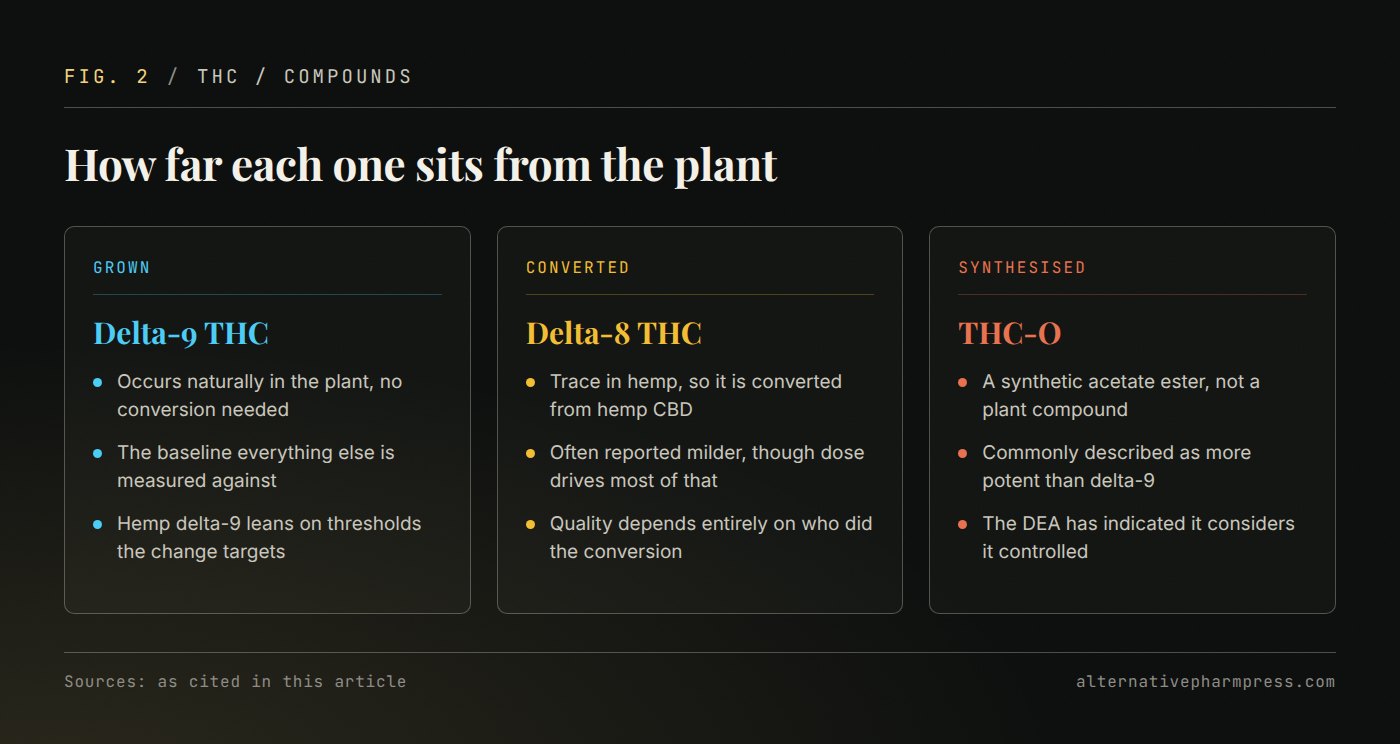
Delta-9 is the cannabinoid most people mean when they say “THC.” It’s the main intoxicating compound in cannabis, it occurs naturally in the plant in meaningful amounts, and it’s the reference point everything else gets measured against. Decades of cannabis use, for better and worse, are built on delta-9.
Because it grows in the plant, delta-9 doesn’t require a chemical conversion to exist. That’s a real distinction from the other two. The catch is regulatory: hemp is legally defined by its low delta-9 content on a dry-weight basis, so “hemp-derived delta-9” products usually rely on product size and math to stay under the threshold. That’s exactly the kind of workaround the reported 2026 change is aimed at, with its per-container total-THC cap. If you want the longer breakdown of how hemp, CBD, and THC relate, see CBD vs hemp vs THC and our plain-language cannabis glossary entry.
Delta-8 THC: the milder isomer, usually converted
Delta-8 is an isomer of delta-9. The molecules are close cousins, with a small difference in where a double bond sits, and that small difference tends to make delta-8 feel milder to a lot of users. “Milder” is not “harmless,” and it’s not a promise about how any given product will hit you, since dose and your own tolerance drive most of that.
Here’s the part people skip: delta-8 exists in hemp only in trace amounts, so commercial delta-8 is almost always made by converting hemp-derived CBD through a chemical reaction. That conversion is legal in plenty of places and routine in the industry, but it’s still a lab process, which means the quality of the finished product depends entirely on who did the conversion and how carefully they cleaned it up. A sloppy batch can carry leftover reagents, unwanted isomers, or residual solvents. That’s the whole reason a third-party Certificate of Analysis (COA) isn’t optional for delta-8. We walk through how to read those documents in our COA guide, and the same logic applies here. For shopping, our vetted delta-8 brand roundup is built around lab transparency, not hype.
THC-O: synthetic, more potent, and on regulators’ radar
THC-O, short for THC-O-acetate, is a different animal. It’s not something you pull out of the plant. It’s a synthetic acetate ester, made by adding an acetyl group to THC, and it’s commonly described as more potent than delta-9. More potent is not the same as better. With a stronger, slower-onset compound, the margin for a too-much-too-fast mistake gets wider, and there’s less of a use history to fall back on.
Two cautions stand out. First, the legal status: the DEA has indicated it considers THC-O a controlled substance, which puts it on shakier ground than delta-8 even before the 2026 federal change. Second, the safety question around inhalation. Acetate esters and vaping have drawn specific concern from researchers, because heating certain acetate compounds may produce byproducts you don’t want in your lungs. We’re not going to overstate the science, but “we don’t fully know what this does when you vape it” is exactly the kind of unknown that should make you cautious rather than curious.
And because THC-O is fully synthetic, the maker’s process is everything. There’s no plant to anchor it. A COA that shows what’s actually in the cartridge or bottle is the only window you have, and a brand that won’t show you a current, batch-matched one is telling you something.
Side-by-side comparison
| Cannabinoid | Source | Potency vs delta-9 | Legal status trend | Notes |
|---|---|---|---|---|
| Delta-9 THC | Occurs naturally in the plant | The baseline (100%) | Restricted federally; “hemp delta-9” relies on thresholds the 2026 change targets | Longest use history; per-container THC cap is the pressure point |
| Delta-8 THC | Trace in hemp; commercially converted from hemp CBD | Often reported milder | Widely sold but banned or restricted in many states; swept into 2026 federal change | Quality depends on conversion; COA is essential |
| THC-O (THC-O-acetate) | Synthetic acetate ester | Commonly described as stronger | DEA has indicated it considers it controlled; included in 2026 federal change | Inhalation-safety concerns with acetate esters; maker’s process is everything |
Why the manufacturing story matters more than the marketing
Notice the through-line: two of these three are made, not grown. Delta-8 is converted, THC-O is synthesized, and in both cases the label on the front of the package tells you almost nothing about what came out the other end of the reaction. The marketing will talk about feelings and vibes. The COA talks about milligrams, residual solvents, heavy metals, pesticides, and whether the cannabinoid profile matches what’s claimed.
That’s why we keep pointing readers back to lab documents. A real COA comes from an independent lab, names the specific batch, and matches the batch code on your package. If a brand only posts one old “representative” report for every product it sells, that’s a flag, not a feature. Our directory of vetted brands and our running list of current coupons can help once you’ve decided a product clears that bar. If you’re newer to the terms, the hemp glossary and CBD glossary are good background, and you can browse everything we’ve published under THC topics.
So which one should you care about?
If your goal is to understand the category, think of it as a spectrum of how far the product sits from the plant. Delta-9 is closest. Delta-8 is one chemical step away. THC-O is further still, fully synthetic, and carries both a tougher legal read and open safety questions around inhalation. None of that is a recommendation. It’s a way to weigh source, potency, and risk with your eyes open.
And whatever you’re weighing, the November 12, 2026 federal change is the ceiling over all of it. A product that’s easy to buy today may not be legal to sell after that date, regardless of your state. Plan around the deadline, verify the current rules yourself, and don’t stockpile on the assumption that today’s market is tomorrow’s.
Frequently asked questions
Is delta-8 just a weaker version of delta-9?
Not exactly. Delta-8 is a chemical isomer of delta-9, and many users report a milder effect, but it’s a distinct compound made through a different route. Most commercial delta-8 is converted from hemp CBD in a lab, so “weaker” doesn’t capture the real difference, which is about source and manufacturing.
Why is THC-O treated differently from delta-8?
THC-O is a synthetic acetate ester rather than a plant compound or a simple isomer, and the DEA has indicated it considers it a controlled substance. There are also specific safety concerns about heating acetate esters when vaping. Both factors put it on shakier ground than delta-8.
What does the November 12, 2026 federal change actually do?
According to industry and news reporting, it redefines hemp to exclude intoxicating hemp-derived cannabinoids, including delta-8, delta-10, THC-P, and THCA, and sets a 0.4 mg total THC per container limit. It’s reported to apply nationwide regardless of state law. Verify the current federal rule and your state’s rules before buying, since details and timing can change.
Why do COAs matter so much for these products?
Because delta-8 is converted and THC-O is synthesized, what ends up in the bottle depends entirely on the maker’s process. A current, batch-matched third-party Certificate of Analysis is the only reliable way to see the actual cannabinoid content and check for contaminants. No COA, no confidence.
Will any of these still be legal to buy after the deadline?
That depends on how the federal rule is implemented and how your state responds. The reported change targets intoxicating hemp cannabinoids broadly, so don’t assume today’s availability carries over. Check current law close to the date rather than relying on older articles or forum posts.
Editorial note: This article is for general information only and is not medical or legal advice. These products have not been evaluated by the FDA to diagnose, treat, cure, or prevent any disease. Laws vary by location and change often, so verify the rules that apply to you. Always talk to a licensed healthcare provider before use, especially if you are under 21, pregnant or nursing, taking medication, or managing a health condition.
More comparisons
-
Distillate vs Live Resin: Refining, Terpenes and What Carts Contain
-
Live Resin vs Live Rosin: Extraction Chemistry and Solvent Testing
-
Indica vs Sativa: What Genetic and Terpene Research Actually Shows
-
THCA vs CBD: Why Heat, Drug Tests and the Law Split Them Apart
-
Delta-8 vs CBD: Intoxication, Evidence, Drug Tests and the 2026 Law