
This article is for educational purposes only and does not constitute medical advice.
Last updated: October 15, 2026. Added the 2020 kava anxiety trial, newer kratom trials, corrected citations and updated legal status.
Quick answer: Kratom (Mitragyna speciosa) is a Southeast Asian leaf whose alkaloids act on opioid, adrenergic and serotonin receptors, and it can be stimulating or sedating depending on dose. Kava (Piper methysticum) is a Pacific Island root whose kavalactones act mainly on GABA pathways and are generally calming. Both have liver-safety questions, and their legal status differs sharply.
Introduction
Disclaimer: Educational content for adult readers. Not medical advice. US (FDA): Statements have not been evaluated by the FDA. Kratom is not approved for medical use. UK: Kratom supply is restricted under the Psychoactive Substances Act 2016. Canada: Kratom is not authorized for sale (Health Canada advisory). Kava sale is permitted in much of Canada and the US under specific labeling rules; the EU has historically restricted it.
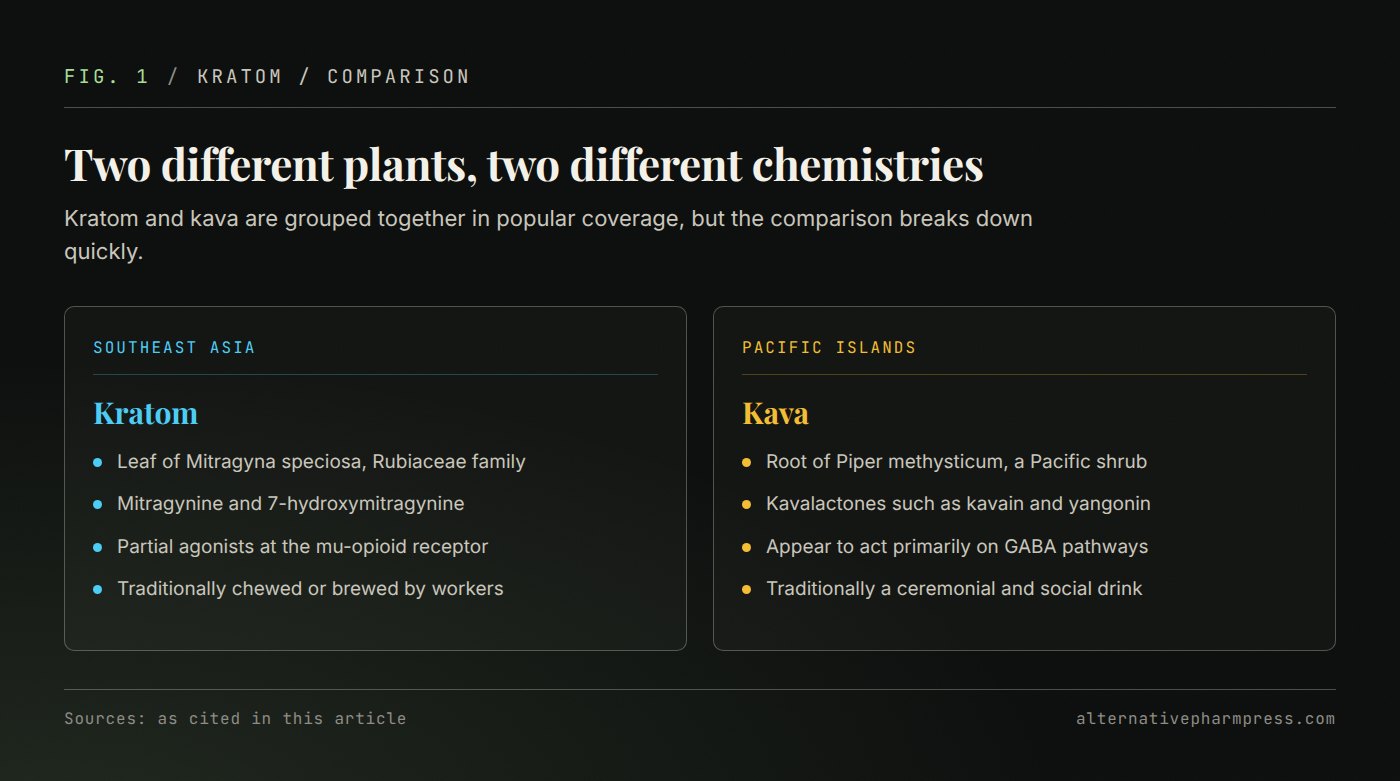
Kratom and kava are often grouped together in popular coverage because both are botanical, both have traditional regional roots, and both are sold in modern supplement forms. Beyond that the comparison breaks down quickly. They come from different plant families, contain entirely different active compounds, are prepared differently, and sit in different legal slots in the US, UK, and Canada.
What kratom is
Kratom is the leaf of Mitragyna speciosa, a tropical evergreen in the Rubiaceae family native to Thailand, Indonesia, Malaysia, Myanmar, and Papua New Guinea. Farmers and laborers historically chewed the fresh leaves or brewed them into tea (Singh et al., 2016). Modern Western markets buy it as dried, milled powder, capsules, or extracts.
The plant contains more than 40 alkaloids; the most studied are mitragynine and 7-hydroxymitragynine, which act as partial agonists at the mu-opioid receptor and engage adrenergic and serotonergic receptors as well (Kruegel and Grundmann, 2018). The pharmacology is genuinely complex, and the FDA continues to flag safety concerns while research is ongoing.
What kava is
Kava is the root of Piper methysticum, a Pacific Island shrub. The traditional preparation grinds the root and steeps it in water to make a beverage that has been central to ceremonial and social life in Fiji, Vanuatu, Samoa, Tonga, and other Pacific cultures for centuries. The active compounds are kavalactones (kavain, dihydrokavain, methysticin, yangonin, and others), which appear to act primarily on GABA pathways and are chemically unrelated to kratom’s alkaloids (NCCIH).
Kratom vs kava at a glance
| Kratom | Kava | |
|---|---|---|
| Plant | Mitragyna speciosa leaf (coffee family) | Piper methysticum root (pepper family) |
| Origin | Thailand, Malaysia, Indonesia, Myanmar, Papua New Guinea | Fiji, Vanuatu, Samoa, Tonga and other Pacific islands |
| Active compounds | Indole alkaloids (mitragynine, 7-hydroxymitragynine) | Kavalactones (kavain, methysticin, yangonin and others) |
| Main targets | Mu-opioid, adrenergic and serotonin receptors | GABA pathways |
| Reported effects | Stimulating at low doses, sedating at higher doses | Relaxing and sociable; numbs the mouth |
| Main risks | Dependence and withdrawal, drug interactions, rare liver injury | Rare liver injury, skin changes with heavy use, drug interactions |
| U.S. status | Banned in 9 states; 7-OH concentrates moving to Schedule I | Legal as a supplement and traditional drink |
Origin and cultural use
Kratom’s traditional context is functional. Field workers and laborers in Southeast Asia used it during long shifts as a stimulant at lower amounts and as a relaxant at higher amounts. It was, and largely still is, an individual rather than ceremonial substance.
Kava sits at the opposite end of that spectrum. It is consumed in groups, often in formal ceremony, and the preparation itself – the pounding of the root, the straining through hibiscus fiber, the order of service – carries significant cultural weight. The 2007 WHO Assessment of the Risk of Hepatotoxicity with Kava Products documents some of this context as well as the safety questions that drove the European bans of the early 2000s.
Active compounds
Mitragynine is structurally an indole alkaloid. Kavalactones are 4-methoxy alpha-pyrones. They are entirely different chemical classes acting on different receptor systems. Effect profiles differ accordingly. Kratom’s effects are typically described as dose-dependent and often biphasic in user surveys (stimulant lower, relaxant higher); kava’s effects are usually described as relaxing across its typical use range.
For controlled study, kava has more clinical-trial coverage than kratom. Sarris et al. (2013) conducted a randomized double-blind placebo-controlled trial of kava in generalized anxiety disorder; the 2018 review by Smith and Leiras in Complementary Therapies in Clinical Practice summarizes the trial landscape. Kratom by contrast has very few human RCTs.
That evidence is not all positive. A larger 16-week randomized trial by the same group (Sarris et al., 2020; 171 participants) found no significant difference in anxiety reduction between kava and placebo, and liver function abnormalities were more frequent in the kava group, although no one met criteria for herb-induced liver injury. Kratom’s controlled evidence is growing: a 2020 double-blind trial found kratom increased pain tolerance in regular users (Vicknasingam et al., 2020), and a 2026 placebo-controlled trial of kratom leaf powder in 116 healthy adults reported no serious adverse events at modest doses.
Reported effects
Effects below are user-reported, not clinical outcomes. Kratom users report alertness or productivity at lower amounts and sedation or analgesia at higher amounts. The same user may report markedly different experiences across strains, batches, and intake patterns.
Kava is more consistently described as a calming social drink. The traditional ceremonial preparation produces a distinct numbing of the mouth on first sip – a reliable signal that the kavalactones have extracted properly.
Safety and side effects
- Kratom: Tolerance, dependence, and withdrawal are documented in regular users (Henningfield et al., 2018). Polysubstance use is the dominant fatal risk pattern (CDC MMWR, 2019).
- Kava: Hepatotoxicity case reports drove EU restrictions in the 2000s. Subsequent analysis suggested adulteration, solvent extraction, and use of the wrong plant parts as contributing factors. Modern guidance limits duration of use and concentrates on noble cultivars (NCCIH).
Legal status by region
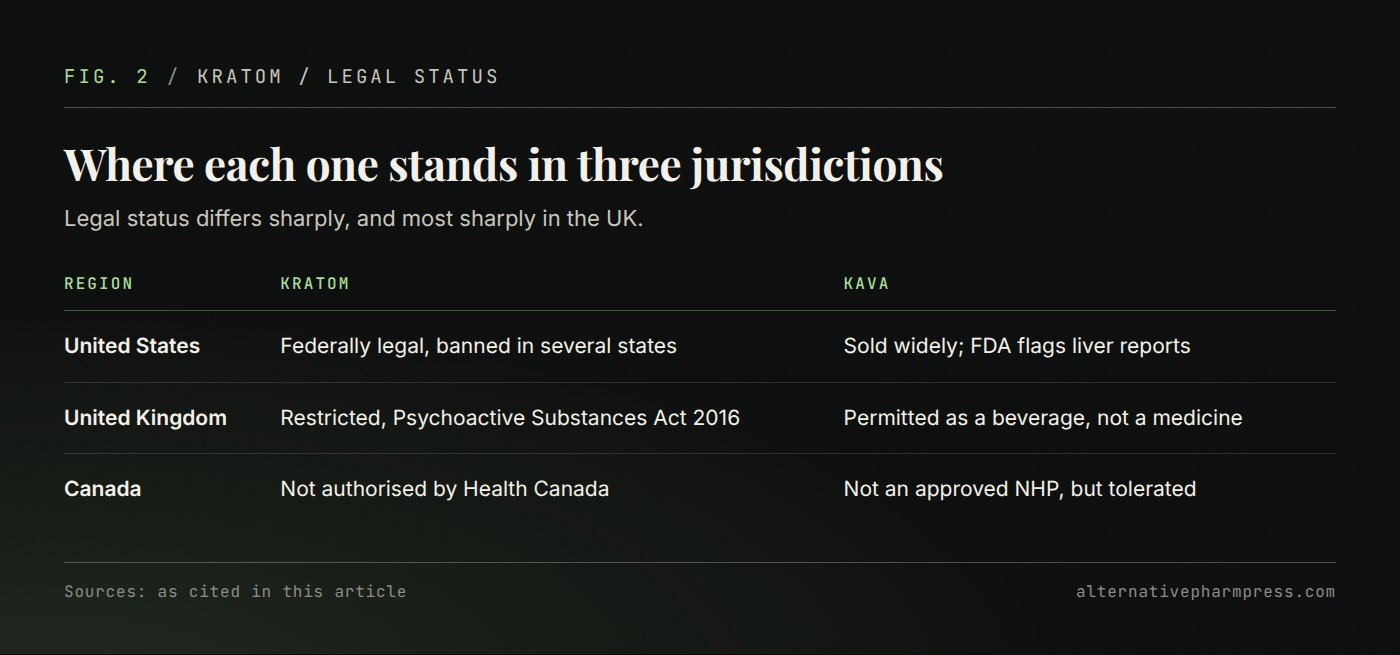
- United States: Kratom leaf is not federally scheduled, but nine states ban it outright: Alabama, Arkansas, Connecticut, Indiana, Louisiana, Massachusetts (temporary emergency order), Tennessee, Vermont and Wisconsin. Rhode Island lifted its ban in April 2026. In October 2026 the DEA moved to place concentrated 7-OH above 1 mg/g in Schedule I. Kava is sold widely as a supplement and traditional drink; the FDA issued a liver-injury advisory in 2002 and in 2020 said kava is not generally recognized as safe as a food additive. See our kratom legal guide.
- United Kingdom: Kratom supply is restricted under the Psychoactive Substances Act 2016. Kava is also restricted: the Kava-kava in Food (England) Regulations 2002 prohibit selling food containing kava, so it is not freely sold as a beverage.
- Canada: Health Canada has not authorized kratom and treats it as an unauthorized health product. Kava’s status is more nuanced; check Health Canada’s Licensed Natural Health Products Database before buying.
Who might choose which
This is an editorial question without a clean answer. Cultural and legal context will dominate for many readers. Where both are legally available, kratom users tend to skew toward functional use cases and kava users toward social or evening use. People with liver disease, on hepatically-cleared medications, or with histories of substance use disorders should approach either with extra caution and, ideally, with a clinician’s input.
Frequently asked questions
Can you take kratom and kava together?
No studies have tested the combination. Both can cause sedation and both have rare liver-injury reports, so combining them stacks risks without known benefit. Talk to a clinician first.
Which is harder on the liver?
Both have case reports of liver injury. Kava’s were serious enough to trigger European restrictions in the early 2000s; poor-quality extracts and the wrong plant parts were likely contributors. Kratom liver injury is rare and usually reversible. See kratom and liver injury.
Is kava legal where kratom is banned?
Usually, yes. In the U.S., kava is sold legally in the states that ban kratom.
Is kava addictive like kratom?
Kava is not known to cause the opioid-type dependence and withdrawal seen with regular kratom use, but heavy long-term use is linked to skin changes and other health effects.
Conclusion
Kratom and kava are often grouped together as alternative relaxants, but they are pharmacologically distinct: kratom acts at opioid receptors via mitragynine and 7-hydroxymitragynine, while kava modulates GABA via its kavalactones. Different mechanisms, different risk profiles, and different legal landscapes. Knowing which one fits your goal — and which combinations to avoid — matters more than picking a winner.
Key takeaways
- Different plants, different families, different active compounds, different cultural histories.
- Kava has more clinical trials, but the largest found no benefit over placebo for anxiety; kratom’s trial base is small but growing.
- Legal status differs sharply: kratom is banned in nine U.S. states while kava is widely sold, and both are restricted in the UK.
- Both deserve respect, especially when traditional preparation methods carry cultural meaning.
Sources & Further Reading
- Singh D, Narayanan S, Vicknasingam B. Traditional and non-traditional uses of mitragynine (kratom). Brain Res Bull. 2016;126:41-46. PMID 27178014
- Kruegel AC, Grundmann O. Neuropharmacology. 2018;134:108-120. PMID 28830758
- Sarris J, et al. J Clin Psychopharmacol. 2013;33(5):643-648. PMID 23635869
- Smith K, Leiras C. Complement Ther Clin Pract. 2018. PMID 30396607
- Henningfield JE, et al. Psychopharmacology. 2018. PMID 29273821
- Sarris J, et al. Kava for generalised anxiety disorder: a 16-week double-blind, randomised, placebo-controlled study. Aust N Z J Psychiatry. 2020. PMID 31813230
- Vicknasingam B, et al. Kratom and pain tolerance: a randomized, placebo-controlled, double-blind study. Yale J Biol Med. 2020. PMID 32607084
- WHO. Assessment of the risk of hepatotoxicity with kava products. 2007. iris.who.int
- CDC. Notes from the Field. MMWR. 2019. cdc.gov
- NCCIH. Kratom and Kava
- FDA. FDA and Kratom
More comparisons
-
Green Malay vs Green Maeng Da Kratom: What the Labels Really Tell You
-
Borneo vs Bali Kratom: What the Labels Mean and What Lab Data Shows
-
Kratom vs Kanna: Two Botanicals With Very Different Mechanisms
-
Kratom Capsules vs Powder: Same Leaf, Different Trade-offs
-
Red vs White Kratom: Relaxing vs Energising, and What Tests Show