
This article is for educational purposes only and does not constitute medical advice.
Last updated: October 15, 2026. Corrected the lemon and boiling guidance using alkaloid stability research, fixed citations and added FAQs.
Quick answer: Traditional kratom tea is made by simmering fresh or dried Mitragyna speciosa leaves (or powder) in water for 20 to 40 minutes, then straining out the plant material. Lab research shows kratom alkaloids are sensitive to heat and acid, so a gentle simmer is sensible, and the popular lemon trick is unproven. Brewing does not make kratom safer.
Introduction
Disclaimer: Educational content for adult readers. Not medical advice. US (FDA): Statements have not been evaluated by the FDA. Kratom is not approved for medical use. UK: Kratom supply is restricted under the Psychoactive Substances Act 2016. Canada: Kratom is not authorized for sale (Health Canada advisory).
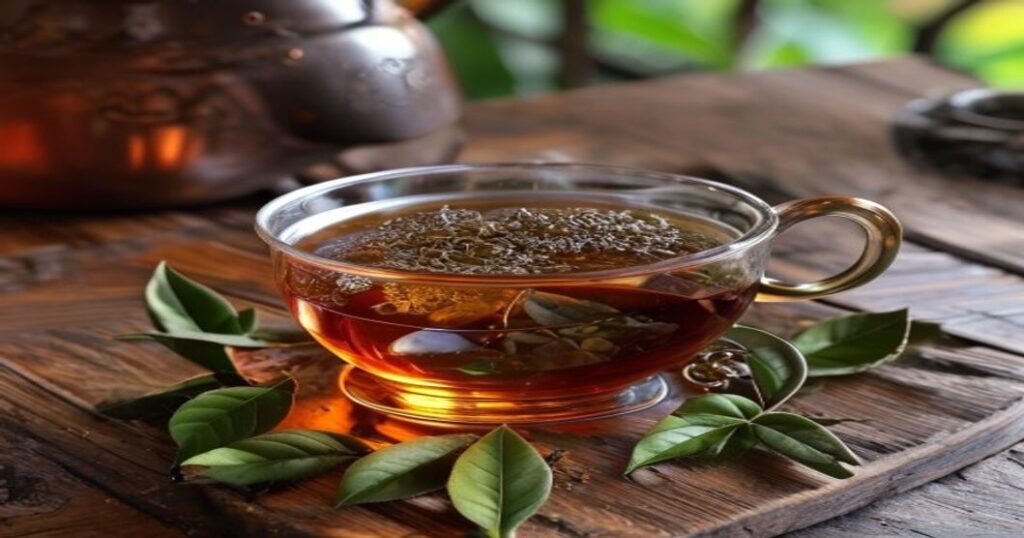
Tea is the oldest documented way to take kratom. Long before powder, capsules, and extracts, farmers in Thailand, Malaysia, and Indonesia simmered fresh or dried Mitragyna speciosa leaves in water and drank the strained liquid. The practice survives in part because it produces a less harsh experience than chewing leaves or swallowing dry powder, and in part because brewing offers control over strength and flavor that other forms don’t.
Historical use
Ethnobotanical surveys document kratom tea use across rural Southeast Asia going back many decades. Tanguay’s 2011 field guide for the Transnational Institute and the 2016 literature review by Singh, Narayanan and Vicknasingam describe the cultural role: tea served at the start of long shifts, drunk warm or cool, prepared with whatever kitchen tools were on hand. The recipe traveled within families.
Even after powders and capsules dominated the export market, the tea preparation has persisted because it is cheap, customizable, and considered easier on the stomach than dry powder.
Traditional Thai preparation
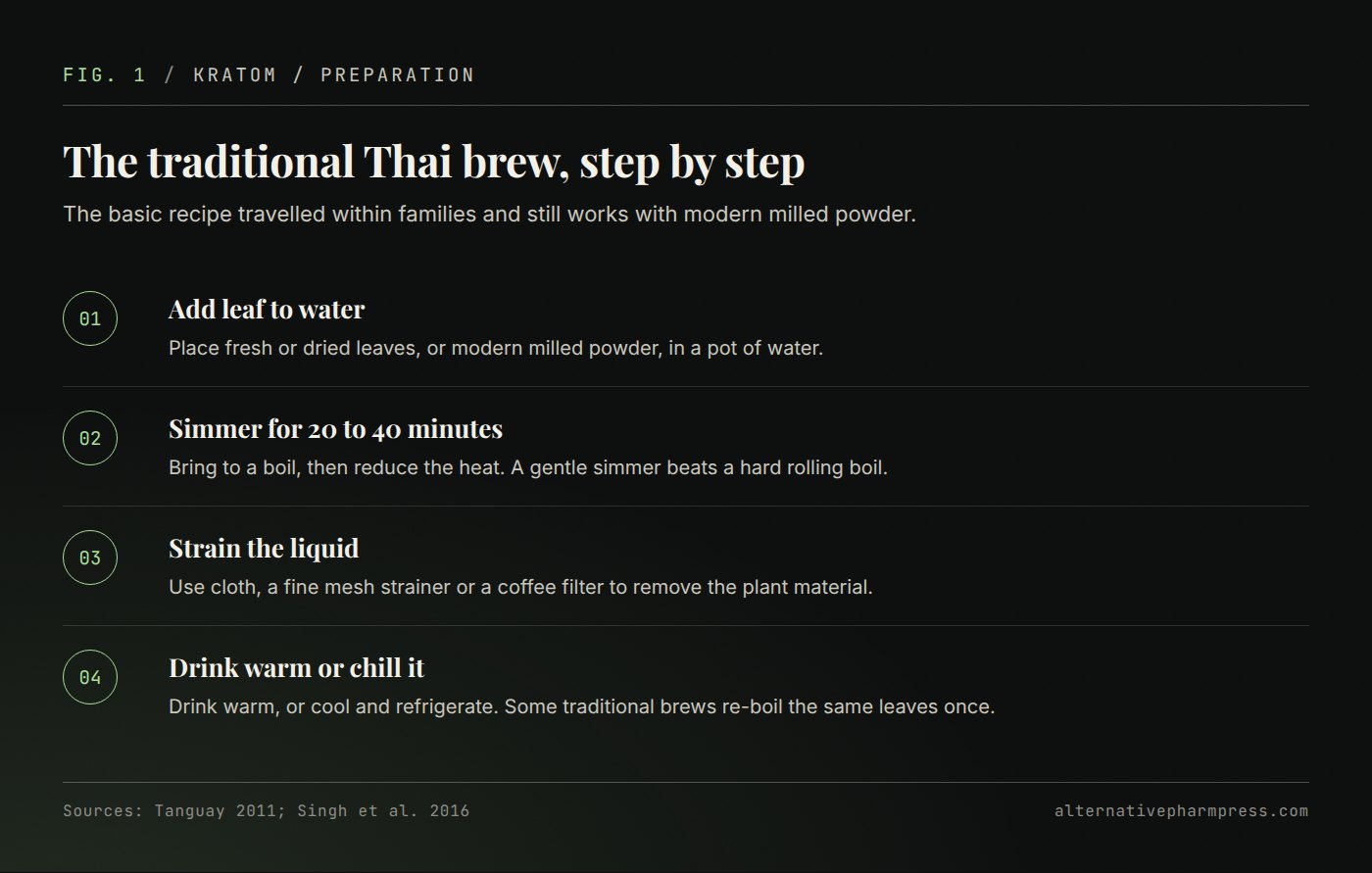
The basic Thai recipe is straightforward:
- Place fresh or dried leaves (or, in modern adaptations, kratom powder) in a pot of water.
- Bring to a boil, then reduce heat and simmer for 20 to 40 minutes.
- Strain through cloth, fine mesh, or a coffee filter to remove plant material.
- Drink warm, or cool and refrigerate for later.
Some traditional preparations re-boil the same leaves a second time to extract residual alkaloids – a frugal practice that’s still common in rural areas.
What changes the strength of a brew
Water temperature
Heat matters, but differently for each alkaloid. A 2020 stability study in the Journal of Analytical Toxicology (Basiliere and Kerrigan) found no significant loss of mitragynine in water at up to 40°C over 8 hours, while 7-hydroxymitragynine was the least stable alkaloid, with significant losses at 40°C and above. Losses grow at higher temperatures, which supports the common habit of using a gentle simmer rather than a long, rolling boil.
Time
Longer simmering pulls more material into solution. Beyond a point you stop gaining strength and start gaining bitterness.
Acidity (lemon and citrus)
Many brewers add lemon juice on the theory that acid helps dissolve mitragynine, which is a basic alkaloid. That part is chemically plausible. However, the same 2020 study found that all of the kratom alkaloids it tested were acid labile, meaning they break down faster in acidic conditions, especially when heated. No study has measured whether lemon improves or reduces the alkaloid content of a real kitchen brew, so treat it as a flavor choice rather than a proven way to make tea stronger.
Leaf or powder source
Strain (red, green, white), harvest, drying conditions, and storage all change alkaloid content. Two batches from the same vendor can brew up differently. Lab-tested product with a published certificate of analysis (COA) is the only reliable way to compare strength batch to batch.
Filtering
Three common options:
- Cloth (cheesecloth or muslin): Traditional, inexpensive, removes large particles. Some plant material slips through.
- Fine mesh strainer: Convenient and reusable. Cleaner than cloth.
- Coffee filter: Slowest and finest. Produces the smoothest cup but takes time.
Filtering well is the difference between a drinkable tea and a gritty one.
Taste tips
Kratom tea is bitter. Common ways to make it more drinkable:
- Honey or sugar to soften the edge.
- Co-brew with herbal teas (mint, ginger, chamomile) to round out the flavor.
- Serve cold over ice with citrus.
- Reduce the volume to a “shot” for a quick drink rather than a sipping cup.
Tea vs toss-and-wash
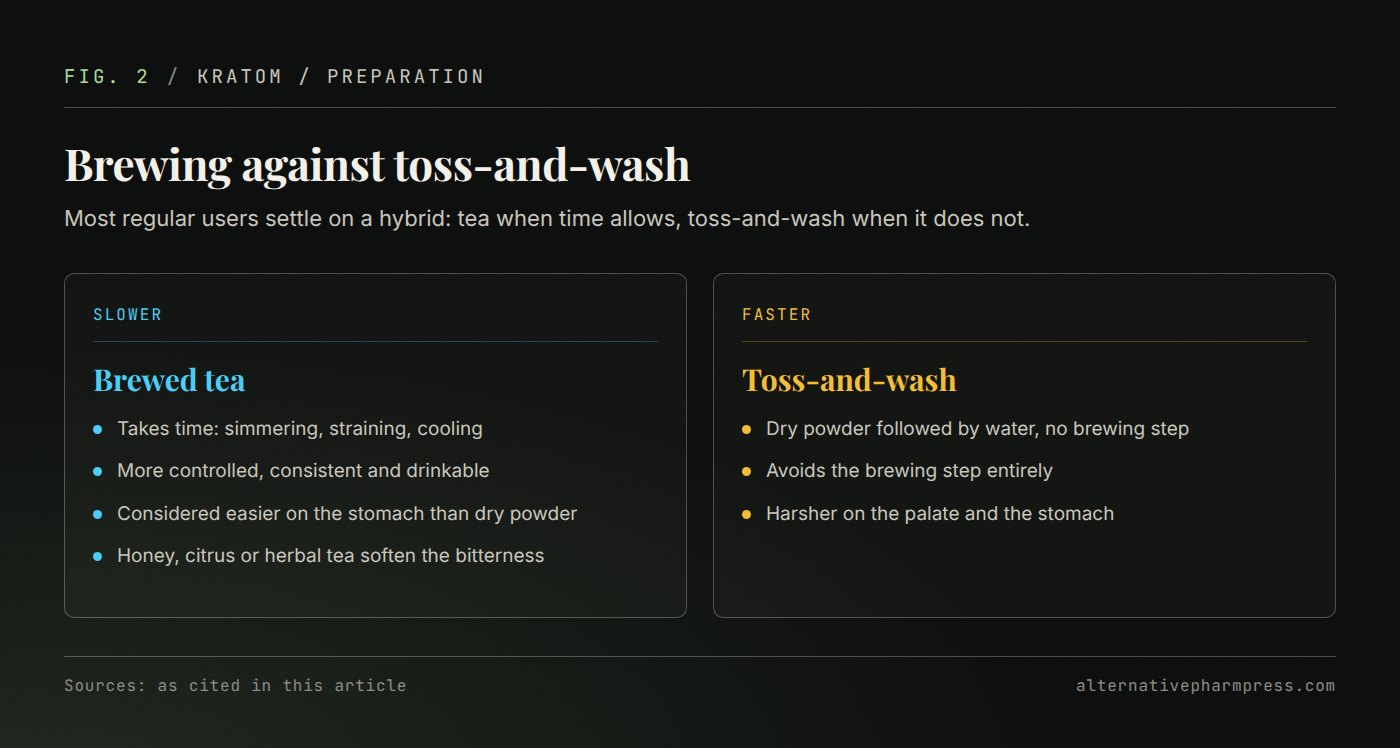
The toss-and-wash method – dry powder followed by water – is faster and avoids the brewing step entirely. It’s also harsher on the palate and stomach. Tea takes longer but produces a more controlled, consistent, drinkable result. Most regular users settle on a hybrid: tea when time allows, toss-and-wash when it doesn’t.
Safety notes
Brewing method does not change the underlying pharmacology. Tolerance, dependence, withdrawal, drug interactions, and quality-control issues (heavy metals, salmonella, adulterants) are present whether you brew tea or swallow capsules. The FDA has issued multiple warnings about contaminated product. A vendor’s published COA is your best signal. See our drug-interaction explainer if you take prescription medications. Brewing also makes strength harder to judge, because you cannot see how much alkaloid ended up in the cup; our kratom dosage guide explains why measuring by weight matters.
Frequently asked questions
Is kratom tea stronger than powder?
Not necessarily. Some alkaloid stays in the leaf material you strain out, and some may break down with heat, so a cup of tea may deliver less than the same weight of powder swallowed directly. Strength varies by batch and method.
How long does kratom tea keep?
Refrigerate it and use it within a few days. No study has tested shelf life, and 7-OH breaks down faster than mitragynine, so older tea may change in strength.
Can you reuse kratom leaves for a second brew?
Yes, many traditional brewers do, but the second brew is weaker and less predictable.
Does lemon make kratom tea stronger?
It is unproven. Acid may help dissolve mitragynine, but lab research shows kratom alkaloids are also broken down faster by acid, especially when heated.
Conclusion
Brewing kratom tea is the traditional preparation that Southeast Asian users have relied on for generations, and it remains one of the more controllable ways to consume it: heat extraction, acidulation, and straining give a reproducible product when you start with a known-quality leaf. Source carefully, measure by weight, and treat the resulting brew with the same dose discipline you would apply to any kratom product.
Key takeaways
- Tea is the oldest preparation and still widely used.
- A gentle simmer is sensible: 7-OH in particular degrades at higher temperatures.
- Lemon may help flavor, but its effect on strength is unproven, and kratom alkaloids break down faster in acid.
- Strain well; filter quality determines drinkability.
- Brewing technique does not address the underlying safety concerns. Choose lab-tested product.
Sources & Further Reading
- Tanguay P. Kratom in Thailand: A field guide. TNI, 2011. PDF
- Singh D, Narayanan S, Vicknasingam B. Traditional and non-traditional uses of mitragynine (kratom). Brain Res Bull. 2016;126:41-46. PMID 27178014
- Kruegel AC, Grundmann O. Neuropharmacology. 2018;134:108-120. PMID 28830758
- Basiliere S, Kerrigan S. Temperature and pH-dependent stability of Mitragyna alkaloids. J Anal Toxicol. 2020;44(4):314-324. PMID 31897484
- FDA. FDA and Kratom
- NCCIH. Kratom: What You Need To Know