
CBD does not get you high the way THC does. Human studies show that pure CBD does not cause intoxication or impair thinking or driving, with low abuse potential. It is psychoactive in a broad sense, because it acts on the brain and can cause drowsiness. When a “CBD” product feels like cannabis, hidden THC is the usual reason.
That distinction between psychoactive and intoxicating is where most online arguments start. Some people insist CBD “does nothing”; others describe a product as “diet weed” or say CBD flower left them stoned. Both experiences can be real, for different reasons.
This guide explains what CBD does in the brain, what human abuse-liability and driving studies found, how often CBD products contain THC, the role of expectation, drug-testing risks, and what the federal hemp change on 11 December 2026 means. For more on the cannabinoid, see our CBD research hub.
At a glance
| Question | What the evidence shows |
|---|---|
| Does pure CBD get you high? | No. A 750 mg oral dose was rated similar to placebo for drug liking in experienced drug users5 |
| Is CBD psychoactive? | Broadly, yes: it acts on the brain and can cause sleepiness. It is not intoxicating like THC1,2 |
| Does it impair driving? | CBD-dominant cannabis did not increase lane weaving in a randomised on-road trial7 |
| Why do some CBD products feel like weed? | Unlabelled or excess THC, THCA in flower, delta-8 contamination, sedation or expectation8,10,12 |
| How common is THC in CBD products? | Found in 18 of 84 online products in 2017 and 39% of 56 gummy products in 20258,10 |
| Can it fail a drug test? | Yes, mainly through trace THC11 |
| What changes on 11 December 2026? | Products with more than 0.4 mg total THC per container are no longer hemp under federal law15,17 |
Is CBD psychoactive? Psychoactive vs intoxicating
“Psychoactive” is used in two ways. In everyday speech, it means something that makes you high. In pharmacology, it means anything that acts on the brain and changes mood, perception or behaviour, which includes caffeine and many prescription drugs.
By the narrow definition, CBD is not psychoactive. The World Health Organization’s drug dependence committee concluded in 2018 that pure CBD was “not found to have psychoactive properties” and “presents no potential for abuse or dependence”.1 By the broader definition, it is. The FDA label for Epidiolex, the prescription CBD medicine, warns that it can cause somnolence and sedation: in the main epilepsy trials, 32% of patients on CBD reported somnolence, sedation or lethargy, compared with 11% on placebo.2 Those doses were far higher than most retail products, but they show CBD does act on the central nervous system.
The useful distinction is intoxicating. THC and delta-8 THC are intoxicating; the FDA describes delta-8 as having “psychoactive and intoxicating effects, similar to delta-9 THC”.14 CBD is not intoxicating at the doses studied. So the most accurate one-line answer to “is CBD psychoactive?” is: it affects the brain, but it does not produce a cannabis-style high. Our delta-8 vs CBD comparison sets the two side by side.
What CBD does in the brain
THC produces its high mainly by activating CB1 cannabinoid receptors. CBD binds poorly to the same site.4 In cell studies it behaves as a negative allosteric modulator of CB1: rather than switching the receptor on, it binds elsewhere and reduces how strongly THC and the body’s own cannabinoids can activate it.3 The researchers who described this mechanism also noted that CBD acts through targets other than CB1, which may explain effects such as drowsiness.3
That is why CBD is often described as dampening rather than mimicking THC. It is a laboratory finding, though, and it does not mean CBD reliably blocks a THC high in people. In a 2016 randomised laboratory study of 31 cannabis smokers, oral CBD at up to 800 mg, taken 90 minutes before smoked cannabis, did not change how high people felt or how much they liked the cannabis. CBD on its own produced no significant psychoactive or cardiovascular effects.19
Does CBD get you high? What human studies found
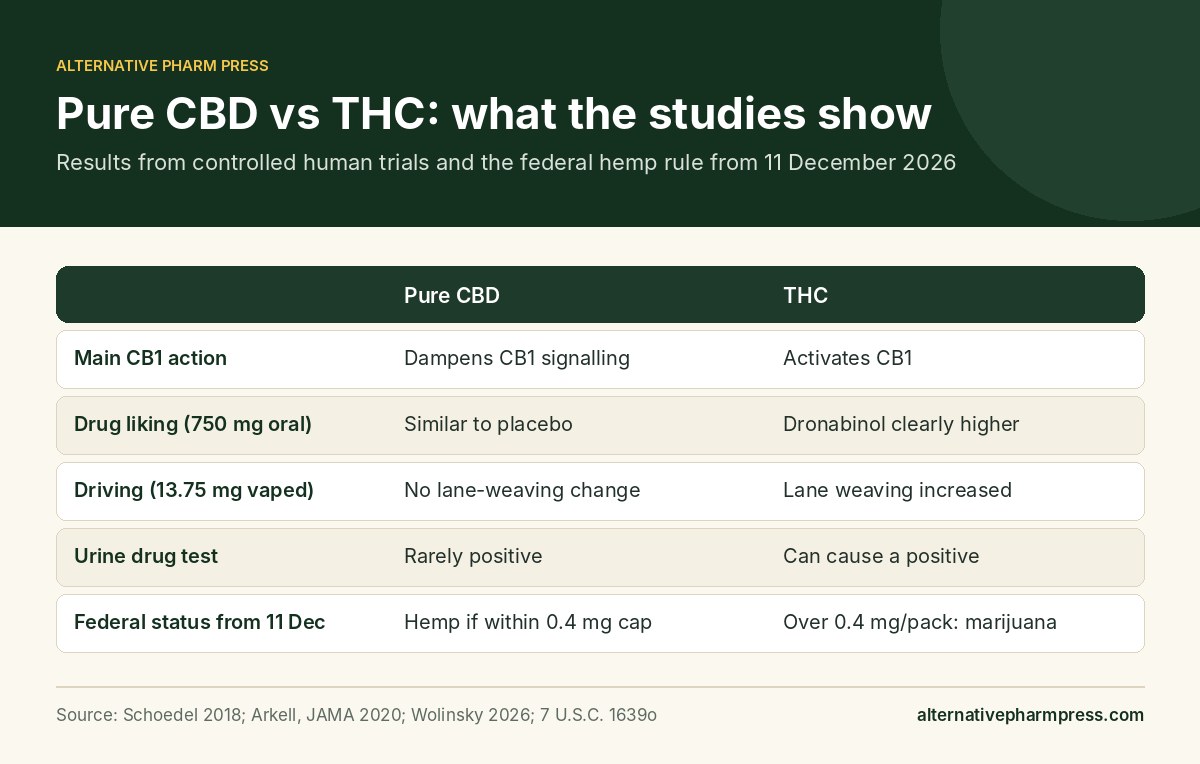
Abuse-potential trial. The most rigorous test is a 2018 randomised, double-blind trial in recreational polydrug users, a group sensitive to drug effects. Of 43 participants dosed, 35 were analysed. Oral CBD at 750 mg did not differ from placebo on “drug liking”. At 1,500 mg and 4,500 mg there were small increases, less than 10 points on a 100-point scale, compared with more than 18 points for the comparison drugs alprazolam and dronabinol (synthetic THC). CBD had no measurable effect on cognitive or psychomotor tests.5 The Epidiolex label adds that a month of high-dose CBD produced no withdrawal signs after stopping, and Epidiolex is not a controlled substance.2 See our guide to whether CBD is addictive for more.
Vaped vs swallowed CBD. A 2020 controlled laboratory study gave 18 healthy adults 100 mg of oral CBD, 100 mg of vaped CBD, vaped CBD-dominant cannabis (100 mg CBD with 3.7 mg THC) and placebo. Oral CBD felt no different from placebo. Vaped CBD did produce noticeable effects, with higher ratings for items such as “like drug effect”, and the CBD-dominant cannabis produced stronger effects and a faster heart rate. No condition impaired cognitive or psychomotor performance, and women tended to rate the vaped products as more pleasant than men did.6 So inhaled CBD can be felt, especially when it carries some THC, without being intoxicating in the usual sense.
Driving. In a randomised on-road trial in JAMA, 26 occasional cannabis users vaped cannabis containing 13.75 mg of THC, CBD, both, or neither. THC-dominant and mixed cannabis increased lane weaving shortly after use; CBD-dominant cannabis did not differ from placebo. The authors cautioned that the trial could not rule out clinically important impairment, and the doses may not match real-world use.7
Why some people feel high on CBD
If CBD itself is not intoxicating, why do so many people report feeling stoned? Several explanations are better supported than others.
1. The product contains more THC than the label says
This is the most common and best-documented cause. In a 2017 JAMA study of 84 CBD extracts sold online, only about 31% were accurately labelled for CBD, and THC was detected in 18 products, at up to 6.43 mg/mL.8,9 A 2025 analysis of 56 CBD gummy products found delta-9 THC in 39% of them, ranging from 0.019 to 0.88 mg per gummy; 9 products held more than 0.4 mg in a single gummy. Seventy per cent of gummies were more than 10% off their labelled CBD content, and some contained delta-8 THC.10
A few milligrams of THC across several gummies, or a dropper of a mislabelled oil, can be enough for a sensitive or THC-naive person to notice. Our CBD isolate vs full spectrum guide explains which product types carry THC by design.
2. CBD flower contains THCA
Hemp flower sold as “CBD flower” is plant material. Until 11 December 2026, federal law tests hemp only for delta-9 THC, so flower can be high in THCA, the acid form that turns into THC when heated.15,18 Smoking or vaping it delivers THC. That is the likeliest explanation when someone says CBD flower got them stoned. See THCA vs delta-9 THC for the chemistry.
3. Sedation is not the same as a high
Drowsiness is CBD’s most consistent side effect at higher doses, and the Epidiolex label warns that alcohol and other sedating drugs can add to it.2 Feeling heavy, relaxed or sleepy is easy to interpret as being high, especially at night or after a drink.
4. Expectation shapes the experience
In a 2021 randomised crossover study, 43 healthy adults took CBD-free hemp seed oil on two occasions. When they were told it contained CBD, they reported more sedation and showed changes in heart-rate variability. Overall stress and anxiety did not change, but participants who strongly believed CBD reduces anxiety did report feeling less anxious.12 Expectancy is real and measurable, though it does not explain intoxication on its own.
5. The stomach conversion theory is weak
A popular claim is that stomach acid turns CBD into THC. That idea came from experiments in simulated gastric fluid. Reviews of the human data have found no meaningful conversion after oral CBD, even at high doses, and a 2026 review concluded the risk in people remains “a speculative scenario”.4,13
Trace THC, effects and drug tests
How much THC does it take to matter? A 2026 controlled dosing study gave 60 adults 100 mg of CBD in oil with 0, 0.5, 1, 2, 2.8 or 3.7 mg of delta-9 THC, twice daily for two weeks. There were no significant differences in subjective effects or cognitive and psychomotor performance between the CBD-only group and any THC group. Yet urine tests were positive in at least one participant at every THC dose during the outpatient phase, one CBD-only sample tested positive, and two positives appeared after a one-week washout.11
The researchers concluded that standard drug tests cannot reliably tell legal hemp use from cannabis use, and that a positive result can follow THC doses too low to cause impairment.11 In other words, “not enough to get high” is not the same as “not enough to fail a test”. Our guide on whether CBD can make you fail a drug test covers this in detail.
What the 11 December hemp rule changes for CBD
From 11 December 2026, federal hemp is measured by total THC, including THCA, and finished products with more than 0.4 mg of total THC per container are excluded from the hemp definition and treated as marijuana.15,17 That catches many full-spectrum oils and gummies, and in the 2025 gummy study some products exceeded the whole-container cap in a single piece.10 CBD flower with high THCA will also fall outside the definition.
The likely effect for consumers is a shift towards isolate and broad-spectrum products with no detectable THC, which should make accidental intoxication less likely if labels are accurate. A December 2025 executive order acknowledged that the new language could inadvertently recriminalise full-spectrum, non-intoxicating CBD, and asked Congress to preserve access, but no fix had passed as of October 2026.16,17 Our explainers on the hemp ban and the federal THC limit for CBD go further.
How to avoid unexpected effects from CBD
- Check a batch-matched certificate of analysis for THC in milligrams per serving and per container, not just a percentage. Our checklist for buying CBD online explains what to look for.
- Choose isolate or broad spectrum if you want to avoid THC, and look for “not detected” rather than “under 0.3%”.
- Treat CBD flower as a THC product if you smoke or vape it.
- Avoid mixing with alcohol or sedatives, and do not drive until you know how a product affects you.
- If a product makes you feel high, stop using it and assume it contains THC. Report serious reactions to your doctor or the FDA’s MedWatch programme.
- If you are subject to drug testing, assume any full-spectrum product could cause a positive result.
If you are unsure how the three relate, our plain-language CBD vs hemp vs THC guide is a good starting point.
Frequently asked questions
Does CBD get you high?
Pure CBD does not produce a cannabis-style high. In a randomised trial of recreational drug users, 750 mg of oral CBD was rated similar to placebo for drug liking, and CBD did not impair thinking or coordination. If a CBD product makes you feel high, the most likely cause is THC in the product, either by design in full-spectrum products or through mislabelling.
Is CBD psychoactive?
It depends on the definition. CBD acts on the brain and can cause drowsiness, so it is psychoactive in the broad pharmacological sense. It is not intoxicating like THC. The WHO concluded in 2018 that pure CBD was not found to have psychoactive properties in the sense of producing a high, and that it presents no potential for abuse or dependence.
Why does CBD make me feel high?
The usual reasons are hidden or excess THC, THCA in CBD flower that turns into THC when heated, sedation, or expectation. Lab studies have repeatedly found unlabelled THC in CBD products, including 39% of 56 gummy products tested in 2025. Stop using a product that makes you feel intoxicated and check its batch certificate of analysis.
Can CBD flower get you stoned?
Yes, because of THC rather than CBD. Hemp flower is currently tested only for delta-9 THC, so it can contain large amounts of THCA, which converts to THC when smoked or vaped. From 11 December 2026, federal law counts THCA towards the total-THC limit, so most high-THCA flower will no longer qualify as hemp.
Will CBD show up on a drug test?
Standard tests look for THC metabolites, not CBD, but trace THC in CBD products can cause a positive result. In a 2026 controlled study, positives occurred with THC doses as low as 0.5 mg taken twice daily alongside CBD, even though participants showed no impairment. One sample from the CBD-only group also tested positive. Isolate products with no detectable THC carry less risk.
Sources
- World Health Organization. WHO Expert Committee on Drug Dependence review of cannabis (questions and answers). 31 July 2018. who.int
- Jazz Pharmaceuticals. EPIDIOLEX (cannabidiol) oral solution: US prescribing information. Revised May 2026. accessdata.fda.gov
- Laprairie RB, Bagher AM, Kelly ME, Denovan-Wright EM. Cannabidiol is a negative allosteric modulator of the cannabinoid CB1 receptor. Br J Pharmacol. 2015;172(20):4790-4805. PMID: 26218440. pubmed.ncbi.nlm.nih.gov
- Nahler G, Grotenhermen F, Zuardi AW, Crippa JAS. A conversion of oral cannabidiol to delta9-tetrahydrocannabinol seems not to occur in humans. Cannabis Cannabinoid Res. 2017;2(1):81-86. PMID: 28861507. pubmed.ncbi.nlm.nih.gov
- Schoedel KA, Szeto I, Setnik B, et al. Abuse potential assessment of cannabidiol (CBD) in recreational polydrug users: a randomized, double-blind, controlled trial. Epilepsy Behav. 2018;88:162-171. PMID: 30286443. pubmed.ncbi.nlm.nih.gov
- Spindle TR, Cone EJ, Goffi E, et al. Pharmacodynamic effects of vaporized and oral cannabidiol (CBD) and vaporized CBD-dominant cannabis in infrequent cannabis users. Drug Alcohol Depend. 2020;211:107937. PMID: 32247649. pubmed.ncbi.nlm.nih.gov
- Arkell TR, Vinckenbosch F, Kevin RC, et al. Effect of cannabidiol and Δ9-tetrahydrocannabinol on driving performance: a randomized clinical trial. JAMA. 2020;324(21):2177-2186. PMID: 33258890. pubmed.ncbi.nlm.nih.gov
- Bonn-Miller MO, Loflin MJE, Thomas BF, Marcu JP, Hyke T, Vandrey R. Labeling accuracy of cannabidiol extracts sold online. JAMA. 2017;318(17):1708-1709. PMID: 29114823. pubmed.ncbi.nlm.nih.gov
- HealthDay. Cannabidiol concentration varies widely in online products. November 2017. consumer.healthday.com
- Johnson ED, Kilgore MW, Stafford M, Randolph M, Glover M, Babalonis S. Cannabidiol gummy products: LC-MS/MS assessment of cannabinoid concentrations. Cannabis Cannabinoid Res. 2025;10(6):710-718. PMID: 40454463. pubmed.ncbi.nlm.nih.gov
- Wolinsky D, Zamarripa CA, Spindle TR, et al. The acute and chronic pharmacokinetics and pharmacodynamics of oral cannabidiol with and without low doses of delta-9-tetrahydrocannabinol. J Anal Toxicol. 2026;50(1):bkaf075. PMID: 40704705. pubmed.ncbi.nlm.nih.gov
- Spinella TC, Stewart SH, Naugler J, Yakovenko I, Barrett SP. Evaluating cannabidiol (CBD) expectancy effects on acute stress and anxiety in healthy adults: a randomized crossover study. Psychopharmacology (Berl). 2021;238(7):1965-1977. PMID: 33813611. pubmed.ncbi.nlm.nih.gov
- Simonsen JB, Bruun HZ, Hoeng J, Jensen SS. Revisiting the literature on gastric CBD-to-THC conversion: contextualizing conflicting evidence. Eur J Pharm Sci. 2026;227:107632. PMID: 42556486. pubmed.ncbi.nlm.nih.gov
- US Food and Drug Administration. 5 things to know about delta-8 tetrahydrocannabinol (delta-8 THC). Content current as of 4 May 2022. fda.gov
- Legal Information Institute, Cornell Law School. 7 U.S. Code § 1639o: Definitions (as amended by Pub. L. 119-37, § 781). law.cornell.edu
- George A, Todeschi J. 2026 federal hemp ban: what it means for the future of consumable hemp products. Vicente LLP. 7 May 2026. vicentellp.com
- Hemp Law Group. Federal hemp law in 2026: the ban, the deadline, and every bill trying to change it. Current as of 19 October 2026. hemplawgroup.com
- Taschwer M, Schmid MG. Determination of the relative percentage distribution of THCA and Δ9-THC in herbal cannabis seized in Austria: impact of different storage temperatures on stability. Forensic Sci Int. 2015;254:167-171. PMID: 26247127. pubmed.ncbi.nlm.nih.gov
- Haney M, Malcolm RJ, Babalonis S, et al. Oral cannabidiol does not alter the subjective, reinforcing or cardiovascular effects of smoked cannabis. Neuropsychopharmacology. 2016;41(8):1974-1982. PMID: 26708108. pubmed.ncbi.nlm.nih.gov
Featured image: CBD/Hemp oil by elsaolofsson, CC BY 2.0. Cropped.
This article is for educational purposes only and is not medical or legal advice. Products discussed here are not intended to diagnose, treat, cure or prevent any disease. Laws vary by location and change often, so verify the rules that apply where you are. Always talk to a licensed healthcare provider before use, especially if you are under 21, pregnant or nursing, taking medication, or managing a health condition.