
The “Wolverine” peptide stack is BPC-157 and TB-500 used together, often sold pre-mixed in one vial. Both peptides have animal data suggesting effects on tissue repair, but there are no controlled human trials of the combination. The only controlled test we found, in rats, showed no added benefit from combining them. Both are banned in sport, and neither is FDA-approved.1,2
The name borrows from the comic-book character who heals from any injury, which says a lot about how the stack is marketed. An Australian men’s health charity has described “Wolverine stack” as a marketing term rather than a scientific one.3
We have already compared the two peptides individually in BPC-157 vs TB-500. This article looks at the combined product trend: what evidence exists for using them together, how regulators and anti-doping bodies treat the pair in October 2026, and what the risks are of injecting a two-peptide blend from an unregulated seller. It does not cover dosing or sourcing. More background is in our research peptides hub.
At a glance: the Wolverine peptide stack
| Question | Short answer |
|---|---|
| What is it? | BPC-157 plus TB-500, taken together or as one pre-mixed blend |
| Randomised human trials of the pair | None found |
| Any human data on the combination | 4 patients in an uncontrolled knee pain chart review4 |
| Controlled combination study | One rat study: no added benefit over either alone1 |
| FDA status | Neither approved; advisory panel backed both 8-6 for compounding, with no rule issued5,6 |
| Sport | Both prohibited at all times under the WADA list2 |
| Main practical risks | Wrong or missing peptide, contamination, endotoxin, infection7,8 |
What is the Wolverine stack, and why is it sold as a blend?
BPC-157 is a synthetic 15-amino-acid peptide based on a sequence from a protein in gastric juice. Most research on it comes from rat models of tendon, ligament, muscle and gut injury.9 TB-500 is sold as a synthetic version of thymosin beta-4, a naturally occurring 43-amino-acid protein involved in cell movement and repair. In practice, products labelled TB-500 often contain a short fragment instead: Belgian anti-doping chemists who analysed one TB-500 product identified a seven-amino-acid acetylated fragment, not the full protein.10
The idea behind stacking is that the two act through different pathways, so together they might do more than either alone. Sellers increasingly offer the pair as a single “Wolverine stack” peptide vial, also listed as a “BPC-157/TB-500 blend”, and the same pair forms the core of larger blends such as GLOW and KLOW, which add GHK-Cu and, in KLOW’s case, KPV.
Pre-mixing is convenient for sellers and buyers, but it changes what can be checked. A single-peptide vial needs one identity, purity and content result. A blend needs each of those for every ingredient, and a COA that reports one purity figure for “BPC-157/TB-500” does not tell you how much of each is present.
What evidence exists for BPC-157 and TB-500 together?
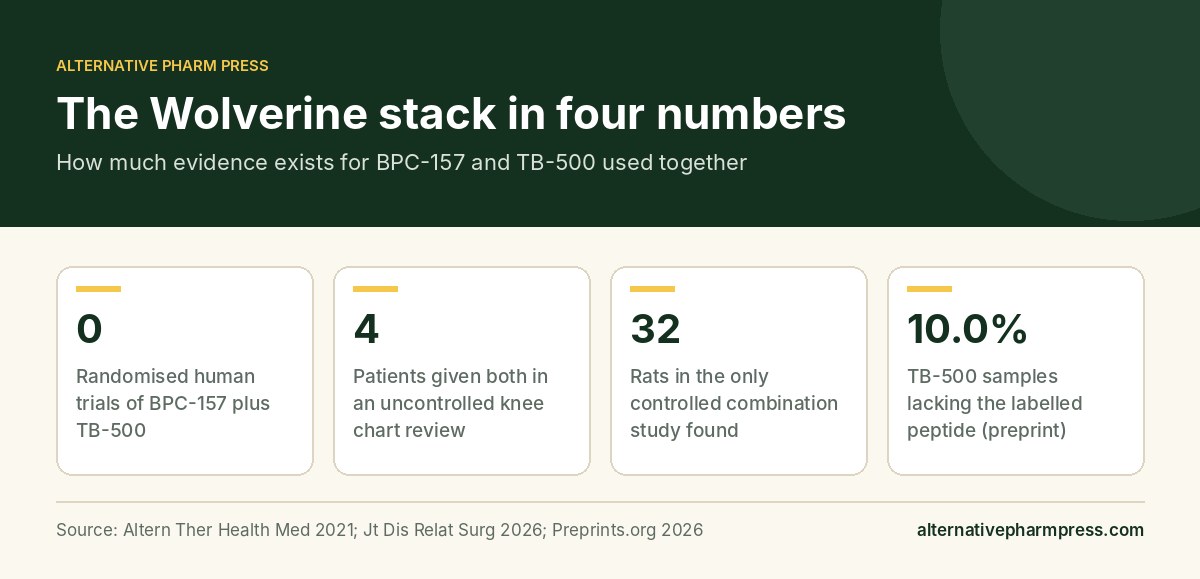
Very little. The evidence for each peptide on its own is mostly preclinical, and the evidence for the combination is thinner still. In searches of PubMed we found zero randomised human trials of BPC-157 and TB-500 used together.
Human data: four patients, no control group
The only published human data on the pair that we found come from a 2021 retrospective chart review at a Florida hormone clinic. Researchers phoned 16 patients who had received knee injections. Twelve had BPC-157 alone and 4 had BPC-157 combined with thymosin beta-4. Of the 4 who received both, 3 (75%) reported significant improvement in knee pain; 11 of the 12 given BPC-157 alone reported improvement.4
That study had no control group, no imaging, no validated outcome measures and recall-based pain ratings, so it cannot show that either regimen worked, let alone that the combination was better. With four people in the combination group, the numbers are too small to compare.4 A 2025 systematic review of BPC-157 in sports medicine found 35 preclinical studies and only one clinical study, and no clinical safety data.9
A 2026 dental case series described three patients with nerve injury treated with a combination that included peptides such as BPC-157 and thymosin beta-4 derivatives alongside a steroid and local anaesthetic. The authors stressed that the cases were uncontrolled and that spontaneous recovery could not be excluded.11
Animal data: one controlled test of the combination
The most direct test we found is a 2026 study in the Joint Diseases and Related Surgery journal. Researchers cut and repaired the Achilles tendons of 32 rats and randomly assigned them to four groups of eight: no treatment, BPC-157, TB-500, or both, given daily by injection into the abdominal cavity for four weeks.1
TB-500 alone produced a statistically significant gain in the load the tendon could bear before failing, and better tissue scores than controls. BPC-157 alone showed numerically better scores that did not reach significance on overall measures. The combination group improved on one tissue score, but the authors concluded that combined treatment “did not confer additional benefits” compared with either peptide alone.1 They suggested the two may act on overlapping downstream pathways, which would undercut the main rationale for stacking.
It is one small, four-week rat study, with doses and routes that do not map onto human use. But it is the only controlled comparison of the pair we found, and its answer to the question the stack is built on, whether two beat one, was no. You can read the abstract on PubMed.
What the single-peptide evidence does and does not show
A 2025 narrative review counted only three small human pilot studies of BPC-157 in any setting and concluded it should be considered investigational until well-designed trials are done.12 For TB-500 specifically, we found no controlled human trials. Small human trials of the full thymosin beta-4 protein exist, for example a nine-patient phase 2 study of eye drops for severe dry eye,13 but those used a different molecule by a different route.
A 2026 review in Sports Medicine covering BPC-157, thymosin beta-4 and TB-500 concluded that many unapproved peptides show favourable tissue repair outcomes in animals, that rigorous human safety data are scarce, and that placebo effects and social media can amplify perceived benefits.14 The individual comparison in our BPC-157 vs TB-500 guide and our summary of BPC-157 side effects and safety go into those studies in more detail.
Why the Wolverine stack is more popular than its evidence
A common question in peptide forums is whether the pair should be used together “for synergy”, usually after a tendon or joint injury that has not healed as quickly as hoped. The appeal is understandable. Soft-tissue injuries are slow, frustrating and often only partly helped by rest and rehabilitation.
Three things push the stack’s reputation ahead of its data:
- Natural recovery. Most tendon and muscle injuries improve over weeks to months anyway. Without a control group, any treatment started during that window can look effective.
- Stacked narratives. Each peptide brings its own set of hopeful animal studies. Combining them sounds like combining the evidence, but no study has shown that the effects add up.1
- Influencer and seller amplification. Reviewers have flagged social media as a driver of perceived peptide benefits.14
This does not prove the stack is useless. Healthy Male, the Australian charity, makes the fair point that a ban does not show a substance fails to work.3 It does mean the claims made for it are not backed by human evidence.
Wolverine stack and anti-doping: both peptides are banned
For tested athletes, the evidence question is moot. The World Anti-Doping Agency Prohibited List names BPC-157 as an example under S0, non-approved substances, and lists “thymosin-β4 and its derivatives e.g. TB-500” under S2.3, growth factors and growth factor modulators. Both categories are prohibited at all times, in and out of competition.2 WADA published its 2027 list on 6 October 2026, effective 1 January 2027; athletes should check it directly for any changes.15
The US Anti-Doping Agency says there are no human clinical trials establishing efficacy for BPC-157 for any diagnosis, that it is unknown whether a safe dose exists, and that some human studies appear to have stopped without published results.16 Anti-doping laboratories have developed methods to detect both BPC-157 and the TB-500 fragment in urine or plasma.10,17 A pre-mixed blend therefore exposes an athlete to two prohibited substances at once.
FDA status of BPC-157 and TB-500 in 2026
Neither peptide is an FDA-approved drug, and no BPC-157/TB-500 combination has been submitted for approval.
The July 2026 advisory vote. The FDA’s Pharmacy Compounding Advisory Committee voted 8-6, with one abstention, on 23 July 2026 to recommend adding BPC-157, KPV and TB-500 to the 503A bulks list, which would let licensed pharmacies compound them for individual patients. FDA staff had recommended against all seven peptides reviewed, citing short, small studies that were insufficient to establish safety or effectiveness.5 The vote is advisory. As of mid-October 2026, nothing had been added to the list, and FDA would need to publish a proposed rule, take comments and issue a final rule before that happens.6 We cover the vote in detail in BPC-157 in 2026: the FDA advisory vote and our 503A bulks list explainer.
Interim access policy. HHS and the FDA sent an interim peptide compounding policy to the White House Office of Management and Budget on 14 October 2026. It has not been issued. Holland & Knight expects it, if finalised, to take the form of enforcement discretion for state-licensed 503A pharmacies rather than approval, and notes that it would not cover research-use-only sellers.6 The peptides it would cover have not been made public, and whether it would extend to pre-mixed blends is unknown.
Enforcement. On 24 August 2026, the FDA sent warning letters to five online peptide sellers, concluding that “research use only” disclaimers did not outweigh evidence, including dosing calculators and bacteriostatic water sold alongside vials, that products were intended for human use.18 Those letters named GLP-1 drugs and other peptides rather than BPC-157 or TB-500, but the legal reasoning applies to any seller. Our explainer on what research use only means covers why the label is not a safety signal.
BPC-157 and TB-500 blend risks: what can go wrong
Because human safety data are so limited, the best-documented risks come from product quality and injection practice rather than from the peptides’ pharmacology.
The wrong peptide, or none. A 2026 preprint, not yet peer reviewed, analysed more than 6,000 third-party test reports on consumer peptides. About 3.5% of BPC-157 samples and 10.0% of TB-500 samples did not contain the labelled compound, and TB-500 had the lowest median purity of the 14 peptides studied.7 In a blend, a missing or substituted ingredient is harder to spot.
Endotoxin and contamination. In the same preprint, 15% of the samples with endotoxin data had measurable endotoxin, and purity did not predict endotoxin levels.7 A Health Canada advisory in April 2026 named BPC-157 and TB-500 among unauthorised peptides that may contain incorrect amounts, unlisted ingredients, particles, bacteria, fungi or endotoxins, and warned of infections and allergic reactions.8
Injection-site infection. Any non-sterile injection can cause local infection or abscess. Spreading redness, warmth, swelling, pus or fever after an injection needs prompt medical assessment.
Unknown long-term effects. A 2026 review in Missouri Medicine listed pathological blood-vessel growth and possible cancer promotion among theoretical risks of unapproved injectable peptides including BPC-157 and TB-500, alongside contamination and inaccurate dosing.19 These are plausible concerns based on how the peptides are thought to work, not documented outcomes, because no one has followed users long term.
If you are looking at lab reports for a blend, our guides to reading a peptide COA and signs a brand is genuinely third-party tested explain what a credible result should show for each ingredient.
Talking to a clinician about injury recovery
If you are considering the Wolverine stack for an injury, a sports medicine doctor or physiotherapist can assess the injury, check for problems that need imaging or surgery, and discuss treatments with human trial evidence, such as structured loading programmes for tendon problems. If you have already injected a blend and feel unwell, seek care and bring the vial and packaging. Athletes should check with their anti-doping organisation before using any peptide product.
Frequently asked questions
What is the Wolverine peptide stack?
It is BPC-157 and TB-500 used together, either as two separate products or as one pre-mixed blend. Sellers market it for injury recovery. Neither peptide is FDA-approved, both are banned in sport, and there are no controlled human trials of the combination. One rat study found no added benefit over either peptide alone.1,2
Does BPC-157 work better with TB-500?
There is no good evidence that it does. In a 2026 study of 32 rats with repaired Achilles tendons, combined BPC-157 and TB-500 did not confer additional benefits over either peptide alone. The only human data are 4 patients in an uncontrolled knee pain chart review, which cannot show whether the combination helped.1,4
Is a BPC-157 and TB-500 blend legal?
Neither peptide is FDA-approved. An FDA advisory committee voted 8-6 in July 2026 to recommend both for the 503A compounding bulks list, but no rule has been issued. The FDA has said research-use-only labels do not protect sellers whose products are clearly intended for human use, and an interim access policy is still under review.5,6,18
Can athletes use the Wolverine stack?
Not if they are subject to anti-doping rules. The WADA Prohibited List bans BPC-157 under S0 and thymosin beta-4 derivatives such as TB-500 under S2, both at all times, in and out of competition. Anti-doping labs have published methods to detect both. Athletes should check the current list with their anti-doping organisation.2,10,17
Is the Wolverine stack safe?
Its safety in people is unknown. The best-documented risks are product quality and contamination: in a 2026 preprint, 10.0% of TB-500 samples did not contain the labelled peptide and 15% of samples tested for endotoxin had measurable levels. Health Canada has warned that unauthorised injectable peptides can cause infections and allergic reactions.7,8
Sources
- Biçer O, Adanir O, Güleryüz Y, Balci EC, Dinçel YM, Yenigün MY, et al. Effects of BPC-157 and TB-500 on Achilles tendon healing in rats: A histopathological and biomechanical study. Jt Dis Relat Surg. 2026;37(3):822-837. DOI: 10.52312/jdrs.2026.2951. PMID: 42542926. pubmed.ncbi.nlm.nih.gov
- World Anti-Doping Agency. The 2026 Prohibited List (S0 Non-approved substances; S2 Peptide hormones, growth factors, related substances and mimetics). wada-ama.org
- Healthy Male (Andrology Australia). What you need to know about the “Wolverine stack”. Accessed 25 October 2026. healthymale.org.au
- Lee E, Padgett B. Intra-Articular Injection of BPC 157 for Multiple Types of Knee Pain. Altern Ther Health Med. 2021;27(4):8-13. PMID: 34324435. pubmed.ncbi.nlm.nih.gov
- Steinzor P. FDA panel backs 6 peptides for compounding. AJMC. 31 July 2026. ajmc.com
- Crossan SS, Watkins S. Peptides at a Crossroads: What Wellness Providers Need to Know About HHS and FDA Actions. Holland & Knight Alert. 16 October 2026. hklaw.com
- Mendias CL, Awan TM. Evaluation of Research Grade Peptides Marketed Directly to Consumers Reveals Extensive Variability in Purity and Measured Abundance. Preprint (not peer reviewed), Preprints.org. 24 April 2026. DOI: 10.20944/preprints202604.1748.v1. preprints.org
- Health Canada. Think twice before injecting peptides bought online: unauthorized products can seriously harm you. Public advisory, 9 April 2026. recalls-rappels.canada.ca
- Vasireddi N, Hahamyan H, Salata MJ, Karns M, Calcei JG, Voos JE, Apostolakos JM. Emerging Use of BPC-157 in Orthopaedic Sports Medicine: A Systematic Review. HSS J. 2025;21(4):485-495. DOI: 10.1177/15563316251355551. PMID: 40756949. pubmed.ncbi.nlm.nih.gov
- Esposito S, Deventer K, Goeman J, Van der Eycken J, Van Eenoo P. Synthesis and characterization of the N-terminal acetylated 17-23 fragment of thymosin beta 4 identified in TB-500, a product suspected to possess doping potential. Drug Test Anal. 2012;4(9):733-738. DOI: 10.1002/dta.1402. PMID: 22962027. pubmed.ncbi.nlm.nih.gov
- Froum S, Estrin N, Pico G, Yakubov M, Ahmad P, LaValle J. Case Report: Regenerative peptides for Inferior alveolar nerve injury: a narrative review with hypothesis-generating three clinical cases. Front Oral Health. 2026;7:1907109. DOI: 10.3389/froh.2026.1907109. PMID: 42876687. pubmed.ncbi.nlm.nih.gov
- McGuire FP, Martinez R, Lenz A, Skinner L, Cushman DM. Regeneration or Risk? A Narrative Review of BPC-157 for Musculoskeletal Healing. Curr Rev Musculoskelet Med. 2025;18(12):611-619. DOI: 10.1007/s12178-025-09990-7. PMID: 40789979. pubmed.ncbi.nlm.nih.gov
- Sosne G, Dunn SP, Kim C. Thymosin β4 significantly improves signs and symptoms of severe dry eye in a phase 2 randomized trial. Cornea. 2015;34(5):491-496. DOI: 10.1097/ICO.0000000000000379. PMID: 25826322. pubmed.ncbi.nlm.nih.gov
- Mendias CL, Awan TM. Safety and Efficacy of Approved and Unapproved Peptide Therapies for Musculoskeletal Injuries and Athletic Performance. Sports Med. 2026;56(8):1921-1935. DOI: 10.1007/s40279-026-02437-0. PMID: 41966639. pubmed.ncbi.nlm.nih.gov
- World Rugby. WADA publishes 2027 Prohibited List. October 2026. world.rugby
- US Anti-Doping Agency. BPC-157: Experimental Peptide Creates Risk for Athletes. Last updated August 2026. usada.org
- Cox HD, Miller GD, Eichner D. Detection and in vitro metabolism of the confiscated peptides BPC 157 and MGF R23H. Drug Test Anal. 2017;9(10):1490-1498. DOI: 10.1002/dta.2152. PMID: 28035768. pubmed.ncbi.nlm.nih.gov
- Kundi A, Cowley EM, Golden S, Billan N. RUO-ined: Five Peptide Vendors Learn That ‘Research Use Only’ Is Not a Legal Strategy. ArentFox Schiff. 18 September 2026. afslaw.com
- Moiz A, O’Keefe EL, O’Keefe JH. Dangers of Injectable Peptides and Other Unregulated “Biohacking” Drugs. Mo Med. 2026;123(4):337-343. PMID: 42757290. pubmed.ncbi.nlm.nih.gov
Featured image: eppendorfs forest (close-up) by jepoirrier, CC BY-SA 2.0. Cropped.
This article is for educational purposes only and is not medical or legal advice. Products discussed here are not intended to diagnose, treat, cure or prevent any disease. Laws vary by location and change often, so verify the rules that apply where you are. Always talk to a licensed healthcare provider before use, especially if you are under 21, pregnant or nursing, taking medication, or managing a health condition.