
If you’ve ever stood in a store wondering whether the bottle in your hand will get you high, get you arrested, or do nothing at all, you’re not alone. The words CBD, hemp, and THC get tossed around as if they mean the same thing, and the marketing rarely helps. They’re related, but they’re not interchangeable. Here’s the plain version, with the legal and drug-test angles that actually affect your decision.
Start with the plant: what “hemp” means
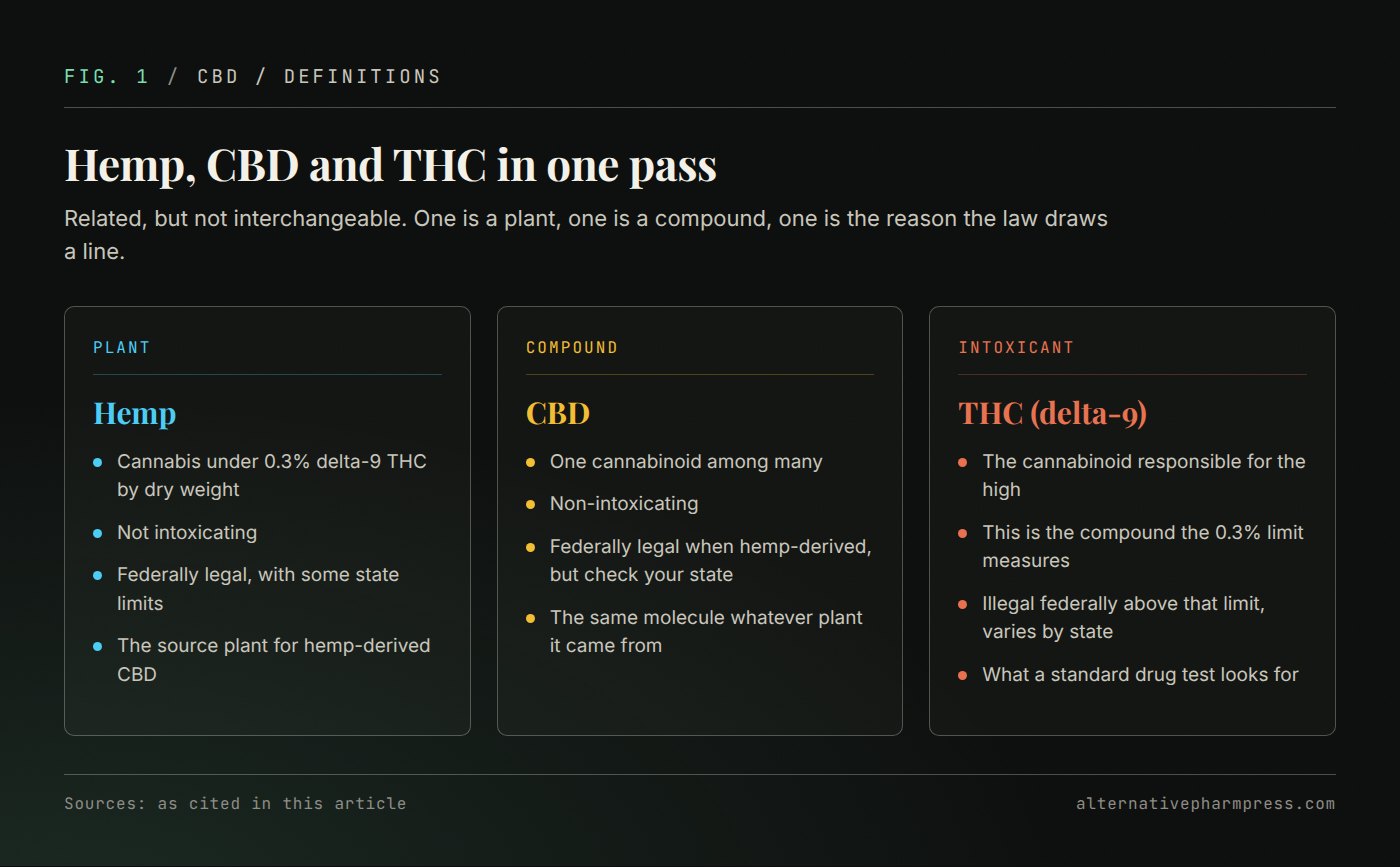
Hemp is a plant, specifically a variety of cannabis. In the US, the legal definition is precise: cannabis that contains no more than 0.3% delta-9 THC on a dry-weight basis. That single number is the line between hemp and marijuana under federal law. Same plant family, different legal category, decided by how much intoxicating THC the plant produces.
So when a label says “hemp-derived,” it’s telling you the source plant stayed under that 0.3% threshold. Hemp is used for fiber, seeds, and, relevant here, as the source of cannabinoids like CBD. Our hemp glossary entry and cannabis glossary entry go into the botany if you want it.
CBD: a compound, not a plant
CBD (cannabidiol) is one of many cannabinoids found in cannabis. The key fact: it’s non-intoxicating. It doesn’t produce the high associated with cannabis. CBD can be extracted from hemp, and because hemp is federally legal, hemp-derived CBD occupies a different legal space than CBD pulled from higher-THC marijuana plants.
People reach for CBD for various personal reasons, and we’ll leave it there, because these products are not approved to treat, cure, or relieve any condition, and we don’t make those claims. What we can say is that the quality, sourcing, and testing behind a CBD product matter a great deal, which is why we keep pointing readers toward lab reports. Our CBD glossary entry has the basics, and the CBD category collects our guides.
THC: the intoxicating one
THC (delta-9 tetrahydrocannabinol) is the cannabinoid responsible for the high. When people talk about cannabis being intoxicating, THC is usually what they mean. This is the compound the 0.3% limit is measuring, and it’s why the legal picture for THC is so different from CBD. Higher-THC cannabis (often called marijuana) remains federally illegal, even though many states have legalized it for medical or adult use.
There’s also a growing world of alternative cannabinoids, like delta-8 and THC-O, that occupy their own murky legal territory. If that’s where your questions are heading, our breakdown of delta-8 vs delta-9 vs THC-O picks up that thread.
Hemp-derived vs marijuana-derived
This distinction trips up a lot of shoppers. CBD itself is the same molecule no matter where it comes from. What differs is the source plant and, with it, the legal status. Hemp-derived CBD comes from plants under the 0.3% THC limit and is treated as federally legal under the 2018 Farm Bill. Marijuana-derived CBD comes from higher-THC plants and is regulated like marijuana, which means its legality depends entirely on your state.
For most products you buy online, “hemp-derived” is the phrase you’ll see. That’s the federally legal lane. But federal legal and state legal aren’t always the same thing, which we’ll get to.
Full-spectrum vs broad-spectrum vs isolate
Once you’re looking at hemp-derived CBD products, you’ll hit three more terms. They describe what else is in the extract besides CBD.
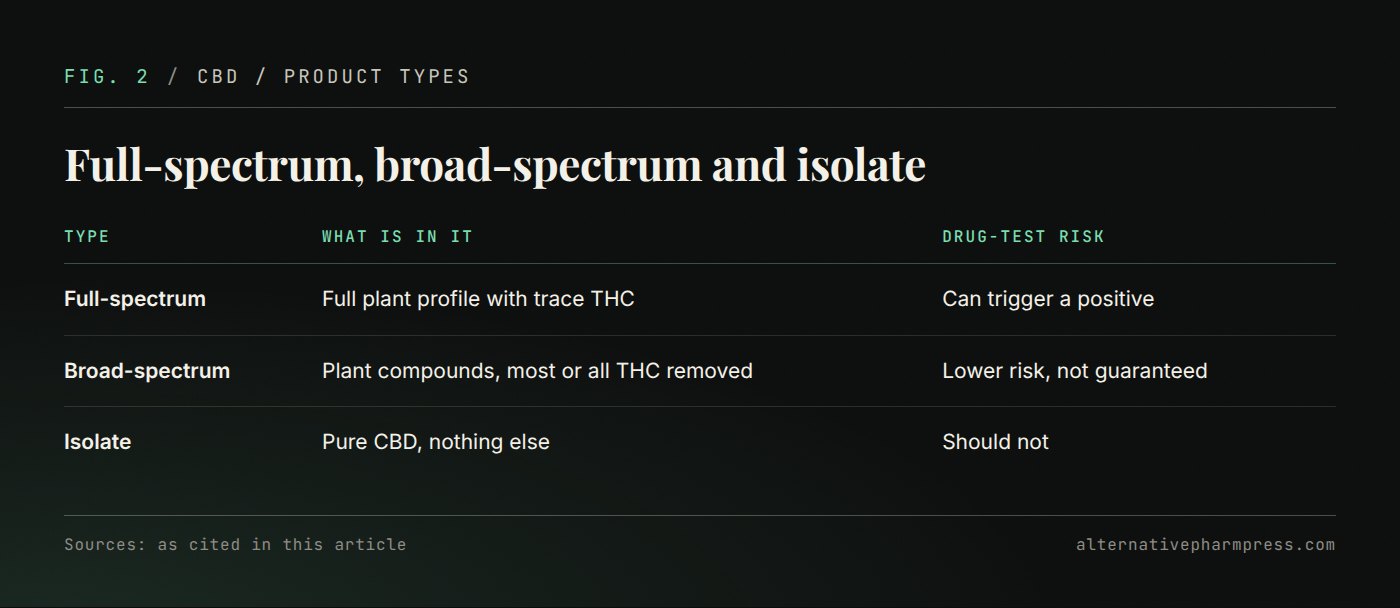
Full-spectrum keeps the plant’s natural range of compounds, including a trace of THC under the legal limit. Broad-spectrum keeps many of those compounds but has most or all of the THC removed. Isolate is pure CBD with everything else stripped out. None of these is automatically “best.” The right pick depends on what you want from the product and whether trace THC is a concern for you, for example if you get drug tested. When you’re comparing products, our guide on what to check before buying CBD online walks through how to confirm the spectrum on the label against the lab report.
Legality: federal vs state
Here’s where it gets practical. At the federal level, hemp and hemp-derived CBD (under 0.3% delta-9 THC) are legal thanks to the 2018 Farm Bill. Delta-9 THC above that limit is not. But states write their own rules on top of the federal baseline, and some are stricter. A few states restrict or ban certain hemp-derived products even when they meet the federal definition.
The takeaway: federally legal does not guarantee legal where you live. Check your state’s current rules before you order, because they change often. The FDA’s consumer page on cannabis and CBD and the USDA hemp program are useful starting points for the federal side.
Drug tests: the part people forget
A standard drug test usually screens for THC and its metabolites, not CBD. That’s the crux of the drug-test question. Pure CBD isolate shouldn’t trigger a positive, but full-spectrum products contain trace THC, and that trace can build up in your system or show up on a sensitive test. Broad-spectrum sits in between, with most THC removed but no guarantee it’s all gone.
If your job tests you, the safer choices are broad-spectrum or isolate, and you should still read the COA to confirm the THC content. No product can be honestly promised as undetectable, so factor that into your decision rather than trusting a label that says “THC-free.”
Quick comparison table
| Term | What it is | Intoxicating? | Typical legal status (US) | Shows on a drug test? |
|---|---|---|---|---|
| Hemp | Cannabis plant under 0.3% delta-9 THC by dry weight | No | Federally legal; some state limits | The plant itself, no; products vary |
| CBD | Non-intoxicating cannabinoid, often from hemp | No | Hemp-derived federally legal; check state | Pure CBD, no; full-spectrum can |
| THC (delta-9) | Intoxicating cannabinoid | Yes | Illegal over 0.3% federally; varies by state | Yes, this is what tests look for |
| Full-spectrum | Full plant profile with trace THC | No (trace THC under limit) | Follows hemp-derived rules | Can trigger a positive |
| Broad-spectrum | Plant compounds, most/all THC removed | No | Follows hemp-derived rules | Lower risk, not guaranteed |
| Isolate | Pure CBD, nothing else | No | Follows hemp-derived rules | Should not |
So which one do you want?
Sort it out in this order. First, decide whether you want any intoxicating effect; if not, you’re in CBD or hemp territory, not delta-9 THC. Second, check whether drug testing applies to you, which steers you toward broad-spectrum or isolate. Third, confirm your state’s rules. Fourth, and this is the one we never skip, read the lab report for the specific product so the label’s claims match the testing. If you want help with that last step, our guide on how to read a COA applies directly.
From there, our roundup of the best full-spectrum CBD brands of 2026 and the full brand directory can point you to specific names worth a look.
Frequently asked questions
Is CBD the same as THC?
No. Both are cannabinoids found in cannabis, but CBD is non-intoxicating and THC is the compound that produces a high. They behave differently in the body and sit in very different legal categories, which is why the distinction matters when you shop.
Will hemp-derived CBD get me high?
No, CBD itself is non-intoxicating. Full-spectrum products do contain a trace of THC under the legal limit, but that amount isn’t intended to produce a high. If you want to avoid THC entirely, look at broad-spectrum or isolate.
Is CBD legal everywhere in the US?
Hemp-derived CBD under 0.3% delta-9 THC is federally legal, but states set their own rules and some are stricter. Federally legal doesn’t guarantee it’s legal where you live, so check your state’s current laws before buying, since they change often.
Can CBD make me fail a drug test?
Pure CBD shouldn’t, since tests screen for THC, not CBD. But full-spectrum products contain trace THC that can accumulate and trigger a positive on sensitive tests. If you’re tested for work, broad-spectrum or isolate carries less risk, though nothing can be promised as undetectable.
What’s the difference between full-spectrum, broad-spectrum, and isolate?
Full-spectrum keeps the plant’s natural compounds including trace THC, broad-spectrum removes most or all THC while keeping other compounds, and isolate is pure CBD. None is automatically better; the right choice depends on your preferences and any drug-testing concerns.
Editorial note: This article is for general information only and is not medical or legal advice. These products have not been evaluated by the FDA to diagnose, treat, cure, or prevent any disease. Laws vary by location and change often, so verify the rules that apply to you. Always talk to a licensed healthcare provider before use, especially if you are under 21, pregnant or nursing, taking medication, or managing a health condition.
Unlike THC, CBD carries no dependence potential of its own. See Is CBD Addictive? for what the WHO’s review found.
More comparisons
-
CBD Gummies vs CBD Oil: Absorption, Onset and Label Accuracy
-
CBN vs Melatonin: What Sleep Trials and Regulators Actually Say
-
CBD Isolate vs Full Spectrum: Drug Tests, Entourage Claims and Law
-
CBD Oil vs Hemp Oil: Seed Oil, Flower Extract and Label Traps
-
CBN vs CBD: Sleep Claims, Trial Results and Key Differences