


Yes, you can overdose on kratom, but the risk depends heavily on the product. Deaths involving leaf kratom alone appear rare, and most kratom-linked deaths involve other drugs, especially opioids. Concentrated 7-OH products are different: 7-OH is a potent opioid that suppresses breathing in animal studies, and human overdoses reversed with naloxone have been reported.1,2,8,9
Two arguments run side by side in kratom forums. Long-term leaf users say overdosing on plain leaf is close to impossible because nausea and vomiting set a natural limit. Partners of people using 7-OH describe emergencies that needed several doses of naloxone. The evidence supports parts of both, and it does not support the idea that any amount of any kratom product is safe. Toxicologists say the toxic dose of 7-OH is unknown and no safe dose can be recommended.15
This article sets out what US death data, poison-centre reports and toxicology studies show, what is known about 7-OH and breathing, whether naloxone works, the warning signs of overdose and what to do. For background on the plant, see our kratom research hub. If someone is unresponsive or breathing slowly, call 911 now.
At a glance
| Question | What the evidence shows |
|---|---|
| Kratom-only deaths | Rare: 7 of 152 kratom-positive overdose deaths in CDC data had no other substance detected1 |
| Other drugs involved | 79% of 233 kratom-associated deaths reported to poison centres in 2015 to 20252 |
| Most common co-drugs | Opioids, especially fentanyl; then benzodiazepines, stimulants and alcohol1,2 |
| 7-OH and breathing | Suppressed breathing in rats, 4.5 times more potently than morphine8 |
| Mitragynine and breathing | Increased breathing rate in the same rat study8 |
| Naloxone | Reversed 7-OH breathing suppression in rats and humans; response to kratom variable8,9,10,15 |
| Seizures | Reported in poison-centre data and case reports3,16,17 |
| Good Samaritan laws | All 50 states and DC, as of July 202520 |
Can you overdose on kratom? What death reports show
The most cited US data come from the CDC’s 2019 report on its State Unintentional Drug Overdose Reporting System. Of 27,338 overdose deaths recorded in up to 27 states between July 2016 and December 2017, 152 (0.56%) tested positive for kratom. Medical examiners judged kratom a cause of death in 91 of them, including seven in which kratom was the only substance detected, although the CDC noted that other substances could not be ruled out.1
Almost all of these decedents had several drugs in their system. Fentanyl was listed as a cause in 65.1% of kratom-positive deaths, followed by heroin (32.9%), benzodiazepines (22.4%), prescription opioids (19.7%) and cocaine (18.4%). About 80% had a history of substance misuse. Testing methods varied, so the true number of kratom-positive deaths may be higher.1
The CDC’s 2026 analysis of poison-centre data tells a similar story at larger scale. US poison centres logged 14,449 kratom exposure reports between 2015 and 2025, rising from 258 to 3,434 a year, an increase of about 1,200%, with a marked surge in 2025 that coincided with high-potency semi-synthetic products such as 7-OH. Of 233 kratom-associated deaths, 184 (79%) involved more than one substance. Opioids were reported in 62% of fatalities, benzodiazepines and stimulants in 20% each, and alcohol in 19%. Reports involving several substances also led to hospitalisation far more often (44% to 56% a year, against 24% to 29% for kratom alone).2
One important limitation: poison-centre records do not say whether a person used traditional leaf or a concentrated 7-OH product, so these figures cannot separate the two.2
Do “kratom-only” deaths happen?
A common question in kratom forums is whether “kratom-only” deaths are real or reflect adulterants and incomplete testing. The honest answer is that they are rare but documented. A 2022 report described two young men whose deaths were certified as acute mitragynine intoxication with no other drugs found.5 A 2026 systematic review of 24 pulmonary case reports and forensic series found that single-agent deaths involved high mitragynine concentrations.7 On the other hand, in 28 Oklahoma death investigations from 2022 and 2023, 22 listed mitragynine as a cause, and 21 of those named at least one other drug too.6 An earlier CDC poison-centre review recorded one death in 660 calls between 2010 and 2015, in a person who had also taken paroxetine and lamotrigine.4
The vomiting argument has some basis. In a survey of 8,049 US users, unwanted effects were mostly gastrointestinal, such as nausea, and appeared mainly at high and frequent doses.24 But vomiting does not protect against seizures, mixing with sedatives or concentrated extracts, and poison-centre reports include people who stopped breathing.3 Our guide to kratom extracts vs powder explains why concentrated products change the calculation.
Can you overdose on 7-OH? The respiratory depression evidence
Leaf and 7-OH behave very differently on breathing. In a 2025 study in rats, given intravenous doses and monitored for breathing, 7-OH reduced breathing rate, depth and minute volume, as morphine did, and was 4.5 times more potent than morphine at halving minute volume. Naloxone fully reversed those effects. Mitragynine, the main leaf alkaloid, instead increased breathing rate, an effect naloxone did not change.8 A human study of leaf powder notes that mitragynine, unlike morphine, does not activate the beta-arrestin-2 pathway linked to respiratory depression.23 Our explainer on kratom and opioid receptor research covers the receptor science.
Human evidence is following. A 2026 report described a cardiopulmonary arrest in a patient revived with naloxone after reported 7-OH use.9 The DEA’s October 2026 scheduling notice says its toxicology programme has identified 7-OH in 85 cases since 2019, 55 of them fatal, with samples often also containing other kratom alkaloids or drugs such as fentanyl, bromazolam or ketamine. A related semi-synthetic compound, mitragynine pseudoindoxyl, appeared in at least 31 overdose cases between February 2025 and February 2026, 25 of them fatal.14 Poison-centre reports on 7-OH listed loss of consciousness, seizures and difficulty breathing among symptoms.14
Product strength explains part of the gap. A 2026 potency analysis by a consultancy estimated mean morphine-equivalent values per serving ranging from 2.7 for kratom powders to 31 for tablets, in a product set that included concentrated 7-OH and pseudoindoxyl products.22 The American College of Medical Toxicology says concentrated products have been linked to overdose and death and advises against using 7-OH outside monitored research.15 See our comparison of 7-OH vs traditional kratom for more.
Does naloxone (Narcan) work on kratom and 7-OH?
For 7-OH, the evidence says yes. Naloxone fully reversed 7-OH’s breathing suppression in rats,8 revived the patient in the 2026 cardiac arrest case,9 and toxicologists state that it has been effective at reversing 7-OH-associated respiratory depression in animal studies and human case reports.15
For kratom more broadly, responses have been mixed:
- In ten Czech poisoning cases, naloxone helped in two and failed in one; all ten survived, and effects wore off within two days.11
- A US woman with low oxygen levels after a large amount of gas-station kratom recovered with naloxone.12
- A young man found with agonal breathing responded minimally to naloxone, needed intubation and came off the ventilator on day 14.13
A 2026 review offers two explanations. Products differ in which alkaloids dominate, and only opioid-receptor effects respond to naloxone. Timing matters too: naloxone acts for 30 to 90 minutes, while mitragynine’s half-life can reach 68 hours, so breathing problems can return after an initial response. The authors describe delayed or recurrent respiratory depression, support repeat naloxone where needed, and advise observation guided by the patient’s course rather than first response.10 That fits forum accounts of 7-OH emergencies needing more than one dose.
Naloxone is easy to get. The FDA approved the first over-the-counter naloxone nasal spray in March 2023, and it can be given by people with or without medical training.19
Seizures and other overdose dangers
Breathing is not the only risk. In one analysis of US poison-centre data, covering 2,312 kratom exposures of which 935 involved kratom alone, reported serious effects included seizures (6.1%), hallucinations (4.8%), respiratory depression (2.8%), coma (2.3%) and cardiac or respiratory arrest (0.6%).3 A 2010 case confirmed by urine testing described a 64-year-old man who had two seizures and fell into a coma after kratom,16 and neurologists have reported breakthrough seizures linked to kratom in three people being treated for epilepsy.17 Seizures also feature in 7-OH poison-centre reports.14
Interactions raise the stakes. The CDC’s 2026 authors point to additive effects with alcohol, opioids, benzodiazepines, stimulants and antidepressants, and to drug-metabolism interactions that raise blood levels.2 Our guides to kratom and drug interactions and kratom and alcohol cover these. Lower tolerance is another hidden risk: after stopping opioid-type substances, most opioid overdose deaths occur in people who have just detoxed and return to an old dose.26 Our article on kratom withdrawal explains why tolerance drops.
Signs of overdose and what to do
The CDC lists these signs of opioid overdose: being unconscious or impossible to wake; slow, shallow or difficult breathing, including choking, gurgling or snoring sounds; discoloured skin, especially lips and nails; and small, pinpoint pupils.18
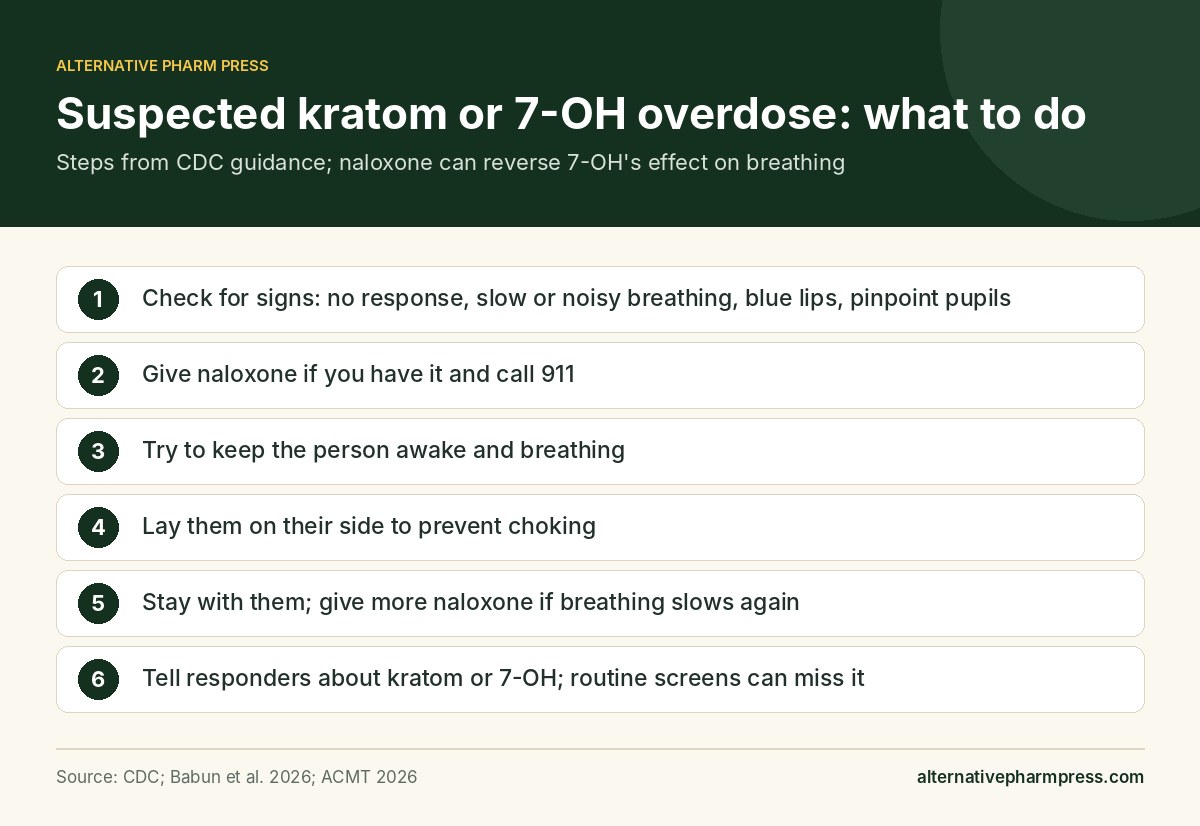
- Give naloxone if you have it and call 911.18
- Try to keep the person awake and breathing.18
- Lay them on their side to prevent choking.18
- Stay with them until help arrives.18 Be ready to give more naloxone if breathing slows again, and make sure they are assessed in hospital even if they wake up, because symptoms can return.10
- Tell responders exactly what was taken, including kratom or 7-OH, and bring the packaging if you can. Routine opioid urine screens do not detect kratom alkaloids.10
For a worrying reaction that is not an emergency, call Poison Help on 1-800-222-1222.21 Harm reduction advice from toxicologists is simple: do not use 7-OH alone, do not combine it with alcohol, benzodiazepines or other sedatives, and keep naloxone where others can find it.15
Good Samaritan laws: calling 911 is protected
Fear of arrest stops some people calling for help. As of July 2025, all 50 states, the District of Columbia and the Northern Mariana Islands had Good Samaritan overdose laws. Their stated aim is to “prioritize the overdose victim’s safety over arresting drug users.”20 Protection from low-level possession charges is the norm, although Iowa, Texas, Utah and the Northern Mariana Islands take a different approach; 39 states and DC expressly cover paraphernalia, and 27 states and DC cover probation or parole violations.20 Details vary, so check your state, but the laws exist to encourage calling.
That matters more as rules change. On 14 October 2026 the DEA published a revised notice of intent to place 7-OH above a set threshold temporarily in Schedule I; the order cannot be published before 13 November 2026, and plain leaf is not covered.14 Our explainer on where 7-OH scheduling stands has the detail.
Getting help
If you use 7-OH or kratom daily and want to cut down or stop, talk to a clinician. Our article on Suboxone for kratom and 7-OH withdrawal explains the treatment options. The SAMHSA National Helpline, 1-800-662-4357, offers free, confidential treatment referral 24 hours a day.25 For suicidal thoughts, call or text 988.26
Frequently asked questions
Can you overdose on kratom?
Yes, although deaths from leaf kratom alone appear rare. In CDC data on 152 kratom-positive overdose deaths, only seven had no other substance detected, and most involved fentanyl or other opioids.1 Poison-centre reports also describe seizures, coma and breathing problems.3 Risk rises with concentrated extracts, 7-OH products and mixing with other drugs or alcohol.
Can you overdose on 7-OH?
Yes. 7-OH is a potent opioid: in rats it suppressed breathing more potently than morphine, and a 2026 human report described cardiopulmonary arrest reversed with naloxone.8,9 The DEA reports 55 fatal cases among 85 toxicology cases involving 7-OH since 2019, often with other drugs present.14 Toxicologists say no safe dose can be recommended.15
Does Narcan work on kratom or 7-OH?
Naloxone (Narcan) has reversed 7-OH breathing suppression in animal studies and human cases.8,15 Responses to kratom poisoning are less consistent, because mitragynine’s effects on breathing are not mainly opioid-driven.8,11 Because kratom alkaloids can outlast naloxone, symptoms may return, so more than one dose and hospital observation may be needed.10 Always call 911 as well.
How many deaths are caused by kratom alone?
Very few are documented. The CDC found seven deaths with only kratom detected among 27,338 overdose deaths reviewed in 2016 and 2017, and could not rule out other substances.1 Poison centres recorded 233 kratom-associated deaths over 2015 to 2025, 79% involving other substances.2 Forensic reports confirm occasional single-substance mitragynine deaths.5
What should I do if someone overdoses on 7-OH?
Give naloxone if you have it and call 911, then try to keep the person awake and breathing, lay them on their side and stay with them.18 Give more naloxone if breathing slows again, and tell responders about the 7-OH. Good Samaritan laws in every state offer some protection to people who call for help.20
Sources
- Olsen EO, O’Donnell J, Mattson CL, Schier JG, Wilson N. Notes from the Field: Unintentional Drug Overdose Deaths with Kratom Detected, 27 States, July 2016-December 2017. MMWR Morb Mortal Wkly Rep. 2019;68(14):326-327. DOI: 10.15585/mmwr.mm6814a2. PMID: 30973850. pubmed.ncbi.nlm.nih.gov
- Towers EB, Thomas YT, Holstege CP, Farah R. Increases in Kratom-Related Reports to Poison Centers, National Poison Data System, United States, 2015-2025. MMWR Morb Mortal Wkly Rep. 2026;75(11):139-145. DOI: 10.15585/mmwr.mm7511a1. PMID: 41886310. pubmed.ncbi.nlm.nih.gov
- Eggleston W, Stoppacher R, Suen K, Marraffa JM, Nelson LS. Kratom Use and Toxicities in the United States. Pharmacotherapy. 2019;39(7):775-777. DOI: 10.1002/phar.2280. PMID: 31099038. pubmed.ncbi.nlm.nih.gov
- Anwar M, Law R, Schier J. Notes from the Field: Kratom (Mitragyna speciosa) Exposures Reported to Poison Centers, United States, 2010-2015. MMWR Morb Mortal Wkly Rep. 2016;65(29):748-749. DOI: 10.15585/mmwr.mm6529a4. PMID: 27466822. pubmed.ncbi.nlm.nih.gov
- Behonick GS, Vu C, Czarnecki L, El-Ters M, Shanks KG. Two Single-Drug Fatal Intoxications by Mitragynine. J Anal Toxicol. 2022;46(5):e110-e114. DOI: 10.1093/jat/bkac016. PMID: 35285475. pubmed.ncbi.nlm.nih.gov
- Kliewer RS, Kemp JM, Cliburn KD, Jourdan TH. Determination of mitragynine concentrations in medicolegal death investigations at the Oklahoma Office of the Chief Medical Examiner from 2022 to 2023. J Forensic Sci. 2026;71(5):2305-2312. DOI: 10.1111/1556-4029.70370. PMID: 42210044. pubmed.ncbi.nlm.nih.gov
- Kanchustambham V, Saladi S. Kratom-Associated Pulmonary Toxicity: A Systematic Review of Case Reports and Forensic Series with a Proposed Clinical Phenotype Classification. J Med Toxicol. 2026;22(4):480-489. DOI: 10.1007/s13181-026-01153-5. PMID: 42661120. pubmed.ncbi.nlm.nih.gov
- Zuarth Gonzalez JD, Ragsdale AK, Mukhopadhyay S, McCurdy CR, McMahon LR, Obeng S, et al. Mitragynine and 7-hydroxymitragynine: Bidirectional effects on breathing in rats. J Pharmacol Exp Ther. 2025;392(11):103720. DOI: 10.1016/j.jpet.2025.103720. PMID: 41106041. pubmed.ncbi.nlm.nih.gov
- Pullman MK, Kanumuri SRR, Leon JF, Cutler SJ, McCurdy CR, Sharma A. Cardio-pulmonary arrest in a patient revived with naloxone following reported use of 7-hydroxymitragynine. Clin Toxicol (Phila). 2026;64(1):65-66. DOI: 10.1080/15563650.2025.2565428. PMID: 41025553. pubmed.ncbi.nlm.nih.gov
- Babun AA, Evans BR, Volic IN, Wood S, Knighton K, Lopez F, et al. Kratom Toxicity: Pharmacologic Mechanisms, Clinical Risks, and Management Considerations. Cureus. 2026;18(7):e113280. DOI: 10.7759/cureus.113280. PMID: 42634663. pubmed.ncbi.nlm.nih.gov
- Peran D, Stern M, Cernohorsky P, Sykora R, Popela S, Duska F. Mitragyna speciosa (Kratom) poisoning: Findings from ten cases. Toxicon. 2023;225:107054. DOI: 10.1016/j.toxicon.2023.107054. PMID: 36801215. pubmed.ncbi.nlm.nih.gov
- Ahmed S, Tran QV, McLean M. The Great Imitator: A Case of Accidental Kratom Overdose. Cureus. 2023;15(8):e43144. DOI: 10.7759/cureus.43144. PMID: 37560054. pubmed.ncbi.nlm.nih.gov
- Palasamudram Shekar S, Rojas EE, D’Angelo CC, Gillenwater SR, Martinez Galvis NP. Legally Lethal Kratom: A Herbal Supplement with Overdose Potential. J Psychoactive Drugs. 2019;51(1):28-30. DOI: 10.1080/02791072.2018.1562591. PMID: 30620247. pubmed.ncbi.nlm.nih.gov
- Drug Enforcement Administration. Schedules of Controlled Substances: Temporary Placement of 7-Hydroxymitragynine and Mitragynine Pseudoindoxyl Above a Specified Threshold in Schedule I. 91 FR 65370, FR Doc. 2026-20943, Docket DEA-1570. 14 October 2026. federalregister.gov
- American College of Medical Toxicology. ACMT Position Statement: Public Health Concerns Associated with 7-Hydroxymitragynine and Other Kratom Compounds. August 2026. acmt.net
- Nelsen JL, Lapoint J, Hodgman MJ, Aldous KM. Seizure and coma following Kratom (Mitragynina speciosa Korth) exposure. J Med Toxicol. 2010;6(4):424-426. DOI: 10.1007/s13181-010-0079-5. PMID: 20411370. pubmed.ncbi.nlm.nih.gov
- Burke DJ, Mahonski SG, Van Cott AC. Breakthrough Seizure Associated With Kratom Use in Patients With Epilepsy. Neurol Clin Pract. 2021;11(1):78-84. DOI: 10.1212/CPJ.0000000000000846. PMID: 33968476. pubmed.ncbi.nlm.nih.gov
- Centers for Disease Control and Prevention. Responding to an Overdose. Reviewed 2 April 2024. cdc.gov
- US Food and Drug Administration. Information about Naloxone and Nalmefene. Updated 8 August 2024. fda.gov
- Legislative Analysis and Public Policy Association. Good Samaritan Fatal Overdose Prevention and Drug-induced Homicide: Summary of State Laws. July 2025. legislativeanalysis.org
- US Food and Drug Administration. Hiding in Plain Sight: 7-OH Products. Updated 12 October 2026. fda.gov
- Heywood J, Farnham H, Jackson E, Steimel K, Brown S, Riordan A. Beyond kratom: Concentrated 7-hydroxymitragynine and mitragynine pseudoindoxyl products, an MME potency assessment. Regul Toxicol Pharmacol. 2026;173:106272. DOI: 10.1016/j.yrtph.2026.106272. PMID: 42838255. pubmed.ncbi.nlm.nih.gov
- Huestis MA, Brett MA, Bothmer J, Atallah R. Human Mitragynine and 7-Hydroxymitragynine Pharmacokinetics after Single and Multiple Daily Doses of Oral Encapsulated Dried Kratom Leaf Powder. Molecules. 2024;29(5):984. DOI: 10.3390/molecules29050984. PMID: 38474495. pubmed.ncbi.nlm.nih.gov
- Grundmann O. Patterns of Kratom use and health impact in the US: Results from an online survey. Drug Alcohol Depend. 2017;176:63-70. DOI: 10.1016/j.drugalcdep.2017.03.007. PMID: 28521200. pubmed.ncbi.nlm.nih.gov
- Substance Abuse and Mental Health Services Administration. SAMHSA’s National Helpline. samhsa.gov
- MedlinePlus, US National Library of Medicine. Opiate and opioid withdrawal. Reviewed 15 May 2026. medlineplus.gov
Featured image: Ambulance by gwire, CC BY 2.0. Cropped.
This article is for educational purposes only and is not medical or legal advice. Products discussed here are not intended to diagnose, treat, cure or prevent any disease. Laws vary by location and change often, so verify the rules that apply where you are. Always talk to a licensed healthcare provider before use, especially if you are under 21, pregnant or nursing, taking medication, or managing a health condition.