


Suboxone (buprenorphine with naloxone) is the medicine US clinicians most often use for kratom and 7-OH dependence, and published case series report good short-term results. But no controlled trial has tested it for this use, and experts advise against routine use for mild leaf withdrawal because it can create a new opioid dependence.1,2,3
The case for buprenorphine is strongest for people using concentrated 7-OH products or with a history of opioid use disorder, and weakest for occasional or light leaf use. Where someone sits on that spectrum is a decision to make with a prescriber, not alone.
This article covers what the case series show, why starting buprenorphine needs clinical supervision, the honest trade-offs of long-term treatment, the alternatives, the telehealth rules in force in 2026 and how to find a provider. For symptoms and timelines, see our guides to kratom withdrawal and 7-OH withdrawal, or browse the kratom research hub.
At a glance
| Question | What the evidence shows |
|---|---|
| What Suboxone is | Buprenorphine plus naloxone, FDA-approved for opioid use disorder24 |
| Approved for kratom? | No; no controlled trials for kratom use disorder1 |
| Evidence base | Case reports and small retrospective series1,3,4 |
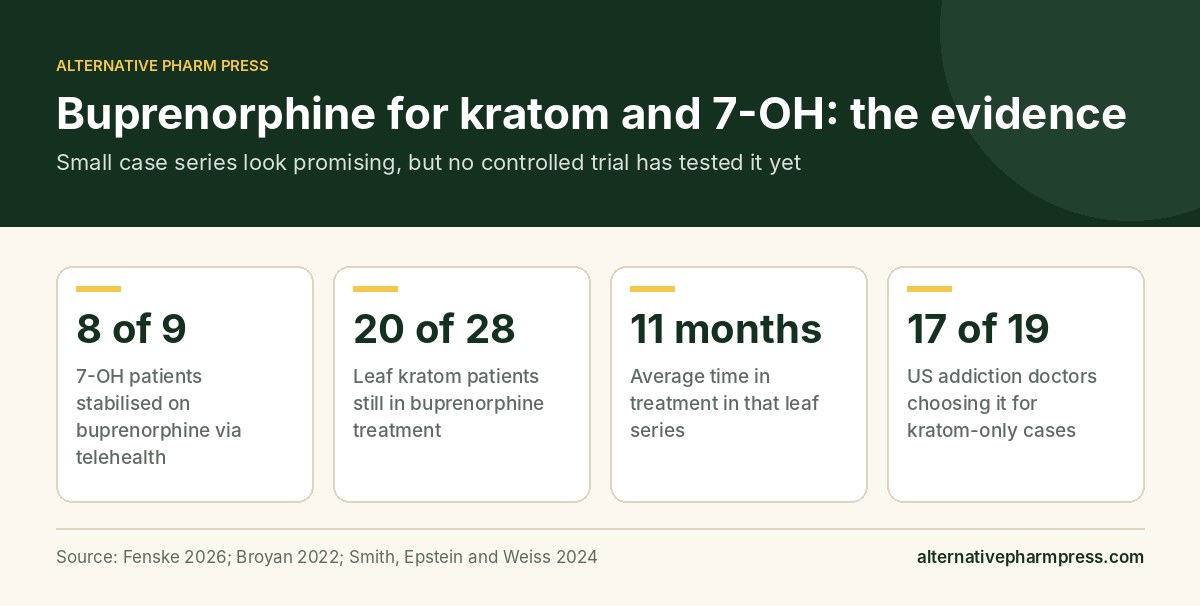
| 7-OH results | 8 of 9 telehealth patients stabilised, no precipitated withdrawal3 |
| Leaf results | 20 of 28 patients still in treatment at follow-up4 |
| Main start-up risk | Precipitated withdrawal if started at the wrong time8,9 |
| Expert caution | Not first-line for most leaf withdrawal2 |
| Telehealth (2026) | Federal flexibilities run to 31 December 202615 |
What clinicians say about Suboxone for kratom withdrawal
A 2024 review by researchers at Johns Hopkins and the National Institute on Drug Abuse found buprenorphine or buprenorphine-naloxone was the most frequent approach to kratom dependence in the US, often in patients who also had opioid use disorder. In a survey it cites, 17 of 19 US addiction physicians who had treated kratom use disorder without opioid use disorder chose buprenorphine; 3 had used naltrexone and 1 methadone. The authors stress there are no controlled studies showing buprenorphine is safe or effective for this group.1
Their recommendations split by situation. When kratom use disorder comes with opioid use disorder, medication for opioid use disorder should be first-line, as it would be for anyone with opioid addiction. When kratom is the only problem, starting buprenorphine should follow a careful, shared weighing of risks and benefits, with informed consent about all the options.1
A 2023 expert forum went further. It judged leaf withdrawal generally milder than opioid withdrawal and said methadone and buprenorphine should not be first-line, and should be used only judiciously, especially in people without prior opioid use, because they may produce opioid tolerance, physical dependence and possibly an opioid use disorder that was not there before.2 In 2026, the American College of Medical Toxicology said buprenorphine has been used successfully for kratom and 7-OH withdrawal and recommended longitudinal care.21
So the forum argument over whether buprenorphine is overkill has a factual basis on both sides. In a survey of 2,061 US consumers, most of those meeting criteria for kratom use disorder had mild or moderate forms.25 For them, the risk-benefit balance differs from someone taking 7-OH tablets many times a day.
The case series: buprenorphine for leaf kratom
| Study | Patients | Key findings |
|---|---|---|
| Weiss and Douglas, 20215 | 8 (6 from the literature, 2 from clinic) | Strong correlation (0.84) between kratom amount and buprenorphine needed |
| Broyan et al., 20224 | 28 in outpatient care | 20 still in treatment; 82% negative for mitragynine at 12 weeks; no link between kratom amount and stabilising dose |
| Kiyokawa et al., 20236 | 2, seen by telehealth | Unobserved home starts with no adverse effects; stabilised on very different doses |
| Swart et al., 20247 | 1, kratom only | After years of withdrawal episodes and trials of naltrexone, stabilised on buprenorphine, later tapered off |
| Hernandez et al., 202627 | 1, with chronic pain | Pharmacist-led start managed pain and kratom dependence without significant withdrawal |
The pattern is encouraging but fragile. Every study is retrospective and uncontrolled, and successful cases are more likely to be written up. The early dose correlation was not confirmed in the larger series, so reviewers now recommend that dosing be individualised by the prescriber.1,4 Broyan’s patients stayed in treatment between 5 and 22 months, an average of 11 months, which says something about how long treatment can last.4
Suboxone for 7-OH withdrawal: why the case is stronger
Concentrated 7-OH is a more potent opioid than leaf, and its withdrawal looks more like classic opioid withdrawal.11 The best data come from a 2026 retrospective series at a low-barrier telehealth addiction clinic. Nine patients using purified 7-OH products (mean age 33.5; seven men) were treated between April and October 2025. Clinicians used low-dose initiation in six and standard initiation in three. Initiation and stabilisation succeeded in 88.9%, or 8 of 9, with no precipitated withdrawal or adverse events, and eight reported improvement at a median six-week follow-up.3
Other 2026 reports point the same way. US community paramedics gave buprenorphine to two people in severe withdrawal from 7-OH and a related compound, MGM-15, and both were still in treatment at 30 days; the authors noted that a full buprenorphine start was needed.12 A Hawaii case described a woman who had used kratom to get off illicit opioids, moved to 7-OH, developed tolerance and suicidal thoughts, and was treated with buprenorphine-naloxone.26
The DEA’s revised notice of intent, published 14 October 2026, would temporarily place 7-OH above a set threshold in Schedule I; the order cannot be published before 13 November 2026.22 People who are physically dependent on these products have good reason to talk to a clinician before supply changes. Our explainer on where 7-OH scheduling stands covers the threshold.
Precipitated withdrawal: why starting Suboxone needs a prescriber
The most common fear in forum threads is precipitated withdrawal, and it is a real risk. Buprenorphine is a partial opioid agonist that binds very tightly to the mu-opioid receptor. If a stronger opioid is still occupying those receptors, buprenorphine can displace it while activating them less, which can plunge someone into sudden, intense withdrawal. That is why drug labels and guidelines have traditionally advised waiting until there are clear, objective withdrawal signs before the first dose.8
Kratom makes that timing harder to judge. Mitragynine lingers, with a half-life of up to about 68 hours after repeated leaf dosing, while 7-OH clears faster.28 A 2025 case shows how complicated this can get: a patient stopping 7-OH and high-dose nicotine pouches together became severely unwell, needing intensive care, and the course was further complicated by precipitated withdrawal after buprenorphine was started.9 We deliberately give no waiting times or doses here; the right timing depends on the product, the pattern of use and the person.
Low-dose (“micro”) induction and the Bernese method
Some clinicians avoid the waiting period with low-dose initiation, which starts buprenorphine in very small amounts while the person is still using their usual opioid, then builds up. Swiss doctors described this “Bernese method” in 2016 in two patients, one of whom had repeatedly struggled with conventional starts; both reported only mild withdrawal.8 Six of the nine 7-OH patients in the telehealth series were started this way.3 It is a clinician-designed schedule that needs monitoring and adjustment, not a home protocol to copy from a forum.
Naltrexone carries a mirror-image risk. As an opioid blocker, it can trigger severe withdrawal if given too soon;11 a 2026 report described exactly that in a patient with kratom use disorder, who was then treated with buprenorphine.10
Is Suboxone harder to quit than kratom?
One widely shared forum view holds that Suboxone was harder to quit than the kratom it replaced. No study has compared the two directly, but several points are worth weighing.
- Buprenorphine causes physical dependence. That is how it works. The expert forum’s concern is precisely that it may introduce opioid dependence in someone who only used kratom.2
- Stopping it carries risks, at least in opioid use disorder. In a Medicaid study of people with opioid use disorder who stopped buprenorphine after at least six months, about 5% had a medically treated overdose within six months, and outcomes were better for those treated longer than 15 months.14 Those patients are not the same as people with kratom-only dependence.
- Tapering off is possible. In one kratom-only case, a patient was tapered off buprenorphine after a period without kratom, using monthly extended-release injections.7
- The goal matters. Short-term stabilisation followed by a planned taper, and longer maintenance, are both used. Reviewers recommend making that choice jointly, with full information about every option.1
For someone whose alternative is escalating 7-OH use or illicit opioids, staying on a prescribed, predictable medicine may be the lower-risk path. For a light leaf user, it may not be. Our article on 7-OH tolerance explains why use tends to escalate with concentrated products.
Alternatives: naltrexone, methadone and non-opioid care
- Naltrexone. Reviewers consider it reasonable for some people with kratom-only use disorder, partly because it is opioid-free, although there is no evidence of efficacy.1 In a 2026 case of withdrawal from mitragynine pseudoindoxyl, a semi-synthetic alkaloid, clinicians started naltrexone once the patient had been opioid-free long enough, and a later lapse produced no euphoria.11
- Methadone. Not first-line for kratom alone.1 A 2026 report described 14 patients treated with methadone in opioid treatment programmes, 64% of whom used both kratom and 7-OH, and found it well tolerated.13
- Non-opioid symptom relief. Clonidine and lofexidine, which ease opioid withdrawal through a different mechanism, have been proposed for formal study in kratom withdrawal, along with gradual dose reduction.2 Inpatient teams have also used anti-sickness, anti-diarrhoeal and anti-anxiety medicines.11
- Talking therapies. Contingency management and cognitive behavioural therapy are low-risk additions, though unproven for kratom.1
A 2026 survey of Malaysian doctors found opioid agonists were commonly used for kratom withdrawal, and the authors cautioned that opioid-based treatment may not fully address kratom’s distinct pharmacology.23
Telehealth Suboxone in 2026: what the rules allow
Getting buprenorphine has become easier in several steps.
- No special waiver. The Consolidated Appropriations Act, 2023 removed the federal requirement for practitioners to submit a notice of intent, the so-called X-waiver, before prescribing buprenorphine for opioid use disorder.18
- Temporary telemedicine flexibilities. A fourth temporary extension by the DEA and HHS lets DEA-registered practitioners prescribe Schedule II to V medicines by telemedicine without an in-person evaluation, if conditions are met, from 1 January to 31 December 2026.15
- A permanent buprenorphine rule. The DEA’s January 2025 rule on buprenorphine by telemedicine took effect on 31 December 2025.15 It allows an initial six-month supply after a telemedicine visit, including audio-only, provided the prescriber checks the state prescription drug monitoring database; later prescriptions can continue by other permitted telemedicine routes or after an in-person evaluation.16
- What comes next. The DEA sent a final “special registration” rule for telemedicine to White House review on 25 August 2026, with final action anticipated in November, though that date is not binding.17
Two of the published reports, the 7-OH series and the two home-start cases, show this route is already used for kratom-related dependence.3,6 If you go this way, ask whether the service treats kratom or 7-OH, how it handles drug testing and what happens if federal rules change after 31 December 2026.
How to find treatment
- FindTreatment.gov, SAMHSA’s confidential, anonymous locator for substance use and mental health treatment.20
- SAMHSA National Helpline: 1-800-662-4357, free and confidential, 24 hours a day, in English and Spanish.19
- Your own doctor, now that no separate federal waiver is needed to prescribe buprenorphine for opioid use disorder.18
Tell any clinician the exact product, how often you use it and when you last did. Standard drug screens do not detect kratom alkaloids, so reviewers recommend confirmatory laboratory testing; our guide to whether kratom shows up on a drug test and our explainer on how long 7-OH stays in your system explain why.1,11 Mention any other substances too; kratom drug interactions can affect treatment. The ACMT also advises people who use 7-OH to carry naloxone and not use alone.21 For the overdose side, see can you overdose on kratom or 7-OH?
Frequently asked questions
Does Suboxone work for kratom withdrawal?
Case reports and small series suggest it can, especially for heavy use and 7-OH: eight of nine 7-OH patients in one 2026 telehealth series were stabilised.3 But no controlled trial has tested it, and experts advise against routine use for mild leaf withdrawal because it can create new opioid dependence.1,2 Whether it suits you is a decision to make with a prescriber.
Can Suboxone cause precipitated withdrawal after kratom or 7-OH?
Yes. Buprenorphine binds tightly to opioid receptors but activates them less than stronger opioids, so starting it too early can trigger sudden, severe withdrawal.8 This has been reported after 7-OH use.9 Clinicians manage the risk by timing the first dose carefully or using low-dose initiation, which is why starting it should be supervised rather than improvised.
Is Suboxone harder to quit than kratom?
No study has compared them directly. Buprenorphine does cause physical dependence, and experts worry it can introduce opioid dependence in people who only used kratom.2 Tapering off has been reported in a kratom-only case.7 For people using concentrated 7-OH, a predictable prescribed medicine may carry less risk than continued or escalating use.
Can I get Suboxone for 7-OH through telehealth?
Often, yes. Federal flexibilities allow telemedicine prescribing of controlled medicines without an in-person visit until 31 December 2026, and a DEA rule effective 31 December 2025 allows an initial six-month buprenorphine supply after a telemedicine visit.15,16 Services differ in what they offer, so ask the provider directly whether it treats kratom or 7-OH.
What are the alternatives to Suboxone for kratom dependence?
Options described in the literature include naltrexone, methadone in selected patients, non-opioid medicines such as clonidine for symptoms, gradual dose reduction and talking therapies.1,2,13 None has been tested in a controlled trial for kratom. A clinician or the SAMHSA helpline (1-800-662-4357) can help you weigh them.
Sources
- Smith KE, Epstein DH, Weiss ST. Controversies in Assessment, Diagnosis, and Treatment of Kratom Use Disorder. Curr Psychiatry Rep. 2024;26(9):487-496. DOI: 10.1007/s11920-024-01524-1. PMID: 39134892. pubmed.ncbi.nlm.nih.gov
- Henningfield JE, Chawarski MC, Garcia-Romeu A, Grundmann O, Harun N, Hassan Z, et al. Kratom withdrawal: Discussions and conclusions of a scientific expert forum. Drug Alcohol Depend Rep. 2023;7:100142. DOI: 10.1016/j.dadr.2023.100142. PMID: 37397437. pubmed.ncbi.nlm.nih.gov
- Fenske E, Williams B, Hallock-Koppelman L, Buchheit BM. Buprenorphine for the Management of 7-Hydroxymitragynine (7-OH) Use: A Retrospective Case Series. J Addict Med. 2026 (published online 1 June 2026). DOI: 10.1097/ADM.0000000000001723. PMID: 42225057. pubmed.ncbi.nlm.nih.gov
- Broyan VR, Brar JK, Allgaier Student T, Allgaier JT. Long-term buprenorphine treatment for kratom use disorder: A case series. Subst Abus. 2022;43(1):763-766. DOI: 10.1080/08897077.2021.2010250. PMID: 35112990. pubmed.ncbi.nlm.nih.gov
- Weiss ST, Douglas HE. Treatment of Kratom Withdrawal and Dependence With Buprenorphine/Naloxone: A Case Series and Systematic Literature Review. J Addict Med. 2021;15(2):167-172. DOI: 10.1097/ADM.0000000000000721. PMID: 32858563. pubmed.ncbi.nlm.nih.gov
- Kiyokawa M, Kwon AK, Cape MC, Streltzer JM. Kratom use disorder: case reports on successful treatment with home induction of buprenorphine-naloxone. Fam Pract. 2023;40(4):596-598. DOI: 10.1093/fampra/cmad081. PMID: 37499179. pubmed.ncbi.nlm.nih.gov
- Swart BB, Reznikoff C, Steen K. Isolated Kratom Use Disorder Treated With Extended-Release Buprenorphine Taper. J Addict Med. 2024;18(5):602-604. DOI: 10.1097/ADM.0000000000001328. PMID: 38776432. pubmed.ncbi.nlm.nih.gov
- Hämmig R, Kemter A, Strasser J, von Bardeleben U, Gugger B, Walter M, et al. Use of microdoses for induction of buprenorphine treatment with overlapping full opioid agonist use: the Bernese method. Subst Abuse Rehabil. 2016;7:99-105. DOI: 10.2147/SAR.S109919. PMID: 27499655. pubmed.ncbi.nlm.nih.gov
- Sharma A, Nair BS, Pemminati S. 7-Hydroxymitragynine and Nicotine Pouch Withdrawal Syndrome: A Case Report. Cureus. 2025;17(12):e98386. DOI: 10.7759/cureus.98386. PMID: 41487756. pubmed.ncbi.nlm.nih.gov
- Williams JB, Erskine NA, Holt AG, Stepanek KD, Saha S. A Case of Precipitated Withdrawal From Naltrexone Treated With Buprenorphine in a Patient With Kratom Use Disorder. J Clin Psychopharmacol. 2026;46(2):229-231. DOI: 10.1097/JCP.0000000000002126. PMID: 41486738. pubmed.ncbi.nlm.nih.gov
- Stanciu CN. Severe Early-Onset Withdrawal Following Intentional Use of Mitragynine Pseudoindoxyl: A Case Report and Emerging Clinical Considerations. Cureus. 2026;18(3):e105224. DOI: 10.7759/cureus.105224. PMID: 41982589. pubmed.ncbi.nlm.nih.gov
- Gormley MA, Wampler WR, Darby T, Mann D, McElmurray K, Brophy B, et al. Community Paramedics Addressing the Evolving Opioid Crisis: A Case Series Addressing the Kratom Derivatives 7-Hydroxymitragynine and MGM-15. Prehosp Emerg Care. 2026 (published online 22 October 2026). DOI: 10.1080/10903127.2026.2753000. PMID: 42911834. pubmed.ncbi.nlm.nih.gov
- Sherrick RC. Treatment of Kratom Use Disorder With Methadone in an Opioid Treatment Program. J Addict Med. 2026 (published online 12 February 2026). DOI: 10.1097/ADM.0000000000001666. PMID: 41673921. pubmed.ncbi.nlm.nih.gov
- Williams AR, Samples H, Crystal S, Olfson M. Acute Care, Prescription Opioid Use, and Overdose Following Discontinuation of Long-Term Buprenorphine Treatment for Opioid Use Disorder. Am J Psychiatry. 2020;177(2):117-124. DOI: 10.1176/appi.ajp.2019.19060612. PMID: 31786933. pubmed.ncbi.nlm.nih.gov
- Drug Enforcement Administration and Department of Health and Human Services. Fourth Temporary Extension of COVID-19 Telemedicine Flexibilities for Prescription of Controlled Medications. 90 FR 61301, FR Doc. 2025-24123. 31 December 2025. federalregister.gov
- Jones Day. DEA Releases Rules on Telemedicine Prescribing of Controlled Substances, Proposes Special Registrations. February 2025. jonesday.com
- Telehealth.org. DEA Telemedicine Special Registration Rule Enters Final Review. 9 September 2026. telehealth.org
- Substance Abuse and Mental Health Services Administration. Waiver Elimination (MAT Act). samhsa.gov
- Substance Abuse and Mental Health Services Administration. SAMHSA’s National Helpline. samhsa.gov
- Substance Abuse and Mental Health Services Administration. FindTreatment.gov. findtreatment.gov
- American College of Medical Toxicology. ACMT Position Statement: Public Health Concerns Associated with 7-Hydroxymitragynine and Other Kratom Compounds. August 2026. acmt.net
- Drug Enforcement Administration. Schedules of Controlled Substances: Temporary Placement of 7-Hydroxymitragynine and Mitragynine Pseudoindoxyl Above a Specified Threshold in Schedule I. 91 FR 65370, FR Doc. 2026-20943, Docket DEA-1570. 14 October 2026. federalregister.gov
- Singh D, Yee LC, Narayanan S. The assessment and treatment of kratom dependence: findings from a physician survey in Malaysia. Am J Drug Alcohol Abuse. 2026;52(4):498-505. DOI: 10.1080/00952990.2026.2677090. PMID: 42258633. pubmed.ncbi.nlm.nih.gov
- US Food and Drug Administration. Information about Medications for Opioid Use Disorder (MOUD). fda.gov
- Hill K, Grundmann O, Smith KE, Stanciu CN. Prevalence of Kratom Use Disorder Among Kratom Consumers. J Addict Med. 2024;18(3):306-312. DOI: 10.1097/ADM.0000000000001290. PMID: 38441236. pubmed.ncbi.nlm.nih.gov
- Kiyokawa M, Chun A, Hsia C. Managing 7-Hydroxymitragynine Use Disorder with Buprenorphine-Naloxone. Hawaii J Health Soc Welf. 2026;85(10):295-298. DOI: 10.62547/GAHW6645. PMID: 42857839. pubmed.ncbi.nlm.nih.gov
- Hernandez R, Hsiao KJ, Bell E, Jubran N. Case Report: Pharmacist-Led Induction of Sublingual Buprenorphine/Naloxone for Kratom Use Disorder. J Psychoactive Drugs. 2026 (published online 2 September 2026). DOI: 10.1080/02791072.2026.2727015. PMID: 42684681. pubmed.ncbi.nlm.nih.gov
- Huestis MA, Brett MA, Bothmer J, Atallah R. Human Mitragynine and 7-Hydroxymitragynine Pharmacokinetics after Single and Multiple Daily Doses of Oral Encapsulated Dried Kratom Leaf Powder. Molecules. 2024;29(5):984. DOI: 10.3390/molecules29050984. PMID: 38474495. pubmed.ncbi.nlm.nih.gov
Featured image: stethoscope by jasleen_kaur, CC BY-SA 2.0. Cropped.
This article is for educational purposes only and is not medical or legal advice. Products discussed here are not intended to diagnose, treat, cure or prevent any disease. Laws vary by location and change often, so verify the rules that apply where you are. Always talk to a licensed healthcare provider before use, especially if you are under 21, pregnant or nursing, taking medication, or managing a health condition.