
Does microdosing psilocybin work? In the best-controlled studies so far, not reliably. People who microdose often report better mood, focus and creativity, but when trials hide whether participants took psilocybin or a placebo, both groups tend to improve by similar amounts. Expectation, rather than the drug, appears to explain much of the reported benefit.1,2,3
That conclusion rests on a handful of small trials, mostly in healthy volunteers, so modest effects in particular groups cannot be ruled out. But a 2026 randomised trial of LSD microdosing in people with major depression, the clinical question many readers are really asking, also failed to beat an active placebo.6
Below we set out what the observational and placebo-controlled studies found, why blinding is so difficult, the interaction risks with antidepressants and lithium, the long-term heart-valve question and the legal position in October 2026. We do not give dosing protocols or sourcing information. For related reading, see our mushrooms coverage.
At a glance
| Question | What the evidence shows |
|---|---|
| Does it beat placebo? | Not consistently in blinded trials1,2,3,4 |
| Mood benefits reported? | Yes in observational studies, where expectation is uncontrolled4,5 |
| Depression | LSD microdoses no better than a caffeine placebo in a 2026 trial6 |
| Reported downsides | Anxiety; more negative bodily feelings3,7 |
| On an SSRI | Effects often feel weaker, possibly for months after stopping8 |
| On lithium | Seizures in 47% of 62 online reports9 |
| Long-term heart risk | Theoretical valve concern via 5-HT2B receptors; not studied in people10 |
| US federal status | Psilocybin and psilocin are Schedule I11 |
What microdosing psilocybin means, and what people hope it does
Microdosing means repeatedly taking amounts of a psychedelic too small to cause hallucinations, typically on a schedule over several weeks. Psilocybin mushrooms and LSD are the substances most often used. Claimed benefits include better mood, less anxiety and stress, sharper focus and more creative thinking.1,12 People chasing focus or memory specifically may find our bacopa vs lion’s mane evidence review more useful.
It is a different practice from the single high-dose, therapist-supported psilocybin sessions being tested for treatment-resistant depression. Evidence from those trials does not transfer to microdosing, and microdosing evidence has to stand on its own.
Microdosing is also unrelated to the non-psychedelic functional mushrooms sold as supplements, such as lion’s mane and reishi, which carry their own, separate evidence base. Our reishi vs lion’s mane comparison covers those.
Observational studies: why they look positive
The most-cited positive data come from people who were already microdosing. In a 2022 study by Rootman and colleagues, 953 psilocybin microdosers and 180 non-microdosing comparators logged their mood and mental health on an app for about 30 days. Microdosers showed small-to-medium improvements in mood and mental health compared with the comparison group.5
The study had no placebo, participants chose whether to microdose, and they knew what they were taking. Several authors also declared commercial ties, including one who owns a company selling lion’s mane supplements and is named on pending patents for combining psilocybin, lion’s mane and niacin.5 (Our review of the lion’s mane cognition trials covers that mushroom separately.)
A 2026 systematic review in CNS Drugs concluded that mood and personality improvements seen in observational studies were “likely influenced by expectancy or lifestyle factors”.4 That is the core problem: people who seek out microdosing tend to expect it to help, and expectation alone improves self-rated mood.
What placebo-controlled microdosing trials show
The self-blinding citizen-science study (2021)
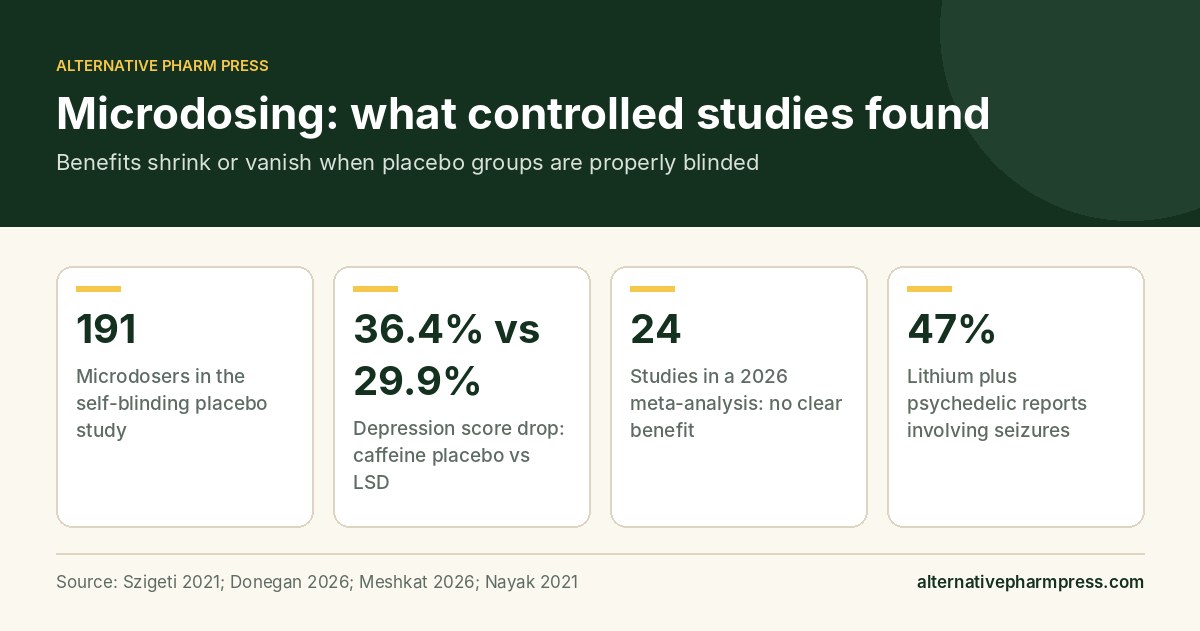
Imperial College London researchers gave microdosers online instructions to build their own placebo control, mixing active and empty capsules so they did not know which they were taking. In the eLife study, 191 people completed it. Every psychological outcome improved over four weeks in the microdose group, but the placebo group improved too, with no significant difference between them. Small acute differences could be explained by participants guessing correctly which capsules were active.1
Psilocybin mushroom trials (2022 to 2026)
In an Argentine double-blind trial of 34 people about to start microdosing psilocybin mushrooms, acute effects were rated as more intense on the active dose, but only among those who correctly guessed their condition. There was no evidence of better well-being, creativity or cognition, and a few small changes pointed towards cognitive impairment.2
A Dutch preregistered crossover study found psilocybin microdosing did not affect emotion processing or symptoms of anxiety and depression compared with placebo, and participants broke blind in the second block.12 Two later randomised trials of psilocybin truffles from Leiden University, published in 2026, found no significant effects on cognition, mood or subjective measures after correcting for multiple comparisons. Negative bodily feelings were more common on the active dose, and blinding held.3
LSD microdosing trials, including in depression
New Zealand researchers working with MindBio Therapeutics have run the largest microdosing programme. In a 2023 trial in healthy men, mood ratings were higher on dose days than non-dose days, but no questionnaire or cognitive test changed from baseline to six weeks. Four participants left the LSD group because of anxiety.7
An open-label pilot in 19 people with major depression, most of them on antidepressants, reported a 59.5% fall in depression scores. Without a placebo, though, that figure cannot separate drug effect from expectation.13 The follow-up randomised trial (LSDDEP2), which used the company’s MB22001 formulation and caffeine as an active placebo, answered that question. Depression scores fell by 36.4% on caffeine and 29.9% on LSD, and LSD was not superior. Masking worked, according to a September 2026 conference abstract in the International Journal of Neuropsychopharmacology; a full paper has not yet been published.6
The 2026 meta-analysis
A systematic review of 24 studies (3,681 participants) in healthy adults found that randomised trials of psilocybin and LSD microdosing produced subjective and brain-activity changes but “minimal impact” on cognition, creativity or sustained mood, with no clear evidence of reduced depression, anxiety or stress symptoms.4
Why blinding and expectancy matter so much
Psychedelic trials have a built-in problem. The more noticeable a drug’s effects, the easier it is for participants to work out whether they received it, and the more their expectations can shape the results. A 2024 review of expectancy effects in psychedelic research describes this as a central challenge as public enthusiasm grows.14
That helps answer one of the most common forum questions: what should microdosing feel like, and does feeling nothing mean it is not working? The trials suggest the question may be the wrong one. In the Argentine study, the people who felt something were mostly those who correctly guessed they had the active dose.2 Feeling an effect does not show benefit, and feeling nothing does not show failure. Both groups in the self-blinding study improved.1
Another frequent question is whether benefits persist after stopping. The controlled data do not show a lasting benefit to persist: the healthy-volunteer LSD trial found no change from baseline at six weeks, and the depression trial found no advantage over placebo at eight weeks.6,7
Microdosing on an SSRI, lithium and other interaction risks
SSRIs and SNRIs
In a Johns Hopkins survey of 611 reports of people taking psilocybin mushrooms alongside an antidepressant, the estimated probability of weaker-than-expected effects was 0.47 for SSRIs, 0.55 for SNRIs and 0.29 for bupropion. The dampening appeared to persist for up to three to six months after stopping an SSRI or SNRI.8
A Swiss randomised crossover study in healthy volunteers found that pretreatment with escitalopram did not change the positive mood effects of a single high psilocybin dose but reduced anxiety, “bad drug effects” and cardiovascular effects.15 Neither study looked at microdoses, so how an SSRI interacts with repeated low doses has not been directly measured.
Replacing an antidepressant with microdosing
Forums are full of people considering stopping sertraline or another antidepressant to microdose instead, often after years of treatment that has not worked. The evidence argues strongly against doing that alone. A 2024 meta-analysis in The Lancet Psychiatry found that 31% of people stopping an antidepressant had at least one discontinuation symptom, against 17% after stopping placebo, and 2.8% had severe symptoms.16
Psilocybin trials usually require participants to come off serotonergic antidepressants first, under supervision.17 In one trial, people who stopped an SSRI or SNRI before psilocybin had a smaller treatment response than those who were unmedicated at entry, an exploratory finding the authors say needs testing.17 Stopping is not a neutral step. Any change to an antidepressant, antipsychotic such as quetiapine, or mood stabiliser should be planned with the prescriber, and we do not give washout timings.
Lithium: a seizure signal
An analysis of online experience reports found that 47% of 62 reports of classic psychedelics taken with lithium involved seizures, and 39% involved medical attention. None of 34 reports involving lamotrigine described seizures.9 A 2024 case report described new-onset seizures in an adolescent who used LSD while on low-dose lithium.18 Bipolar disorder has been an exclusion criterion in recent psilocybin trials.9
If you are in crisis or thinking about suicide, call or text 988 in the US. For help finding treatment, the SAMHSA National Helpline is free and confidential on 1-800-662-4357.
Is microdosing safe long term? The heart-valve question
Strong, chronic activation of the serotonin 5-HT2B receptor is a known cause of heart-valve disease, which is why researchers use drugs such as d-fenfluramine as reference cardiotoxins.19 A 2023 review in the Journal of Psychopharmacology found that LSD, psilocybin and other psychedelics bind 5-HT2B with potency equal to or greater than their main 5-HT2A target and act as partial agonists. Safety margins at typical microdoses were wider than for known valve-damaging drugs, “but not without potential risk”, and no animal or human studies designed to assess valve disease existed.10
Two newer data points are reassuring but limited. A 2025 mouse study found no valve or heart-wall changes after prolonged low-dose LSD, while the positive controls, serotonin and d-fenfluramine, did cause changes.19 The open-label depression pilot included echocardiography and found no clinically relevant changes over eight weeks.13 Neither tells us what happens over years of use, which is how some people microdose.
Other reported downsides include anxiety and more negative bodily feelings.3,7 People who report feeling drained or low after a few days should take that seriously rather than push through it. We found no controlled microdosing trial in people with borderline personality disorder or psychosis risk, so there are no data to show it is safe for them.
Is microdosing psilocybin legal? The position in October 2026
Federal law. Psilocybin and psilocin are listed in Schedule I of the Controlled Substances Act.11 Possession, cultivation and sale remain federal offences everywhere in the US, regardless of state or city policy.
Oregon. Under Measure 109, adults 21 or older can access psilocybin without a prescription, but according to the Oregon Health Authority only at a licensed service centre during an administration session with a licensed facilitator.20 It is not a take-home microdosing model.
Colorado. The state had approved 34 licensed healing centres by early 2026, regulated by the Department of Revenue’s Natural Medicine Division.21 The Natural Medicine Health Act also removed state penalties for personal possession and cultivation by adults 21 and over, though cultivation remains a federal crime.22
New Mexico. The Medical Psilocybin Act was signed in April 2025, and the state health department says the programme is set to be implemented by 31 December 2026, for conditions such as treatment-resistant depression and PTSD.23
Cities. About 30 cities, including Denver, Oakland, Seattle and Washington DC, have passed measures making psilocybin a low enforcement priority. That is not legal access.22
FDA. An April 2026 executive order directed the FDA to speed its review of psychedelic medicines, without itself changing any drug’s schedule.24 The FDA granted Compass Pathways a rolling review and a national priority voucher for COMP360, its synthetic psilocybin for treatment-resistant depression.25 As of late October 2026 we found no FDA-approved psilocybin product, and an approved one would be a supervised high-dose treatment, not a microdosing product.
Shops sometimes sell Amanita muscaria as a legal alternative, but it is chemically unrelated to psilocybin; see our Amanita muscaria vs psilocybin explainer and our report on Amanita’s legal position in 2026. Products sold openly as “mushroom gummies” are a separate category again; our guide to whether mushroom gummies work looks at what is in them.
What the evidence does and does not support
- Supported: microdoses can produce noticeable subjective and brain-activity changes, and people who microdose often feel better.2,4
- Not supported: that the improvement exceeds placebo for mood, anxiety, cognition or creativity in healthy adults, or for depression in the one completed randomised trial.1,4,6
- Unknown: years-long safety, especially for heart valves, and effects in specific clinical groups.10
- Clear risks: combining psychedelics with lithium, and stopping prescribed medication without medical advice.9,16
If your interest is in anxiety rather than psychedelics, our review of what trials show for anxiety supplements grades the legal options. For the broader non-psychedelic market, see functional mushrooms in 2026.
Frequently asked questions
Does microdosing psilocybin actually work?
Controlled trials mostly say no, at least beyond placebo. People who microdose often feel better, but in blinded studies the placebo groups improved by similar amounts, and a 2026 meta-analysis of 24 studies found no clear effect on depression, anxiety or stress in healthy adults.1,4 A randomised LSD microdosing trial in major depression also failed to beat a caffeine placebo.6
What is microdosing supposed to feel like?
There is no reliable answer, and the trials suggest feelings are a poor guide. In one double-blind psilocybin study, people rated acute effects as stronger mainly when they correctly guessed they had taken the active dose.2 In the self-blinding study, both microdose and placebo groups improved.1 Feeling nothing does not mean failure, and feeling something does not prove benefit.
Can you microdose while taking an SSRI?
There are no trials of microdosing on an SSRI. Survey data suggest SSRIs and SNRIs often weaken the effects of psilocybin mushrooms, possibly for months after stopping.8 Stopping an antidepressant can itself cause discontinuation symptoms in a substantial minority of people.16 Any change to an antidepressant, antipsychotic or mood stabiliser should be made with your prescriber, not on your own.
Is microdosing psilocybin safe long term?
Nobody knows. Psychedelics activate the 5-HT2B receptor, which is linked to heart-valve damage when stimulated chronically, and a 2023 review called valve disease a potential risk of long-term microdosing.10 A mouse study of low-dose LSD and an eight-week human pilot found no valve changes, but years-long human data do not exist.13,19 Lithium users face a separate seizure risk.9
Is microdosing legal anywhere in the US?
Psilocybin is Schedule I under federal law everywhere.11 Oregon allows adults 21 and over to use psilocybin only at licensed service centres during supervised sessions, and Colorado licenses healing centres and has removed state penalties for personal possession.20,21,22 New Mexico’s medical programme is due by the end of 2026.23 City decriminalisation measures only lower enforcement priority.
Sources
- Szigeti B, Kartner L, Blemings A, Rosas F, Feilding A, Nutt DJ, et al. Self-blinding citizen science to explore psychedelic microdosing. eLife. 2021;10:e62878. DOI: 10.7554/eLife.62878. PMID: 33648632. pubmed.ncbi.nlm.nih.gov
- Cavanna F, Muller S, de la Fuente LA, Zamberlan F, Palmucci M, Janeckova L, et al. Microdosing with psilocybin mushrooms: a double-blind placebo-controlled study. Transl Psychiatry. 2022;12(1):307. DOI: 10.1038/s41398-022-02039-0. PMID: 35918311. pubmed.ncbi.nlm.nih.gov
- Prochazkova L, Marschall J, Lippelt DP, Schon NR, Kuchař M, Hommel B. Cognitive and subjective effects of psilocybin microdosing: Results from two double-blind placebo-controlled longitudinal trials. Neuropharmacology. 2026;283:110722. DOI: 10.1016/j.neuropharm.2025.110722. PMID: 41110634. pubmed.ncbi.nlm.nih.gov
- Meshkat S, Leung M, Meshkat S, Lin Q, Wijendran D, Reichelt AC, et al. Efficacy and Safety of Psychedelic Microdosing on Psychological Outcomes in Healthy Adults: A Systematic Review and Meta-analysis. CNS Drugs. 2026;40(10):1369-1393. DOI: 10.1007/s40263-026-01325-5. PMID: 42593636. pubmed.ncbi.nlm.nih.gov
- Rootman JM, Kiraga M, Kryskow P, Harvey K, Stamets P, Santos-Brault E, et al. Psilocybin microdosers demonstrate greater observed improvements in mood and mental health at one month relative to non-microdosing controls. Sci Rep. 2022;12(1):11091. DOI: 10.1038/s41598-022-14512-3. PMID: 35773270. pubmed.ncbi.nlm.nih.gov
- Donegan C, Forsyth A, Sumner R, Miller E, Alshakhouri M, Murphy R, et al. LSD microdosing for depression: hype or hope? A randomised controlled trial in major depressive disorder (abstract 230). Int J Neuropsychopharmacol. 2026;29(Suppl 1):i11-i12. DOI: 10.1093/ijnp/pyag040.021. academic.oup.com
- Murphy RJ, Sumner R, Evans W, Ponton R, Ram S, Godfrey K, et al. Acute Mood-Elevating Properties of Microdosed Lysergic Acid Diethylamide in Healthy Volunteers: A Home-Administered Randomized Controlled Trial. Biol Psychiatry. 2023;94(6):511-521. DOI: 10.1016/j.biopsych.2023.03.013. PMID: 36997080. pubmed.ncbi.nlm.nih.gov
- Gukasyan N, Griffiths RR, Yaden DB, Antoine DG 2nd, Nayak SM. Attenuation of psilocybin mushroom effects during and after SSRI/SNRI antidepressant use. J Psychopharmacol. 2023;37(7):707-716. DOI: 10.1177/02698811231179910. PMID: 37291890. pubmed.ncbi.nlm.nih.gov
- Nayak SM, Gukasyan N, Barrett FS, Erowid E, Erowid F, Griffiths RR. Classic Psychedelic Coadministration with Lithium, but Not Lamotrigine, is Associated with Seizures: An Analysis of Online Psychedelic Experience Reports. Pharmacopsychiatry. 2021;54(5):240-245. DOI: 10.1055/a-1524-2794. PMID: 34348413. pubmed.ncbi.nlm.nih.gov
- Tagen M, Mantuani D, van Heerden L, Holstein A, Klumpers LE, Knowles R. The risk of chronic psychedelic and MDMA microdosing for valvular heart disease. J Psychopharmacol. 2023;37(9):876-890. DOI: 10.1177/02698811231190865. PMID: 37572027. pubmed.ncbi.nlm.nih.gov
- Electronic Code of Federal Regulations. 21 CFR 1308.11, Schedule I (hallucinogenic substances: psilocybin, psilocyn). Accessed October 2026. ecfr.gov
- Marschall J, Fejer G, Lempe P, Prochazkova L, Kuchar M, Hajkova K, et al. Psilocybin microdosing does not affect emotion-related symptoms and processing: A preregistered field and lab-based study. J Psychopharmacol. 2022;36(1):97-113. DOI: 10.1177/02698811211050556. PMID: 34915762. pubmed.ncbi.nlm.nih.gov
- Daldegan-Bueno D, Donegan CJ, Sumner R, Forsyth A, Evans W, Alshakhouri M, et al. LSD microdosing in major depressive disorder: results from an open-label trial. Neuropharmacology. 2026;283:110762. DOI: 10.1016/j.neuropharm.2025.110762. PMID: 41202873. pubmed.ncbi.nlm.nih.gov
- Szigeti B, Heifets BD. Expectancy Effects in Psychedelic Trials. Biol Psychiatry Cogn Neurosci Neuroimaging. 2024;9(5):512-521. DOI: 10.1016/j.bpsc.2024.02.004. PMID: 38387698. pubmed.ncbi.nlm.nih.gov
- Becker AM, Holze F, Grandinetti T, Klaiber A, Toedtli VE, Kolaczynska KE, et al. Acute Effects of Psilocybin After Escitalopram or Placebo Pretreatment in a Randomized, Double-Blind, Placebo-Controlled, Crossover Study in Healthy Subjects. Clin Pharmacol Ther. 2022;111(4):886-895. DOI: 10.1002/cpt.2487. PMID: 34743319. pubmed.ncbi.nlm.nih.gov
- Henssler J, Schmidt Y, Schmidt U, Schwarzer G, Bschor T, Baethge C. Incidence of antidepressant discontinuation symptoms: a systematic review and meta-analysis. Lancet Psychiatry. 2024;11(7):526-535. DOI: 10.1016/S2215-0366(24)00133-0. PMID: 38851198. pubmed.ncbi.nlm.nih.gov
- Erritzoe D, Barba T, Spriggs MJ, Rosas FE, Nutt DJ, Carhart-Harris R. Effects of discontinuation of serotonergic antidepressants prior to psilocybin therapy versus escitalopram for major depression. J Psychopharmacol. 2024;38(5):458-470. DOI: 10.1177/02698811241237870. PMID: 38520045. pubmed.ncbi.nlm.nih.gov
- Edwards C, Van Gerpen S, Anand V. New-Onset Seizures in an Adolescent Following Use of LSD while on Low-Dose Lithium Therapy: A Case Study. S D Med. 2024;77(1):31-35. PMID: 38986146. pubmed.ncbi.nlm.nih.gov
- Effinger DP, Schalk SS, King JL, Wallingford JR, O’Connell CK, Calderon JR, et al. Assessing the Potential Cardiovascular Risk of Microdosing the Psychedelic LSD in Mice. ACS Pharmacol Transl Sci. 2025;8(11):3923-3931. DOI: 10.1021/acsptsci.5c00202. PMID: 41789300. pubmed.ncbi.nlm.nih.gov
- Oregon Health Authority. Oregon Psilocybin Services: What are psilocybin services? Accessed October 2026. oregon.gov
- Colorado Public Radio. We toured three psychedelic healing centers in Colorado. Here’s what we saw. 4 February 2026. cpr.org
- Mind Medicine Law. Psychedelic Legal Status Map of the United States (2026). Reviewed 21 June 2026. mindmedicinelaw.com
- New Mexico Department of Health. Medical Psilocybin Program. Accessed October 2026. nmhealth.org
- NPR. Trump signs order fast-tracking review of psychedelics for mental health disorders. 18 April 2026. kunc.org
- Compass Pathways. Compass Pathways Announces FDA Granted NDA Rolling Review Request and Awarded Commissioner’s National Priority Voucher. 24 April 2026. ir.compasspathways.com
Featured image: Galerina sp. by Bernard Spragg, CC0 1.0. Cropped.
This article is for educational purposes only and is not medical or legal advice. Products discussed here are not intended to diagnose, treat, cure or prevent any disease. Laws vary by location and change often, so verify the rules that apply where you are. Always talk to a licensed healthcare provider before use, especially if you are under 21, pregnant or nursing, taking medication, or managing a health condition.