
Functional mushrooms went from health-store curiosity to grocery-aisle staple in about a decade, and the marketing got ahead of the science the whole way. You’ll see the same nine or ten species splashed across powders, gummies, coffees, and tinctures, usually with confident promises about what they’ll do for you. We’d rather be honest: the research on most of these is early, a lot of it is preclinical or based on tradition, and very little of it supports the bold claims on the bottle.
So here’s a careful walk through nine well-known functional mushrooms, what each one actually is, and what people traditionally or in early studies have used it for. We use hedged language on purpose. “Is studied for” and “is traditionally used for” are not the same as “works,” and we won’t pretend they are. After the rundown, we get into the part that actually decides whether your product is any good: extraction, beta-glucans, and testing.
The nine mushrooms
Lion’s Mane (Hericium erinaceus)
A white, shaggy mushroom that looks a bit like a frozen waterfall. It contains compounds called hericenones and erinacines, and it’s most often studied for cognitive and nerve-related questions in early laboratory and small human research. People commonly take it for focus and mental clarity. The human evidence is still limited, so treat it as an area of active study rather than a settled answer.
Reishi (Ganoderma lucidum)
A hard, woody, reddish bracket mushroom used in East Asian traditions for centuries, often called the “mushroom of immortality” in old texts. It’s traditionally used for calm and general wellness and is studied for its triterpene and beta-glucan content. It’s bitter, which is why it almost always shows up as an extract rather than a culinary food.
Cordyceps (Cordyceps militaris and Cordyceps sinensis)
Originally a fungus that grows on insect larvae in the wild, though most commercial cordyceps is now cultivated on grain or in liquid fermentation. It’s traditionally used for stamina and is studied in relation to energy and exercise performance, mostly in small or preliminary trials. Cultivated Cordyceps militaris is what’s in most modern products.
Chaga (Inonotus obliquus)
A dark, crusty growth found on birch trees in cold climates, looking more like burnt charcoal than a mushroom. It’s studied for its antioxidant compounds and is traditionally used as a tea in northern folk practices. Because wild chaga is harvested from trees, sourcing and sustainability matter more here than with cultivated species.
Turkey Tail (Trametes versicolor)
A common, colorful shelf fungus with concentric bands that really do resemble a turkey’s tail. It’s one of the most researched functional mushrooms, studied for its polysaccharide fractions known as PSK and PSP and traditionally used for immune support. It’s a good example of a species where the beta-glucan content is the whole point.
Maitake (Grifola frondosa)
Also called “hen of the woods,” a culinary mushroom that grows in large clustered fronds at the base of trees. It’s both eaten as food and studied for its beta-glucan fractions. People take maitake extracts for general immune and metabolic-health interest, though again the human research is preliminary.
Shiitake (Lentinula edodes)
The familiar brown culinary mushroom you’ll find in any produce section. Beyond the kitchen, it’s studied for a beta-glucan called lentinan and is traditionally used in East Asian medicine for immune support. Because it’s a food first, shiitake is one of the more familiar entries here.
Tremella (Tremella fuciformis)
A translucent, jelly-like “snow mushroom” used in Chinese tradition both as food and in beauty preparations. It holds water well, which is why it’s studied and marketed in connection with skin hydration. People take it for skin and general wellness interest, with most claims still resting on tradition and early work.
Agarikon (Laricifera officinalis, also Fomitopsis officinalis)
A rare, long-lived bracket fungus that grows on old-growth conifers, prized in some historical European and Indigenous practices. It’s studied in early laboratory work for its antiviral compounds and is one of the more niche, harder-to-source species on this list. Quality and authenticity matter a lot given how uncommon real agarikon is.
The part that actually decides quality
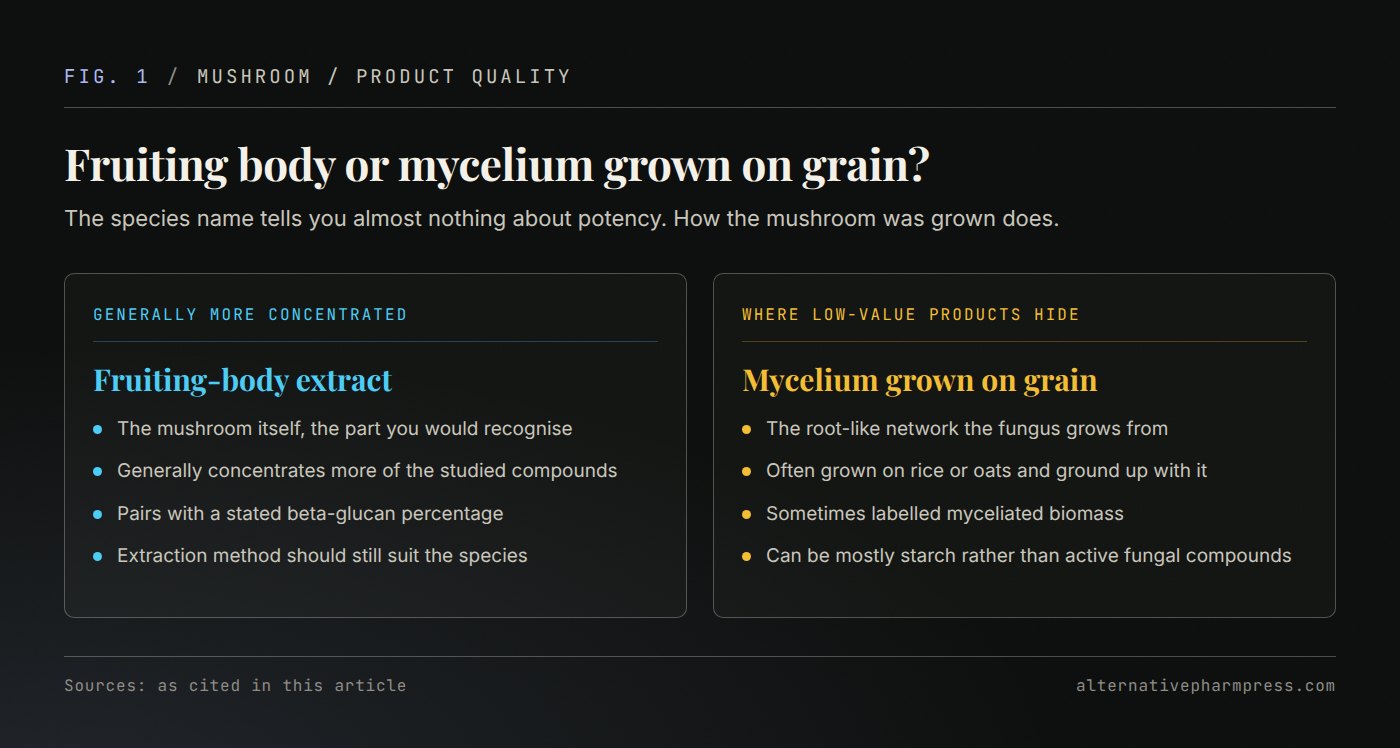
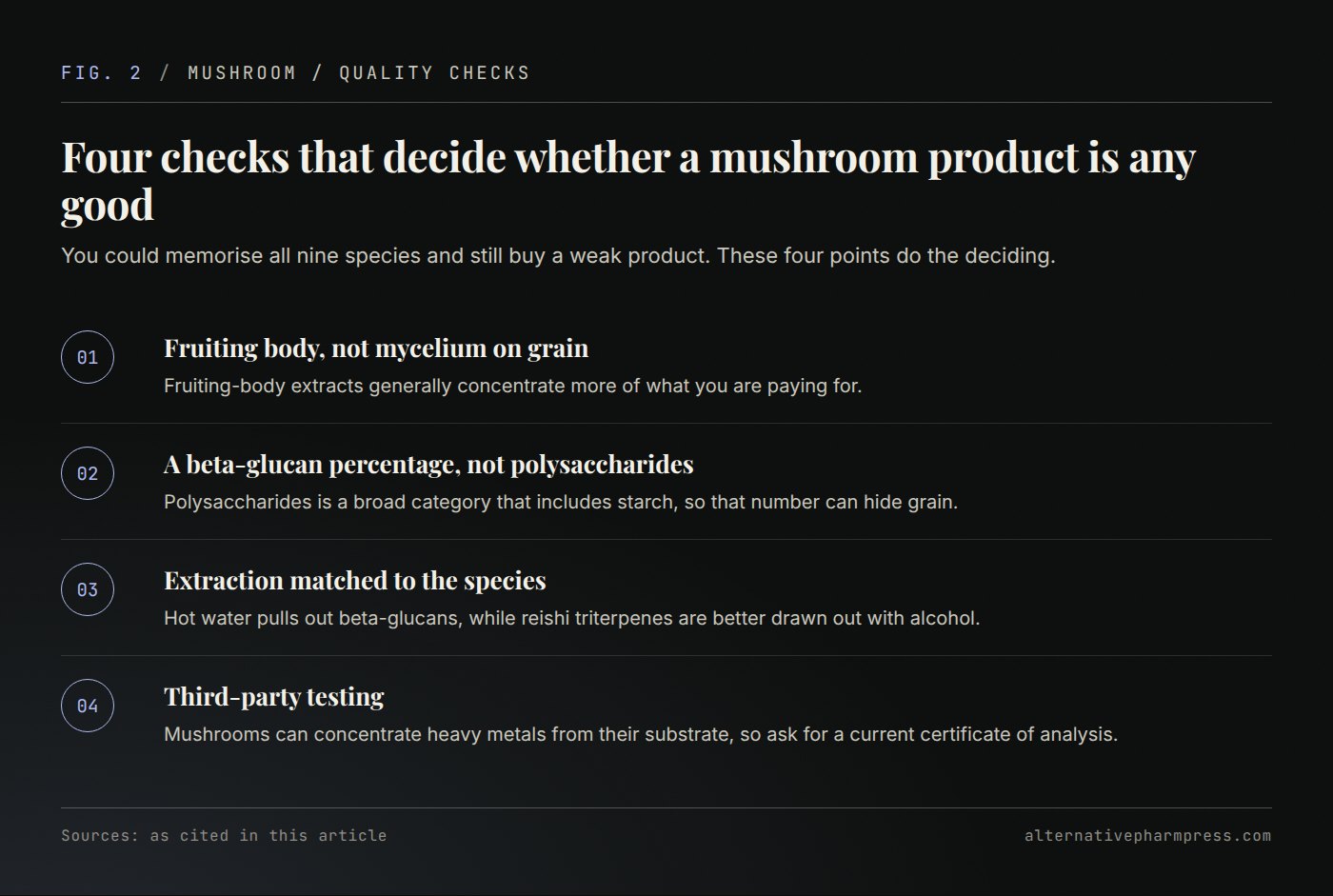
You could memorize all nine species and still buy a weak product, because the species name tells you almost nothing about potency. These four points do.
Fruiting body vs mycelium-on-grain
The fruiting body is the mushroom itself, the part you’d recognize. Mycelium is the root-like network the fungus grows from, and in many cheap products it’s grown on grain (usually rice or oats) and then ground up with that grain still attached. The result, sometimes labeled “myceliated biomass,” can be mostly starch from the grain rather than the active fungal compounds. Fruiting-body extracts generally concentrate more of what you’re paying for. Mycelium isn’t worthless, but mycelium-on-grain is where a lot of low-value products hide.
Why beta-glucan percentage beats “polysaccharides”
Here’s the trick to watch. Beta-glucans are the fungal compounds most of the research focuses on. “Polysaccharides” is a much broader category that includes starch, and starch is exactly what you get from grain. So a label boasting “40% polysaccharides” can be hiding a pile of grain starch, while a label stating a specific “beta-glucan: 25%” is telling you something real. Always look for a beta-glucan percentage, verified by testing, rather than a vague polysaccharide number. Our guide on the signs a brand is third-party tested covers how to confirm those figures.
Hot-water vs dual extraction
Beta-glucans are water-soluble, so hot-water extraction pulls them out and is appropriate for species where those compounds are the focus, like turkey tail and maitake. Some compounds, such as the triterpenes in reishi, are better drawn out with alcohol, so a “dual extraction” uses both water and alcohol. The right method depends on the species. A reishi product that’s water-only may be leaving its triterpenes behind, while a turkey tail product rarely needs the alcohol step.
Third-party testing
Mushrooms can concentrate heavy metals from their substrate, and chaga in particular is harvested from trees, so independent testing for contaminants and verified beta-glucan content is the difference between a trustworthy product and a guess. Ask for a current certificate of analysis. For the broader logic of reading one, our COA reading guide applies to mushroom products too.
Quick comparison
| Mushroom | Commonly studied / used for | What to look for |
|---|---|---|
| Lion’s Mane | Focus, cognitive interest | Fruiting body, beta-glucan % |
| Reishi | Calm, general wellness | Dual extraction for triterpenes |
| Cordyceps | Stamina, energy interest | Cultivated militaris, beta-glucan % |
| Chaga | Antioxidant interest | Tested sourcing, low contaminants |
| Turkey Tail | Immune support interest | Hot-water extract, PSK/PSP |
| Maitake | Immune, metabolic interest | Fruiting body, beta-glucan % |
| Shiitake | Immune support interest | Whole mushroom or extract |
| Tremella | Skin hydration interest | Fruiting body, clean sourcing |
| Agarikon | Early antiviral research | Verified identity, real sourcing |
Where this fits
If lion’s mane is the one you keep hearing about, we go deeper in our best lion’s mane brands of 2026 roundup, which applies the beta-glucan and extraction tests to specific brands. Several of these mushrooms also turn up inside focus formulas, which we cover in the best nootropic brands of 2026 guide and the nootropics glossary. You can browse vetted sellers in the directory, read product write-ups in our reviews section, scan the wider nootropics category, and check the coupons page before buying.
For neutral, non-marketing background, ConsumerLab tests mushroom supplement quality, and the NIH Office of Dietary Supplements publishes plain-language fact sheets worth reading before you buy.
Frequently asked questions
Are functional mushrooms proven to work?
For most of them the research is early, preclinical, or based on traditional use, with limited human trials. We don’t make health claims. Treat these as products some people take for general wellness interest, not as established treatments.
Is fruiting body really better than mycelium?
Fruiting-body extracts generally concentrate more of the studied compounds, while mycelium grown on grain can be largely starch. Mycelium itself isn’t useless, but mycelium-on-grain products often dilute the active fraction. Check the label and the beta-glucan percentage.
Why does beta-glucan percentage matter more than polysaccharides?
“Polysaccharides” includes starch, which can come from the grain a mushroom was grown on, so that number can be inflated. Beta-glucans are the specific fungal compounds most research focuses on. A verified beta-glucan percentage is a far more honest measure.
What is dual extraction?
Dual extraction uses both hot water and alcohol to pull out different compound types. Water captures beta-glucans, alcohol captures things like reishi’s triterpenes. The right method depends on the species, so it’s worth checking how a given product was made.
How do I know a mushroom product is tested?
Look for a current third-party certificate of analysis that confirms identity, beta-glucan content, and the absence of heavy metals and contaminants. If a brand won’t share one, that’s a reason to be cautious, especially for tree-harvested species like chaga.
Editorial note: This article is for general information only and is not medical or legal advice. These products have not been evaluated by the FDA to diagnose, treat, cure, or prevent any disease. Laws vary by location and change often, so verify the rules that apply to you. Always talk to a licensed healthcare provider before use, especially if you are under 21, pregnant or nursing, taking medication, or managing a health condition.