
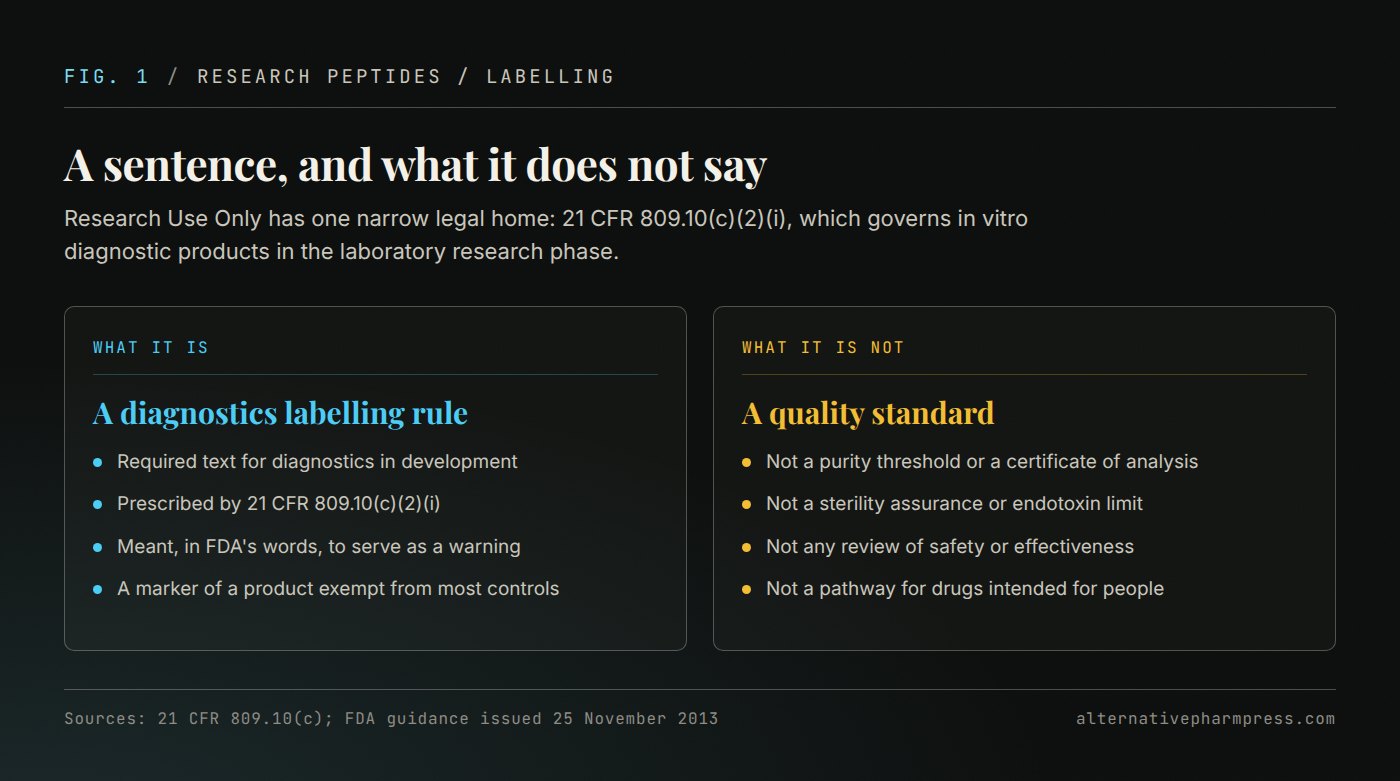
Research Use Only is a labelling category, not a quality standard. In United States regulation the phrase has one narrow legal home: 21 CFR 809.10(c)(2)(i) requires an in vitro diagnostic product in the laboratory research phase to carry the statement “For Research Use Only. Not for use in diagnostic procedures.”1 The label makes no claim about purity, potency or human safety.
That also answers the question people usually ask underneath it. The difference between a research peptide and a regular peptide is not chemistry. It is regulatory history. An approved peptide drug such as semaglutide has cleared a marketing application, is made under current good manufacturing practice, and reaches a patient through a pharmacy with an FDA reviewed label. A vial sold as research material carries none of that, whatever the molecule inside is called.
None of these research-labelled compounds are FDA approved for human use. The sections below set out where the phrase comes from, what it covers, what it does not guarantee, and what the FDA has said when sellers use it as a shield.
Where the phrase actually comes from
The Research Use Only statement is written into the labelling rules for in vitro diagnostic products, meaning reagents, instruments and test systems used on specimens taken from the human body. Under 21 CFR 809.10(c), a shipment of such a product is exempt from the usual labelling requirements if it is part of an investigation and the labelling bears the prescribed statement, prominently placed.1 There is a parallel statement for the later product testing phase: “For Investigational Use Only. The performance characteristics of this product have not been established.”
The FDA set out its thinking in a guidance issued on 25 November 2013, Distribution of In Vitro Diagnostic Products Labeled for Research Use Only or Investigational Use Only.2 Two points matter more than the rest. First, the agency describes these products as being in a development phase and therefore “exempt from most regulatory controls”. Second, it states that the labelling “is meant to serve as a warning”, to keep such products out of clinical diagnosis and patient management.
Read plainly, the label is a restriction on the buyer, not a promise to the buyer. It exists because the product has not been evaluated.
Note what the rule does not cover. There is no equivalent Research Use Only pathway for drugs. A chemical intended for use in humans is regulated as a drug under the Federal Food, Drug, and Cosmetic Act, and no disclaimer converts it into something else. Sellers of peptides and similar compounds have borrowed a diagnostics labelling phrase and applied it to a category it was never written for. Our overview of what research peptides are covers that mismatch.
What the label does not guarantee
A Research Use Only statement says nothing about what is in the vial. It is not a certificate of analysis, not a purity threshold, not a sterility assurance, and not an endotoxin limit. It is a sentence.
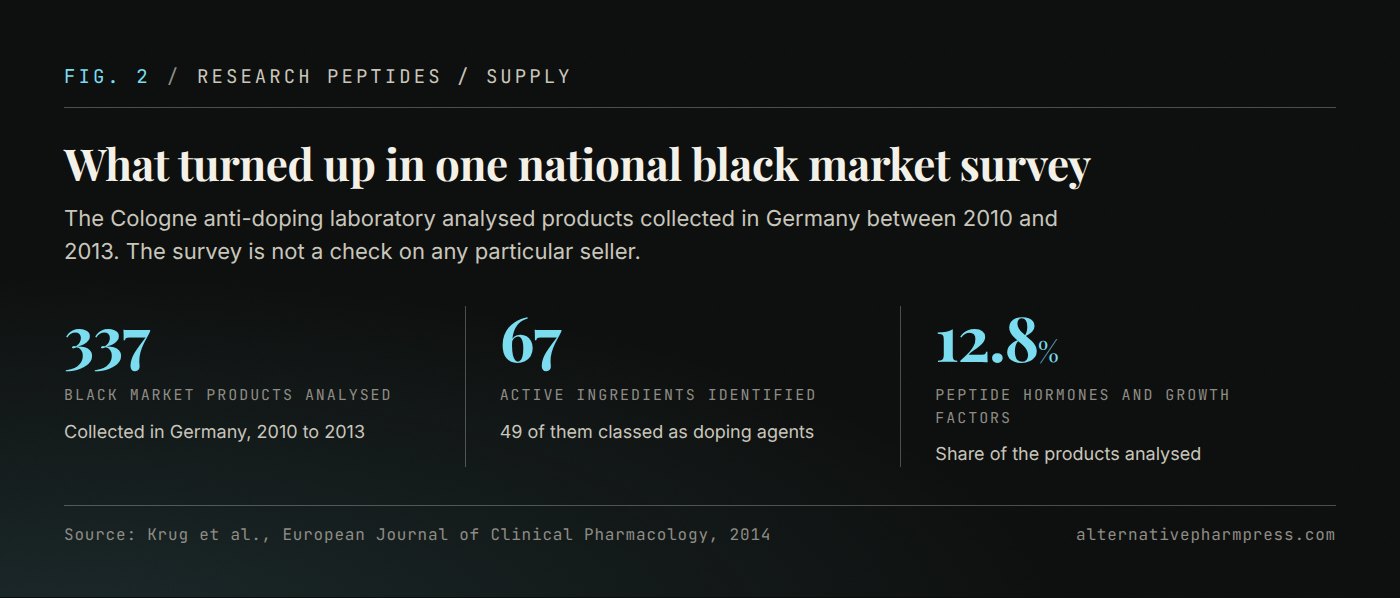
Analytical work on illegally traded peptide preparations gives a sense of the gap. A Belgian Official Medicines Control Laboratory team published a screening method in Talanta in 2015 for counterfeit and illegal injectable peptide preparations seized by the national medicines agency and customs, noting that the traffic includes substances still in preclinical and clinical development and that such preparations “could imply severe health threats”.3 In Germany, the Cologne anti-doping laboratory analysed 337 black market products collected between 2010 and 2013 and identified 67 active ingredients, 49 of them classed as doping agents; peptide hormones and growth factors accounted for 12.8 per cent of the products.4
Neither study is a survey of any particular seller, and neither should be read as one. What they establish is narrower and still useful: material moving through unregulated channels is routinely something other than what the label states, which is why identity and purity have to be demonstrated rather than assumed. Our note on documentation and source verification sets out what a paper trail should contain.
What an approved drug has to clear instead
The contrast is stark. A new drug application is, in the FDA’s own description, “the vehicle through which drug sponsors formally propose that the FDA approve a new pharmaceutical for sale and marketing in the U.S.”5 Reviewers must decide whether the drug is safe and effective in its proposed use, whether the benefits outweigh the risks, whether the proposed labelling is appropriate, and whether the manufacturing methods and controls “are adequate to preserve the drug’s identity, strength, quality, and purity”. Biological products follow a comparable route through a biologics licence application.
Manufacturing is a separate obligation. Current good manufacturing practice regulations require manufacturers to control operations so as to assure “the identity, strength, quality, and purity of drug products”.6 A drug made outside those controls is deemed adulterated under the law, whether or not any defect is ever demonstrated in that particular batch.
Then comes the dispensing route. A prescription drug reaches a person through a licensed prescriber and a pharmacy, with an approved label carrying indications, contraindications and warnings. Material shipped as a research chemical has none of those. Readers newer to the subject may want our general primer on peptides first.
Research use only labelling used as a shield
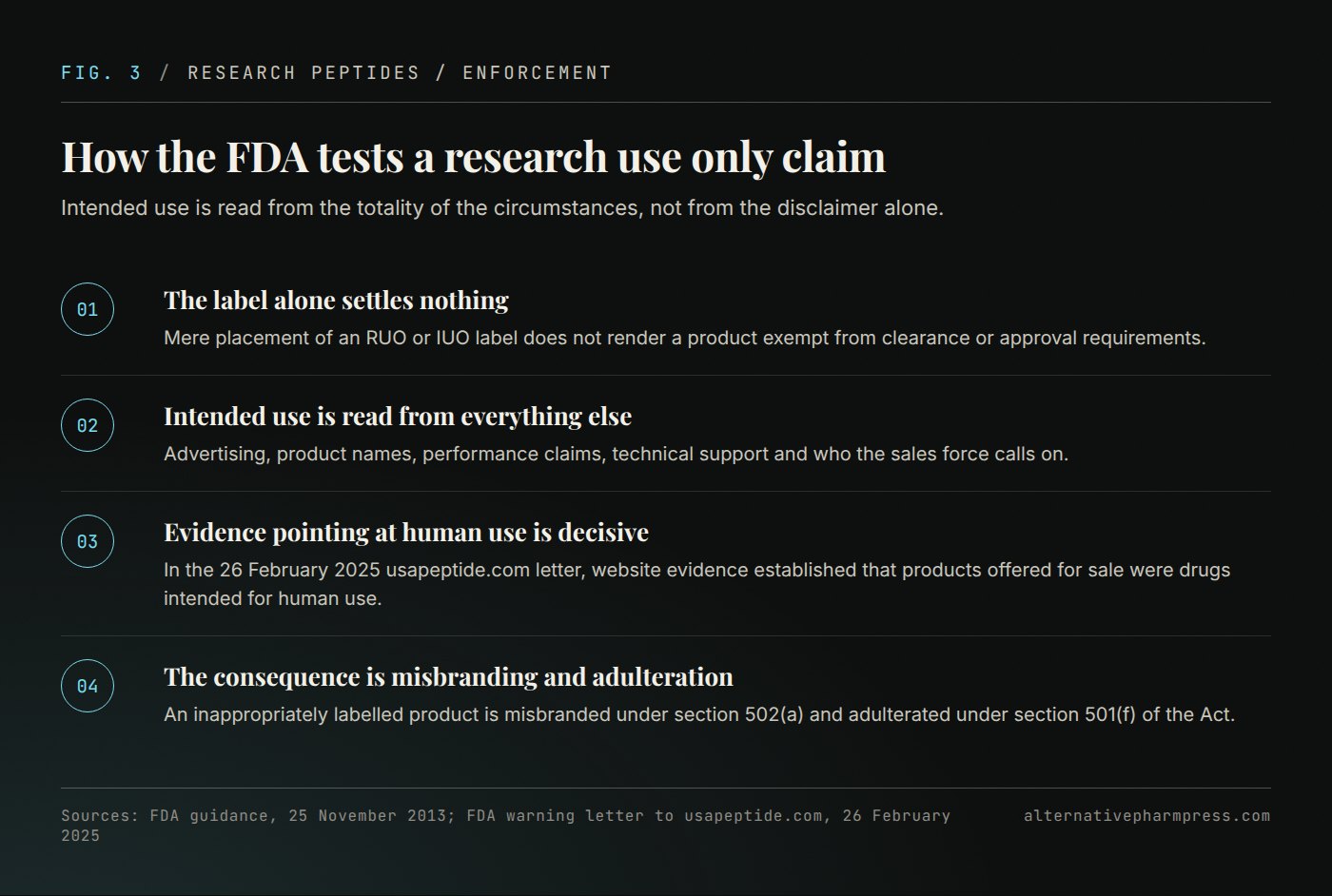
The FDA has been explicit that the label does not determine the legal status of the product. In the 2013 guidance the agency states: “Mere placement of an RUO or IUO label on an IVD product does not render the device exempt from otherwise applicable clearance, approval, or other requirements. FDA may determine that the device is intended for use in clinical diagnosis based on other evidence, including how the device is marketed.”2 Intended use is read from the totality of circumstances: advertising, product names, performance claims, technical support, who the sales force calls on. If a product is inappropriately labelled Research Use Only, the guidance says it would be misbranded under section 502(a) of the Act and adulterated under section 501(f).
The same reasoning has been applied outside diagnostics. In a warning letter dated 26 February 2025, the FDA told the operator of usapeptide.com that “despite statements on your product labeling and website such as ‘research use only,’ ‘not for human consumption,’ ‘lab purposes only,’ and ‘not intended to diagnose, cure, mitigate, treat or prevent disease,’ evidence obtained from your website establishes that certain products offered for sale by www.usapeptide.com are drugs intended for human use.”7 The letter cited the unapproved new drug and misbranding provisions of the Act.
The pattern is consistent. Where marketing, imagery or testimonials point at human use, the FDA treats the disclaimer as ineffective. It is not a legal boundary; it is a claim about intent that the agency is willing to test against the evidence.
Side by side
The table compares material carrying a research use only statement with an approved drug.
| Dimension | Material labelled research use only | FDA approved drug |
|---|---|---|
| Manufacturing standard | No approval-linked manufacturing obligation. Quality depends entirely on the supplier and is not verified by any agency. | Current good manufacturing practice under FDA regulation; failure renders the drug adulterated by law.6 |
| Regulatory oversight | Products in the research phase are, in FDA’s words, exempt from most regulatory controls.2 No premarket review of safety or effectiveness. | Premarket review of safety, effectiveness, labelling and manufacturing controls through an NDA or BLA.5 |
| Labelling accuracy | Not assessed. The statement describes a permitted use, not the contents. Independent analyses of illegally traded peptide preparations repeatedly find mismatches.34 | Label content reviewed by FDA, including indications, contraindications and warnings, with post-approval reporting obligations. |
| Legal route to a person | None. Marketing such material for human use exposes the seller to unapproved new drug and misbranding charges.7 | Prescription written by a licensed prescriber and dispensed by a pharmacy, or over-the-counter sale where authorised. |
Frequently asked questions
What is the difference between research peptides and regular peptides?
The molecule may be the same. The regulatory position is not. A regular peptide drug has an approved application, defined manufacturing controls and an FDA reviewed label, and is dispensed through a pharmacy. A research peptide is a chemical sold with a disclaimer, with no approval, no verified identity or purity, and no lawful route to a person.
Does a research use only label mean the product is pure?
No. Purity is not part of the statement and no agency assesses it as a condition of using the phrase. The only way to know what is in a container is documented analytical testing of that batch.
Is it legal to sell a compound with a research use only label?
It depends on intended use, which the FDA reads from the totality of the circumstances rather than from the disclaimer alone. Where marketing indicates the product is meant for people, the agency has treated the goods as unapproved new drugs and misbranded drugs regardless of the label.7
Does research use only mean the compound is being studied in humans?
No. The phrase refers to a product development phase for diagnostics, not to a human research programme. Many compounds sold with it have never been the subject of a registered human trial.
Are research use only compounds approved for human use?
No. By definition they are not approved. The label exists precisely because the product has not been evaluated for safety or effectiveness in people.
Sources
- Electronic Code of Federal Regulations. 21 CFR 809.10, Labeling for in vitro diagnostic products, paragraph (c). ecfr.gov
- U.S. Food and Drug Administration. Distribution of In Vitro Diagnostic Products Labeled for Research Use Only or Investigational Use Only: Guidance for Industry and Food and Drug Administration Staff. Issued 25 November 2013. fda.gov
- Vanhee C, Janvier S, Desmedt B, Moens G, Deconinck E, De Beer JO, Courselle P. Analysis of illegal peptide biopharmaceuticals frequently encountered by controlling agencies. Talanta. 2015;142:1–10. doi:10.1016/j.talanta.2015.04.022. PMID 26003685.
- Krug O, Thomas A, Walpurgis K, Piper T, Sigmund G, Schänzer W, Laussmann T, Thevis M. Identification of black market products and potential doping agents in Germany 2010-2013. European Journal of Clinical Pharmacology. 2014;70:1303–1311. doi:10.1007/s00228-014-1743-5. PMID 25168622.
- U.S. Food and Drug Administration. New Drug Application (NDA). fda.gov
- U.S. Food and Drug Administration. Facts About the Current Good Manufacturing Practice (CGMP). fda.gov
- U.S. Food and Drug Administration. Warning Letter, USApeptide.com, MARCS-CMS 696885, 26 February 2025. fda.gov
Editorial note: This article is for general information only and is not medical or legal advice. Research use only material has not been evaluated by the FDA to diagnose, treat, cure or prevent any disease. Laws vary by location and change often, so verify the rules that apply where you are. Always talk to a licensed healthcare provider before use, especially if you are under 21, pregnant or nursing, taking medication, or managing a health condition.