
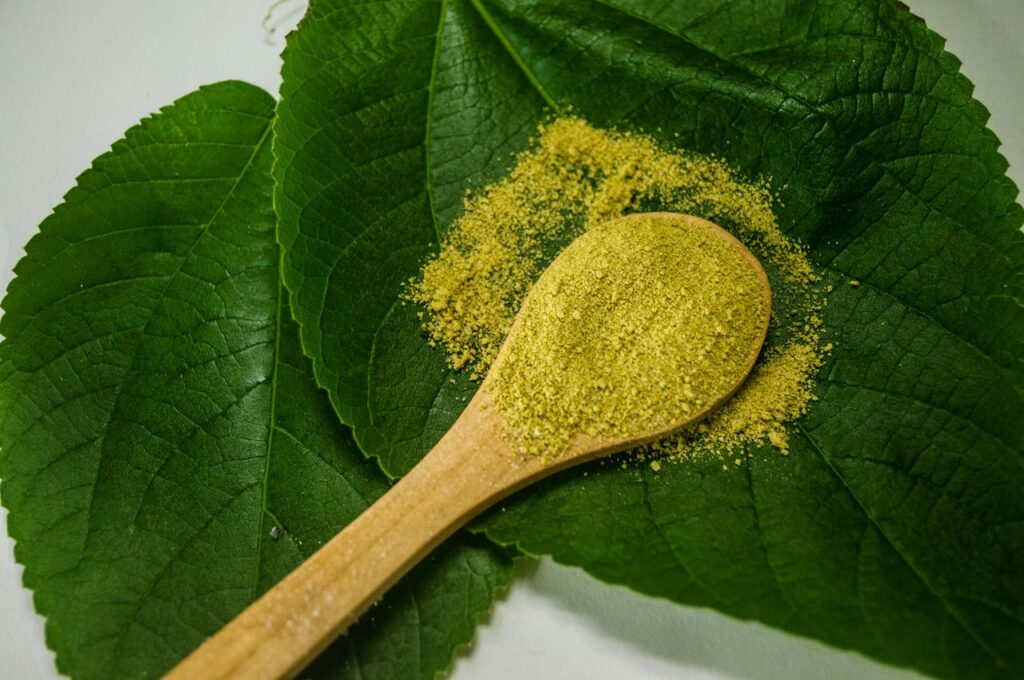
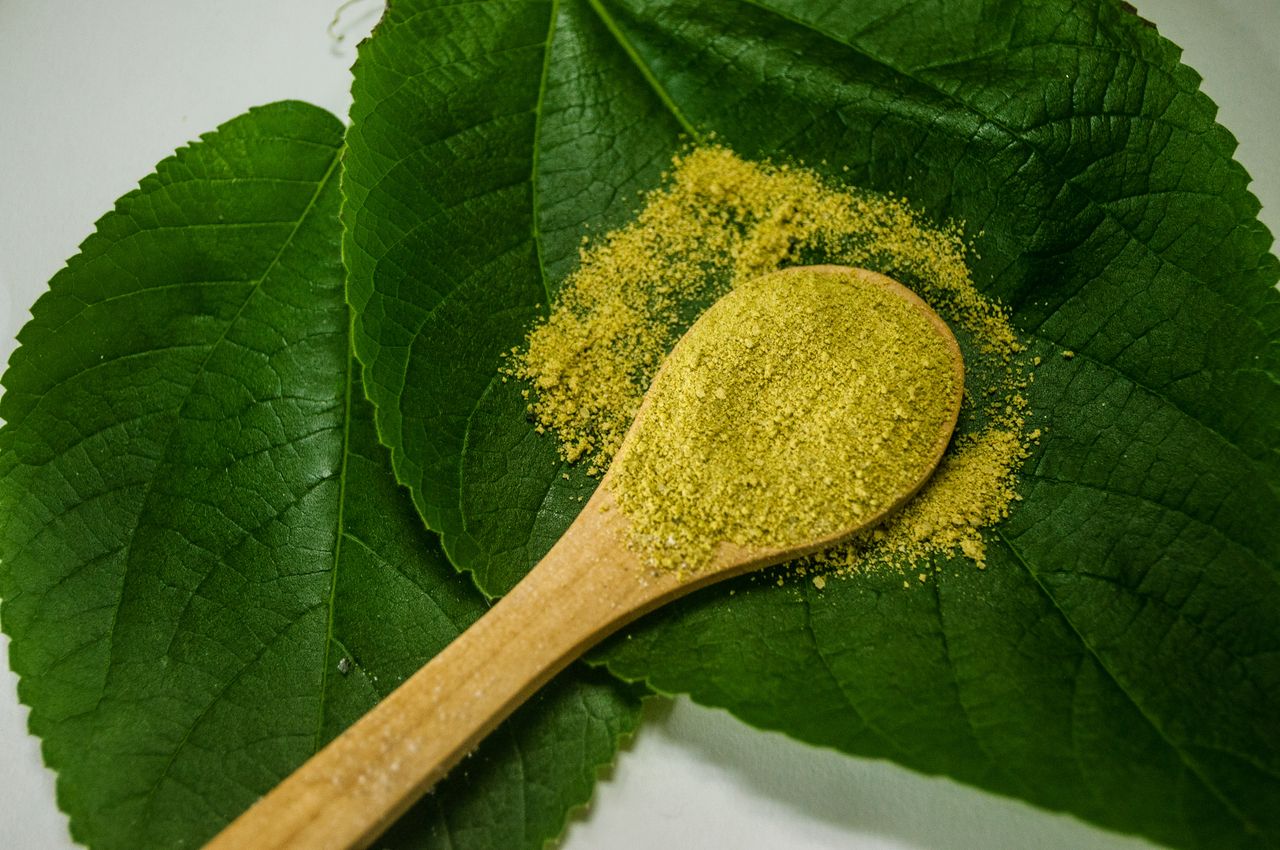
Red and green kratom are the same plant, Mitragyna speciosa, sold under different colour labels. The label loosely reflects leaf vein colour and, more often, how the leaves were dried. Users tend to describe red as calmer and green as more balanced or alert, but when researchers have tested retail products, the colour name has not reliably predicted alkaloid content.
That gap between what people report and what the lab shows is the real story of this comparison. Below we set out what the terms mean, what the one dedicated user survey found, what plant scientists have measured, and the checks that matter more than colour: a batch-specific certificate of analysis (COA), the 7-OH figure and contaminant screening.
Nothing here is dosing advice. Kratom is not an approved medicine, and its federal legal picture moved again in 2026, which we cover near the end.
At a glance
| Property | Red kratom | Green kratom |
|---|---|---|
| Plant | Mitragyna speciosa leaf | Mitragyna speciosa leaf |
| What the label reflects | Red-tinged veins or reddish powder; vendors cite longer or warmer drying | Green veins or greener powder; vendors cite indoor or shade drying |
| Standardised definition | None | None |
| Main alkaloid | Mitragynine | Mitragynine |
| Alkaloids in lab testing | No consistent difference from green in retail products tested 1 | Slightly higher mitragynine in some fresh Thai leaf samples 4 |
| Commonly reported by users | Relaxation and sleep | Mood, steadier energy, concentration |
| Blinded human trials | None | None |
| Safety and interaction risks | Same as any kratom | Same as any kratom |
| Proposed federal 7-OH line | Over 0.050% 7-OH by dry weight 11 | Over 0.050% 7-OH by dry weight 11 |
| What to check | Batch COA: mitragynine %, 7-OH, metals, microbes | Batch COA: mitragynine %, 7-OH, metals, microbes |
What the red and green labels actually describe
Kratom leaves have a central vein that can look green, red or pale. Vendors build product lines around this, adding a region to create “strains” such as Red Bali or Green Malay. None of these labels is defined by a regulator, a pharmacopoeia or an industry standard, so two sellers can use the same name for different material.
Vein colour is not even a fixed trait of a tree. In a 2026 study of Thai kratom, one tree produced leaves with veins ranging from green to red depending on the leaf’s stage of development, and mature-leaf alkaloid profiles stayed largely consistent across trees despite visible vein differences.3
The colour of the powder may say more about processing than about the vein. A 2025 postharvest study dried portions of the same leaves at different temperatures: leaves dried at 60°C gave a reddish powder, leaves dried at 25°C stayed green, and the key alkaloids were similar. The authors concluded that powder colour mainly signals the postharvest environment and that marketing strains by powder colour can mislead.2
What vendors say happens
A common seller account is that red kratom comes from mature red-veined leaves dried for longer, sometimes in sun or with a fermentation step, while green comes from green-veined leaves dried indoors or in shade. We found no published standard or audit showing these methods are used consistently. Treat them as marketing descriptions, not specifications. Our explainer on how kratom is processed covers drying and grinding in more detail.
The alkaloids involved
Whatever the label, the main active compound is mitragynine, alongside paynantheine, speciogynine, speciociliatine and a trace of 7-hydroxymitragynine (7-OH). The FDA describes 7-OH as a minor alkaloid, under 2% of total alkaloids, but notes it is considerably more potent at opioid receptors than mitragynine.6
What users report: calmer red, steadier green
The only peer-reviewed study built around this question is a 2023 anonymous survey of 644 current kratom users, most of them customers of one US vendor.1 Respondents rated the colours they used on 39 effect scales and ranked their reasons for using them.
- Red: users ranked relaxation or sleep as a higher-priority reason than green or white users did, and rated red the least energising of the three.
- Green: users ranked mood as a higher-priority reason than red or white users did, and rated green as more energising than red (about 64 versus 53 on a 0 to 100 scale) and better for concentration (about 61 versus 50).
- Constipation: rated lower for green (about 26) than for red (about 39).
- Sleep onset: red scored a little higher for falling asleep, but the red versus green difference did not reach statistical significance.
Just as telling is what did not differ. Of the 39 effect scales, only six showed any difference between colours. Ratings for pain, relaxation, calm, happiness, anxiety and nausea were statistically similar across red, green and white.1
What the lab data show about red and green
The 2023 survey had the vendor’s products analysed by an independent laboratory. There were no significant differences in alkaloid content between the red, green and white products respondents were using.1 The postharvest study reached the same point from the other direction: the same leaves could be made red or green without meaningfully shifting the main alkaloids, while two green powders from the same leaves differed in mitragynine depending on how long they were withered before drying.2
Some studies of fresh Thai leaf do find a gap. A 2026 analysis reported slightly higher mitragynine in green-veined than red-veined leaves, but concluded that vein type contributed only modestly and that colour alone is not a reliable proxy for alkaloid composition; growing region mattered more.4
Season and location swamp most of this. Across 745 Thai leaf samples, mitragynine ranged from roughly 0.3% to 4.9% of dry weight, shifting with season and region, and geography did not predict vein colour.5
| Study | Design | Relevant finding | Main limitation |
|---|---|---|---|
| Huisman 2023 | Survey of 644 users plus product testing | Colour-consistent effect reports; no alkaloid differences | Mostly one vendor; self-report; unblinded |
| Zhang 2025 | Controlled drying experiment | Drying heat changed powder colour, not key alkaloids | Two cultivars; no human effects measured |
| Krongrawa 2026 | Lab analysis of Thai leaves | Green-veined slightly higher in mitragynine; region mattered more | Fresh leaf, not retail powder |
| Ransden 2026 | Genetic and alkaloid profiling | Vein colour varied within one tree; mature profiles similar | Eight trees only |
The honest summary: no blinded human study has compared red and green kratom. The differences users describe may be real, may be expectation shaped by marketing, or may come from minor alkaloids and other compounds nobody has measured, all possibilities the survey authors themselves raised.1
Safety, interactions and drug testing: colour changes nothing
Red and green kratom share one risk profile because they are the same plant. The FDA warns of liver toxicity, seizures, substance use disorder, tolerance and withdrawal, and notes rare deaths, often involving other substances.6 A calmer reputation does not make red a safer choice, and a brighter one does not make green a lighter one.
Interactions deserve attention. In a small clinical study of 12 healthy adults, a single serving of kratom tea raised exposure to midazolam, a drug cleared by the CYP3A enzyme, by roughly 40% on average, pointing to inhibition of CYP3A in the gut.7 Anyone on prescription medicines should read our guide to kratom and drug interactions and check with a pharmacist.
On drug testing, mitragynine is not part of the standard five-drug workplace panel, but targeted laboratory tests can detect it. Colour has no bearing on whether it shows up.
Contamination risk is shared as well. A 2017 to 2018 US outbreak linked to kratom caused 199 Salmonella infections across 41 states, with 54 people admitted to hospital.8 FDA testing of 30 kratom products found lead and nickel at levels the agency said could exceed safe daily exposure for heavy, long-term users.9
How to check a kratom COA before choosing red or green
Because the colour name tells you so little, the certificate of analysis is the most useful document a seller can offer. Our full guide to reading a kratom lab report goes further. The essentials:
- Batch match. The lot or batch number on the COA should match the pack. A generic, undated COA says little about the product you hold.
- Who tested it. Look for a named independent laboratory, ideally accredited to ISO/IEC 17025, a test date and a way to verify the report with the lab.
- Mitragynine as a percentage. Field studies of Thai leaf have measured roughly 0.3% to 5% of dry weight.5 A plain leaf powder reporting far more than that suggests an extract or fortification.
- 7-OH, with its limit stated. In natural leaf 7-OH is a trace. The DEA’s proposed line for botanical kratom is 0.050% 7-OH by dry weight.11 Look for a number, or “below LOQ” with the limit of quantification given, from a method that separates 7-OH from look-alike compounds; some mass spectrometry approaches can misidentify it.10
- Heavy metals. Lead, arsenic, cadmium and mercury as a minimum, with numeric results. Nickel is worth seeing given the FDA findings.9
- Microbials. Salmonella and E. coli should be reported as not detected, alongside total aerobic count and yeast and mould.
Red flags include “pass” results with no numbers, a COA older than the product, one COA reused for both a red and a green product, or a lab you cannot find. See kratom COA red flags for more examples.
Legal status of red and green kratom in September 2026
The law does not distinguish between colours. In the US, kratom leaf is not a federally controlled substance. The FDA does not consider it lawful as a dietary supplement or food ingredient, and no kratom drug product is approved.6
Federal action in 2026 targets concentrated 7-OH. On 6 July 2026 the DEA published a notice of intent to temporarily place 7-OH in Schedule I above a threshold: more than 0.050% 7-OH by dry weight for botanical kratom, and for other products more than 0.050% or more than 1 mg of 7-OH per article. Botanical kratom with naturally occurring 7-OH below that line is excluded.11 As of 23 September 2026 the order itself had not been published, and a related HHS request for information on the threshold had its comment period extended to 10 September. Three related compounds, mitragynine pseudoindoxyl, MGM-15 and MGM-16, have been temporarily in Schedule I since 26 August 2026.12 Our 7-OH scheduling explainer tracks the details.
State rules vary widely. Several states and some cities ban kratom outright, many states have Kratom Consumer Protection Acts with age limits and labelling rules, and Florida has used emergency rules against concentrated 7-OH products. Check our kratom legal status by state guide before buying or travelling.
In the UK, supplying or importing kratom is an offence under the Psychoactive Substances Act 2016, although simple possession is not. In Canada, kratom is not a scheduled drug, but Health Canada has not authorised the sale of any product containing kratom.
Frequently asked questions
Is red kratom stronger than green kratom?
Not in any consistent, measurable way. In the one study that paired user reports with lab testing, red, green and white products from the same vendor did not differ significantly in alkaloid content.1 Strength depends on the mitragynine and other alkaloid levels in a specific batch, which vary with growing region, season and drying. The batch COA is a better guide than the colour on the label.
Why do people say red kratom is more relaxing than green?
In a 2023 survey, red users ranked relaxation or sleep higher as a reason for use and rated red as less energising than green.1 Whether that reflects chemistry or expectation is unknown. The survey authors raised placebo and marketing effects as possible explanations, alongside minor compounds that were not measured. No blinded trial has tested red against green kratom.
Does red kratom have more 7-OH than green?
There is no good evidence that it does. Some vendors say longer drying or fermentation raises 7-OH in red kratom, but published studies have not shown a consistent colour pattern, and drying conditions affect alkaloids in ways the colour does not reveal.2 In natural leaf 7-OH is a trace. Check the batch COA against the DEA’s proposed botanical line of 0.050% by dry weight.11
Can you mix red and green kratom?
Vendors sell colour blends, but no research has examined whether mixing colours changes effects. Chemically, a blend is simply the combined alkaloid content of its parts, so it adds unpredictability rather than anything new. The more meaningful risks come from combining kratom with alcohol, opioids, sedatives or medicines cleared by the CYP3A enzyme.7
Will red or green kratom show up on a drug test?
Colour makes no difference to detection. Mitragynine is not part of the standard five-drug workplace panel, but targeted laboratory tests can identify it. Employers, courts and treatment programmes can order expanded panels, so anyone subject to testing should assume kratom of any colour can be detected.
Is green kratom legal where red kratom is banned?
No. Laws apply to kratom or to specific alkaloids, not to vein colour, so where kratom is banned every colour is banned. The pending federal 7-OH order turns on measured 7-OH content rather than the name on the bag, and many states add their own age and labelling rules through Kratom Consumer Protection Acts.
Sources
- Huisman G, Menke M, Grundmann O, Schreiber R, Mason N. Examining the Psychoactive Differences between Kratom Strains. Int J Environ Res Public Health. 2023;20(14):6425. DOI: 10.3390/ijerph20146425. PMID: 37510657. pubmed.ncbi.nlm.nih.gov
- Zhang M, Lyndon A, Kanumuri SRR, Sharma A, Pearson BJ, McCurdy CR, Chen J. Alkaloid biosynthesis in medicinal crop kratom (Mitragyna speciosa) varies with postharvest, genetic, and seasonal factors. Front Plant Sci. 2025;16:1653916. DOI: 10.3389/fpls.2025.1653916. PMID: 41090093. pubmed.ncbi.nlm.nih.gov
- Ransden KE, Ramachandria P, Laforest LC, Kanumuri SRR, Sharma A, McCurdy CR, Nadakuduti SS. Comparative analysis of monoterpene indole alkaloid composition and genotypic variation in Thai Mitragyna speciosa. Front Plant Sci. 2026;17:1821609. DOI: 10.3389/fpls.2026.1821609. PMID: 42158609. pubmed.ncbi.nlm.nih.gov
- Krongrawa W, Ponphaiboon J, Koedruen J, Samran C, Limmatvapirat S, Limmatvapirat C. Effects of Botanical Variation, Plant Part, and Extraction Technique on Mitragynine and 7-Hydroxymitragynine in Kratom (Mitragyna speciosa) Extracts Quantified by a Validated HPLC-DAD Method. Molecules. 2026;31(13):2241. DOI: 10.3390/molecules31132241. PMID: 42451610. pubmed.ncbi.nlm.nih.gov
- Sengnon N, Vonghirundecha P, Chaichan W, Juengwatanatrakul T, Onthong J, Kitprasong P, Sriwiriyajan S, Chittrakarn S, Limsuwanchote S, Wungsintaweekul J. Seasonal and Geographic Variation in Alkaloid Content of Kratom (Mitragyna speciosa (Korth.) Havil.) from Thailand. Plants (Basel). 2023;12(4):949. DOI: 10.3390/plants12040949. PMID: 36840297. pubmed.ncbi.nlm.nih.gov
- US Food and Drug Administration. FDA and Kratom. FDA Public Health Focus; page last updated 2 December 2025. fda.gov
- Tanna RS, Nguyen JT, Hadi DL, Layton ME, White JR, Cech NB, Oberlies NH, Rettie AE, Thummel KE, Paine MF. Clinical Assessment of the Drug Interaction Potential of the Psychotropic Natural Product Kratom. Clin Pharmacol Ther. 2023;113(6):1315-1325. DOI: 10.1002/cpt.2891. PMID: 36924284. pubmed.ncbi.nlm.nih.gov
- Schwensohn C, Nsubuga J, Cronquist L, Jose G, Mastel L, McCullough L, Smith L, Powell M, Booth H, Allen K, Classon A, Gieraltowski L. A Multiple-Serotype Outbreak of Salmonella Infections Linked to Kratom, United States, 2017-2018. Foodborne Pathog Dis. 2022;19(9):648-653. DOI: 10.1089/fpd.2022.0013. PMID: 35917511. pubmed.ncbi.nlm.nih.gov
- US Food and Drug Administration. Laboratory Analysis of Kratom Products for Heavy Metals. FDA Public Health Focus (analysis of 30 kratom products for lead and nickel, 2019). fda.gov
- Sheehan D, Li Y, Meckler E, Upton R, Zhang M. Avoiding False Identification of 7-Hydroxymitragynine in Kratom Products Using a Multicriteria LC-MS Confirmation. J Am Soc Mass Spectrom. 2026;37(5):1303-1312. DOI: 10.1021/jasms.6c00088. PMID: 41989479. pubmed.ncbi.nlm.nih.gov
- Drug Enforcement Administration. Schedules of Controlled Substance: Temporary Placement of 7-Hydroxymitragynine Above a Specified Threshold in Schedule I (notice of intent). Federal Register. 6 July 2026;91 FR 40917. Document 2026-13580. federalregister.gov
- Drug Enforcement Administration. Schedules of Controlled Substances: Temporary Placement of Mitragynine Pseudoindoxyl, MGM-15, and MGM-16 in Schedule I (temporary scheduling order, effective 26 August 2026). Federal Register. 26 August 2026;91 FR 54948. Document 2026-17429. federalregister.gov
Editorial note: This article is for general information only and is not medical or legal advice. Red and green kratom have not been evaluated by the FDA to diagnose, treat, cure or prevent any disease. Laws vary by location and change often, so verify the rules that apply where you are. Always talk to a licensed healthcare provider before use, especially if you are under 21, pregnant or nursing, taking medication, or managing a health condition.
More comparisons
-
Green Malay vs Green Maeng Da Kratom: What the Labels Really Tell You
-
Borneo vs Bali Kratom: What the Labels Mean and What Lab Data Shows
-
Kratom vs Kanna: Two Botanicals With Very Different Mechanisms
-
Kratom Capsules vs Powder: Same Leaf, Different Trade-offs
-
Red vs White Kratom: Relaxing vs Energising, and What Tests Show