
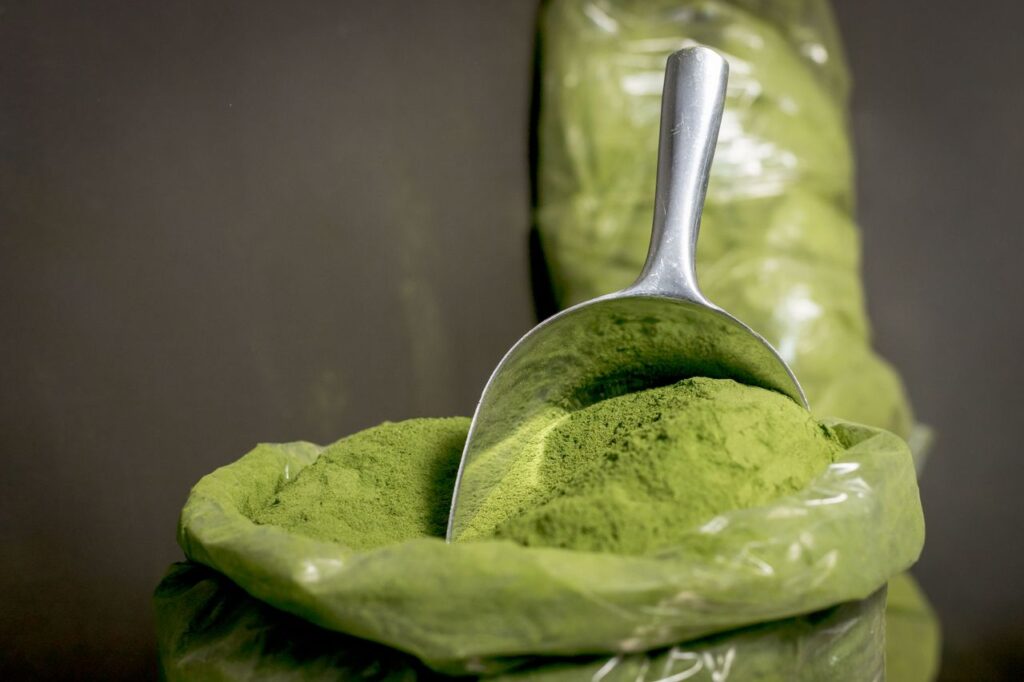
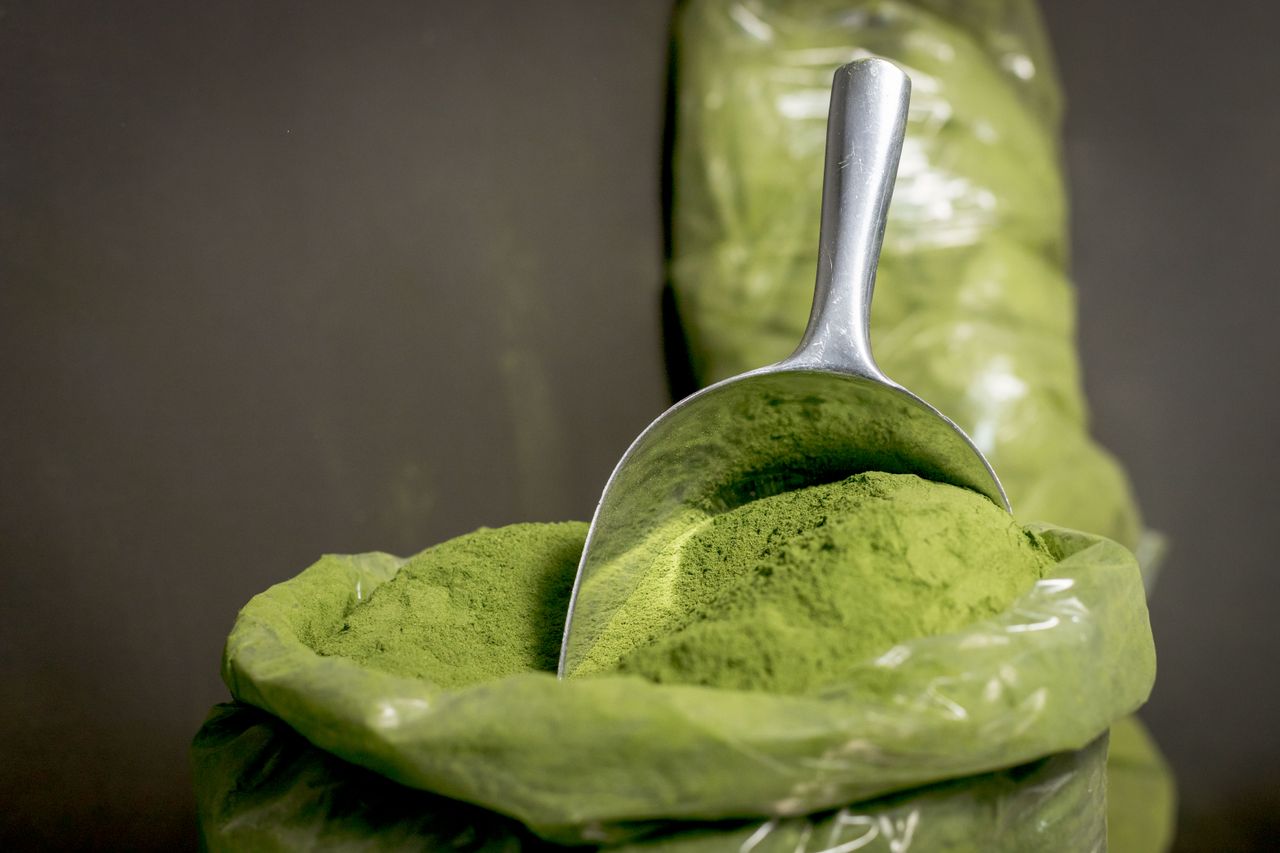
Maeng Da and Bali are trade names for kratom, not botanically distinct varieties. Maeng Da is sold as a stronger, more stimulating strain with a Thai origin story; Bali is sold as a smoother, more relaxing one named after the Indonesian island. Both are offered in red, green and white, neither name is standardised, and no study has compared them head to head.
What little lab data exists comes from single samples that happened to carry these names. Those results show why a strain name is a poor guide to potency: the same name from different sellers can vary widely, and the ranking of two products can flip depending on how they are tested.
Below we cover the origin of the names, what sellers and users claim, the laboratory evidence, safety, how to read a certificate of analysis (COA) and the legal position in September 2026. None of it is dosing advice.
At a glance
| Property | Maeng Da | Bali |
|---|---|---|
| What it is | Trade name for Mitragyna speciosa leaf | Trade name for Mitragyna speciosa leaf |
| Name origin | Thai phrase vendors gloss as “pimp grade”, signalling potency | Indonesian island; kratom’s native range does not list Bali 2 |
| Colours sold | Red, green, white | Red, green, white; red especially common |
| Marketing position | Potent, energising, long-lasting | Smooth, relaxing, beginner-friendly |
| Standardised definition | None | None |
| Head-to-head studies | None | None |
| Single-sample lab data | One Red Maeng Da: about 3.4% to 3.6% mitragynine 5 | One Bali: about 2.1% to 2.8% mitragynine 5 |
| Across sellers | Ten Green Maeng Da powders: about 1.4% to 1.8% 3 | No multi-seller data found |
| Safety and interactions | Same as any kratom | Same as any kratom |
| What to check | Batch COA: mitragynine %, 7-OH, metals, microbes | Batch COA: mitragynine %, 7-OH, metals, microbes |
Where the names Maeng Da and Bali come from
Maeng Da is a Thai phrase that kratom sellers usually translate as “pimp grade”, a slang way of saying top quality or extra strong. Origin stories vary by seller: some say it was selectively bred or grafted in Thailand, others that it is simply a premium grade grown in Indonesia or Malaysia. None of these accounts is documented in the scientific literature. In forensic toxicology, “maeng da” appears simply as one of the popular names for kratom itself.1 Our Maeng Da glossary entry covers the usage.
Bali refers to the Indonesian island, but Bali is not part of kratom’s recognised native range, which covers central and southern Thailand, northern Malaysia, Sumatra, Borneo, the Philippines and New Guinea.2 Many sellers acknowledge that “Bali” kratom is grown elsewhere in Indonesia, often on Borneo or Sumatra, and explain the name as a legacy of trading routes. See our Bali kratom and Borneo kratom entries.
In practice both names now describe a product line rather than a place or a plant. In a 2025 test purchase of ten powders sold online as Green Maeng Da in central Europe, the few packs that stated a country of origin mostly listed Indonesia rather than Thailand, and only two carried a lot number.3
What sellers and users claim about each
Seller copy is fairly consistent. Maeng Da is presented as the potent option: energising, long-lasting and suited to experienced users. Bali is presented as the gentle option: smoother, more relaxing, often recommended to newcomers, and most strongly associated with its red version.
There is no published survey of Maeng Da or Bali users as such. The only peer-reviewed survey of strain effects grouped products by colour, not by name. In that 2023 study of 644 users, red products were rated less energising and less helpful for concentration than green or white, and red users ranked relaxation or sleep higher as a reason for use.4 Because Bali is so often sold as red, while Maeng Da is widely sold in green and white versions, colour expectations and name expectations tend to point the same way, which makes it hard to separate either from marketing.
That same study had the vendor’s products tested and found no significant alkaloid differences between the colours, and its authors cautioned that reported differences may be disproportionately shaped by marketing and anecdote.4 There is no reason to think strain names are more reliable than colours.
What the lab data show for Maeng Da and Bali
Three studies include samples with these names. None was designed to compare them, and each involved very few products.
| Study | Samples | Finding | Caveat |
|---|---|---|---|
| Hughes 2022 | One Red Maeng Da, one Bali, one White Borneo powder | Maeng Da about 3.4% to 3.6% mitragynine in alcohol extracts; Bali about 2.1% to 2.8% | One product each; results shifted with solvent |
| Boffa 2018 | Five named strains including Red Bali | Red Bali had 24 alkaloids detected versus 11 in the others; Green Malay was richest in mitragynine | One sample per name |
| Balázs 2025 | Ten Green Maeng Da powders from nine sellers | Mitragynine about 1.4% to 1.8% (14.2 to 18.4 mg per gram) | European market; different method |
Read together, these point in one direction: the name does not fix the potency. The single Red Maeng Da tested in the US measured roughly twice the mitragynine of the Green Maeng Da powders bought in central Europe, although methods differed.35 And in the 2022 study, whether Maeng Da or Bali showed more 7-OH depended on the extraction solvent: Bali was higher in the ethanol and water extracts, Maeng Da in the methanol extract.5
The Red Bali finding from 2018 is interesting but thin.6 Detecting more alkaloids in one sample does not show that Bali products in general are chemically richer, and nobody has tested whether those minor alkaloids change how the product feels.
Batch variation from the field is larger than any of these gaps. Thai leaf samples ranged from roughly 0.3% to 4.9% mitragynine by dry weight, depending on season and region.7
Safety: the “strongest strain” framing carries its own risk
Maeng Da and Bali share the risks of all kratom. The FDA warns of liver toxicity, seizures, substance use disorder, tolerance and withdrawal, and of rare deaths, often with other substances involved.8 A gentler reputation does not make Bali low-risk.
Maeng Da’s positioning as the “strongest” strain creates a particular problem. It invites sellers to offer “enhanced” or “ultra” versions, and it invites buyers to chase potency. Researchers have found commercial kratom products with 7-OH levels substantially higher than those in raw leaf, which they judged to be probable adulteration.10 Concentrated 7-OH is the focus of the 2026 federal action described below. Our explainer on 7-OH scheduling explains why.
Interactions apply to both names. In 12 healthy adults, a single serving of kratom tea raised exposure to midazolam, a drug cleared by the CYP3A enzyme, by roughly 40%.9 Anyone taking prescription medicines, particularly sedatives or opioids, should speak to a pharmacist. On drug testing, mitragynine is not on the standard five-drug workplace panel, but targeted tests can detect it regardless of strain name.
Checking a Maeng Da or Bali COA
A strain name tells you where a product sits in a seller’s range. A batch-specific certificate of analysis tells you what is in it. Check:
- Lot number and lab. The COA should match your pack’s lot, carry a recent date and come from a named independent lab, ideally ISO/IEC 17025 accredited, that can confirm it issued the report.
- Mitragynine percentage. Thai field studies measured roughly 0.3% to 5% in plain dried leaf.7 A “Maeng Da” leaf powder far above that range is likely boosted with extract.
- 7-OH. Natural leaf contains only a trace. The DEA’s proposed line for botanical kratom is 0.050% 7-OH by dry weight.11 Expect a number or a result below a stated limit of quantification, not a bare “ND”.
- Heavy metals. Numeric results for lead, arsenic, cadmium and mercury, and ideally nickel.
- Microbiology. Salmonella and E. coli not detected, with total aerobic count and yeast and mould listed.
Warning signs include one COA covering several strains, results reported only as “pass”, or a seller who cannot link a report to your batch. Our list of kratom COA red flags has more.
Legal status of Maeng Da and Bali in September 2026
Strain names have no legal meaning; the law looks at the plant and its alkaloids. Kratom leaf is not federally scheduled in the US, but the FDA does not consider it lawful as a dietary supplement or food ingredient, and no kratom drug is approved.8
On 6 July 2026 the DEA published a notice of intent to place 7-OH temporarily in Schedule I above a threshold: more than 0.050% by dry weight in botanical kratom, or more than 0.050% or 1 mg per article in other products. Botanical kratom with naturally occurring 7-OH below that line is excluded.11 As of 23 September 2026, that order had not been published. Three related compounds, mitragynine pseudoindoxyl, MGM-15 and MGM-16, have been temporarily in Schedule I since 26 August 2026.12 An “enhanced Maeng Da” containing added 7-OH could fall on the wrong side of the proposed line once an order takes effect; a plain leaf powder with natural trace 7-OH would not.
State law varies: some states and localities ban kratom, many regulate it through Kratom Consumer Protection Acts, and Florida has used emergency rules against concentrated 7-OH. See our state-by-state kratom guide. In the UK, supplying or importing kratom is an offence under the Psychoactive Substances Act 2016, though possession is not. In Canada, kratom is not a scheduled drug, but Health Canada has not authorised the sale of any product containing it.
Frequently asked questions
Is Maeng Da stronger than Bali kratom?
Sellers market it that way, but there is no systematic evidence. In one lab study, a single Red Maeng Da powder had more mitragynine than a single Bali powder.5 Yet ten Green Maeng Da powders bought in Europe measured less than that US Maeng Da sample.3 Potency depends on the batch, so only a COA can tell you how two products compare.
Is Bali kratom actually from Bali?
Usually not. Bali is not within kratom’s recognised native range, which covers parts of Thailand, Malaysia, Sumatra, Borneo, the Philippines and New Guinea.2 Sellers commonly say Bali kratom is grown elsewhere in Indonesia and named after historical trading routes. Treat the name as a product label rather than a statement of origin.
What does Maeng Da mean?
Sellers usually translate the Thai phrase as “pimp grade”, slang for top quality or extra strength. It is a marketing term, not a botanical or legal category. In forensic toxicology literature, “maeng da” is listed simply as one of the popular names for kratom.1 Products sold as Maeng Da come in red, green and white versions from many different sources.
Is red Bali the same as red Maeng Da?
They are both red-labelled kratom, but no two products are the same unless they come from the same batch. Neither name is standardised, and no study has compared red Bali with red Maeng Da. Lab data from single samples show large differences between products that share a name, so compare batch COAs rather than names.
Is Maeng Da kratom legal?
It has the same legal status as any kratom, because the law does not recognise strain names. Kratom leaf is not federally controlled in the US, though several states and localities ban it. Products with added 7-OH are the target of a pending DEA temporary scheduling order that would cover botanical kratom above 0.050% 7-OH by dry weight.11
Sources
- Papsun DM, Chan-Hosokawa A, Friederich L, Brower J, Graf K, Logan B. The Trouble With Kratom: Analytical and Interpretative Issues Involving Mitragynine. J Anal Toxicol. 2019;43(8):615-629. DOI: 10.1093/jat/bkz064. PMID: 31424079. pubmed.ncbi.nlm.nih.gov
- Ransden KE, Ramachandria P, Laforest LC, Kanumuri SRR, Sharma A, McCurdy CR, Nadakuduti SS. Comparative analysis of monoterpene indole alkaloid composition and genotypic variation in Thai Mitragyna speciosa. Front Plant Sci. 2026;17:1821609. DOI: 10.3389/fpls.2026.1821609. PMID: 42158609. pubmed.ncbi.nlm.nih.gov
- Balázs O, Kárász D, Ashraf AR, Domián BM, Fittler AT, Csabai D, Hesszenberger D, Lajtai A, Vén B, Lakatos Á, Kuzma M, Mayer M, Vida RG. Evaluation of the unregulated online kratom market in two east-central European countries: test purchase and analysis of potential toxicological consequences. Harm Reduct J. 2025;23:10. DOI: 10.1186/s12954-025-01363-0. PMID: 41382258. pubmed.ncbi.nlm.nih.gov
- Huisman G, Menke M, Grundmann O, Schreiber R, Mason N. Examining the Psychoactive Differences between Kratom Strains. Int J Environ Res Public Health. 2023;20(14):6425. DOI: 10.3390/ijerph20146425. PMID: 37510657. pubmed.ncbi.nlm.nih.gov
- Hughes S, van de Klashorst D, Veltri CA, Grundmann O. Acute, Sublethal, and Developmental Toxicity of Kratom (Mitragyna speciosa Korth.) Leaf Preparations on Caenorhabditis elegans as an Invertebrate Model for Human Exposure. Int J Environ Res Public Health. 2022;19(10):6294. DOI: 10.3390/ijerph19106294. PMID: 35627831. pubmed.ncbi.nlm.nih.gov
- Boffa L, Ghè C, Barge A, Muccioli G, Cravotto G. Alkaloid Profiles and Activity in Different Mitragyna speciosa Strains. Nat Prod Commun. 2018;13(9). DOI: 10.1177/1934578X1801300904. journals.sagepub.com
- Sengnon N, Vonghirundecha P, Chaichan W, Juengwatanatrakul T, Onthong J, Kitprasong P, Sriwiriyajan S, Chittrakarn S, Limsuwanchote S, Wungsintaweekul J. Seasonal and Geographic Variation in Alkaloid Content of Kratom (Mitragyna speciosa (Korth.) Havil.) from Thailand. Plants (Basel). 2023;12(4):949. DOI: 10.3390/plants12040949. PMID: 36840297. pubmed.ncbi.nlm.nih.gov
- US Food and Drug Administration. FDA and Kratom. FDA Public Health Focus; page last updated 2 December 2025. fda.gov
- Tanna RS, Nguyen JT, Hadi DL, Layton ME, White JR, Cech NB, Oberlies NH, Rettie AE, Thummel KE, Paine MF. Clinical Assessment of the Drug Interaction Potential of the Psychotropic Natural Product Kratom. Clin Pharmacol Ther. 2023;113(6):1315-1325. DOI: 10.1002/cpt.2891. PMID: 36924284. pubmed.ncbi.nlm.nih.gov
- Lydecker AG, Sharma A, McCurdy CR, Avery BA, Babu KM, Boyer EW. Suspected Adulteration of Commercial Kratom Products with 7-Hydroxymitragynine. J Med Toxicol. 2016;12(4):341-349. DOI: 10.1007/s13181-016-0588-y. PMID: 27752985. pubmed.ncbi.nlm.nih.gov
- Drug Enforcement Administration. Schedules of Controlled Substance: Temporary Placement of 7-Hydroxymitragynine Above a Specified Threshold in Schedule I (notice of intent). Federal Register. 6 July 2026;91 FR 40917. Document 2026-13580. federalregister.gov
- Drug Enforcement Administration. Schedules of Controlled Substances: Temporary Placement of Mitragynine Pseudoindoxyl, MGM-15, and MGM-16 in Schedule I (temporary scheduling order, effective 26 August 2026). Federal Register. 26 August 2026;91 FR 54948. Document 2026-17429. federalregister.gov
Editorial note: This article is for general information only and is not medical or legal advice. Maeng Da and Bali kratom have not been evaluated by the FDA to diagnose, treat, cure or prevent any disease. Laws vary by location and change often, so verify the rules that apply where you are. Always talk to a licensed healthcare provider before use, especially if you are under 21, pregnant or nursing, taking medication, or managing a health condition.
More comparisons
-
Green Malay vs Green Maeng Da Kratom: What the Labels Really Tell You
-
Borneo vs Bali Kratom: What the Labels Mean and What Lab Data Shows
-
Kratom vs Kanna: Two Botanicals With Very Different Mechanisms
-
Kratom Capsules vs Powder: Same Leaf, Different Trade-offs
-
Red vs White Kratom: Relaxing vs Energising, and What Tests Show