
On the published record, kava has the stronger causality case. The NIH LiverTox database grades kava with a likelihood score of A, its highest category, and kratom with a B. Kava injury is usually hepatocellular and has produced transplant cases. Kratom injury is usually cholestatic or mixed, and most reported patients recovered.12
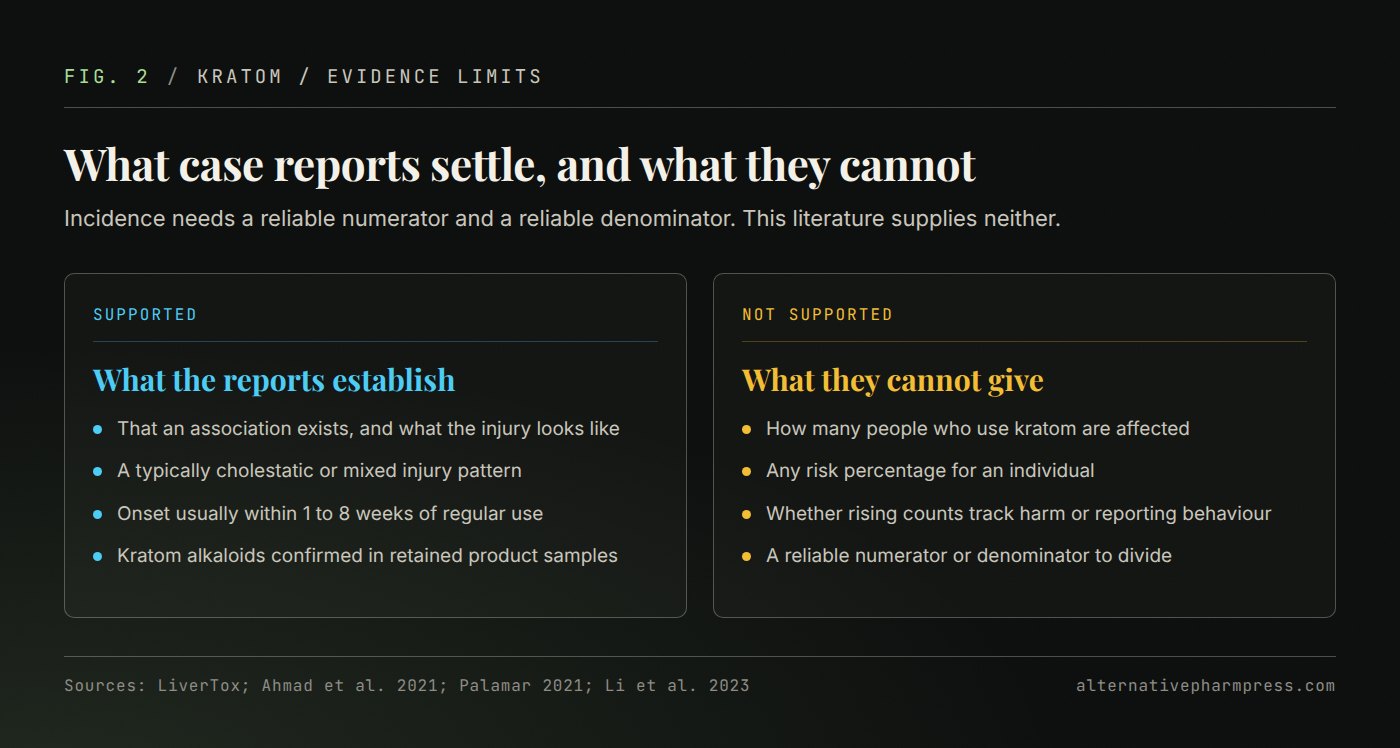
That comparison should not be read as a safety ranking. Neither botanical has a known incidence of liver injury, because nobody knows how many people take either product, at what strength, or for how long. Case reports and case series establish that an association exists and describe what the injury looks like. They cannot tell anyone what the odds are.
What follows is what the published literature actually says about kratom liver damage: the pattern of injury, the timing, the size of the evidence base, the confounders that make attribution difficult, and how the kava record compares.
What LiverTox concludes about kratom
LiverTox is the drug-induced liver injury database maintained by the National Institute of Diabetes and Digestive and Kidney Diseases and hosted on the NCBI Bookshelf. It is the closest thing to a consensus reference on hepatotoxicity attribution, and it has a dedicated kratom chapter.1
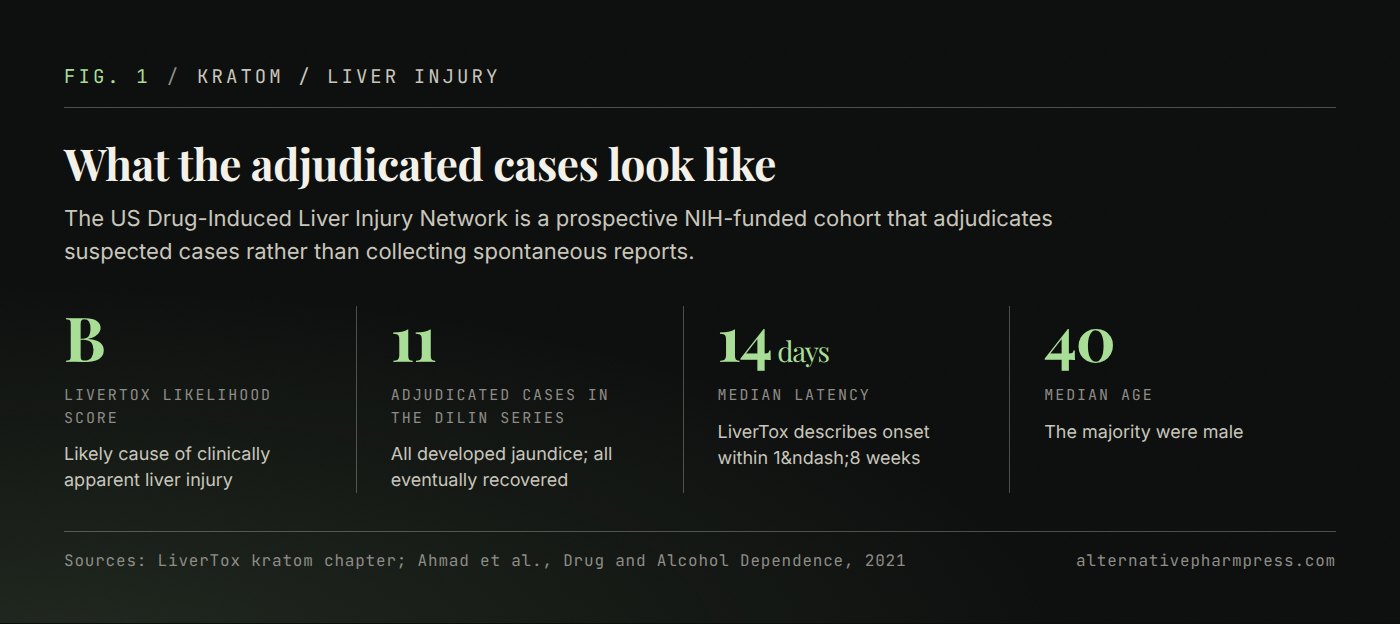
LiverTox assigns kratom a likelihood score of B, meaning a likely cause of clinically apparent liver injury. The chapter states that at least two dozen cases of clinically apparent liver injury with jaundice have appeared in the literature. It describes the onset as usually within one to eight weeks of starting regular use, and the pattern of injury as typically cholestatic or mixed. In severe cases, bilirubin has exceeded 20 mg/dL. The mechanism is not known.1
A likelihood score of B is a meaningful signal. It is not the same as a well-established causal relationship, which is what score A denotes, and it is well short of the evidence base behind drugs with mandatory hepatic monitoring. It sits in the middle: enough published, well-characterised cases with plausible temporal relationships and adequate exclusion of other causes to make chance an unlikely explanation.
What the case series describe
The most useful single dataset comes from the US Drug-Induced Liver Injury Network, a prospective NIH-funded cohort that adjudicates suspected cases rather than collecting spontaneous reports. Ahmad and colleagues published the network’s kratom experience in Drug and Alcohol Dependence in 2021. They identified eleven cases of liver injury attributed to kratom, with the cases clustering in recent years. The majority were male, median age 40. All were symptomatic and all developed jaundice. Median latency was 14 days. Most required hospitalisation, and all eventually recovered. Chemical analysis of retained product samples confirmed the presence of kratom alkaloids.2
Eleven adjudicated cases is a small number. It is also eleven cases in which alternative explanations were systematically worked through by hepatologists, with the implicated product analysed in a laboratory. That combination is rare in botanical hepatotoxicity and is why the DILIN series carries more weight than a much larger pile of uncontrolled reports.
Two features recur across the published cases: jaundice is close to universal at presentation, and recovery after stopping the product is the usual outcome. Neither observation makes the injury trivial. Cholestatic injury can take months to resolve and can be severe enough to require admission. The relevant point for readers of kratom coverage is that the signal is real, characterised, and not currently quantified.
Why the case count does not give an incidence figure
Two dozen published jaundice cases sounds small against any plausible estimate of use. Analysis of the 2019 National Survey on Drug Use and Health found that an estimated 0.7 percent of the US population aged 12 and over reported past-year kratom use.3 Against a denominator that size, a few dozen literature cases would represent a very low rate.
That arithmetic is misleading in both directions. Spontaneous and published reporting captures a small and unmeasured fraction of drug-induced liver injury. An analysis of the FDA Adverse Event Reporting System covering January 2004 to September 2021 found 489 deduplicated kratom-related adverse drug reaction reports, of which 94.2 percent were filed from 2018 onward.4 A jump of that size in a few years reflects rising awareness and reporting behaviour as much as it reflects rising harm. Neither the numerator nor the denominator is reliable enough to divide one by the other.
The honest statement is that the incidence of kratom-associated liver injury is unknown. Anyone quoting a risk percentage for kratom hepatotoxicity is extrapolating from data that do not support it.
Adulteration, co-exposure and product variability
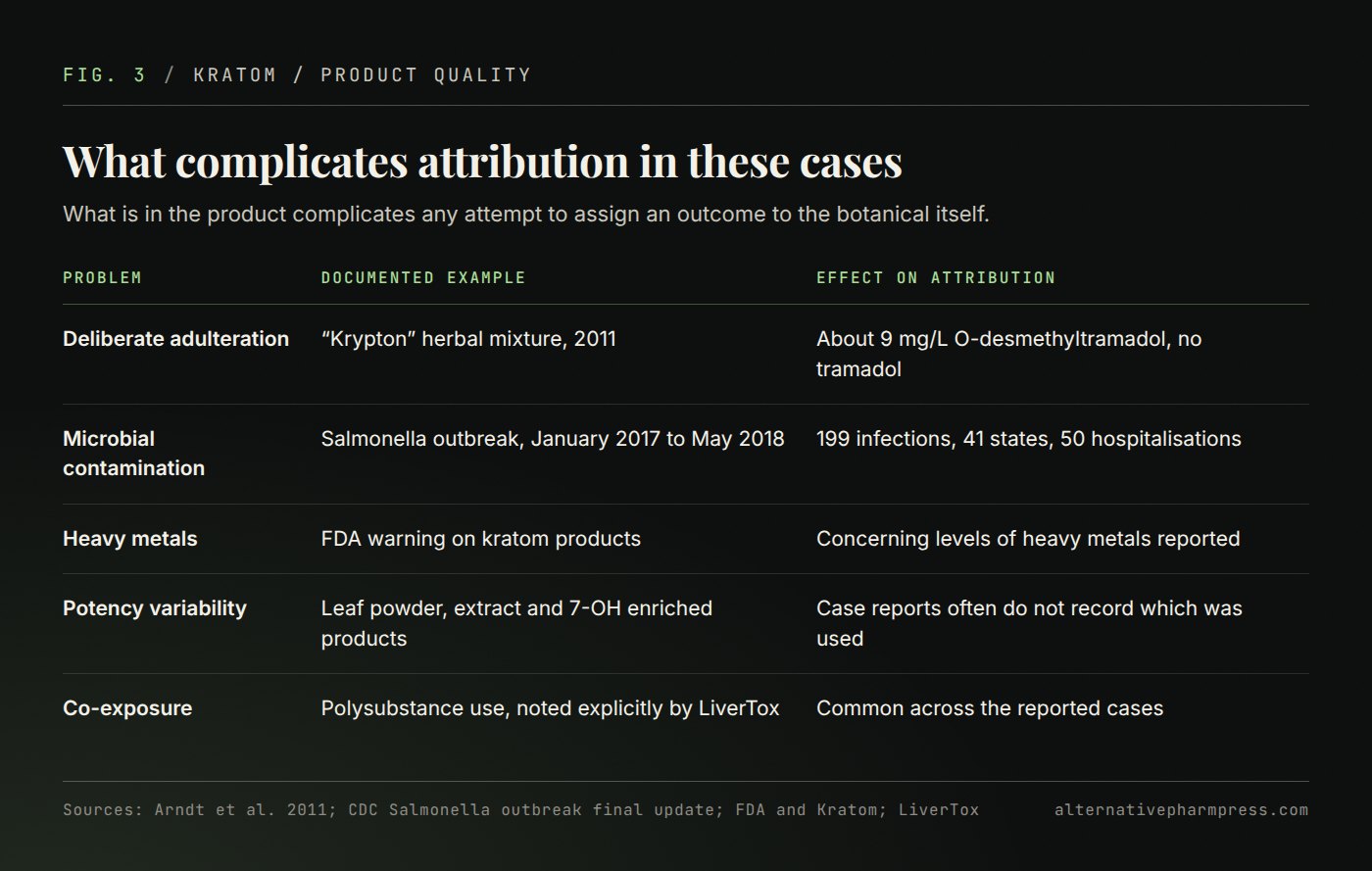
Attribution is complicated by what is actually in the products. Three documented problems recur.
The first is deliberate adulteration. A 2011 case published in Forensic Science International described a rehabilitation patient whose urine contained the kratom alkaloids mitragynine, speciociliatine, speciogynine, mitraciliatine and paynantheine, alongside approximately 9 mg/L of O-desmethyltramadol, a synthetic opioid, with no parent tramadol present. The product was a herbal mixture sold as “Krypton”.5 Where a synthetic opioid has been added to a botanical, any adverse outcome becomes hard to assign to the botanical.
The second is contamination. A multistate Salmonella outbreak linked to kratom products ran from January 2017 to May 2018, producing 199 infections across 41 states with 50 hospitalisations and multiple serotypes involved. Investigators could not identify a single common source.6 The FDA has separately warned about kratom products containing concerning levels of heavy metals.7 Multi-serotype contamination and heavy metal findings both point to supply chains without meaningful process control.
The third is potency variability. Leaf powder, concentrated kratom extract and products enriched for 7-hydroxymitragynine are not equivalent exposures, and case reports often do not record which was involved. Batch-level certificates of analysis are the only routine check on alkaloid content, and COA quality in this market is uneven. Polysubstance use is also common in the reported cases, which LiverTox notes explicitly.1
How the kava record compares
Kava has a longer and more regulatorily consequential hepatotoxicity history. LiverTox assigns kava a likelihood score of A, the category reserved for well-established causes of clinically apparent liver injury. The injury is hepatocellular, with marked aminotransferase elevations and minimal alkaline phosphatase rise, and latency typically runs from two to twenty-four weeks.8
The regulatory record is specific. A 2002 CDC MMWR report described hepatic toxicity possibly associated with kava-containing products in the United States, Germany and Switzerland between 1999 and 2002, including eleven patients with liver failure who required transplantation. The FDA issued a consumer advisory on 25 March 2002, and Germany, Switzerland, Canada, Australia and France restricted sales.9 Germany’s 2002 ban was later reversed by a court in 2014, and the causality attribution has been contested since.8
| Feature | Kratom | Kava |
|---|---|---|
| LiverTox likelihood score | B, likely cause | A, well established cause |
| Typical injury pattern | Cholestatic or mixed | Hepatocellular |
| Reported latency | Usually 1 to 8 weeks; median 14 days in the DILIN series | Usually 2 to 24 weeks |
| Published case volume | At least two dozen jaundice cases; 11 adjudicated in DILIN | Roughly 50 to 100 published or discussed cases |
| Documented transplants or deaths | No deaths in the DILIN series; all eleven recovered | 11 transplant cases reported to CDC across three countries, 1999 to 2002 |
| Regulatory action on hepatic grounds | No US ban; FDA warns of liver toxicity among other risks | FDA consumer advisory 2002; bans and restrictions in several countries, German ban reversed in 2014 |
| Known incidence | Unknown | Unknown; LiverTox cites estimates below 1 per million daily doses |
Read across that table, kava carries the better-documented causal link and the more severe documented outcomes, while kratom carries a newer signal with a shorter observation period and heavier confounding from adulteration and co-exposure. The comparison answers a narrow question about evidence quality, not a broad question about which product is safer overall. Kratom’s principal safety concerns are not confined to the liver; dependence, withdrawal and mu-opioid receptor activity by mitragynine and its metabolites are separate matters.
Where regulation stands as of August 2026
Kratom is not approved by the FDA for any use. The agency states that kratom is not lawfully marketed in the United States as a drug product, a dietary supplement or a food additive in conventional food, and lists liver toxicity, seizures, substance use disorder and rare deaths among the reasons it advises against use.7
On 6 July 2026 the DEA published a notice of intent to temporarily place 7-hydroxymitragynine above a specified threshold into Schedule I, at 91 FR 40917. The threshold is 0.050 percent of 7-hydroxymitragynine on a dry weight basis, or more than 1.00 milligram in the article. The order was set to take effect on or after 5 August 2026 and to run for two years, extendable by one.10 That action targets concentrated 7-OH products rather than leaf material, and it does not turn on hepatotoxicity. State law varies and changes frequently.
Frequently asked questions
Is kava or kratom worse for the liver?
On evidence quality, kava has the stronger causal record: LiverTox score A versus B for kratom, a hepatocellular injury pattern, and documented transplant cases reported to the CDC. Kratom’s published cases are typically cholestatic or mixed and have generally resolved after stopping. Neither has a measured incidence, so the comparison is about evidence, not about individual risk.
How quickly does kratom-associated liver injury appear?
LiverTox describes onset usually within one to eight weeks of starting regular use. The DILIN prospective series reported a median latency of 14 days from a cohort of eleven adjudicated cases.
Does a cholestatic pattern mean the injury is less serious?
No. Cholestatic and mixed injury can involve marked jaundice, with bilirubin above 20 mg/dL in severe published cases, and often resolves more slowly than hepatocellular injury. In the DILIN series most patients were hospitalised.
Why can the literature not produce a risk percentage?
Incidence needs a reliable numerator and denominator. Published and spontaneous reports capture an unknown fraction of cases, and product exposure is not measured at population level. The FAERS analysis showing 94.2 percent of kratom reports filed from 2018 onward illustrates how much reporting behaviour, rather than underlying risk, drives the counts.
Do contaminated or adulterated products explain the cases?
Not entirely. The DILIN investigators confirmed kratom alkaloids in retained product samples, which argues against contamination explaining every case. Adulteration with synthetic opioids, Salmonella contamination and heavy metal findings do complicate attribution across the broader literature.
Sources
- LiverTox: Clinical and Research Information on Drug-Induced Liver Injury. Kratom. National Institute of Diabetes and Digestive and Kidney Diseases. https://www.ncbi.nlm.nih.gov/books/NBK548231/
- Ahmad J, Odin JA, Hayashi PH, Fontana RJ, Conjeevaram H, Avula B, Khan IA, Barnhart H, Vuppalanchi R, Navarro VJ; Drug-Induced Liver Injury Network. Liver injury associated with kratom, a popular opioid-like product: experience from the U.S. drug induced liver injury network and a review of the literature. Drug and Alcohol Dependence. 2021;218:108426. doi:10.1016/j.drugalcdep.2020.108426. https://pubmed.ncbi.nlm.nih.gov/33257199/
- Palamar JJ. Past-year kratom use in the U.S.: estimates from a nationally representative sample. American Journal of Preventive Medicine. 2021;61(2):240–245. doi:10.1016/j.amepre.2021.02.004. https://pubmed.ncbi.nlm.nih.gov/34027890/
- Li X, Ndungu P, Taneja SB, et al. An evaluation of adverse drug reactions and outcomes attributed to kratom in the US Food and Drug Administration Adverse Event Reporting System from January 2004 through September 2021. Clinical and Translational Science. 2023;16(6):1002–1011. doi:10.1111/cts.13505. https://pubmed.ncbi.nlm.nih.gov/36861661/
- Arndt T, Claussen U, Güssregen B, et al. Kratom alkaloids and O-desmethyltramadol in urine of a “Krypton” herbal mixture consumer. Forensic Science International. 2011;208(1–3):47–52. doi:10.1016/j.forsciint.2010.10.025. https://pubmed.ncbi.nlm.nih.gov/21112167/
- Centers for Disease Control and Prevention. Multistate outbreak of Salmonella infections linked to kratom, final update, 24 May 2018. https://archive.cdc.gov/www_cdc_gov/salmonella/kratom-02-18/index.html
- US Food and Drug Administration. FDA and Kratom. https://www.fda.gov/news-events/public-health-focus/fda-and-kratom
- LiverTox: Clinical and Research Information on Drug-Induced Liver Injury. Kava Kava. National Institute of Diabetes and Digestive and Kidney Diseases. https://www.ncbi.nlm.nih.gov/books/NBK548637/
- Centers for Disease Control and Prevention. Hepatic toxicity possibly associated with kava-containing products: United States, Germany, and Switzerland, 1999–2002. MMWR Morbidity and Mortality Weekly Report. 2002;51(47):1065–1067. https://www.cdc.gov/mmwr/preview/mmwrhtml/mm5147a1.htm
- Drug Enforcement Administration. Schedules of Controlled Substances: Temporary Placement of 7-Hydroxymitragynine Above a Specified Threshold in Schedule I. 91 FR 40917, 6 July 2026. https://www.federalregister.gov/documents/2026/07/06/2026-13580/
Editorial note: This article is for general information only and is not medical or legal advice. Kratom has not been evaluated by the FDA to diagnose, treat, cure or prevent any disease. Laws vary by location and change often, so verify the rules that apply where you are. Always talk to a licensed healthcare provider before use, especially if you are under 21, pregnant or nursing, taking medication, or managing a health condition.