
Human trials of lion’s mane report few side effects, but the trials are small, short and few in number. Across the published randomised controlled trials, the most common reported problems are mild digestive complaints. The more serious signals come from case reports rather than trials: occupational contact dermatitis and one case of drug induced lung injury.
The honest answer to whether there is a downside is that the safety record looks unremarkable at the doses studied, and that the evidence base is too thin to call it established. Most trials enrolled fewer than 50 people and ran for four to sixteen weeks. Nothing in that literature can rule out uncommon or delayed harms.
Hericium erinaceus is sold in the United States as a dietary supplement. It is not approved by the FDA for any medical use, and supplements are not reviewed for safety or efficacy before they reach shelves.
What the randomised trials actually report
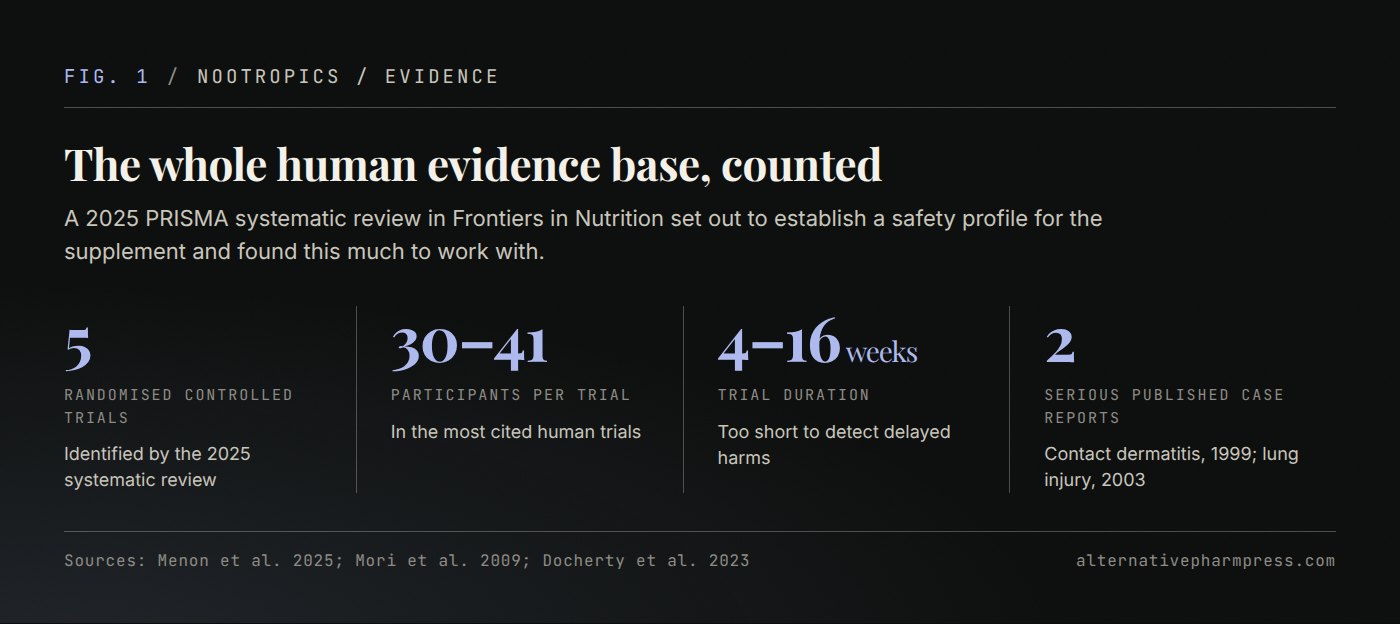
The most cited trial is a 2009 double blind, placebo controlled study by Mori and colleagues in Phytotherapy Research. It randomised 30 Japanese adults aged 50 to 80 with mild cognitive impairment into two groups of 15 and ran for 16 weeks, with a four week follow up after intake stopped. Cognitive scores rose in the treatment group and fell again after the intervention ended. On safety, the authors state only that laboratory tests showed no adverse effect.1 That is a narrow claim. Thirty people over sixteen weeks cannot detect anything uncommon.
A 2010 trial by Nagano and colleagues in Biomedical Research randomised 30 women to lion’s mane cookies or placebo cookies for four weeks and measured menopausal symptoms, depression scores and sleep quality.2 Again the sample is small and the duration short.
A 2023 pilot study by Docherty, Doughty and Smith in Nutrients is one of the better designed recent entries. It was randomised, double blind and placebo controlled, with 41 healthy adults aged 18 to 45 taking 1.8 g of Hericium erinaceus, testing both a single dose at 60 minutes and a 28 day course. Stroop task speed improved acutely, and a reduction in subjective stress after 28 days fell just short of statistical significance at p = 0.051. The authors explicitly note that null and limited negative findings were also observed and that the small sample means the results should be read with caution.3
A 2025 systematic review in Frontiers in Nutrition by Menon and colleagues set out to establish a safety profile for the supplement. Working to PRISMA methods and registered on PROSPERO, it found five randomised controlled trials, three pilot clinical trials, one cohort study, one case report and a set of laboratory studies.4 Five randomised controlled trials is the entire human efficacy and safety base for a product sold at scale. That number is the single most important fact about lion’s mane safety.
The case reports that matter
Two published cases describe harm serious enough to require medical treatment.
In 1999, Maes and colleagues reported occupational allergic contact dermatitis from Hericium erinaceum in Contact Dermatitis. The exposure was to the mushroom itself in a work setting rather than to a capsule.5
In 2003, Nakatsugawa and colleagues reported in Internal Medicine a case of acute respiratory distress syndrome attributed to a commercial Hericium erinaceum extract. A 63 year old man was admitted with severe acute respiratory failure and diffuse infiltration in both lungs. Bronchoalveolar lavage showed a high percentage of lymphocytes, and a lymphocyte stimulation test showed strong reactivity against the extract formulation he had taken four months before onset. He recovered after steroid pulse therapy under mechanical ventilation. The authors describe it as the first report suggesting a causal relationship between acute respiratory distress syndrome and this extract.6
A single case report is not an incidence rate. It does establish that a hypersensitivity reaction to a lion’s mane preparation is possible, which is the sort of risk that small short trials are structurally incapable of finding.
How the evidence compares to how the product is sold
| Question | What the human evidence supports | How the category is often marketed |
|---|---|---|
| Number of randomised controlled trials | Five identified in a 2025 PRISMA systematic review4 | Described as clinically studied without a count |
| Typical sample size | 30 to 41 participants in the most cited trials13 | Sample size rarely stated |
| Typical duration | 4 to 16 weeks123 | Framed as long term daily use |
| Serious adverse events in trials | None reported in the trials cited here | Reported as no side effects |
| Serious events outside trials | Contact dermatitis and one ARDS case report56 | Generally not mentioned |
| Regulatory status | Dietary supplement, no premarket approval7 | Implied to be vetted |
Why supplement regulation changes what a clean trial record means
Under the Dietary Supplement Health and Education Act, the FDA does not approve dietary supplements before they are marketed. The agency states plainly that it has no authority to do so, that manufacturers and distributors carry initial responsibility for ensuring their products meet safety standards, and that FDA is limited to postmarket enforcement because there are no provisions in the law for the agency to approve supplements for safety before they reach the consumer.7 A new dietary ingredient requires a notification submitted at least 75 days before marketing, but a notification is not an approval.
Manufacturers and distributors must record, investigate and forward to the FDA any serious adverse event reports they receive, and consumers can report through the Safety Reporting Portal.7 That system is passive and depends on someone connecting a symptom to a supplement, which people rarely do.
The consequence is specific. A trial testing one characterised extract says something about that extract. It says less than buyers assume about a different product made by a different process. This is a general problem across functional mushroom research and across the wider nootropics category.
Fruiting body, mycelium and the identity problem
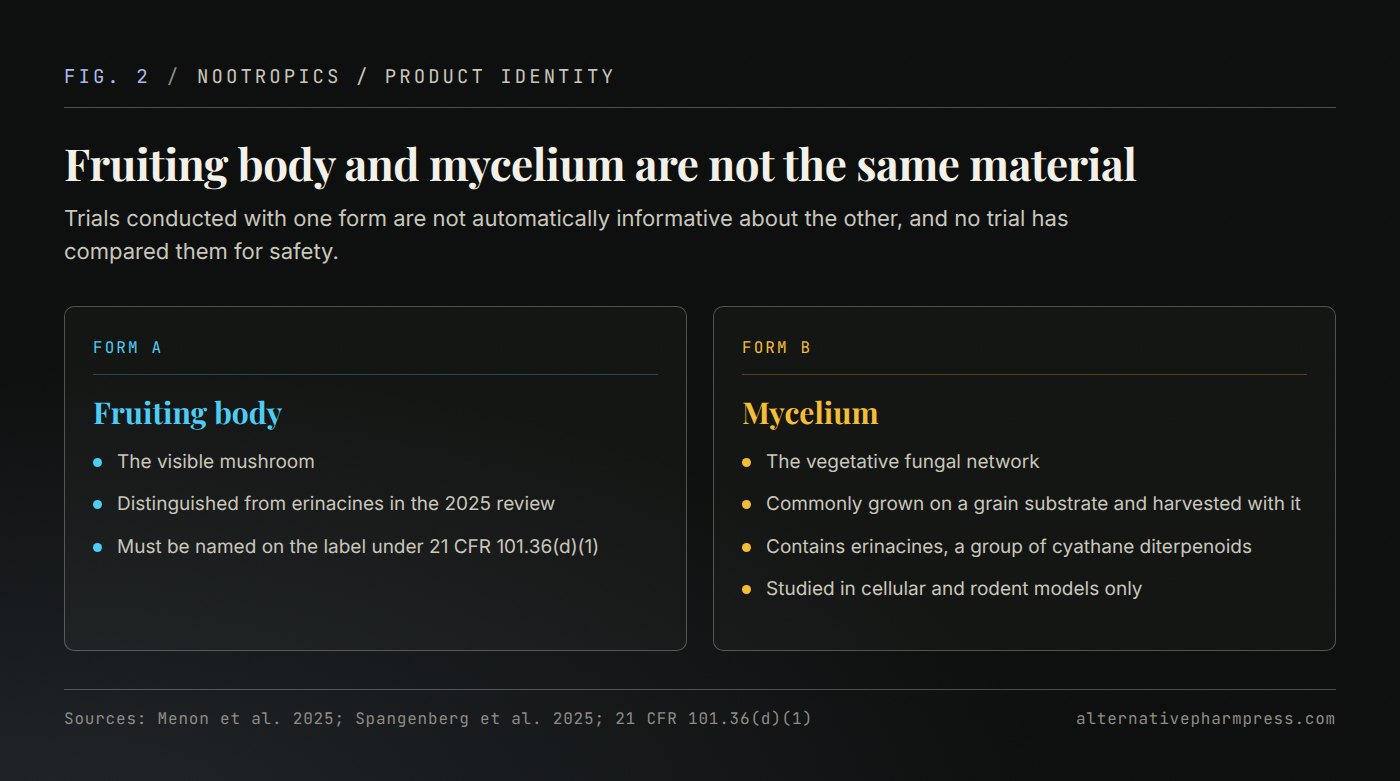
Lion’s mane products are not one thing. The fruiting body is the visible mushroom. Mycelium is the vegetative fungal network, and in commercial production it is commonly grown on a grain substrate and harvested together with that substrate.
The two parts are chemically different. A 2025 systematic review in Frontiers in Pharmacology examining erinacines notes that the mycelia of H. erinaceus contain erinacines, a group of cyathane diterpenoids, and reviews their neurobiological effects in cellular and rodent models.8 The 2025 Frontiers in Nutrition review likewise distinguishes compounds derived from fruiting bodies from erinacines derived from mycelia.4 Trials conducted with one form are therefore not automatically informative about the other.
Labelling law does require the distinction to be visible. Under 21 CFR 101.36(d)(1), source ingredients must be identified in accordance with 21 CFR 101.4, and the listing of botanicals must specify the part of the plant from which the ingredient is derived.9 A label that names only the species without stating fruiting body or mycelium is not giving buyers the information the regulation contemplates. Neither form has been shown to be safer than the other, because no trial has compared them for safety.
Frequently asked questions
Is there a downside to taking lion’s mane?
The published randomised trials did not report serious adverse events, but they were small and short. Case reports document allergic contact dermatitis and one instance of acute respiratory distress syndrome linked to an extract. The realistic summary is low reported harm in a very limited evidence base, not established safety.
Can lion’s mane cause an allergic reaction?
Yes. Occupational allergic contact dermatitis from Hericium erinaceum was reported in Contact Dermatitis in 1999, and a 2003 case in Internal Medicine documented a hypersensitivity type lung injury after use of an extract, confirmed by lymphocyte stimulation testing.
Has the FDA approved lion’s mane?
No. It is sold as a dietary supplement. The FDA does not approve dietary supplements before marketing and has no premarket approval authority over them under DSHEA.
Does fruiting body versus mycelium affect side effects?
There is no trial evidence either way. The two forms differ chemically, with erinacines associated with mycelia, so trials of one form do not transfer cleanly to the other. Federal labelling rules require the plant part to be stated, which makes the distinction checkable on the label.
How much human research exists?
A 2025 PRISMA systematic review identified five randomised controlled trials and three pilot clinical trials covering the clinical use of Hericium erinaceus. That is a small base for a widely sold product, and it is the main reason to treat confident safety claims sceptically.
Sources
- Mori K, Inatomi S, Ouchi K, Azumi Y, Tuchida T. Improving effects of the mushroom Yamabushitake (Hericium erinaceus) on mild cognitive impairment: a double-blind placebo-controlled clinical trial. Phytotherapy Research. 2009;23(3):367–372. PMID 18844328. pubmed.ncbi.nlm.nih.gov
- Nagano M, Shimizu K, Kondo R, Hayashi C, Sato D, Kitagawa K, Ohnuki K. Reduction of depression and anxiety by 4 weeks Hericium erinaceus intake. Biomedical Research (Tokyo). 2010;31(4):231–237. PMID 20834180. pubmed.ncbi.nlm.nih.gov
- Docherty S, Doughty FL, Smith EF. The Acute and Chronic Effects of Lion’s Mane Mushroom Supplementation on Cognitive Function, Stress and Mood in Young Adults: A Double-Blind, Parallel Groups, Pilot Study. Nutrients. 2023;15(22):4842. PMID 38004235. pubmed.ncbi.nlm.nih.gov
- Menon A, Jalal A, Arshad Z, Nawaz FA, Kashyap R. Benefits, side effects, and uses of Hericium erinaceus as a supplement: a systematic review. Frontiers in Nutrition. 2025;12:1641246. PMID 40959699. pubmed.ncbi.nlm.nih.gov
- Maes MF, van Baar HM, van Ginkel CJ. Occupational allergic contact dermatitis from the mushroom White Pom Pom (Hericium erinaceum). Contact Dermatitis. 1999;40(5):289–290. PMID 10344494. pubmed.ncbi.nlm.nih.gov
- Nakatsugawa M, Takahashi H, Takezawa C, Nakajima K, Harada K, Sugawara Y, Kobayashi S, Kondo T, Abe S. Hericium erinaceum (yamabushitake) extract-induced acute respiratory distress syndrome monitored by serum surfactant proteins. Internal Medicine (Tokyo). 2003;42(12):1219–1222. PMID 14714963. pubmed.ncbi.nlm.nih.gov
- US Food and Drug Administration. Questions and Answers on Dietary Supplements. fda.gov
- Spangenberg ET, Moneypenny A, Bozzo GG, Perreault ML. Unveiling the role of erinacines in the neuroprotective effects of Hericium erinaceus: a systematic review in preclinical models. Frontiers in Pharmacology. 2025;16:1582081. PMID 40626304. pubmed.ncbi.nlm.nih.gov
- 21 CFR 101.36(d)(1), Nutrition labeling of dietary supplements. ecfr.gov
Editorial note: This article is for general information only and is not medical or legal advice. Lion’s mane has not been evaluated by the FDA to diagnose, treat, cure or prevent any disease. Laws vary by location and change often, so verify the rules that apply where you are. Always talk to a licensed healthcare provider before use, especially if you are under 21, pregnant or nursing, taking medication, or managing a health condition.