
Research peptides are one of the murkiest corners of the supplement-adjacent world, and a lot of the content written about them blurs an important line on purpose. So let’s be clear before we go a single sentence further: the peptides discussed below are sold “for research use only.” They are not approved by the FDA for human consumption. This article explains what these compounds are and what they’re studied for. It does not tell you how to use them, because we won’t, and frankly no honest source should.
That framing isn’t a disclaimer we’re tacking on. It’s the whole point. When you buy a vial labeled “research use only” from a gray-market website, you have no reliable assurance of what’s actually inside it, how pure it is, or where it came from. People do discuss these compounds constantly online, and you deserve a plain, accurate explanation of what they are. You also deserve to understand the legal and safety reality, which is that most of these sit outside the approved medical system entirely. We’ll give you definitions and status notes, nothing more.
How to read the rest of this article
For each of the six peptides below you’ll get one neutral paragraph on what it is and what it’s studied for, then a clear note on legal and safety status. You will not find doses, administration methods, schedules, or “protocols” anywhere here, because providing those for non-approved compounds is exactly the kind of thing we think is irresponsible. If a compound has an approved prescription form, we’ll say so and point you toward a licensed clinician, which is the only legitimate route for anything meant for the human body.
BPC-157
BPC-157 is a synthetic peptide derived from a sequence found in a protein in gastric juice. In laboratory and animal research it’s studied in connection with tissue and gut-related questions, which is why it comes up so often in online discussion. The human clinical evidence is very limited.
Status and safety: BPC-157 is not an approved drug for human use. It’s sold “for research use only,” and gray-market vials carry unknown purity and origin. There is no quality guarantee on these products, and the contents can differ from the label. This is a compound to read about, not to source from an unregulated seller.
TB-500
TB-500 is a synthetic version related to a naturally occurring peptide called thymosin beta-4. It’s studied in preclinical settings in connection with tissue and recovery research, and like BPC-157 it circulates heavily in fitness forums despite thin human data. What it is, fundamentally, is a research chemical.
Status and safety: TB-500 is not FDA-approved for human consumption and is sold for research use only. Purity and source are unknown in gray-market sales, and there’s no oversight of how it’s manufactured or stored. Treat any product claim about it with heavy skepticism.
GHK-Cu
GHK-Cu is a copper-binding peptide that occurs naturally in human plasma and declines with age. It’s studied in laboratory research for skin and wound-related questions, and it appears in some cosmetic formulations as a topical ingredient at a different regulatory level than injectable research material. The injectable “research” form is a separate matter from a cosmetic cream.
Status and safety: As a research peptide, GHK-Cu is not approved for human consumption and is sold for research use only. The cosmetic topical use exists in a different category, but a vial from a research-chemical site carries the same unknowns as the others here: unverified purity, unverified source, no medical oversight.
Semaglutide
Semaglutide is the important exception on this list, and it needs a clear warning. Semaglutide is a real, FDA-approved prescription medication sold under brand names for specific approved uses. That means a legitimate version exists, but only through a licensed prescriber and a regulated pharmacy. The problem is that “research” semaglutide is also sold by gray-market vendors as a research chemical, and that is an entirely different and dangerous thing.
Status and safety: The approved prescription form is legitimate and should only ever be obtained through a licensed healthcare provider. Unregulated “research use only” semaglutide from a peptide website is not the approved drug, carries unknown purity and dosing accuracy, and skips every safeguard that makes the prescription version safe to use under supervision. If semaglutide is something you’re considering, the only responsible path is a conversation with a licensed clinician, never a research-chemical vendor.
Ipamorelin
Ipamorelin is a synthetic peptide studied in research settings in connection with growth-hormone signaling pathways. It’s a frequent topic in online “peptide” discussion, but it is a research compound, not an approved therapy, and the human evidence supporting consumer claims is limited.
Status and safety: Ipamorelin is not FDA-approved for human consumption and is sold for research use only. Gray-market products carry unknown purity and origin, with no guarantee that the vial matches the label. There’s no legitimate consumer-grade version to source from a research site.
Melanotan II
Melanotan II is a synthetic peptide studied in connection with pigmentation pathways. It’s widely discussed online in relation to skin tanning, but it has not been approved for that or any consumer use, and health authorities in several countries have specifically warned about unregulated products sold under this name.
Status and safety: Melanotan II is not approved for human use and is sold for research use only. Unregulated versions have drawn explicit safety warnings from regulators. Purity and source are unknown in gray-market sales, and the risks of an unregulated injectable compound are real. This is a compound to understand from a distance, not to obtain from an unapproved seller.
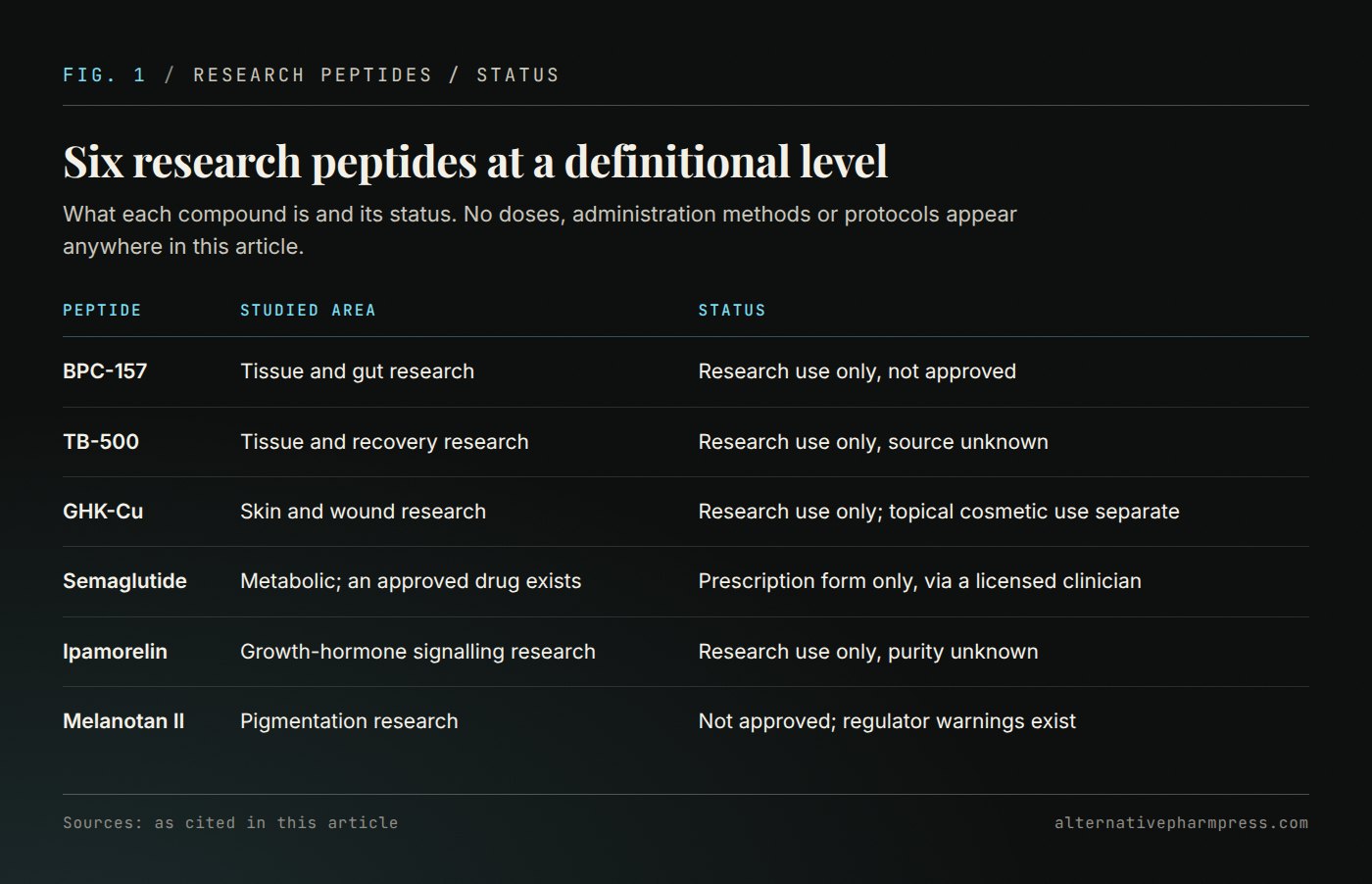
Comparison at a definitional level
| Peptide | Studied area | Status / notes |
|---|---|---|
| BPC-157 | Tissue and gut research | Research use only, not approved, purity unknown |
| TB-500 | Tissue and recovery research | Research use only, not approved, source unknown |
| GHK-Cu | Skin and wound research | Research use only (injectable); topical cosmetic use is separate |
| Semaglutide | Metabolic research; approved drug exists | Use only the prescription form via a licensed clinician; avoid “research” versions |
| Ipamorelin | Growth-hormone signaling research | Research use only, not approved, purity unknown |
| Melanotan II | Pigmentation research | Research use only, not approved, regulator warnings exist |
Why source and testing dominate this entire topic
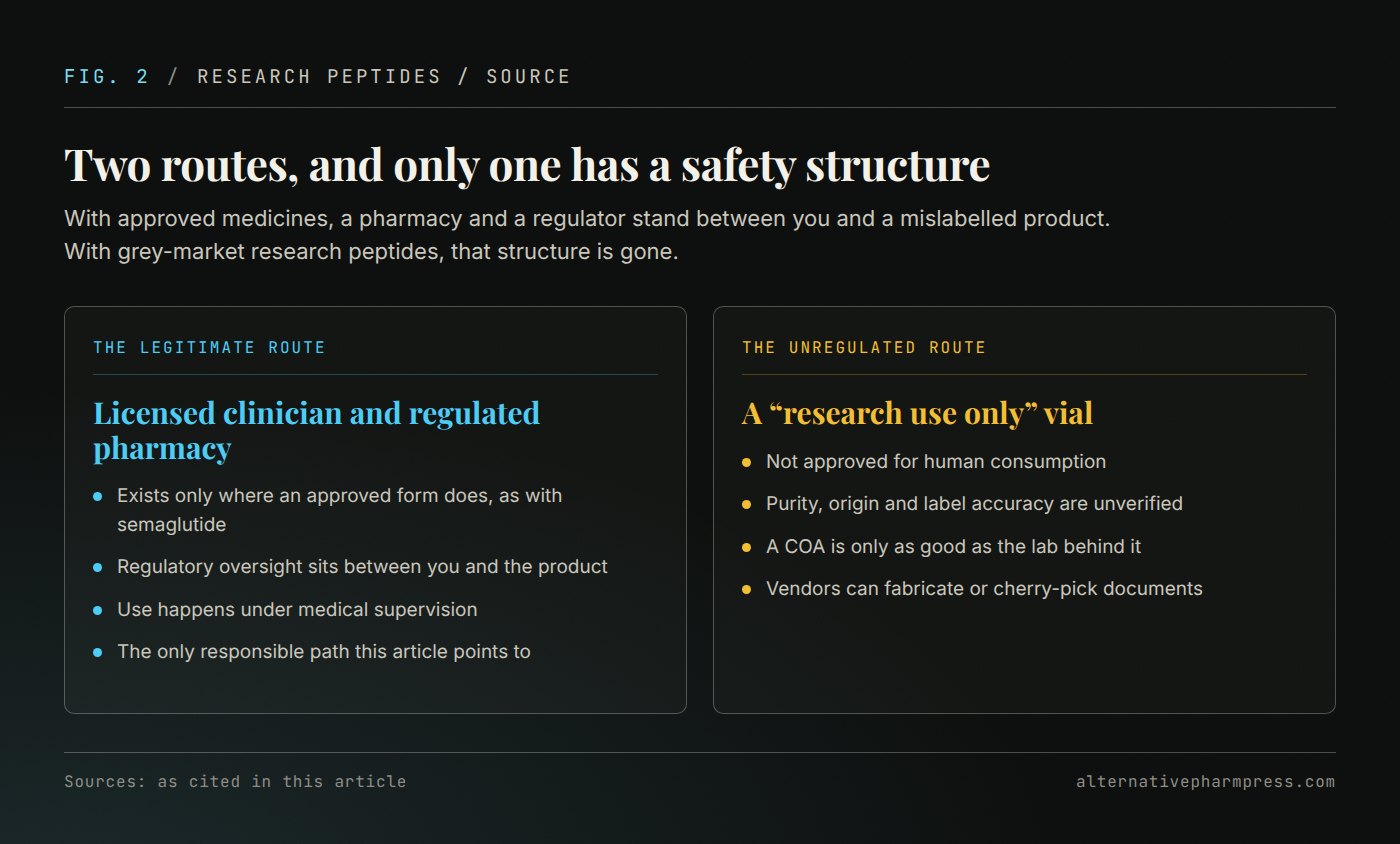
With approved medicines, a pharmacy and a regulator stand between you and a mislabeled product. With gray-market research peptides, that whole safety structure is gone. You’re trusting a website’s word about what’s in a vial, and that word is worth very little. This is why, when people discuss these compounds at all, the conversation should center on source verification and independent testing rather than effects.
A serious third-party certificate of analysis would, in principle, speak to identity and purity, but a COA is only as trustworthy as the lab and the chain of custody behind it, and a research-chemical vendor can fabricate or cherry-pick documents. Our guide to the signs a brand is genuinely third-party tested explains how to tell a real testing process from a decorative badge, and our guide to reading a certificate of analysis shows what a real document should contain. The same skepticism is doubly warranted here. For the general background on what peptides even are, see our peptides glossary entry and the broader research peptides category. None of that changes the core fact: these are not approved for human use, and we’re explaining them, not endorsing their use.
If you want to understand the well-regulated end of the supplement world for contrast, our best nootropic brands of 2026 roundup shows what real dose disclosure and testing look like, and you can browse vetted sellers in the directory, read product write-ups in our reviews section, or check the coupons page for that regulated end of the market. For authoritative, neutral reading, the FDA’s dietary supplements pages explain how approval and oversight actually work, and the NIH Office of Dietary Supplements offers plain background on ingredients.
Frequently asked questions
Are research peptides legal to buy?
Many are sold “for research use only,” which is a regulatory category that does not authorize human consumption. The legal picture varies by compound and location and changes often. Because they are not approved for human use, we don’t treat buying them for personal use as a safe or settled option, and we give no usage guidance.
Can I take a research peptide if it has a COA?
A certificate of analysis is only as trustworthy as the lab and the supply chain behind it, and gray-market vendors can present misleading documents. A COA does not turn a non-approved research chemical into something approved for human use. We’re explaining what these compounds are, not how to use them.
Isn’t semaglutide safe since it’s an approved drug?
The prescription form is approved and legitimate when obtained through a licensed clinician and a regulated pharmacy. “Research use only” semaglutide from a peptide website is not that product and carries unknown purity and accuracy. For anything involving semaglutide, talk to a licensed healthcare provider, not a research-chemical vendor.
Why won’t this article give doses or protocols?
Because these compounds are not approved for human consumption, providing dosing or administration instructions would be irresponsible. Our role is to explain what they are and their status. Anything related to approved medications belongs in a conversation with a qualified clinician.
What’s the single biggest risk with research peptides?
The unknowns. With gray-market products you can’t verify identity, purity, or source, and there’s no regulatory safeguard between you and a mislabeled vial. That uncertainty, on top of the lack of human approval, is why these belong to research settings and licensed medical care rather than self-experimentation.
Editorial note: This article is for general information only and is not medical or legal advice. These products have not been evaluated by the FDA to diagnose, treat, cure, or prevent any disease. Laws vary by location and change often, so verify the rules that apply to you. Always talk to a licensed healthcare provider before use, especially if you are under 21, pregnant or nursing, taking medication, or managing a health condition.