


Sponsored
This article is sponsored by peptides.com, which paid for placement and for the sponsor links it contains. It was not produced by Alternative Pharm Press editorial staff, and it is not an editorial recommendation, review or ranking. Sponsor links are marked rel="sponsored" and pass no ranking credit. See our editorial policy for how we keep sponsored content and editorial coverage separate.
The labels GLP-1, GLP-2 and GLP-3 look like a tidy numbered series, the kind of progression where each one is a slightly upgraded version of the last. That impression is wrong, and the confusion it creates is worth clearing up. Two of these are real, distinct biological molecules with different jobs. The third is a nickname for a synthetic research compound, not a natural hormone at all. If you have ever wondered how these terms relate, this comparison sorts them out in research terms, with no claims about human use.
Everything here is educational. The compounds discussed in a research context are laboratory materials, not products for personal use.
Start with the family name
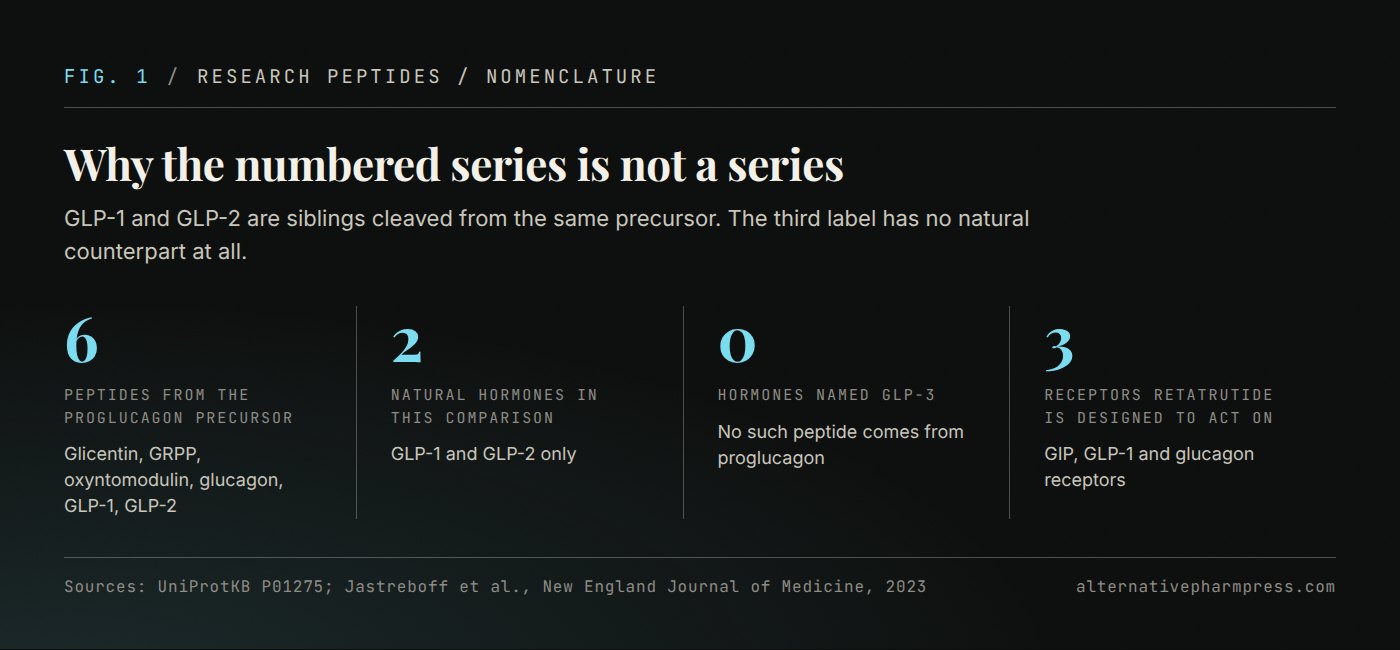
“GLP” stands for glucagon-like peptide. The name reflects a structural resemblance to glucagon, a hormone involved in blood sugar regulation. GLP-1 and GLP-2 are both produced in the body from the same parent molecule, proglucagon, which is cleaved into different products in different tissues.1 That shared origin is why they carry related names, but a shared origin does not mean a shared function. They diverge significantly in what they do.
The proglucagon precursor is the source of a specific, documented set of peptides: glicentin, glicentin-related polypeptide, oxyntomodulin, glucagon, GLP-1 and GLP-2.2 That list is worth holding on to, because it becomes important later.
This is the first thing to fix in your mental model. GLP-1 and GLP-2 are siblings from the same precursor, not sequential versions of one thing.
GLP-1: the well-known incretin
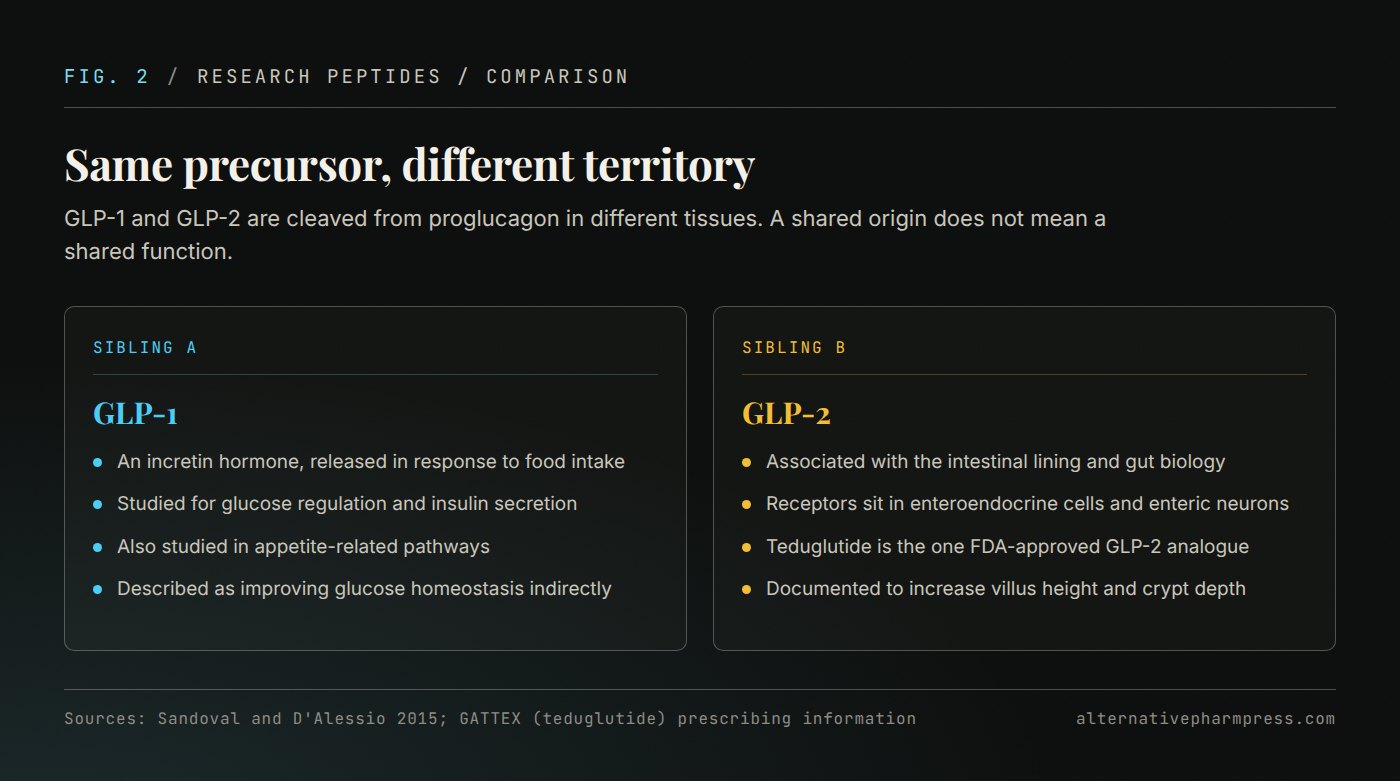
GLP-1, or glucagon-like peptide-1, is the most famous member of the group by a wide margin. It is an incretin hormone, meaning it is released in response to food intake and participates in the body’s metabolic and insulin-related signalling.
In research terms, GLP-1 is studied for its role in glucose regulation, insulin secretion and appetite-related pathways. The physiological literature describes it as improving glucose homeostasis indirectly, through nutrient-induced insulin release and reduced glucagon secretion.1 An entire generation of pharmaceutical research has focused on GLP-1 receptor activity, which is why the term has escaped the lab and entered everyday conversation. When people casually discuss “GLP” compounds, they almost always mean GLP-1 or things modelled on it.
For researchers, GLP-1 and its receptor are a heavily studied system, and that depth of prior literature makes it a common reference point for understanding the rest of the family. Our explainers on semaglutide and tirzepatide cover two of the better known molecules built around this pathway.
GLP-2: the same lineage, a different role
GLP-2, glucagon-like peptide-2, comes from the same proglucagon precursor as GLP-1 but does something quite different. Rather than being centred on insulin and glucose signalling, GLP-2 is associated in the research literature with the intestinal lining and the biology of the gut.
That association is not speculative. GLP-2 receptors sit in intestinal enteroendocrine cells, subepithelial myofibroblasts and enteric neurons, and the one FDA-approved GLP-2 analogue, teduglutide, approved for short bowel syndrome, is documented as increasing villus height and crypt depth of the intestinal mucosa.3 The gut is where this branch of the family operates.
This is the key contrast. Same family, same parent molecule, different territory. Someone who assumes GLP-2 is just a follow-up to GLP-1 will misread the entire body of work, because the two operate in largely separate domains.
The lesson generalises. Numbers in biological names often reflect the order of discovery or naming, not a ranking or an upgrade path.
GLP-3: the nickname that is not a hormone
Now the one that breaks the pattern. There is no naturally occurring hormone called GLP-3. Your body does not produce a “glucagon-like peptide-3” the way it produces GLP-1 and GLP-2. It is simply not among the peptides that the proglucagon precursor is processed into.2
“GLP-3” is an informal nickname, most often attached to the synthetic research compound retatrutide. It caught on as conversational shorthand suggesting a next step beyond the famous GLP-1 compounds. It is catchy, but it is not a scientific classification, and treating it as the third entry in a natural series leads you astray.
Retatrutide, the compound usually behind the “GLP-3” label, is not simply a GLP something. It is a synthetic agonist designed to act on three metabolic receptors at once: the glucose-dependent insulinotropic polypeptide (GIP) receptor, the GLP-1 receptor and the glucagon receptor.4 So the nickname is doubly misleading. It implies a natural hormone that does not exist, and it undersells a compound whose actual design is more complex than the name suggests. For the full picture of that molecule, our dedicated retatrutide explainer covers its mechanism in detail.
One point of status that the nickname obscures entirely: retatrutide is an investigational compound. It has not been approved by the FDA for any use, and as of this writing it remains in clinical development.5
Putting the three side by side
| Term | What it actually is | Origin | Main research focus |
|---|---|---|---|
| GLP-1 | Natural incretin hormone | Proglucagon precursor | Glucose, insulin secretion, appetite pathways |
| GLP-2 | Natural hormone | Proglucagon precursor | Intestinal lining and gut biology |
| “GLP-3” | Not a hormone. An informal nickname, usually for retatrutide | Synthetic, with no natural counterpart | Triple receptor agonism at GIP, GLP-1 and glucagon receptors. Investigational, not FDA-approved |
Two of the three are endogenous molecules with distinct physiological roles. The third is a lab-made compound wearing a borrowed naming convention. Once you see that structure, the apparent series dissolves into what it really is: two related natural hormones and one differently categorised synthetic peptide.
Why does the distinction matter for research?
Precision in naming is not pedantry when you are reading or designing studies. If you search the literature for “GLP-3” expecting a hormone, you will not find one, and you may miss that the relevant work is filed under retatrutide and triple-receptor agonism. If you assume GLP-2 behaves like GLP-1 because of the names, you will misinterpret studies that are actually about gut biology. Getting the categories right is the foundation for getting the science right.
It also matters for sourcing. Ambiguity in the molecule compounds ambiguity in the results, so anyone working with these compounds wants well characterised material. A stated purity figure, a batch-matched certificate of analysis from an accredited third-party laboratory, and independent testing are the minimum documentation that separates a defined research compound from an uncertain one. That documentation is worth scrutinising rather than taking on trust. Our guide to peptide source verification explains what a real testing process looks like, and Research Peptides Explained covers the wider regulatory picture.
Frequently asked questions
Are GLP-1, GLP-2 and GLP-3 the same family of hormones?
Not exactly. GLP-1 and GLP-2 are both natural hormones derived from the proglucagon precursor, but they have different roles. “GLP-3” is not a natural hormone at all. It is an informal nickname for the synthetic research compound retatrutide.
What is the difference between GLP-1 and GLP-2?
Although both come from the same precursor molecule, GLP-1 is studied mainly for glucose regulation, insulin secretion and appetite pathways, while GLP-2 is associated in research with the intestinal lining and gut biology. Same lineage, different functions.
Is GLP-3 a real hormone?
No. There is no naturally occurring glucagon-like peptide-3, and no such peptide is produced from the proglucagon precursor. The term is a conversational nickname, usually for retatrutide, a synthetic peptide that acts on three metabolic receptors. It should be treated as a nickname, not a scientific classification.
Is retatrutide FDA-approved?
No. Retatrutide is an investigational compound in clinical development and has not been approved by the FDA for any use. Material sold under that name outside a clinical trial is not an approved medicine, and this article gives no guidance on human use.
Why does the naming cause so much confusion?
Because the numbered labels look like a sequence or an upgrade path, when they actually reflect different molecules and, in the case of “GLP-3”, an informal nickname for a synthetic compound. Understanding what each term genuinely refers to prevents misreading the research.
Sources
- Sandoval DA, D’Alessio DA. Physiology of proglucagon peptides: role of glucagon and GLP-1 in health and disease. Physiological Reviews. 2015;95(2):513–548. PMID 25834231.
- UniProt Consortium. Glucagon, GCG, P01275: proglucagon precursor and its processed peptides. UniProtKB.
- U.S. Food and Drug Administration. GATTEX (teduglutide) prescribing information: Mechanism of Action and Pharmacodynamics. DailyMed, U.S. National Library of Medicine.
- Jastreboff AM, Kaplan LM, Frías JP, et al. Triple-Hormone-Receptor Agonist Retatrutide for Obesity: A Phase 2 Trial. New England Journal of Medicine. 2023;389(6):514–526. PMID 37366315.
- Drugs.com. Retatrutide FDA approval status. Reviewed March 2026. Retatrutide remains investigational and is not FDA-approved.
Editorial note: This article is for general educational purposes and is not medical or legal advice. It compares these peptides as subjects of scientific research and gives no dosing, administration or usage guidance. Several compounds referenced, including retatrutide, are investigational and have not been approved by the FDA for human use. They have not been evaluated by the FDA to diagnose, treat, cure or prevent any disease. Alternative Pharm Press does not sell peptides. Any material sold elsewhere for research is for research use only and is not intended for human or animal consumption. Always speak to a licensed healthcare provider before acting on anything you read here.
More comparisons
-
Foundayo (Orforglipron) vs the Wegovy Pill: Two Obesity Pills Compared
-
GHK-Cu vs BPC-157: Copper Peptide and Gastric Peptide Compared
-
Ipamorelin vs Sermorelin: Two Growth Hormone Peptides on the Evidence
-
Retatrutide vs Semaglutide: Trial Data, Safety and Legal Status
-
Selank vs Semax: How Russia’s Two Nootropic Peptides Differ