


Zepbound (tirzepatide) can make birth control pills less reliable because it slows how fast the stomach empties, which lowers and delays the hormone levels a pill produces. The FDA label advises anyone on an oral contraceptive to switch to a non-oral method, or add a barrier method such as condoms, for 4 weeks after starting Zepbound and for 4 weeks after each dose increase.1
The same advice appears on the label for Mounjaro, which is the same drug sold for type 2 diabetes.2 Semaglutide (Wegovy, Ozempic) does not carry this warning in the US, which is one of the most common points of confusion in GLP-1 patient forums.3
This guide explains what the label says and why, what the pharmacokinetic study found, why semaglutide is treated differently, which contraceptive methods are not affected, and what is known about pregnancy on GLP-1 drugs. It is general information. Your prescriber or pharmacist is the right person to help choose a method that fits your health and preferences. For wider context, see our peptides and GLP-1 hub.
At a glance: Zepbound and birth control
| Question | Short answer |
|---|---|
| Does Zepbound affect the pill? | It may reduce effectiveness by delaying gastric emptying1 |
| What the US label advises | Switch to a non-oral method, or add a barrier method for 4 weeks after starting and after each dose increase1 |
| Which methods are affected | Oral hormonal contraceptives; non-oral hormonal methods “should not be affected”1 |
| Mounjaro | Same warning (same drug)2 |
| Wegovy or Ozempic | No US label warning; studies found no meaningful change in pill hormone levels3,4 |
| Foundayo (orforglipron) | Similar warning, for 30 days after starting and after each dose increase5 |
| Pregnancy | Stop Zepbound when pregnancy is recognised; UK advice is to stop at least 1 month before trying to conceive1,6 |
What the Zepbound label says about oral contraceptives
The Zepbound prescribing information, updated in August 2026, addresses contraception in three places. In the drug interactions section, it says Zepbound “delays gastric emptying and thereby has the potential to impact the absorption of concomitantly administered oral medications.” It then advises patients using oral hormonal contraceptives to switch to a non-oral contraceptive method, or add a barrier method of contraception, for 4 weeks after starting Zepbound and for 4 weeks after each dose escalation.1
The section on females of reproductive potential adds that “Use of ZEPBOUND may reduce the efficacy of oral hormonal contraceptives due to delayed gastric emptying,” and that the delay “is largest after the first dose and diminishes over time.” It also states that hormonal contraceptives not taken by mouth “should not be affected.”1
The wording covers oral hormonal contraceptives as a group, so it applies to progestin-only pills (“minipills”) as well as combined pills. The Mounjaro label uses the same language.2 UK regulators give similar advice and add that the effect may matter most in people who are overweight or obese.6
Why tirzepatide can lower contraceptive protection: the mechanism
Pills work by keeping hormone levels in the blood high enough to prevent ovulation. To do that, the tablet has to leave the stomach and be absorbed in the small intestine on a predictable schedule. Tirzepatide, which acts on both GLP-1 and GIP receptors (see our explainer on how glucagon-like peptides differ), slows the rate at which the stomach empties, so a pill can sit in the stomach longer and its hormones reach the bloodstream later and at a lower peak.
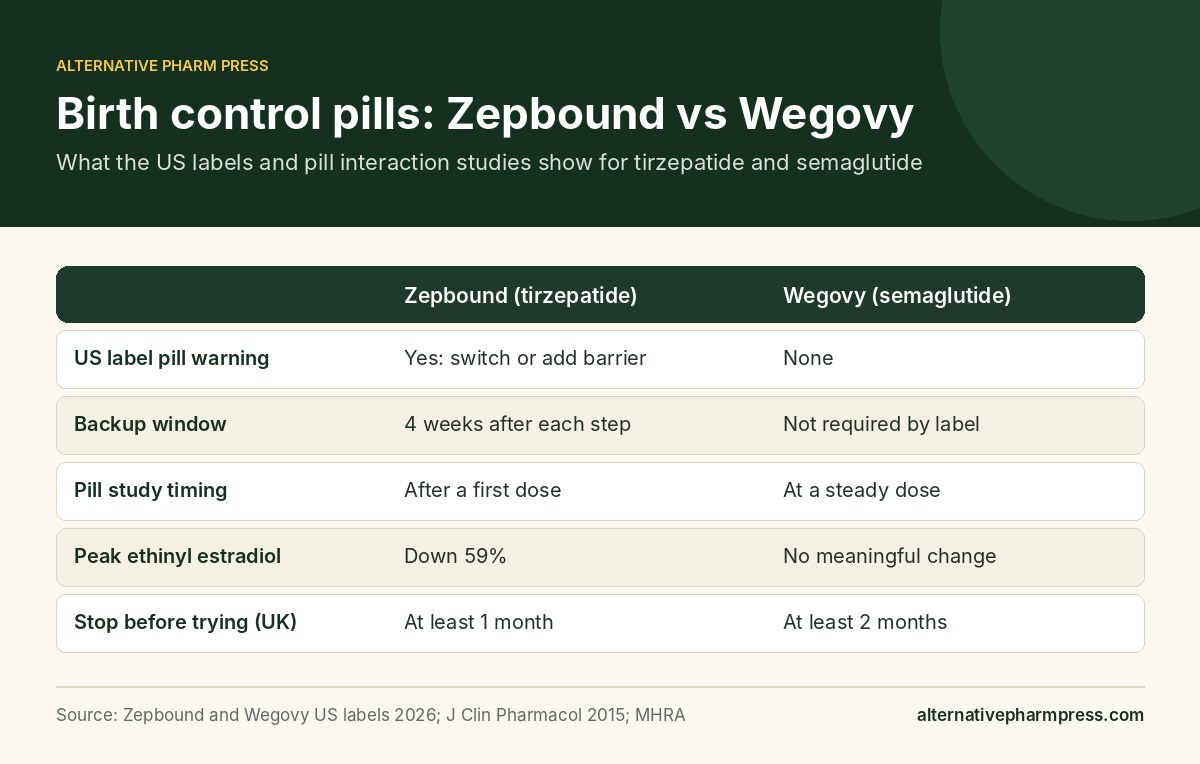
This has been measured directly. In a study described on the label, participants took a combined pill containing ethinyl estradiol and norgestimate alongside a single 5 mg dose of tirzepatide. Peak levels of ethinyl estradiol fell by 59%, norgestimate by 66% and its active metabolite norelgestromin by 55%. Total exposure over time (AUC) fell by 20%, 21% and 23% respectively, and peak levels arrived 2.5 to 4.5 hours later.1
The same effect shows up with other oral drugs. After a first 5 mg dose of tirzepatide, the peak level of paracetamol (acetaminophen) fell by 55%, but by week 6 on a higher dose there was no meaningful effect on paracetamol peak or timing.1 That pattern, a large effect early that fades as the body adapts, explains why the label focuses on the 4 weeks after starting and after each dose increase rather than the whole course of treatment.
It is worth being precise about what the study did not show. It measured hormone levels, not pregnancies, and it did not test whether ovulation actually returned. The warning is a precaution based on drug levels, not on a documented rise in unplanned pregnancies. A 2026 review in the American Journal of Obstetrics and Gynecology noted that studies of GLP-1 drugs and hormonal contraception are limited and that significant knowledge gaps remain.7
Why is tirzepatide flagged but semaglutide less so?
A common question in Zepbound and semaglutide communities is why Wegovy users are not given the same instruction. The short answer is that the two drugs’ pill studies produced different results, and they were designed differently.
The Wegovy label, which covers both the injection and the tablets, lists ethinyl estradiol and levonorgestrel among drugs that showed no clinically significant pharmacokinetic differences when taken with semaglutide, and it has no instruction to use backup contraception.3 In the underlying study, 43 postmenopausal women with type 2 diabetes took a combined pill before and during treatment with semaglutide 1.0 mg at steady state. Exposure to both hormones stayed within the bioequivalence range, and levonorgestrel exposure was actually about 20% higher.4 A separate study of oral semaglutide in 25 postmenopausal women also found no effect on ethinyl estradiol or levonorgestrel levels.8
The key difference is timing. The semaglutide injection study measured hormone levels once participants had reached a steady dose, after weeks of escalation, when the gastric emptying effect has had time to fade. The tirzepatide study measured levels after a single first dose, when the effect is strongest.1,4 So the gap between the labels partly reflects when each drug was tested, not only differences between the molecules.
Regulators outside the US have been more cautious across the class. The UK’s Medicines and Healthcare products Regulatory Agency says people on GLP-1 medicines should use effective contraception, and its specific barrier-method advice for oral contraceptives applies to tirzepatide.6 Lilly’s newer pill, Foundayo (orforglipron), also delays gastric emptying, and its US label advises switching or adding a barrier method for 30 days after starting and after each dose increase.5 We compare the two obesity pills in Foundayo vs the Wegovy pill, and the injectables in semaglutide vs tirzepatide.
Do you really need backup contraception on Zepbound?
When it comes to Zepbound and birth control, people who rely on the pill sometimes ask whether the backup advice is overkill. The label does not frame it as optional: it is the manufacturer’s and FDA’s recommendation for anyone using an oral hormonal contraceptive.1 There are also practical reasons it matters more than it might seem.
- The pill has less margin than people think. CDC estimates that about 7% of people using combined pills become pregnant in a year of typical use, compared with 0.1% for the implant.9 Anything that lowers hormone levels further eats into that margin.
- Gastrointestinal side effects add risk. Nausea, vomiting and diarrhoea are among the most common side effects of GLP-1 drugs.6 CDC guidance notes that vomiting or severe diarrhoea could, in theory, reduce the effectiveness of both combined and progestin-only pills, and its advice on what to do is based on the rules for missed pills.10
- Fertility can change with weight loss. A 2026 review in BJOG notes that GLP-1 drugs may improve fertility in some groups, including women with obesity and polycystic ovary syndrome.11 Someone who had irregular cycles before treatment may become more fertile during it.
The 4-week windows restart with every dose increase. Because Zepbound is usually stepped up several times, the total time covered by backup advice can add up to months. Many people find a non-oral method simpler than tracking each window, but that is a choice to make with a prescriber.
Birth control options that are not affected by Zepbound
The label states that non-oral hormonal contraceptives should not be affected, because they do not depend on absorption from the gut.1 Non-hormonal methods are unaffected for the same reason. CDC’s typical-use pregnancy rates for common methods are below.9
| Method | Route | Typical-use pregnancies per 100 users in a year (CDC) |
|---|---|---|
| Implant | Under the skin of the arm | 0.1 |
| Hormonal (levonorgestrel) IUD | In the uterus | 0.1 to 0.4 |
| Copper IUD | In the uterus, non-hormonal | 0.8 |
| Injection | Injection | 4 |
| Patch | On the skin | 7 |
| Vaginal ring | In the vagina | 7 |
| Male condom | Barrier | 13 |
Patches and rings bypass the stomach, so the Zepbound interaction should not apply, but their typical-use rates are similar to the pill. IUDs and implants are the most effective options and are unaffected by gastric emptying. UK guidance points out that some methods do not work immediately after they are started, so you may still need a barrier method for a short time when switching.6 A pharmacist or prescriber can tell you how long that applies for your chosen method.
If you get your tirzepatide from a compounding pharmacy or an unregulated “research” seller, the same mechanism applies, but the product may not come with this guidance at all. Our explainer on what research use only means covers why those products carry no FDA labelling, and our 2026 weight-loss peptide overview explains where compounded GLP-1s stand.
Period changes after starting Zepbound
Some users report missed, lighter or irregular periods after starting Zepbound. The label does not list menstrual changes as a side effect, and there is little direct research on the question. One plausible link is weight loss itself: a 2026 review notes that GLP-1 drugs may improve fertility in some groups, including women with obesity and polycystic ovary syndrome, which implies changes in ovulation.11
A missed period can also mean pregnancy, especially if you have been relying on the pill during a window when it may have been less effective. Take a pregnancy test if a period is late, and tell your prescriber about any persistent change in your cycle.
Getting pregnant on Zepbound or another GLP-1: what to know
What the labels say. The Zepbound label states that weight loss offers no benefit during pregnancy and may cause fetal harm, and advises stopping Zepbound when a pregnancy is recognised. It notes that human data are insufficient to evaluate risk, and that animal studies showed fetal growth reductions and abnormalities in rats.1 The Wegovy label advises stopping semaglutide at least 2 months before a planned pregnancy because of its long half-life.3 The US Zepbound label does not give a pre-conception washout period; UK guidance advises stopping tirzepatide at least 1 month before trying to conceive, semaglutide at least 2 months before, and liraglutide just before, because it leaves the body much faster.6 Our comparison of semaglutide vs liraglutide explains the difference between weekly and daily drugs.
What the newest human data show. Research on unplanned pregnancies during GLP-1 treatment, sometimes called “Ozempic babies”, has grown quickly. In a 2026 Annals of Internal Medicine study of 3,572 pregnancies in US insurance data, continuing a GLP-1 drug into the first trimester was not definitively linked to higher risks of pregnancy loss, abnormal fetal growth or major birth defects compared with stopping. The authors cautioned that estimates for birth defects and small babies were imprecise and compatible with both no increase and a clinically relevant one.12 A 2026 meta-analysis of seven cohort studies found no statistically significant increase in major malformations after first-trimester exposure, but rated the certainty of evidence as low.13
Data specific to tirzepatide remain limited; the Zepbound label describes the available human data as insufficient to evaluate a drug-related risk.1 A 2026 BJOG review concluded that current data have not shown a clear safety signal from accidental early exposure but cannot rule out important risks, and recommended individual counselling.11 If you become pregnant on Zepbound, stop taking it, contact your prescriber or obstetric provider, and ask about the manufacturer’s pregnancy exposure registry, which is listed on the label.1
If you are planning to stop Zepbound to conceive, our guide to what happens when you stop Zepbound or Wegovy covers weight regain and how people manage the transition.
Questions to ask your prescriber or pharmacist
- Is my current pill affected, and would a non-oral method suit me better?
- If I keep the pill, exactly when do my backup windows start and end?
- If I switch methods, how long until the new one is effective?
- What should I do if I vomit or have severe diarrhoea after taking a pill?
- If I want to become pregnant, when should I stop Zepbound?
The labels for newer drugs such as retatrutide, which is still in trials, are not yet written; our comparison of retatrutide vs tirzepatide covers what is known about it so far.
Frequently asked questions
Does Zepbound make birth control pills less effective?
It may. Zepbound slows stomach emptying, which lowers and delays hormone levels from pills. In a label study, peak ethinyl estradiol fell 59% after a first tirzepatide dose. The FDA label advises switching to a non-oral method, or adding a barrier method, for 4 weeks after starting and after each dose increase.1
How long do I need backup contraception on Zepbound?
According to the US label, for 4 weeks after starting Zepbound and for 4 weeks after each dose escalation, if you rely on an oral hormonal contraceptive. Because doses are usually increased several times, these windows can add up. Switching to a non-oral method such as an IUD, implant, patch or ring avoids the issue.1
Does Wegovy or Ozempic affect birth control pills?
The US Wegovy label does not carry a contraception warning. Studies of semaglutide found no clinically significant change in ethinyl estradiol or levonorgestrel levels, though the injection study measured them at a steady dose, when gastric emptying effects have faded. UK regulators advise effective contraception for anyone on a GLP-1 medicine.3,4,6
Does Zepbound affect IUDs, implants or the patch?
The Zepbound label says hormonal contraceptives that are not taken by mouth should not be affected, because they do not depend on gut absorption. That includes the implant, hormonal IUDs, the injection, the patch and the ring. The copper IUD and condoms are non-hormonal and also unaffected.1
When should I stop Zepbound before trying to get pregnant?
The US Zepbound label advises stopping when pregnancy is recognised but gives no pre-conception washout period. UK guidance advises stopping tirzepatide at least 1 month before trying to conceive, and semaglutide at least 2 months before. Discuss timing with your prescriber, since stopping can lead to weight regain and changes in blood sugar.1,6
Sources
- Eli Lilly and Company. ZEPBOUND (tirzepatide) injection: US prescribing information. DailyMed, US National Library of Medicine. Updated 28 August 2026. dailymed.nlm.nih.gov
- Eli Lilly and Company. MOUNJARO (tirzepatide) injection: US prescribing information. DailyMed, US National Library of Medicine. Label version published 2 September 2026. dailymed.nlm.nih.gov
- Novo Nordisk. WEGOVY (semaglutide) injection and tablets: US prescribing information. DailyMed, US National Library of Medicine. Revised June 2026. dailymed.nlm.nih.gov
- Kapitza C, Nosek L, Jensen L, Hartvig H, Jensen CB, Flint A. Semaglutide, a once-weekly human GLP-1 analog, does not reduce the bioavailability of the combined oral contraceptive, ethinylestradiol/levonorgestrel. J Clin Pharmacol. 2015;55(5):497-504. DOI: 10.1002/jcph.443. PMID: 25475122. pubmed.ncbi.nlm.nih.gov
- Eli Lilly and Company. FOUNDAYO (orforglipron) tablets: US prescribing information. DailyMed, US National Library of Medicine. Label version published 13 August 2026. dailymed.nlm.nih.gov
- Medicines and Healthcare products Regulatory Agency. GLP-1 medicines for weight loss and diabetes: what you need to know. GOV.UK. Updated 5 February 2026. gov.uk
- Yee HM, Han LL. Contraceptive use and GLP-1 receptor agonists: an intersection of metabolic and reproductive health. Am J Obstet Gynecol. Published online 8 October 2026. DOI: 10.1016/j.ajog.2026.10.005. PMID: 42849807. pubmed.ncbi.nlm.nih.gov
- Jordy AB, Albayaty M, Breitschaft A, Anderson TW, Christiansen E, Houshmand-Øregaard A, et al. Effect of Oral Semaglutide on the Pharmacokinetics of Levonorgestrel and Ethinylestradiol in Healthy Postmenopausal Women and Furosemide and Rosuvastatin in Healthy Subjects. Clin Pharmacokinet. 2021;60(9):1171-1185. DOI: 10.1007/s40262-020-00976-x. PMID: 33782832. pubmed.ncbi.nlm.nih.gov
- Centers for Disease Control and Prevention. Contraception and Birth Control Methods. Last updated 6 August 2024. cdc.gov
- Centers for Disease Control and Prevention. U.S. Selected Practice Recommendations for Contraceptive Use, 2024. MMWR Recomm Rep. 2024;73(RR-3). cdc.gov
- Lau KGY, Chopra A, Mullins E, Agha-Jaffar R, Tan T, Sykes L, Yu CKH. Glucagon-Like Peptide-1 Receptor Agonists in Pregnancy: Periconception Exposure and Perinatal Outcomes. BJOG. Published online 4 October 2026. DOI: 10.1111/1471-0528.70339. PMID: 42830218. pubmed.ncbi.nlm.nih.gov
- Brown JP, Huybrechts KF, Straub L, Patorno E, Seely EW, Bateman BT, Hernández-Díaz S. Continuing Glucagon-Like Peptide-1 Receptor Agonists Into the First Trimester of Pregnancy and Pregnancy Outcomes: A Target Trial Emulation Study Using Claims Information. Ann Intern Med. 2026;179(7):929-937. DOI: 10.7326/ANNALS-25-04820. PMID: 42258827. pubmed.ncbi.nlm.nih.gov
- Uysal N, Horoz E, Gungor M, Timarci I, Sozmen MK, Karadas B, Kaplan YC. Pregnancy outcomes following maternal GLP-1 receptor agonist exposure: a systematic review and meta-analysis. Sci Rep. Published online 8 July 2026. DOI: 10.1038/s41598-026-61582-8. PMID: 42420519. pubmed.ncbi.nlm.nih.gov
Featured image: Birth control pills, healthcare photo by unknown, CC0 1.0. Cropped.
This article is for educational purposes only and is not medical or legal advice. Products discussed here are not intended to diagnose, treat, cure or prevent any disease. Laws vary by location and change often, so verify the rules that apply where you are. Always talk to a licensed healthcare provider before use, especially if you are under 21, pregnant or nursing, taking medication, or managing a health condition.