

Difference Between Mitragynine & 7-Hydroxymitragynine
This article is for educational purposes only and does not constitute medical advice.
Last updated: October 15, 2026. Corrected two study descriptions, added metabolism research and the DEA’s October 2026 7-OH notice.
Quick answer: Mitragynine is the most abundant alkaloid in kratom leaf and a partial mu-opioid agonist with milder effects. 7-hydroxymitragynine (7-OH) is present only in trace amounts in leaf but is a far more potent opioid agonist, and the liver also makes it from mitragynine. Concentrated 7-OH products are semi-synthetic and are being placed in federal Schedule I, while natural leaf below the threshold is not.
Introduction to Kratom Alkaloids
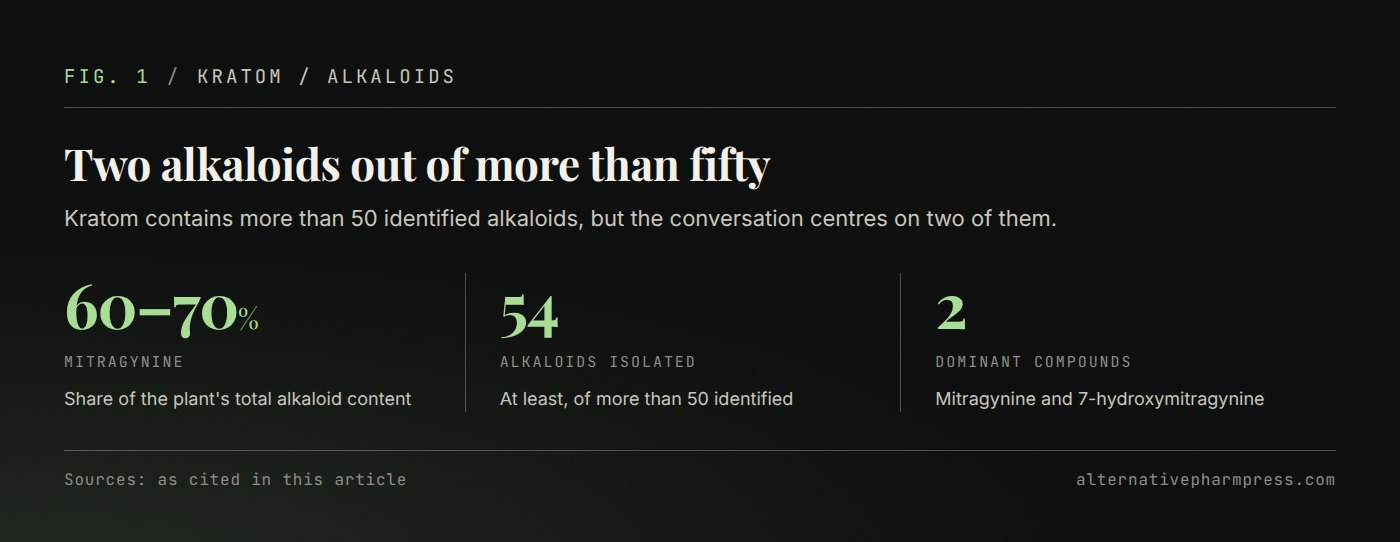
Kratom (Mitragyna speciosa) is comprised of an array of naturally occurring compounds known as alkaloids that create its effects on the body and mind. Among the more than 50 alkaloids identified in kratom (with at least 54 isolated as of current research), two stand out as the most significant: mitragynine and 7-hydroxymitragynine (7-OH). These compounds play a key role in kratom’s effects on users, including stimulating and relaxing effects.
For anyone interested in kratom, these alkaloids are important. For broader context, read our Kratom Research Overview and Kratom Strains Explained articles. Their composition and interaction with the body will directly influence the overall experience. This article explores the key differences between mitragynine and 7-hydroxymitragynine, their effects, and why this knowledge matters for informed decision-making. Health authorities such as the U.S. Food and Drug Administration (FDA) have also highlighted the need for more research and caution regarding kratom use.
Key Takeaways
Mitragynine is the main alkaloid in kratom leaf, often around two-thirds of total alkaloids, though this varies widely.
7-OH is a trace leaf alkaloid but a much more potent mu-opioid agonist.
Both compounds in kratom contribute stimulating and relaxing effects.
The liver converts some mitragynine into 7-OH (via CYP3A), and human blood can convert 7-OH into the even more potent mitragynine pseudoindoxyl.
Concentrated 7-OH products are not the same as leaf and are being moved into federal Schedule I.
What is Mitragynine?
Mitragynine is the primary alkaloid found in kratom leaves, often making up roughly 60–70% of total alkaloids in commonly tested leaf, although studies report wide variation by origin, season and processing. It is largely responsible for the characteristic effects associated with kratom, particularly at lower to moderate doses.
Mitragynine is known for its effects as a mild stimulant at lower doses, with increased energy, alertness, and focus being the most common. At higher doses, it may contribute to more relaxing and calming effects, depending on individual tolerance and body response. Mitragynine is a partial agonist at mu-opioid receptors and also acts on adrenergic and serotonin receptors, which may explain why users describe both stimulating and calming effects.
What is 7-hydroxymitragynine (7-OH)?
7-hydroxymitragynine (7-OH) is another significant alkaloid in kratom, but it is present in significantly lower concentrations relative to mitragynine. Despite its low concentration, it is considered significantly more potent.
Interestingly, 7-OH is naturally occurring in kratom but can also be produced in the body as a metabolite of mitragynine. This means that when kratom is consumed, some mitragynine may convert into 7-OH, contributing to the overall effects. In leaf, 7-OH is scarce: a 2025 University of Florida study measured it at just 0.02% to 0.04% of the leaf alkaloid extract. Mouse research published in ACS Central Science (Kruegel et al., 2019) found the liver enzyme CYP3A converts mitragynine into 7-OH in amounts large enough to drive much of mitragynine’s pain-relieving effect. A 2020 study (Kamble et al.) then showed that human plasma converts 7-OH into mitragynine pseudoindoxyl, which is even more potent at opioid receptors. This metabolic chain helps explain why concentrated 7-OH products behave much more like conventional opioids than plain leaf does.
Key Differences Between Mitragynine & 7-OH
| Feature | Mitragynine | 7-hydroxymitragynine |
|---|---|---|
| Abundance | High (60–70%) | Very Low |
| Potency | Moderate | High |
| Effects | Mild stimulation + relaxation | Stronger opioid-like effects, higher dependence and respiratory risk |
| Occurrence | Natural in leaves | Trace in leaf; made by the liver from mitragynine; concentrated products are lab-made |
| Federal status (Oct 2026) | Not scheduled | Temporary Schedule I above 1 mg/g, from Nov 13, 2026 at the earliest |
While mitragynine is the dominant alkaloid in terms of quantity, 7-hydroxymitragynine stands out due to its higher potency. Together, they create a balanced and complex effect profile that varies from person to person.
How do they interact with the body?
Mitragynine and 7-hydroxymitragynine both interact with receptors in the brain that regulate mood, pain, and general well-being. At lower amounts, mitragynine tends to produce more stimulating effects, while higher levels or the presence of 7-OH may lead to more calming or relaxing outcomes. These interactions have been discussed in scientific research, with studies available on PubMed highlighting how kratom alkaloids affect brain receptors.
Research Findings
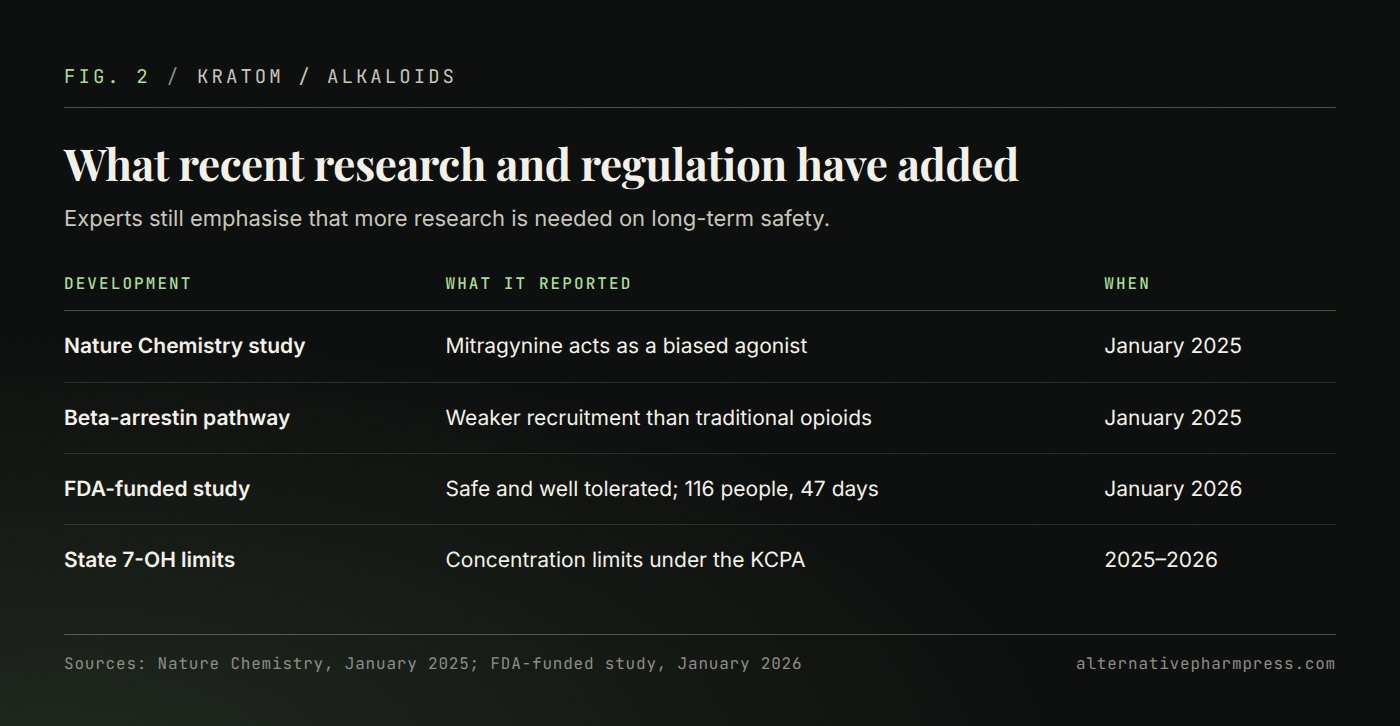
Research on kratom alkaloids continues, with several studies investigating mitragynine and 7-hydroxymitragynine. Lab research from Columbia University in 2016 (Kruegel et al., Journal of the American Chemical Society) suggested mitragynine is a “G protein–biased” opioid agonist that recruits little beta-arrestin, a pathway once linked to respiratory depression. A 2020 study in Science Signaling (Gillis et al.) argued that low overall receptor activation explains the milder side-effect profile better than bias does. In humans, a January 2026 placebo-controlled trial of kratom leaf powder in 116 healthy adults (Huestis et al., Therapeutic Drug Monitoring) reported no serious adverse events at modest, short-term doses. That trial tested leaf, not concentrated 7-OH.
However, experts emphasize that more research is needed to fully understand their long-term safety and impact. Regulators have focused on 7-OH. In July 2025 the FDA recommended scheduling concentrated 7-OH products, and on October 14, 2026 the DEA published notice that it will temporarily place 7-OH and mitragynine pseudoindoxyl in Schedule I when either exceeds 1 mg per gram, or when the mitragynine-to-7-OH ratio is below 100. Several states also cap 7-OH under their Kratom Consumer Protection Acts. See our state-by-state legal guide.
Frequently Asked Questions
Q: Is 7-hydroxymitragynine stronger than mitragynine?
Yes, 7-OH is considered more potent, although it is present in lower concentrations.
Q: Which alkaloid is more common in kratom?
Mitragynine is the predominant alkaloid and comprises most of kratom’s composition.
Q: Why do kratom effects vary?
Dose, tolerance, individual metabolism (including how much mitragynine the liver converts to 7-OH), product quality and the alkaloid profile of the batch all play a part.
Q: Is research on kratom complete?
No, research is still ongoing, and more studies are needed to fully understand its safety and long-term effects.
Conclusion
Mitragynine and 7-hydroxymitragynine are two of the most important alkaloids responsible for the overall effects of kratom. While mitragynine is present in significantly higher concentrations and contributes to both stimulating and mild relaxing effects, 7-hydroxymitragynine stands out due to its higher potency. Understanding the differences between these alkaloids is essential for anyone looking to explore kratom in a more informed and responsible manner.
- Mitragynine Alkaloid Review — PubMed
- Kratom Alkaloid Chemistry — Journal of Natural Products
- Kratom Safety & Toxicology — Frontiers in Pharmacology
- FDA and Kratom
- DEA Kratom Fact Sheet
- Kruegel AC, et al. 7-Hydroxymitragynine is an active metabolite of mitragynine. ACS Cent Sci. 2019
- Kamble SH, et al. Metabolism of a kratom alkaloid metabolite in human plasma increases its opioid potency. ACS Pharmacol Transl Sci. 2020
- Kruegel AC, et al. J Am Chem Soc. 2016
- Gillis A, et al. Sci Signal. 2020
- Federal Register — DEA temporary scheduling of 7-OH (Oct. 14, 2026)
More comparisons
-
Green Malay vs Green Maeng Da Kratom: What the Labels Really Tell You
-
Borneo vs Bali Kratom: What the Labels Mean and What Lab Data Shows
-
Kratom vs Kanna: Two Botanicals With Very Different Mechanisms
-
Kratom Capsules vs Powder: Same Leaf, Different Trade-offs
-
Red vs White Kratom: Relaxing vs Energising, and What Tests Show