
Standard drug tests do not look for cannabidiol. They look for a THC metabolite, 11-nor-9-carboxy-delta-9-tetrahydrocannabinol. Pure CBD does not produce it, so CBD alone should not trigger a positive. The risk comes from the product, not the molecule: hemp extracts often contain more THC than the label says, and full spectrum products contain THC by design.
That distinction matters because federal workplace testing uses fixed thresholds and makes no allowance for where the THC came from. A laboratory reports a concentration. It cannot tell whether the metabolite originated in cannabis flower or in a mislabelled hemp tincture, and the reviewing physician is not required to treat the difference as an excuse.
So the honest answer to “can CBD fail a drug test” is conditional. A genuinely pure isolate, verified by testing, presents a low risk. A full spectrum extract used regularly presents a real one. Most of the uncertainty sits in the gap between what hemp labels claim and what the products actually contain.
What a workplace drug test actually measures
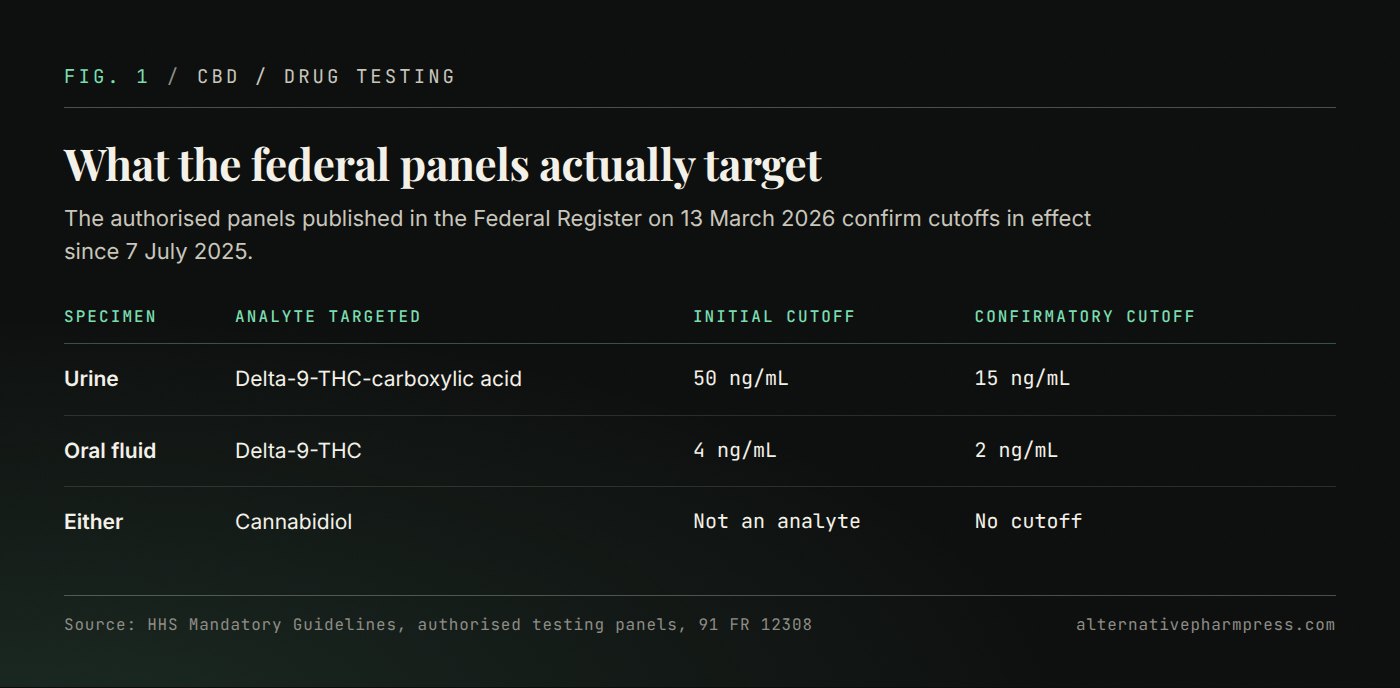
Federal workplace testing is governed by the HHS Mandatory Guidelines, administered by SAMHSA. The authorised panels published in the Federal Register on 13 March 2026 confirm the cutoffs that have been in effect since 7 July 2025 and state that no revisions were made.1 For urine, the marijuana metabolite delta-9-THC-carboxylic acid has an initial immunoassay cutoff of 50 ng/mL and a confirmatory cutoff of 15 ng/mL by mass spectrometry. For oral fluid, the analyte is delta-9-THC itself, with an initial cutoff of 4 ng/mL and a confirmatory cutoff of 2 ng/mL.1
Cannabidiol is not on the panel. It is not an analyte, it has no cutoff, and immunoassays calibrated for the THC metabolite are not designed to respond to it. Non-federal employers are not bound by these cutoffs and may use different panels or thresholds, but the same principle applies: the target is THC and its metabolites.
Two consequences follow. First, a test cannot distinguish hemp-derived THC from cannabis-derived THC, because the metabolite is identical. Second, the oral fluid window is short and reflects recent exposure, while the urine window reflects accumulated metabolite and can extend for days or weeks in frequent users. The specimen type therefore changes the risk profile considerably.
What the controlled data shows about pure CBD
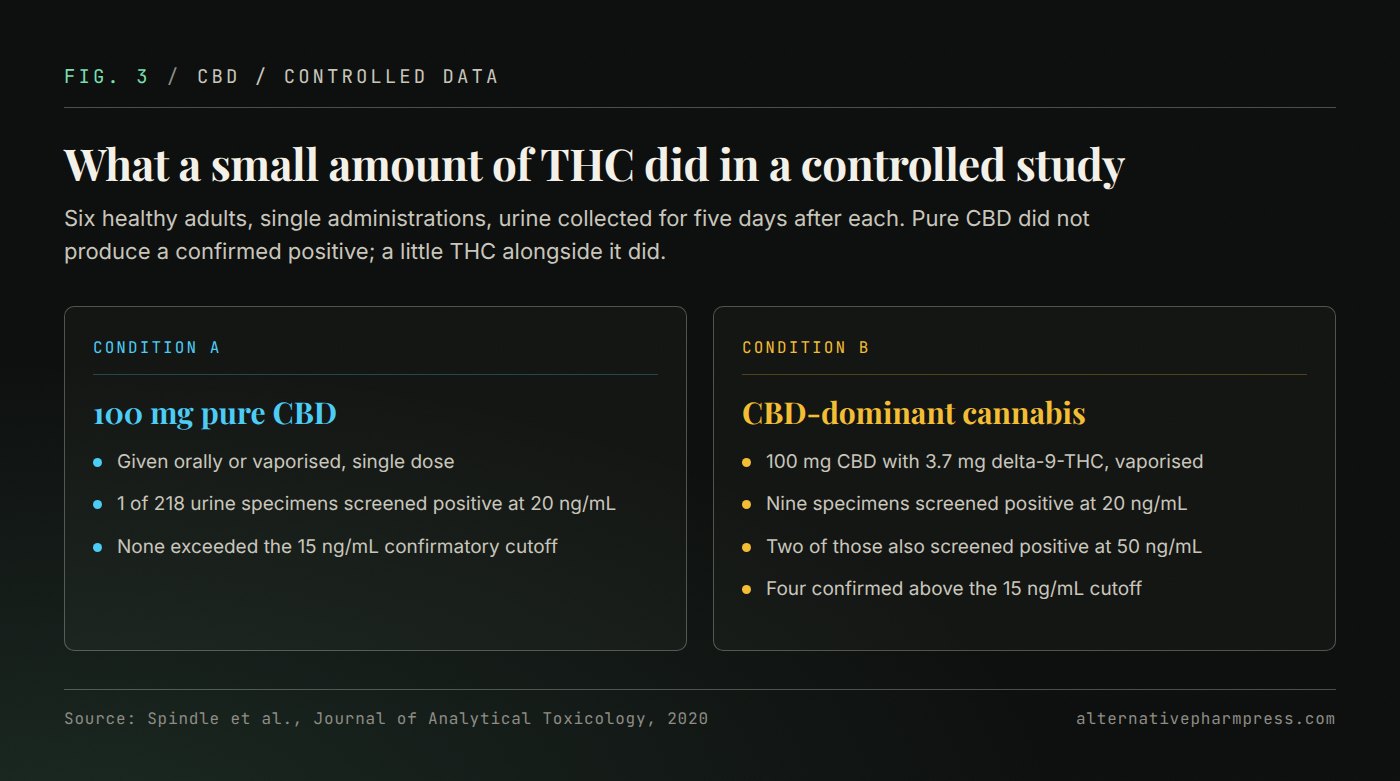
The most directly relevant human study remains the urinary pharmacokinetic work by Spindle and colleagues, published in the Journal of Analytical Toxicology in 2020.4 Six healthy adults received 100 mg of oral CBD, 100 mg of vaporised CBD, vaporised CBD-dominant cannabis containing 100 mg CBD and 3.7 mg delta-9-THC, or placebo. Urine was collected for five days after each administration.
After pure CBD, only 1 of 218 urine specimens screened positive at the most sensitive 20 ng/mL immunoassay cutoff, and none exceeded the 15 ng/mL confirmatory cutoff. After the CBD-dominant cannabis containing 3.7 mg of THC, nine specimens screened positive at 20 ng/mL, two of those also screened positive at 50 ng/mL, and four confirmed above 15 ng/mL.4
The finding is narrow but useful. Pure CBD, given acutely, did not produce a confirmed positive. A small quantity of THC alongside the CBD did, in some specimens, from a single administration. The study used six participants and single doses, so it says little about daily use over months. That limitation is the reason the accumulation question below remains open.
Why the label is the weak point
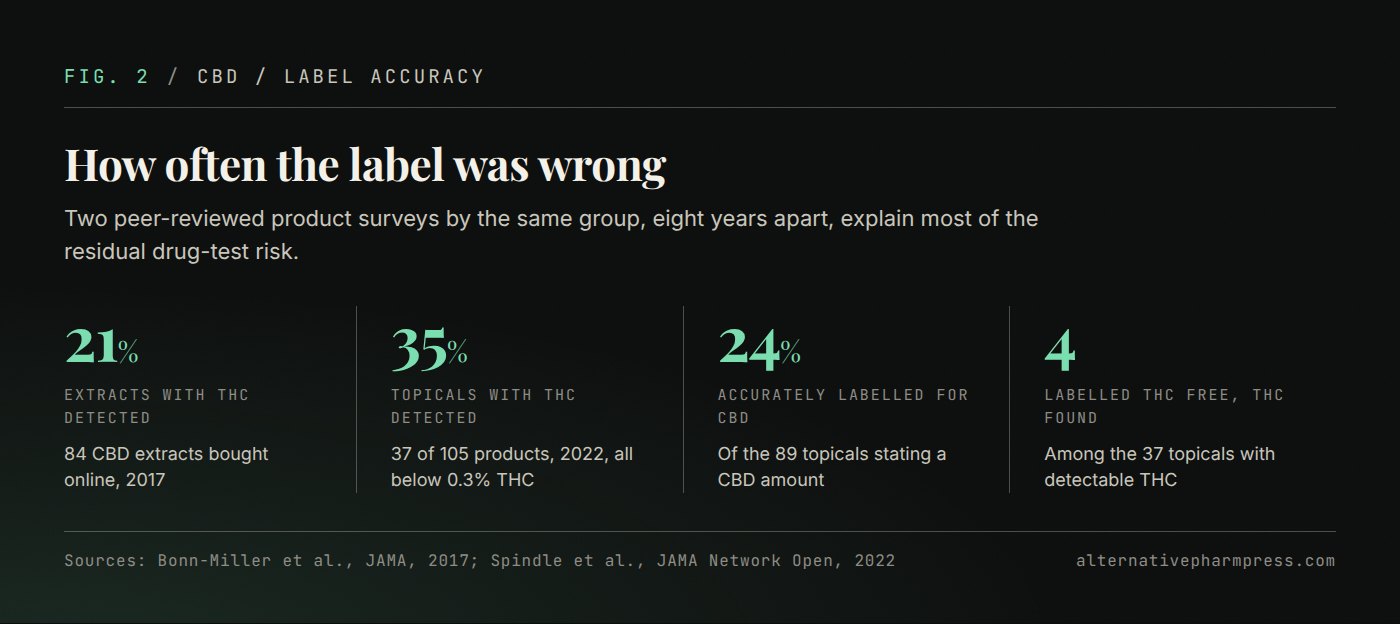
Two peer-reviewed product surveys explain most of the residual risk. In 2017, Bonn-Miller and colleagues bought 84 CBD extracts online from 31 companies and analysed their contents in JAMA. Roughly 26 percent contained less CBD than the label stated and about 43 percent contained more, leaving under a third accurately labelled. THC was detected in 21 percent of the samples.2
In 2022, the same group examined 105 hemp-derived topical products bought from national retailers and online and published the results in JAMA Network Open. Of the 89 products listing a CBD amount, 18 percent contained more than 10 percent less CBD than advertised, 58 percent contained more than 10 percent more, and 24 percent were accurate. THC was detected in 37 of 105 products, or 35 percent, though all were below 0.3 percent THC. Of those 37, four were labelled as THC free, 14 stated they contained less than 0.3 percent THC, and 19 made no reference to THC at all.3
Four products marketed as THC free that contained measurable THC is a small number in absolute terms and a large one in practical terms. It means the phrase carries no guarantee. The US Department of Transportation reached the same conclusion in its 18 February 2020 notice, stating that CBD product labelling “may be misleading because the products could contain higher levels of THC than what the product label states” and that there is no federal oversight ensuring label accuracy.5 A batch-specific certificate of analysis from an accredited third-party laboratory is the only document that addresses this, and even then it describes one batch, not the brand.
Isolate, broad spectrum and full spectrum compared
The three common extract types differ in how much THC they are expected to contain, and that expectation drives the risk. None of the three terms is defined in federal law, which is why verification matters more than terminology.
| Extract type | Expected THC content | Drug-test risk | What the label alone tells you |
|---|---|---|---|
| CBD isolate | None by definition; purified cannabidiol, typically stated as 98 percent or higher | Lowest. Cross-contamination during manufacture is the main residual concern | Little. Purity claims require a batch certificate of analysis to mean anything |
| Broad spectrum | Intended to be non-detectable after THC remediation; residual traces are possible | Low to moderate. Depends entirely on the remediation step and the detection limit used | Little. “THC free” is a marketing phrase with no legal definition or required test method |
| Full spectrum | THC present by design, below the legal hemp threshold but measurable | Highest of the three, and it rises with dose and frequency of use | More than the others, because the presence of THC is disclosed rather than denied |
Full spectrum products are the clearest case. They are not contaminated; they are formulated to retain the plant’s cannabinoid profile, and hemp-derived THC is part of that profile. A product can comply with the legal threshold and still deliver several milligrams of THC per serving if the serving is large enough.
Does trace THC accumulate with repeated use?
This is where the evidence thins. THC is highly lipophilic and distributes into adipose tissue, from which it is released slowly. That pharmacology is well established and is the reason urine metabolite can be detected for extended periods in frequent cannabis users. Whether daily consumption of a low-THC hemp product produces the same accumulation has not been characterised in a controlled study of adequate size.
What can be said is arithmetic rather than experimental. The published product data show measurable THC in 21 to 35 percent of tested items.23 Repeated intake of even a few milligrams per day represents cumulative exposure that a single-dose study cannot model. The Spindle 2020 data show that 3.7 mg of THC in one administration was enough to push some specimens above the confirmatory cutoff.4 Extrapolating from that to chronic use is reasonable as a caution and unreasonable as a quantitative claim. Individual differences in cannabinoid metabolism, body composition and hydration add further variability that has not been mapped for hemp products specifically.
Regulatory status and what happens after a positive
As of August 2026, the FDA has approved one cannabidiol drug product, Epidiolex, for seizures associated with Lennox-Gastaut syndrome, Dravet syndrome and tuberous sclerosis complex. No other CBD product is FDA approved, and the agency’s position is that CBD cannot lawfully be added to food or marketed as a dietary supplement.6 In January 2023 the FDA concluded that existing frameworks for foods and supplements are not appropriate for CBD and said it would work with Congress on a new pathway.6
The definition of hemp is also changing. Division B of P.L. 119-37, enacted on 12 November 2025, replaces the delta-9 THC standard with a total THC standard of less than 0.3 percent on a dry weight basis and excludes final hemp-derived cannabinoid products containing more than 0.4 milligrams of THC per container. That change takes effect on 12 November 2026.7 Products lawful under the older definition may not be lawful after that date.
For regulated testing, the DOT notice is explicit: medical review officers will verify a confirmed positive even if the employee states they used only a CBD product.5 CBD use is not a legitimate medical explanation under 49 CFR Part 40. Non-regulated employers set their own policies, and some accept an explanation that a federal MRO would not.
Frequently asked questions
Does CBD itself show up on a drug test?
Not on standard panels. The urine analyte is the THC metabolite delta-9-THC-carboxylic acid and the oral fluid analyte is delta-9-THC. Cannabidiol is not tested for and has no cutoff in the HHS panels.1 Specialised research assays can measure CBD, but they are not part of routine employment testing.
Is a product labelled THC free actually free of THC?
Not reliably. In the 2022 topical product survey, 4 of the 37 products in which THC was detected carried a THC free label.3 The phrase has no regulatory definition and no required test method or detection limit behind it.
Why does full spectrum carry more risk than broad spectrum?
Because full spectrum products retain THC intentionally, while broad spectrum extracts are processed to remove it. Removal is an additional manufacturing step that can be done well or poorly, so broad spectrum sits between isolate and full spectrum rather than matching either.
How long can a positive persist after stopping?
There is no fixed figure. Detection time depends on cumulative exposure, body composition, specimen type and the cutoff applied. Oral fluid reflects recent use over hours to a small number of days. Urine can remain positive far longer in people with frequent, heavy exposure. Published detection windows come from cannabis studies, not from hemp product users, so applying them here involves assumption.
What documentation actually reduces uncertainty?
A current, batch-matched certificate of analysis from an ISO 17025 accredited laboratory that reports total THC with a stated limit of detection, and that matches the batch number printed on the product. A generic certificate for a different batch, or one with no laboratory accreditation, does not establish what is in the container.
Sources
- Department of Health and Human Services, Substance Abuse and Mental Health Services Administration. Mandatory Guidelines for Federal Workplace Drug Testing Programs: Authorized Testing Panels. 91 FR 12308, 13 March 2026. federalregister.gov
- Bonn-Miller MO, Loflin MJE, Thomas BF, Marcu JP, Hyke T, Vandrey R. Labeling Accuracy of Cannabidiol Extracts Sold Online. JAMA. 2017;318(17):1708–1709. PMID 29114823. PubMed
- Spindle TR, Sholler DJ, Cone EJ, Murphy TP, ElSohly M, Winecker RE, Flegel RR, Bonn-Miller MO, Vandrey R. Cannabinoid Content and Label Accuracy of Hemp-Derived Topical Products Available Online and at National Retail Stores. JAMA Network Open. 2022;5(7):e2223019. PMID 35857320. PubMed
- Spindle TR, Cone EJ, Kuntz D, Mitchell JM, Bigelow GE, Flegel R, Vandrey R. Urinary Pharmacokinetic Profile of Cannabinoids Following Administration of Vaporized and Oral Cannabidiol and Vaporized CBD-Dominant Cannabis. Journal of Analytical Toxicology. 2020;44(2):109–125. PMID 31682266. PubMed
- US Department of Transportation, Office of Drug and Alcohol Policy and Compliance. DOT Office of Drug and Alcohol Policy and Compliance Notice: CBD. 18 February 2020. transportation.gov
- US Food and Drug Administration. FDA Regulation of Cannabis and Cannabis-Derived Products, Including Cannabidiol (CBD). fda.gov
- Congressional Research Service. Change to Federal Definition of Hemp and Implications for Federal Enforcement. Insight IN12620. congress.gov
Editorial note: This article is for general information only and is not medical or legal advice. CBD has not been evaluated by the FDA to diagnose, treat, cure or prevent any disease. Laws vary by location and change often, so verify the rules that apply where you are. Always talk to a licensed healthcare provider before use, especially if you are under 21, pregnant or nursing, taking medication, or managing a health condition.
A drug test result is a separate question from dependence. If you are also wondering whether CBD is habit-forming, see Is CBD Addictive?