
Tianeptine withdrawal looks like opioid withdrawal: anxiety, restlessness, sweating, chills, muscle aches, nausea, diarrhoea, insomnia and strong cravings. That is because tianeptine acts on the same mu-opioid receptor as morphine. Clinicians have treated it with buprenorphine, methadone and supportive care. On 8 July 2026 the DEA proposed placing tianeptine in Schedule I.1,8,12
As of late October 2026 that rule is not final, and we found no final rule in the Federal Register.1,16 Tianeptine is not approved for any medical use in the US, and the FDA has warned consumers not to buy or use it.2 If you are physically dependent, the time to make a plan with a clinician is before a ban changes what is available.
Below: what tianeptine is, what the DEA proposal says, the FDA warnings and state bans, the withdrawal evidence from poison-centre data and case reports, and how people get help. We do not give dosing or tapering schedules. If you need help now, the free, confidential SAMHSA National Helpline is open 24 hours a day on 1-800-662-4357.2 For related coverage, see our nootropics hub.
At a glance
| Question | What the evidence shows |
|---|---|
| What it is | An antidepressant in some countries; not FDA-approved; a mu-opioid receptor agonist2,8 |
| Federal status | Proposed for Schedule I on 8 July 2026; not yet final1,16 |
| State status | 15 states listed as controlling it by 2024, with later laws such as Delaware’s1,13 |
| Withdrawal | Opioid-like; in 22.5% of poison-centre exposures 2015 to 20231,7 |
| Treatments reported | Buprenorphine, methadone, clonidine and supportive care9,10,11,12 |
| Drug tests | May not show up on routine screens3 |
| Help lines | SAMHSA 1-800-662-4357; Poison Help 1-800-222-12222 |
What tianeptine is, and why it causes dependence
Tianeptine is sold as an antidepressant in parts of Europe, Asia and Latin America, but it has never been approved in the US.6 A 2014 laboratory study in Translational Psychiatry showed it is an efficacious agonist at the mu-opioid receptor, the main target of morphine and fentanyl, and a weaker agonist at the delta-opioid receptor.8 The DEA’s proposal adds that its main metabolite, MC5, also activates the mu-opioid receptor, that rats trained on morphine treat tianeptine as morphine-like, and that naloxone has reversed some overdoses.1
In the US it has been sold in gas stations, convenience stores, vape shops and online, often labelled as a supplement, “nootropic” or research chemical.3 (Our explainer on what “research use only” really means covers why those labels offer no protection.) The FDA says reported US daily doses ranged from 1.3 to 250 times the daily dose approved in other countries.2 Tianeptine has a short half-life of about 2.5 hours, with its active metabolite lasting longer, which helps explain why some people describe needing to redose every few hours to hold withdrawal off.1
A common theme in quitting forums is how much tianeptine comes to dominate daily life: money, time and plans built around the next purchase. That pattern is consistent with the case literature, which describes rapid tolerance and dose escalation.12
The DEA’s Schedule I proposal: what it says and when a ban could start
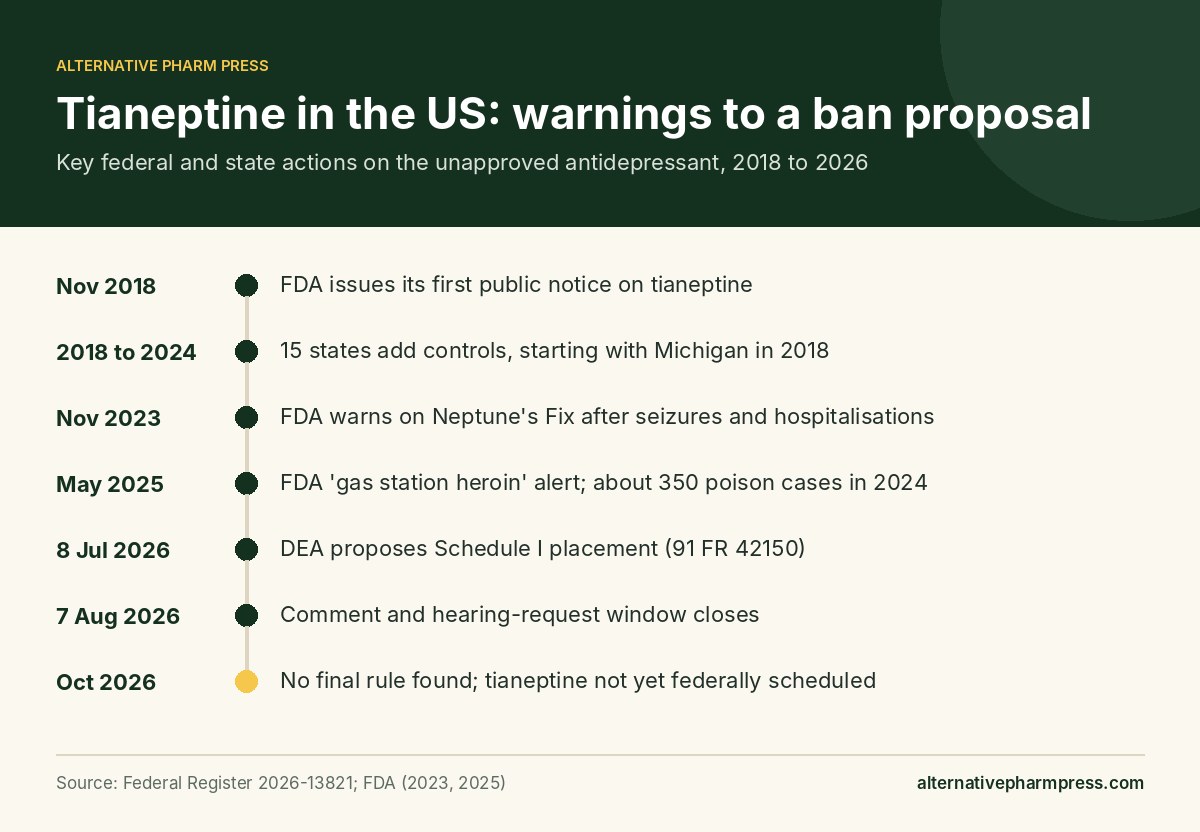
The DEA published a notice of proposed rulemaking in the Federal Register on 8 July 2026 (91 FR 42150, Docket DEA-1596). It proposes adding tianeptine, with its isomers, esters, ethers and salts, to Schedule I as an opioid.1
- The basis. The DEA asked HHS for a scientific evaluation in September 2023, and HHS recommended Schedule I in July 2025, saying tianeptine has effects similar to Schedule II opioids such as morphine and fentanyl. The DEA found a high potential for abuse, no currently accepted medical use in the US and a lack of accepted safety under medical supervision.1
- The process. Comments and requests for a hearing were due by 7 August 2026.1 The rule takes effect only once the DEA publishes a final rule, which will set the effective date. This is ordinary rulemaking, unlike the temporary emergency scheduling the DEA is using for 7-OH.15
- Status. The Federal Register’s 2026 index of DEA documents lists the proposed rule but no final rule.16 Until a final rule appears, tianeptine is not federally scheduled, although it remains unapproved and state bans apply.
- If finalised. Retail sales would end, possession not authorised under the Controlled Substances Act would be unlawful, and unregistered holders would have to surrender or transfer stock to a DEA registrant before the effective date.1
The DEA notes that state bans have not stopped people buying tianeptine online or across state lines.1 Readers following kratom regulation will recognise the pattern from our report on where 7-OH scheduling stands.
FDA warnings, “gas station heroin” and state tianeptine bans
The FDA’s first public notice on tianeptine came in November 2018.1 In November 2023 it warned consumers not to buy or use Neptune’s Fix or any tianeptine product after reports of seizures and loss of consciousness leading to hospitalisation; a January 2024 update added reports of death, and the FDA cautioned that the products might contain ingredients not listed on the label.4 A CDC report linked a New Jersey cluster of severe illness from Neptune’s Fix to synthetic cannabinoids.5
In May 2025 the FDA issued a “gas station heroin” alert about a rising trend of adverse events, including deaths, and said the trend was especially concerning for young people.3 Its consumer update reported that poison-centre cases rose from 4 in 2013 to about 350 in 2024. It states that tianeptine is not a lawful dietary ingredient and has sent warning letters to sellers.2
The DEA proposal lists 15 states that had controlled tianeptine, starting with Michigan in 2018 and followed by Oklahoma, Alabama, Arkansas, Ohio, Tennessee, Florida, Kentucky, Minnesota, Mississippi, Georgia, Indiana, Louisiana, Maryland and Virginia by 2024.1 Delaware banned its manufacture and sale in 2025, although possession there remained legal.13 After Alabama made tianeptine a controlled substance in 2021, its poison-centre exposure rate fell 74.6% by 2023, while rates in other southern states kept rising.7 State lists change often, so check current law where you live.
Tianeptine withdrawal symptoms: what the evidence shows
No controlled study has followed people through tianeptine withdrawal. The evidence comes from poison-centre data, case reports and the HHS review summarised by the DEA, which describes opioid-like withdrawal with muscle pain, chills, anxiety, nausea, vomiting, tremor, insomnia, diarrhoea and cravings.1
- Poison-centre data. A CDC analysis of calls from 2000 to 2017 found that a substantial number reported withdrawal, and the most common co-exposures were phenibut, alcohol, benzodiazepines and opioids.6 A later study in the Journal of Medical Toxicology of 892 single-substance exposures from 2015 to 2023 found the exposure rate rose 1,400%. Withdrawal accounted for 22.5% of cases, 40.1% needed medical admission and 22.9% went to critical care. People aged 50 and over were more likely to have major effects.7
- Case reports. A 2026 systematic review in Drug and Alcohol Dependence identified 53 publications. Of 52 individual cases, half presented with withdrawal and 44% with overdose. Among overdose cases with detailed data, 7 of 22 were fatal.9
How long acute tianeptine withdrawal lasts has not been measured systematically. In one hospital case, symptoms improved within three days of starting buprenorphine.10 Clinicians describe high relapse rates, and some patients need residential care and long-term follow-up.12 Many people first used tianeptine to self-treat anxiety or depression, so those conditions may return and need their own treatment.2
If you also use phenibut, alcohol, benzodiazepines or other drugs, tell the clinician about all of them, because a detox plan depends on everything you take. Our explainer on why mixing kratom and alcohol raises the risk covers a similar problem with combining sedating substances.
How tianeptine withdrawal is treated
Because tianeptine acts on opioid receptors, clinicians have borrowed from opioid treatment. A 2026 case series and review suggests considering buprenorphine as a first-line option, with clonidine and other medicines used for opioid withdrawal possibly helping, plus supportive care.12 In the systematic review, buprenorphine was used for longer-term treatment in 19% of withdrawal cases and methadone in 4%.9
- Buprenorphine. A man admitted to intensive care with heavy daily use improved within three days on buprenorphine-naloxone and was discharged with a bridging prescription.10
- Methadone. A 2026 case report described a woman for whom buprenorphine did not control cravings or withdrawal. She moved to methadone through an opioid treatment programme and had stayed off tianeptine for three years. The authors note a treatment gap, because tianeptine use disorder does not fit neatly into systems built around opioid use disorder.11
- Naloxone. The FDA advises clinicians to make sure patients know how to get naloxone nasal spray, and naloxone was given in 27% of detailed overdose cases in the review.3,9
All of these are prescription treatments that need a clinician to choose, start and monitor. We do not give doses. No medicine is approved specifically for tianeptine withdrawal, and no trial has compared treatments.9
Drug court and supervision. People under court supervision often say they cannot use “helper” medications. US Department of Justice guidance says the Americans with Disabilities Act applies to courts, that a jail’s blanket ban on medication for opioid use disorder would violate the Act, and that the same legal principles apply to other substance use disorders.14 Ask your attorney or the court’s treatment coordinator before assuming prescribed treatment is off the table.
Why switching to 7-OH, kratom or other opioids is risky
Another frequent forum question is whether 7-OH or kratom can get someone through tianeptine withdrawal. Both act on opioid receptors, and concentrated 7-OH can cause its own opioid-type dependence and withdrawal; see our guides to 7-OH withdrawal and kratom withdrawal, and our overview of kratom and the opioid receptor. Swapping one unregulated opioid-acting product for another replaces one dependence with another, without a clinician adjusting the dose.
7-OH is also heading for federal control. The DEA’s revised notice of 14 October 2026 would temporarily place 7-OH above a set threshold in Schedule I, with the order publishable no earlier than 13 November 2026.15 Supply of both products could shrink at around the same time.
An unregulated market is also unpredictable. The DEA describes a seizure of counterfeit pills marked as hydrocodone or oxycodone that contained tianeptine, and Neptune’s Fix was linked to synthetic cannabinoids.1,5 Products bought after a ban are likely to be less predictable, not more. Our explainer on how opioid-type tolerance develops with kratom explains why doses tend to creep upwards.
Getting help before a tianeptine ban takes effect
- Talk to a clinician now. A GP, addiction medicine specialist or opioid treatment programme can assess you. Be honest about how much you use and what else you take.
- Use the national helplines. SAMHSA’s helpline (1-800-662-4357) and findtreatment.gov can find local treatment.2
- Do not stop heavy use abruptly on your own. The FDA notes that chronic use can cause opioid-like withdrawal if stopped suddenly.3
- Keep naloxone at home and make sure someone knows where it is.3
- Call Poison Help (1-800-222-1222) for a suspected overdose or bad reaction, or 911 in an emergency.2
- If you are in crisis or thinking about suicide, call or text 988.
If tianeptine began as a way to manage anxiety, our review of what trials show for anxiety supplements sets out the evidence on legal options, though none is a substitute for proper treatment.
Frequently asked questions
What are the symptoms of tianeptine withdrawal?
They resemble opioid withdrawal: anxiety, restlessness, muscle aches, chills, sweating, nausea, vomiting, diarrhoea, tremor, insomnia and strong cravings.1 Withdrawal accounted for 22.5% of tianeptine exposures reported to US poison centres from 2015 to 2023.7 Symptoms can be severe after heavy use, so speak to a clinician or call the SAMHSA helpline on 1-800-662-4357 rather than stopping alone.
How long does tianeptine withdrawal last?
No study has measured it. Tianeptine has a short half-life of about 2.5 hours, which may explain why symptoms can start quickly.1 In one hospital case, symptoms improved within three days of starting buprenorphine.10 Cravings, low mood and anxiety can last much longer, and clinicians report high relapse rates, so ongoing support after the acute phase matters.12
Is tianeptine banned in the US?
Not federally, yet. The DEA proposed placing tianeptine in Schedule I on 8 July 2026, and the comment period closed on 7 August, but as of late October 2026 we found no final rule.1,16 At least 15 states had already controlled it by 2024, and others such as Delaware have acted since.1,13 The FDA says it is not approved and not a lawful supplement ingredient.2
Can buprenorphine help with tianeptine withdrawal?
Clinicians have used it in published cases, and a 2026 review suggests considering it first-line.12 One intensive-care patient improved within three days on buprenorphine-naloxone, while another patient needed methadone after buprenorphine failed to control cravings.10,11 Buprenorphine is a prescription medicine and no trial has tested it for tianeptine, so it needs a prescriber who knows your full history.
Can I use kratom or 7-OH to get off tianeptine?
It is risky. Both act on opioid receptors, and concentrated 7-OH can cause its own opioid-type dependence and withdrawal. Substituting one unregulated product for another replaces one dependence with another, without medical dose control. The DEA is also moving to schedule 7-OH above a threshold, with an order possible from 13 November 2026.15 Prescribed treatment through a clinician is the safer route.
Sources
- Drug Enforcement Administration. Schedules of Controlled Substances: Placement of Tianeptine in Schedule I (proposed rule). Federal Register. 8 July 2026;91 FR 42150-42158. FR Doc. 2026-13821. federalregister.gov
- US Food and Drug Administration. Tianeptine Products Linked to Serious Harm, Overdoses, Death. 9 May 2025. fda.gov
- US Food and Drug Administration. New “Gas Station Heroin” Tianeptine Product Trend. 8 May 2025. fda.gov
- US Food and Drug Administration. FDA warns consumers not to purchase or use Neptune’s Fix or any tianeptine product due to serious risks. 21 November 2023, updated 23 January 2024. fda.gov
- Counts CJ, Spadaro AV, Cerbini TA, Krotulski AJ, Greller HA, Nelson LS, et al. Notes from the Field: Cluster of Severe Illness from Neptune’s Fix Tianeptine Linked to Synthetic Cannabinoids, New Jersey, June-November 2023. MMWR Morb Mortal Wkly Rep. 2024;73(4):89-90. DOI: 10.15585/mmwr.mm7304a5. PMID: 38300852. pubmed.ncbi.nlm.nih.gov
- El Zahran T, Schier J, Glidden E, Kieszak S, Law R, Bottei E, et al. Characteristics of Tianeptine Exposures Reported to the National Poison Data System, United States, 2000-2017. MMWR Morb Mortal Wkly Rep. 2018;67(30):815-818. DOI: 10.15585/mmwr.mm6730a2. PMID: 30070980. pubmed.ncbi.nlm.nih.gov
- Quadir M, Rine NI, Badeti J, Hays HL, Michaels NL, Yang J, et al. Tianeptine Exposures Reported to United States Poison Centers, 2015-2023. J Med Toxicol. 2025;21(1):30-41. DOI: 10.1007/s13181-024-01053-6. PMID: 39724478. pubmed.ncbi.nlm.nih.gov
- Gassaway MM, Rives ML, Kruegel AC, Javitch JA, Sames D. The atypical antidepressant and neurorestorative agent tianeptine is a μ-opioid receptor agonist. Transl Psychiatry. 2014;4(7):e411. DOI: 10.1038/tp.2014.30. PMID: 25026323. pubmed.ncbi.nlm.nih.gov
- Anand A, Alessi MR, Toussi RA, Tian J, Raffoul JJ, Pratt N, et al. Tianeptine misuse and addiction: A systematic review of withdrawal, toxicity, and clinical management. Drug Alcohol Depend. 2026;285:113196. DOI: 10.1016/j.drugalcdep.2026.113196. PMID: 42177839. pubmed.ncbi.nlm.nih.gov
- Rawal VY, Gallardo M, Henderson K, Hall OT, Klisovic N, Sikic-Klisovic E. Severe tianeptine withdrawal symptoms managed with medications for opioid use disorder: a case report. J Addict Dis. 2025;43(1):98-103. DOI: 10.1080/10550887.2023.2290139. PMID: 38095574. pubmed.ncbi.nlm.nih.gov
- Coyle DT, Kitano M, Calcaterra S. When Buprenorphine Was Not Enough: Methadone Treatment of Tianeptine Use Disorder. J Addict Med. Published online 21 September 2026. DOI: 10.1097/ADM.0000000000001782. PMID: 42767626. pubmed.ncbi.nlm.nih.gov
- Saldana VA, Earley PH, Silverstein DS, Tang YL. Tianeptine Misuse, Dependence, and Clinical Management: Three Case Reports and Literature Review. Case Rep Psychiatry. 2026;2026:2981699. DOI: 10.1155/crps/2981699. PMID: 42016572. pubmed.ncbi.nlm.nih.gov
- Delaware House Republican Caucus. Delaware tianeptine ban (“gas station heroin”), HB 21. 25 July 2025. housegop.delaware.gov
- US Department of Justice, Civil Rights Division. The ADA and Opioid Use Disorder: Combating Discrimination Against People in Treatment or Recovery. 5 April 2022. ada.gov
- Drug Enforcement Administration. Schedules of Controlled Substances: Temporary Placement of 7-Hydroxymitragynine and Mitragynine Pseudoindoxyl in Schedule I (notice of intent). Federal Register. 14 October 2026;91 FR 65370. FR Doc. 2026-20943. federalregister.gov
- Federal Register. 2026 Federal Register Index: Drug Enforcement Administration. Accessed 24 October 2026. federalregister.gov
Featured image: Pill Bottle Demo: Pill Bottle Army by La Chiquita, CC BY-SA 2.0. Cropped.
This article is for educational purposes only and is not medical or legal advice. Products discussed here are not intended to diagnose, treat, cure or prevent any disease. Laws vary by location and change often, so verify the rules that apply where you are. Always talk to a licensed healthcare provider before use, especially if you are under 21, pregnant or nursing, taking medication, or managing a health condition.