
This article is for educational purposes only and does not constitute medical advice.
Last updated: October 15, 2026. Updated with current research on vein colors and 2026 legal changes.
Quick answer: Kratom “strains” are trade names that combine a leaf vein color (red, green, white or gold) with a region or brand name such as Bali, Borneo or Maeng Da. Vendors link red to relaxation, white to energy and green to a middle ground. A 2023 survey of 644 users found reported effects followed that pattern, but lab tests found no significant alkaloid differences between colors.
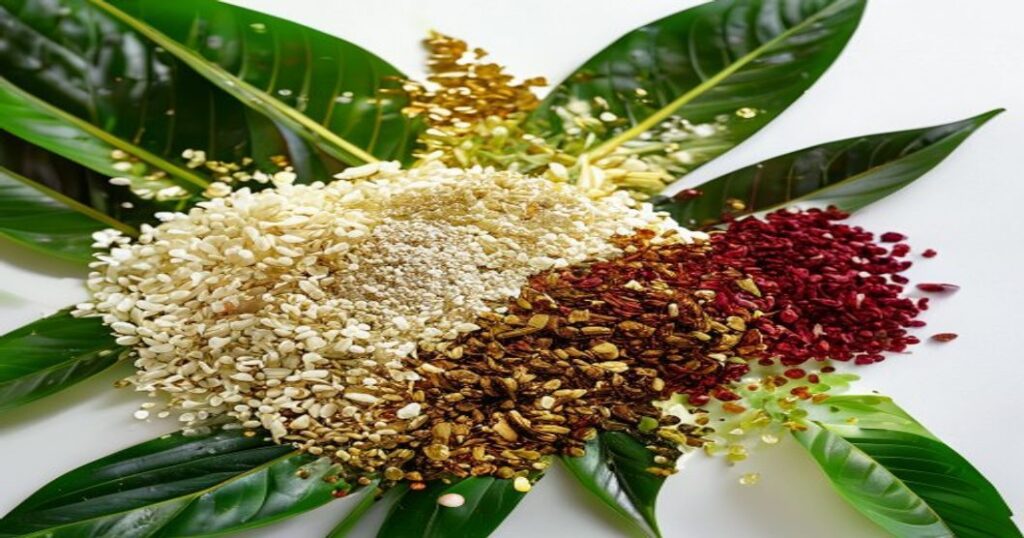
Mitragyna speciosa is the scientific name for kratom. This tree is native to Southeast Asia and grows in tropical areas. Its leaves are divided into different strains based on the color of the leaf veins and the area where they are grown. These strains come in red, green, white, and gold (or yellow), and they are often linked to different effects. For a deeper look at the science behind these effects, see our Kratom Research Overview.
Key Takeaways
Kratom strains are named by vein color plus a region or trade name. These labels are not standardized or regulated.
Red vein strains are commonly associated with relaxation and calming effects.
Green vein strains offer a balanced profile of mild energy and relaxation.
White vein strains are typically linked to increased alertness and focus.
A 2023 study found no significant differences in mitragynine or total alkaloid content between red, green and white products, so expectations and batch-to-batch variation may explain much of what people report.
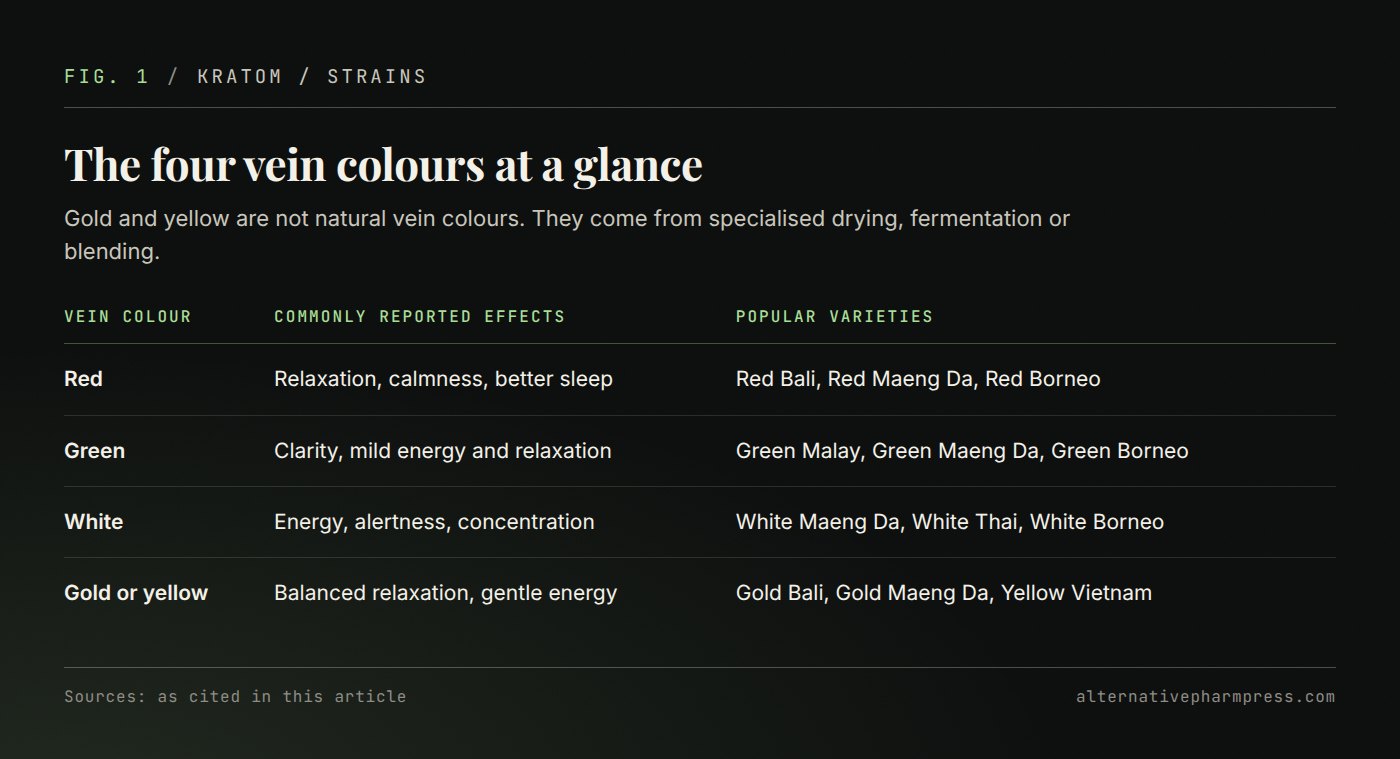
Gold and yellow are not natural vein colors. Vendors make them through extended drying, fermentation or blending.
Alkaloid content varies more between batches than between colors, so a batch lab report (COA) tells you more than the strain name.
How Are Kratom Strains Classified?
Kratom strains are primarily classified based on two key factors: vein color and geographical origin. The vein color — red, green, or white — refers to the color of the central vein in the kratom leaf and is believed to influence the plant’s alkaloid composition and effects. Strains are also often named after their region of origin, such as Bali, Borneo, Maeng Da, or Thai. Some of these names are trade names rather than places. “Maeng Da” is a marketing term for kratom sold as extra-potent, and a “Bali” or “Borneo” label does not prove where the leaf was grown. There is no industry standard for any strain name. To understand the specific alkaloids involved, see our Mitragynine vs 7-OH guide.
Key Alkaloids in Kratom
Mitragynine: The most abundant alkaloid in the leaf. It is a partial agonist at mu-opioid receptors and also acts on adrenergic and serotonin receptors, which may explain both stimulating and calming reports.
7-hydroxymitragynine (7-OH): Present only in trace amounts in natural leaf (usually well under 2% of alkaloids) but far more potent at opioid receptors. Concentrated 7-OH tablets and shots are made in a lab from mitragynine and are not a “strain.” The DEA moved in October 2026 to place them in Schedule I.
Does Vein Color Actually Change the Effects?
The best evidence so far comes from a 2023 study in the International Journal of Environmental Research and Public Health (Huisman et al.). Researchers surveyed 644 current kratom users and compared lab reports for six red, green and white products.
- What users reported: Red users most often cited relaxation or sleep, green users mood, and white users concentration. Ratings of energy and stimulation followed a white > green > red pattern.
- What the lab tests showed: There were no significant differences in mitragynine, paynantheine, speciogynine, speciociliatine or total alkaloid content between the colors.
- What that means: Alkaloid content alone does not explain the reported differences. Marketing and expectation, minor compounds that were not measured, and differences in how each person metabolizes kratom may all play a part.
The study was a self-reported survey of mostly U.S. customers of a single vendor, with no blinding or control group. Until controlled trials compare well-characterized strains, treat strain-effect descriptions as user reports, not established facts. The effect profiles below describe how each color is commonly marketed and reported.
Red Vein Kratom
Red vein kratom is one of the most widely used types and is often associated with calming and relaxing effects. It is commonly chosen by individuals looking to unwind after a long day. Popular varieties include Red Bali (mild and long-lasting), Red Maeng Da (more potent), and Red Borneo (balanced relaxation).
Commonly reported effects: Relaxation & calmness, help with easing discomfort, better sleep, stress reduction.
Popular varieties: Red Bali, Red Maeng Da, Red Borneo, Red Thai.
Best suited for: Evening use, individuals seeking relaxation or mood enhancement.
Green Vein Kratom
Green vein kratom is often described as a middle ground between red and white strains. It offers a balanced combination of mild energy and subtle relaxation, making it suitable for daytime use. Popular varieties include Green Malay (long-lasting), Green Maeng Da (stronger energy boost), and Green Borneo (smooth and balanced).
Commonly reported effects: Mental clarity and focus, mild energy and relaxation, mood enhancement.
Popular varieties: Green Malay, Green Maeng Da, Green Borneo, Green Thai.
Best suited for: Daytime use, study or work, beginners seeking balanced effects.
White Vein Kratom
White vein kratom is typically associated with stimulating and energizing effects. It is often chosen by individuals seeking increased alertness, focus, and motivation. Popular varieties include White Maeng Da (strong and fast-acting), White Thai (mood enhancement), and White Borneo (balanced stimulation).
Commonly reported effects: Increased energy, alertness, boosted drive and concentration.
Popular varieties: White Maeng Da, White Thai, White Borneo, White Sumatra.
Best suited for: Morning use, productivity or physical activities, social situations.
Gold/Yellow Vein Kratom
Unlike red, green, and white vein kratom, gold and yellow strains are not naturally occurring vein colors. Instead, they are created through specialized drying or fermentation processes — the same techniques covered in our How Kratom Is Processed guide. Some vendors also create them by blending different vein varieties. Gold and yellow kratom are often described as offering a combination of mild relaxation and gentle stimulation.
Commonly reported effects: Mood enhancement, balanced relaxation, mild euphoria, gentle energy with calming undertones.
Popular varieties: Gold Bali, Gold Maeng Da, Yellow Vietnam.
Comparison of Kratom Strains
| Strain | Energy Level | Relaxation |
|---|---|---|
| Red | Low | High |
| Green | Moderate | Moderate |
| White | High | Low |
| Gold/Yellow | Moderate | Moderate–High |
This table reflects how vendors and users commonly describe each color. It is not based on controlled clinical trials, and individual batches can differ more than colors do.
Safety and Responsible Use
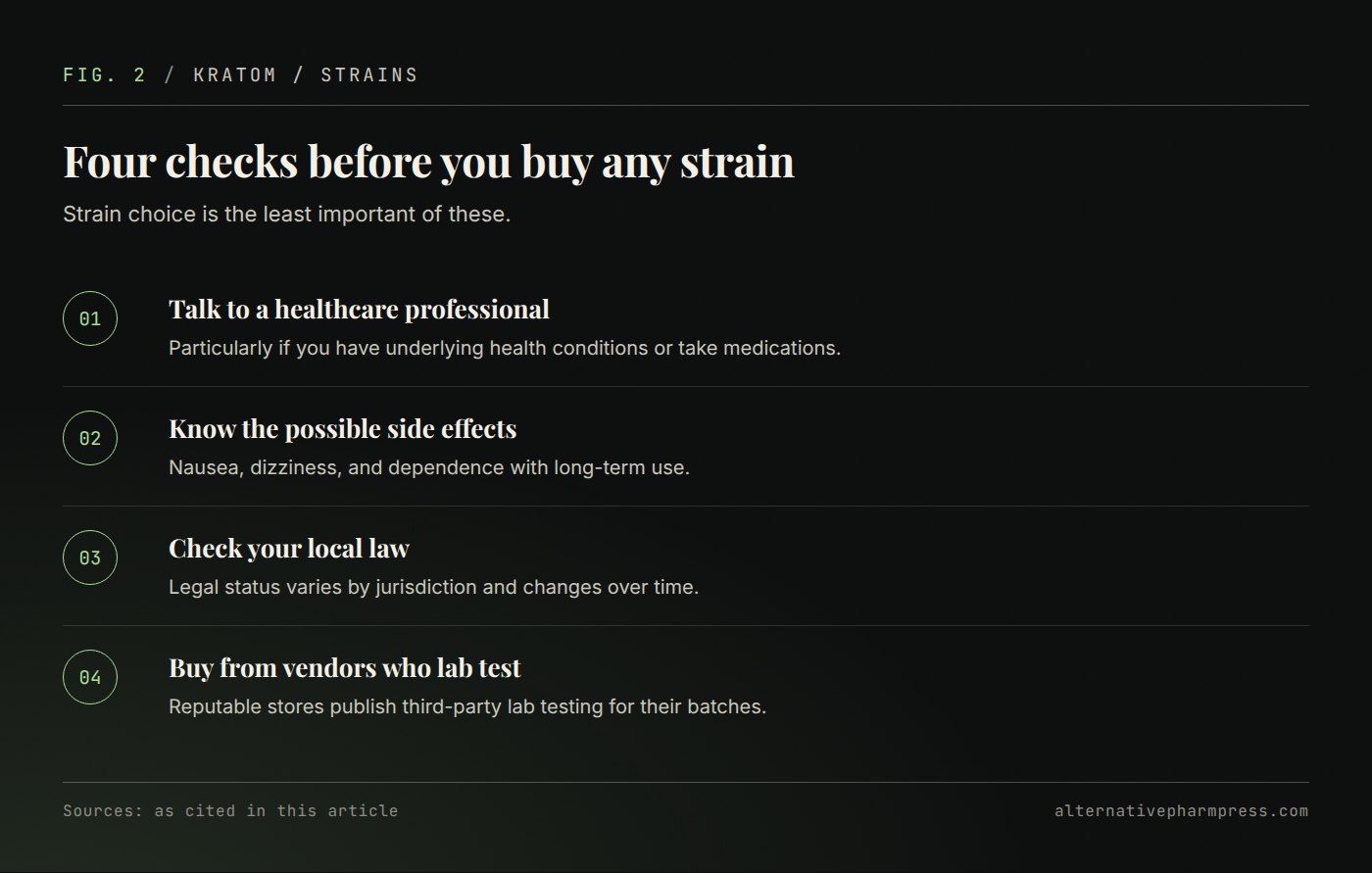
Consult a healthcare professional before use, especially if you have underlying health conditions or take medications.
Be aware of possible side effects, like nausea, dizziness, or dependence with long-term use.
The legal status of kratom varies. Nine states ban it outright, and Rhode Island legalized it for adults 21+ in April 2026 — check our state-by-state legal guide for your jurisdiction.
Buy from reputable stores that offer third-party lab testing. Our COA guide explains what to look for.
Kratom can interact with prescription drugs, alcohol and sedatives. See kratom and drug interactions and kratom and liver injury.
Products labeled as 7-OH are not leaf strains. They are far more potent and are being moved into federal Schedule I.
Frequently Asked Questions
Q: Which kratom strain is the strongest?
No strain is reliably stronger by color. Potency depends on the alkaloid content of the specific batch, which you can only confirm from a lab report. “Maeng Da” is marketed as stronger, but the name is not standardized.
Q: Is red kratom more relaxing than white?
Users commonly report that, and a 2023 survey matched the pattern. However, lab tests in the same study found no significant alkaloid differences between colors, so expectation may play a large role.
Q: Are gold and yellow kratom natural strains?
No. They are made by extended drying, fermentation or blending other veins, not from a naturally gold-veined leaf.
Q: Is 7-OH a kratom strain?
No. 7-OH products are concentrated, lab-made extracts, not leaf. They are the target of the DEA’s 2026 Schedule I action, while natural leaf below the federal threshold is not.
Conclusion
Strain names give a rough idea of how vendors and users describe a product, but they are marketing labels rather than scientific categories. Research to date suggests that vein color does not reliably change alkaloid content, and batch quality matters more than the color on the bag. If you choose to use kratom, rely on batch-specific lab reports, start low, avoid combining it with other sedatives, and check the current law where you live.