
This article is for educational purposes only and does not constitute medical advice.
Last updated: October 15, 2026. Rewritten to cover enhanced and 7-OH products, the DEA’s 2026 threshold, and how to compare extract labels.
Quick answer: Kratom extract is stronger than kratom powder. Powder is simply dried, ground Mitragyna speciosa leaf, with the alkaloids in their natural proportions. Extracts concentrate those alkaloids, so a small amount can deliver many times the mitragynine of the same weight of powder. That makes extracts easier to over-consume, more likely to drive tolerance, and, when they contain concentrated 7-OH, subject to new federal Schedule I controls.
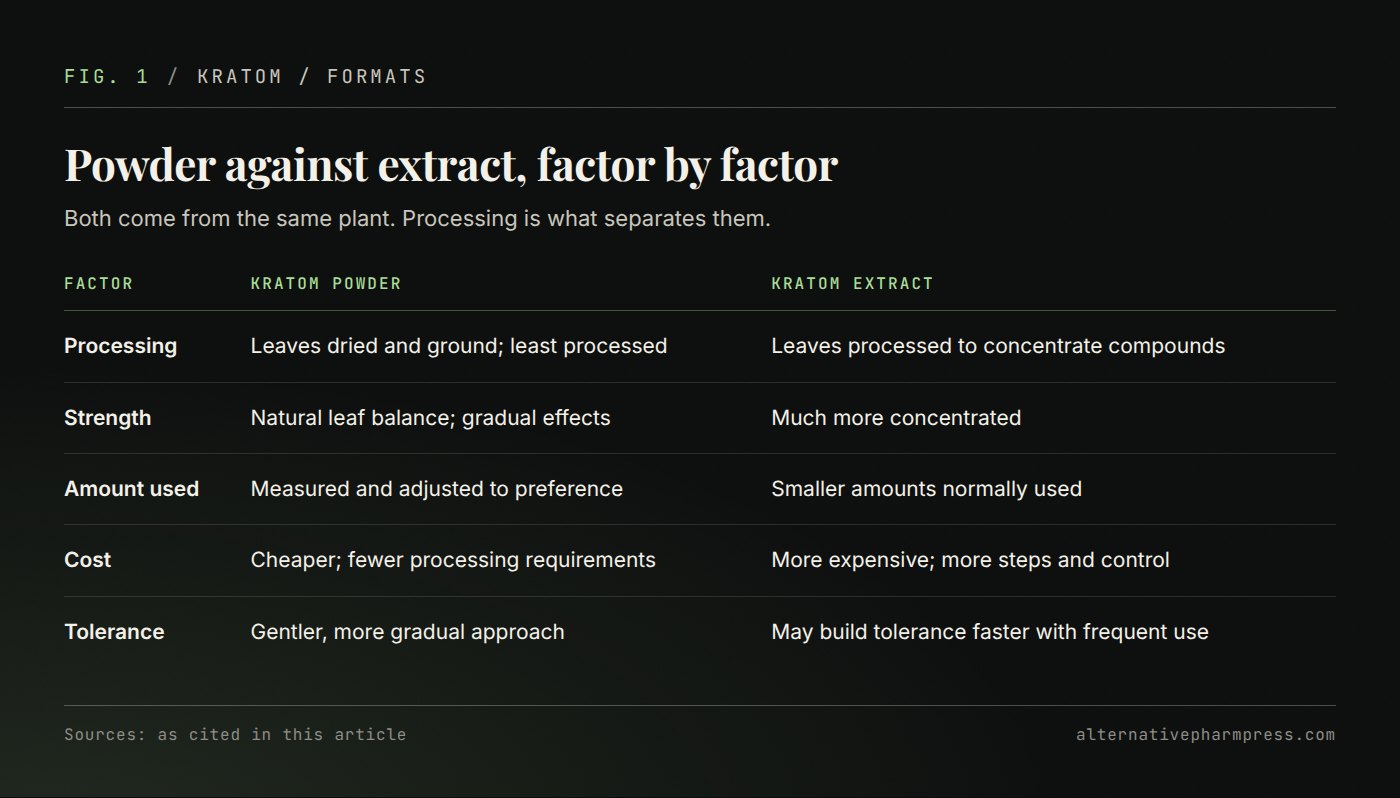
Kratom extract vs powder at a glance
| Kratom powder | Kratom extract | |
|---|---|---|
| What it is | Dried, ground leaf | Leaf processed with water, alcohol or other solvents to concentrate alkaloids |
| Strength | Natural leaf levels; varies by batch | Several times to many times stronger by weight; varies widely by product |
| Alkaloid balance | Natural ratio of mitragynine to minor alkaloids | Altered; may be mitragynine-heavy or, in “enhanced” products, spiked with 7-OH |
| Ease of measuring | Easier to adjust in small steps | Small measuring errors have a big effect |
| Tolerance and dependence risk | Present with regular use | Higher, because of the larger alkaloid load |
| Legal exposure (2026) | Leaf below the federal threshold is not federally controlled | Products over 1 mg/g 7-OH, or with a mitragynine-to-7-OH ratio under 100, fall under the DEA’s temporary Schedule I order |
What is kratom powder?
Kratom powder is the most common and least processed form of kratom. Leaves are harvested, dried and milled into a fine powder, which keeps the plant’s alkaloids in roughly their natural proportions. Mitragynine is the main alkaloid; 7-hydroxymitragynine (7-OH) is present only in trace amounts.
People take powder by mixing it into a drink, brewing it as tea, filling capsules or using the “toss and wash” method. Because it is the least concentrated form, it is the easiest to measure and adjust, and it is usually the cheapest per serving. For what separates a good powder from a poor one, see our kratom powder buying guide.
What is kratom extract?
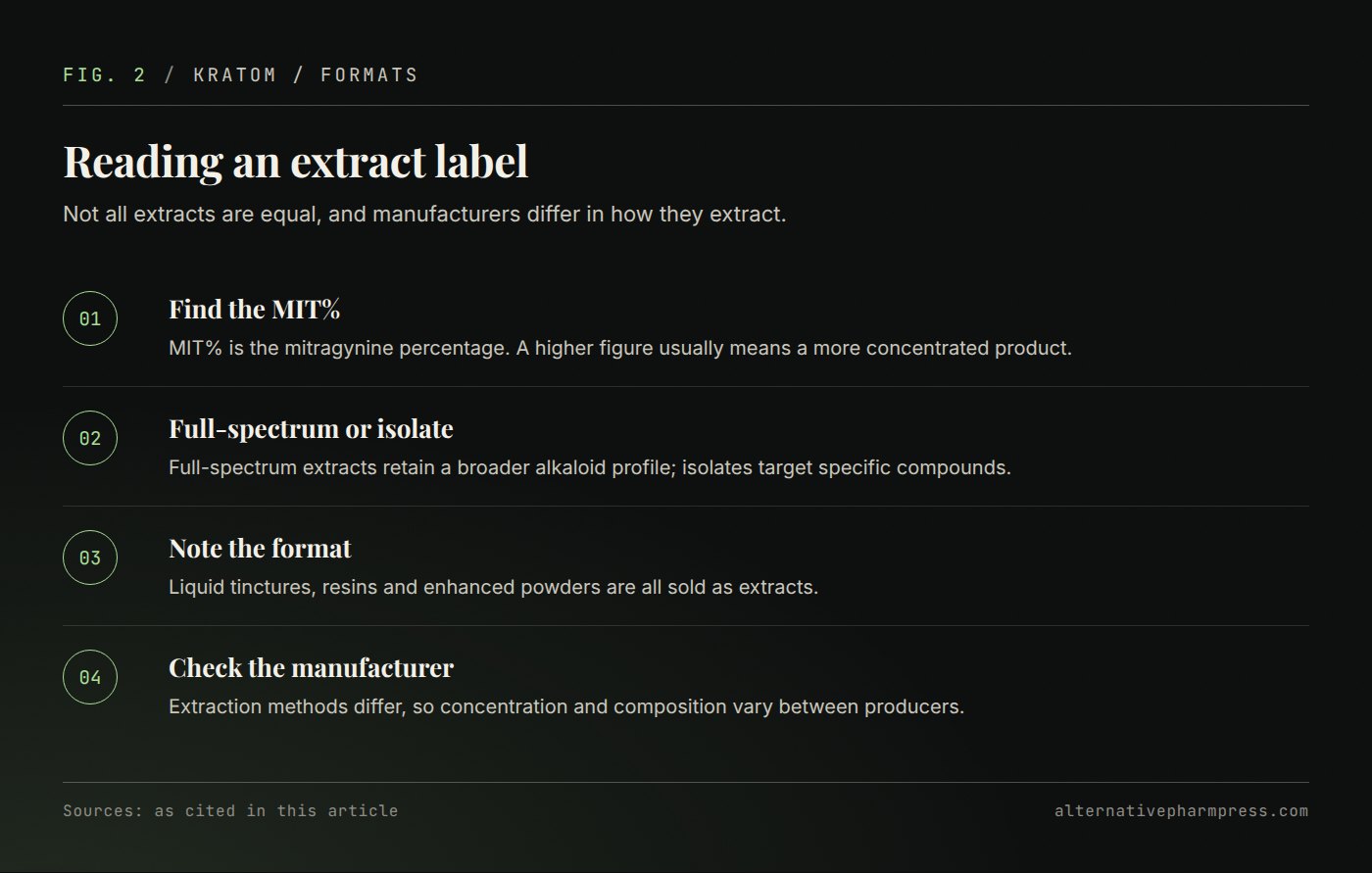
A kratom extract is made by soaking or cooking leaf material in water, alcohol or another solvent, then reducing the liquid to concentrate the alkaloids. The result can be sold as a liquid tincture or shot, a sticky resin, a dried powder or capsules. Common types include:
- Full-spectrum extracts: aim to keep the broader mix of leaf alkaloids, just in higher concentration.
- Standardized or high-mitragynine extracts: labeled by mitragynine percentage (often shown as “MIT%”).
- “Enhanced” powders: plain leaf powder mixed with extract to boost strength. Labels do not always say how much extract was added.
- 7-OH products: tablets and shots built around 7-hydroxymitragynine, usually made in a lab by converting mitragynine. These are not leaf extracts in the traditional sense and are far more potent at opioid receptors.
How extract strength is measured (MIT%)
Extracts are usually labeled by the percentage of mitragynine by weight. A higher MIT% means more mitragynine per gram, but the number alone can mislead:
- It is often unverified. Only a batch-specific certificate of analysis (COA) from an independent, accredited lab confirms the figure. Our COA guide shows how to read one.
- It ignores 7-OH. A product can show a modest MIT% and still contain a large amount of 7-OH. Always check the 7-OH line on the COA.
- It does not show serving strength. To compare products, multiply the MIT% by the serving weight to get milligrams of mitragynine per serving.
Potency: why extracts are riskier
Because extracts pack more alkaloid into less material, small differences in how much you take lead to large differences in effect. Users who move from powder to extract often underestimate this. A 2026 placebo-controlled trial of standardized leaf powder in healthy adults found that side effects became more common as the mitragynine dose increased, which is a reminder that more concentrated products push people up that curve faster.
Extracts also change the balance between alkaloids. Natural leaf contains many minor alkaloids alongside mitragynine; some extraction methods strip these out or tilt the ratio, so an extract is not simply “more of the same leaf.”
Tolerance and dependence
Tolerance means needing more of a substance to get the same effect. User surveys link frequent use and higher intake to tolerance, dependence and withdrawal symptoms such as muscle aches, irritability, poor sleep and a runny nose. Because extracts deliver more alkaloid per serving, they are the form most often associated with rapid escalation. Our kratom dosage guide explains the factors that drive individual response.
Legal status in 2026: extracts face stricter rules
In July 2025 the FDA recommended scheduling concentrated 7-OH products. On October 14, 2026 the DEA published notice that it will temporarily place 7-hydroxymitragynine and mitragynine pseudoindoxyl in Schedule I when either exceeds 1 mg per gram (or per mL), or when the ratio of mitragynine to those compounds is below 100. The order can take effect on or after November 13, 2026.
Ordinary leaf powder should fall well below both limits. Many 7-OH tablets, shots and some “enhanced” extracts will not. Several states also cap 7-OH content under their Kratom Consumer Protection Acts, and nine states ban kratom entirely. Check our state-by-state legal guide before buying any form.
Cost: price per gram vs price per milligram
Extracts cost more per gram than powder because they take more processing and testing. Comparing price per gram is misleading, though. The fairer comparison is price per milligram of mitragynine, which you can only calculate from a lab-verified MIT%. Cheaper extracts with no COA are the riskiest purchase, because you cannot tell what you are getting.
Which is right for you?
This is a personal decision, and kratom is not approved for any medical use. In general, powder is easier to measure, closer to traditional use and less likely to cause rapid tolerance. Extracts are more potent, harder to measure safely and more exposed to new legal restrictions. Anyone with liver disease, taking prescription drugs (see kratom drug interactions) or with a history of substance use disorder should talk to a clinician before using either.
Frequently asked questions
How much stronger is kratom extract than powder?
It depends entirely on the product. Some extracts are a few times stronger by weight; others are many times stronger. Only a batch COA showing mitragynine and 7-OH content lets you compare.
Is kratom extract the same as 7-OH?
No. Traditional extracts concentrate leaf alkaloids, mostly mitragynine. 7-OH products are usually made in a lab and are much stronger at opioid receptors. They are the main target of the DEA’s 2026 Schedule I action.
Are kratom extracts legal?
In states that allow kratom, extracts that stay under the federal 7-OH threshold are not federally controlled, but some state laws restrict them further. Products above the threshold fall under the DEA’s temporary Schedule I order once it takes effect.
What is an “enhanced” kratom powder?
Leaf powder mixed with extract to raise its strength. Because the added amount is often not disclosed, enhanced powders are harder to measure than plain leaf.
Conclusion
Kratom powder and kratom extract come from the same plant but are very different products. Powder keeps the leaf’s natural alkaloid balance and is easier to measure. Extracts concentrate the alkaloids, raising the risks of over-consumption, tolerance and, for high-7-OH products, legal trouble under the DEA’s 2026 rules. Whatever the form, insist on a batch-specific lab report and check the current law where you live.
Key Takeaways
- Powder is dried, ground leaf; extracts concentrate the leaf’s alkaloids with solvents.
- Extracts are stronger by weight, often by a large and variable margin.
- MIT% shows mitragynine content but not 7-OH; always check both on the COA.
- Compare products by milligrams of mitragynine per serving, not grams of product.
- Extracts are more closely linked to rapid tolerance and dependence.
- Products over 1 mg/g 7-OH fall under the DEA’s temporary Schedule I order from November 13, 2026 at the earliest.
More comparisons
-
Green Malay vs Green Maeng Da Kratom: What the Labels Really Tell You
-
Borneo vs Bali Kratom: What the Labels Mean and What Lab Data Shows
-
Kratom vs Kanna: Two Botanicals With Very Different Mechanisms
-
Kratom Capsules vs Powder: Same Leaf, Different Trade-offs
-
Red vs White Kratom: Relaxing vs Energising, and What Tests Show