
This article is for educational purposes only and does not constitute medical advice.
Introduction
Kratom’s interaction with opioid receptors is one of the most studied aspects of its pharmacology. Understanding this requires familiarity with receptor biology and how kratom’s compounds differ from classic opioid drugs. For context on the two primary kratom alkaloids, see our mitragynine vs 7-hydroxymitragynine guide. For the broader research landscape, see our kratom research overview.
Opioid Receptor Basics: Mu, Kappa, and Delta
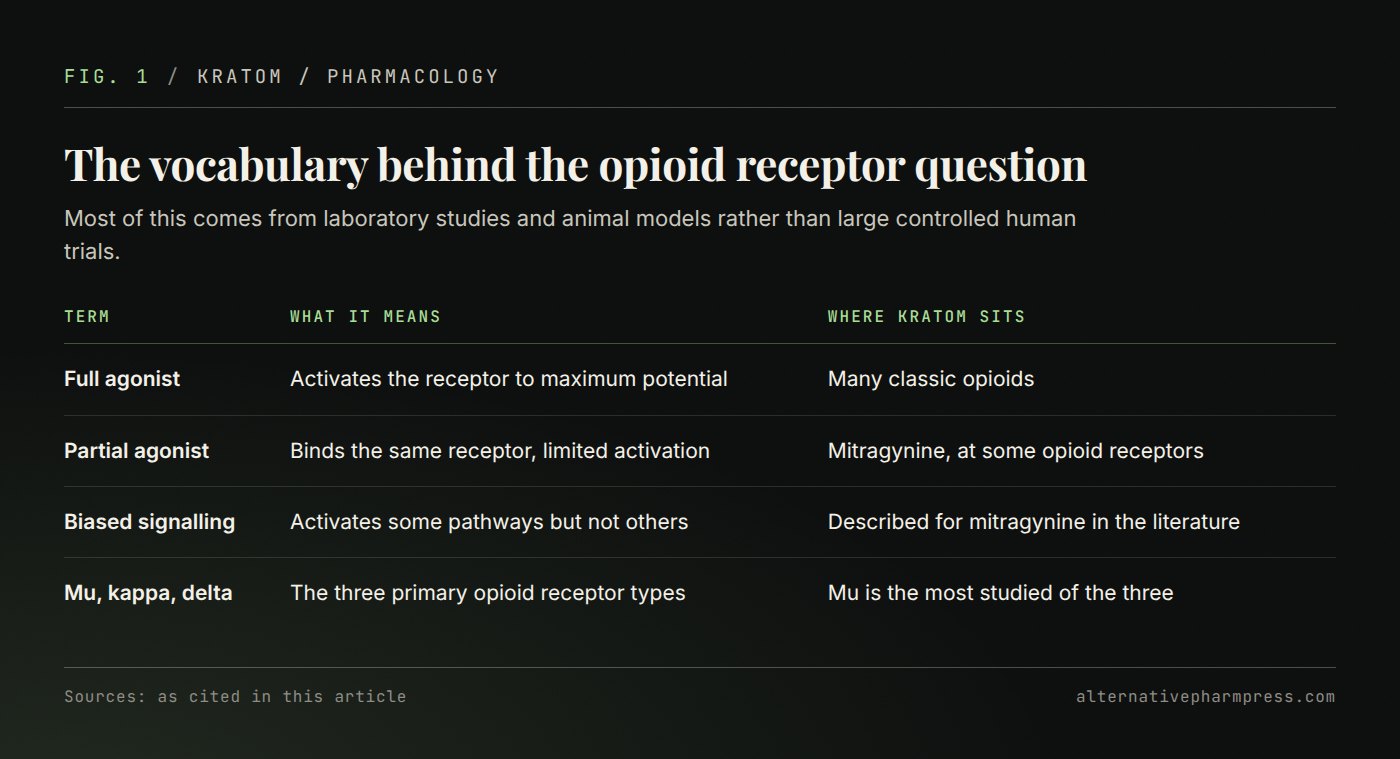
Opioid receptors are proteins located mainly in the brain and nervous system. There are three primary types:
- Mu (μ) receptors — the most studied type; implicated in the effects of many traditional opioid substances.
- Kappa (κ) receptors — associated with different signaling pathways.
- Delta (δ) receptors — part of the wider opioid receptor system; their role is still being investigated.
Research on PubMed has examined how kratom’s alkaloids interact with these receptor systems at the cellular level.
How Mitragynine Binds to Receptors
Mitragynine is the most abundant alkaloid in kratom. Research indicates it may bind to opioid receptors — especially the mu receptor — but does so differently from many traditional opioids. Studies suggest mitragynine acts more selectively, activating some signaling pathways while not fully activating others. This selective interaction is sometimes described as “biased signaling” in the scientific literature. The FDA has noted the need for further research into kratom’s biological mechanisms.
Partial Agonist vs Full Agonist
A full agonist binds to a receptor and activates it to maximum potential — many classic opioids fall in this category. A partial agonist binds to the same receptor but produces more limited activation. Research indicates mitragynine functions as a partial agonist at some opioid receptors. This partial agonism is a key distinction between kratom’s alkaloids and conventional opioid drugs.
Why This Is Different from Classic Opioids
Several features distinguish kratom’s receptor interaction from classic opioids:
- Mitragynine is a partial agonist; many traditional opioids are full agonists.
- Kratom contains multiple alkaloids — including 7-hydroxymitragynine — creating a more complex pharmacological profile.
- Research suggests kratom compounds may influence pathways beyond opioid receptors alone.
These differences do not mean kratom is without risk. For information on how kratom may interact with other substances, see our kratom and drug interactions guide.
Research Limitations
Most current data comes from laboratory studies and animal models rather than large-scale controlled human trials. Studies use varying methodologies, making cross-study comparisons difficult. Product composition variability adds further complexity. These limitations mean conclusions should be drawn cautiously.
Key Takeaways
- Kratom alkaloids bind to opioid receptors — but as partial agonists, not full agonists.
- Partial agonism and selective signaling distinguish kratom from classic opioids at the receptor level.
- Most existing research is laboratory-based; large human clinical trials are limited.
- This information is not medical advice — consult a healthcare professional for guidance.
Educational and informational content only. Not medical advice. These statements have not been evaluated by the FDA. Consult a qualified healthcare professional before making any decisions about kratom use.