
This article is for educational purposes only and does not constitute medical advice.
Last updated: October 15, 2026. Added the first controlled dosing trials, the DEA’s 2026 7-OH rule and corrected citations.
Quick answer: There is no approved or official kratom dose. Kratom is not FDA-approved for any use, and how a given amount affects someone depends on body size, metabolism, CYP2D6 genetics, tolerance and, above all, the alkaloid content of the specific batch. User surveys link lower intake to stimulant-type effects and higher, more frequent intake to sedation and a greater risk of dependence.
Introduction
Disclaimer: Educational content for adult readers. Not medical advice. We do not publish recommended dose figures because no medical or regulatory body has approved any. US (FDA): Statements have not been evaluated by the FDA. Kratom is not approved for any medical use. UK: Kratom supply is restricted under the Psychoactive Substances Act 2016. Canada: Kratom is not authorized for sale; see the Health Canada advisory. Talk to a clinician before using kratom, especially with other medications.
There is no official kratom dosage. Regulators in the US, UK, and Canada have not approved kratom for any indication, so there is no clinical reference range the way there is for, say, ibuprofen. What exists is a body of user surveys, a smaller body of pharmacokinetic studies, and a meaningful safety literature on dependence, withdrawal, and adverse events. This article walks through the variables that drive response – and why “how much” is the wrong first question.
Why response varies
Several factors stack up:
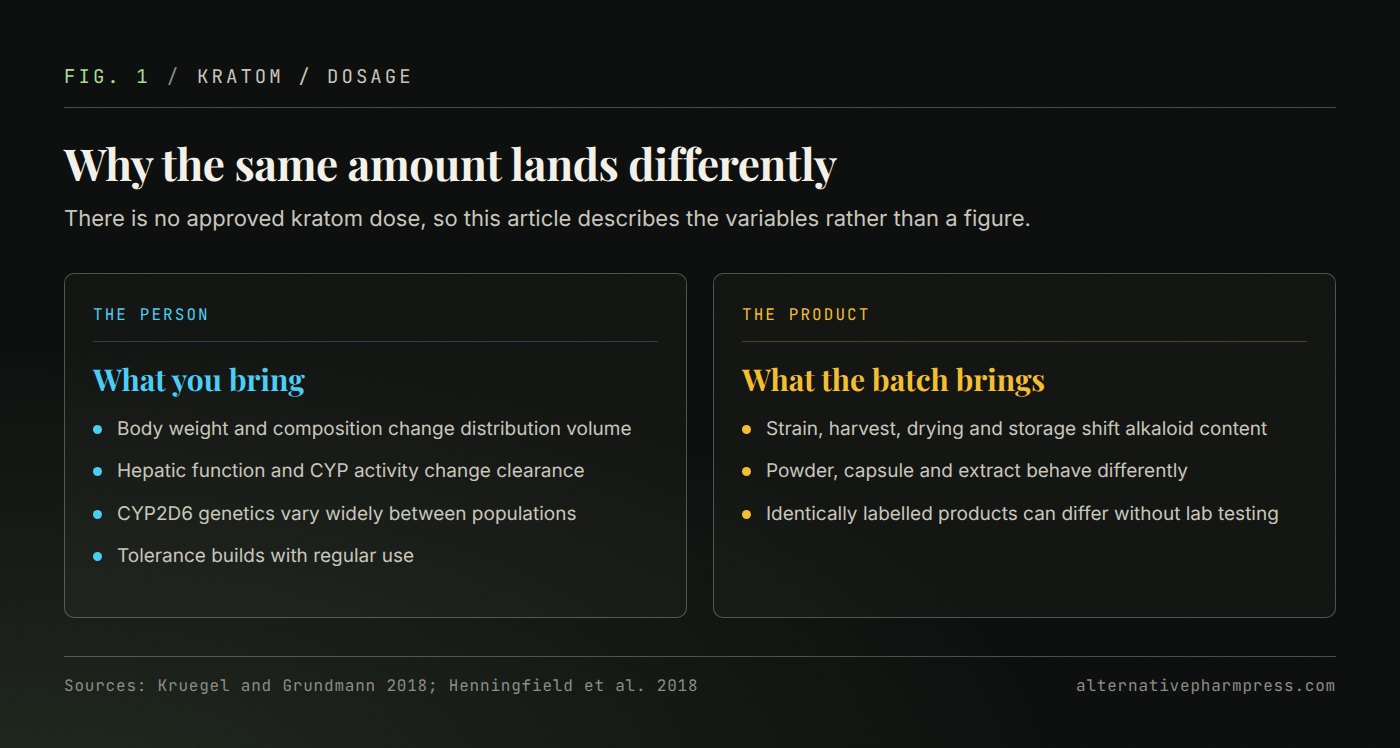
- Body weight and composition. Distribution volume changes with body size.
- Metabolism. Mitragynine clearance varies with hepatic function and CYP enzyme activity (Kruegel and Grundmann, 2018).
- Genetics. CYP2D6 polymorphism, in particular, varies widely between populations and changes how individuals process opioid-like compounds.
- Tolerance. Regular users develop tolerance and withdrawal-on-cessation patterns described by Henningfield et al. (2018).
- Product variability. Strain, harvest, drying, storage, and form (powder, capsule, extract) all shift alkaloid content. Two products labeled identically can deliver different effects without lab testing to back the labels up.
User-reported intake patterns (descriptive, not advisory)
The peer-reviewed survey literature describes typical user patterns rather than recommending them. Veltri and Grundmann (2019), Coe et al. (2019), and Grundmann (2017) are the most cited US user surveys. They describe:
- A wide range of self-reported intakes across users, with no single modal amount.
- Lower intakes more often associated with stimulant-type self-reports; higher intakes more often associated with sedative-type and analgesic self-reports.
- Higher and more frequent intake associated with greater likelihood of dependence and withdrawal symptoms on stopping.
None of this is a clinical guideline. The data points are user reports collected after the fact.
What controlled studies now show
Until recently, almost everything known about kratom amounts came from surveys. That is starting to change. In January 2026, a randomized, double-blind, placebo-controlled trial in Therapeutic Drug Monitoring gave a standardized kratom leaf powder or placebo to 116 healthy adults, using single doses and 15 consecutive daily doses that delivered between about 6.7 mg and 53 mg of mitragynine. Researchers reported no serious adverse events, and side effects were mostly mild but became more common as the dose rose.
These findings apply to a single tested product in healthy volunteers who were not regular kratom users, over a short period. They do not establish a safe dose for daily, long-term or higher-dose use, for people taking other medications, or for products with unknown alkaloid content. Because the trial was built around mitragynine content rather than grams of powder, it also shows why a batch lab report matters more than a scoop size.
Tolerance and withdrawal
Daily users commonly report needing more product over time to achieve the same self-reported effect. Stopping abruptly after extended use is associated with withdrawal symptoms (Henningfield et al., 2018; Veltri and Grundmann, 2019) including muscle aches, irritability, sleep disturbance, and runny nose – a profile resembling mild opioid withdrawal. The FDA has flagged this in consumer advisories.
Form differences
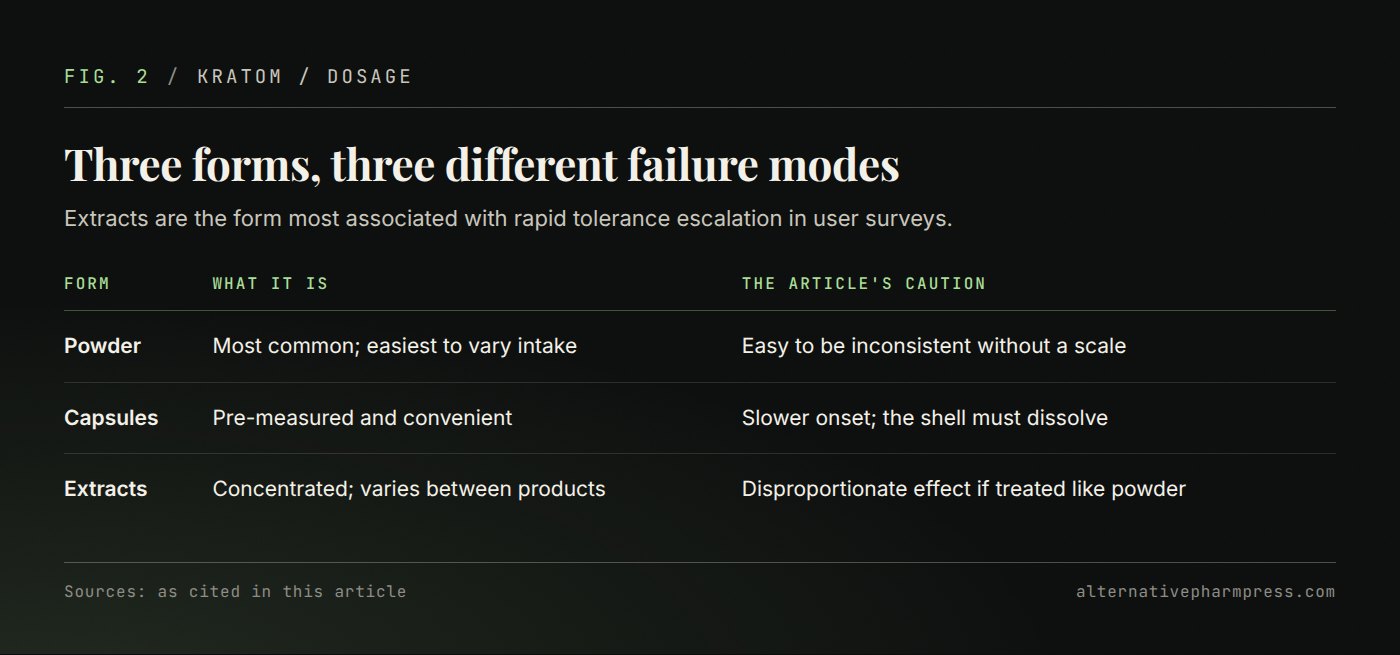
- Powder. Most common, easiest to vary intake, easiest to be inconsistent without a scale.
- Capsules. Pre-measured. Slower onset because the capsule shell has to dissolve. Convenient.
- Extracts. Concentrated. Variable concentration between products. Disproportionate-effect risk if treated like powder. Concentrated 7-hydroxymitragynine products are a separate category: the FDA recommended scheduling them in July 2025, and on October 14, 2026 the DEA moved to place 7-OH above 1 mg per gram in Schedule I, effective no earlier than November 13, 2026.
Extracts are the form most associated with rapid tolerance escalation in user surveys.
Why measurement matters
Eyeballing kratom from a teaspoon will produce a wider range than most users realize. A digital scale accurate to 0.1g costs less than a takeout meal and removes one source of variability. If you’re tracking intake (recommended), a scale and a notebook are the bare minimum.
When to consult a professional
- You take prescription medication, especially anything metabolized by CYP3A4 or CYP2D6. Kratom alkaloids inhibit these enzymes in lab studies, and a 2023 human study found a single low dose of kratom tea raised levels of the CYP3A drug midazolam by about 39% (Tanna et al., 2023). See our kratom drug interactions guide (Hanapi et al., 2013).
- You have liver or kidney disease, are pregnant, or are breastfeeding.
- You have a history of substance use disorder.
- You experience persistent or severe side effects: prolonged nausea, dizziness, jaundice, dark urine, severe abdominal pain, breathing difficulty, or signs of overdose.
- You’re trying to taper off after extended use. Withdrawal protocols exist; seek qualified support.
US poison control centers can be reached anonymously through the AAPCC. Canadian residents can use the Health Canada poison-centre directory. UK residents can call NHS 111 or 999 for emergencies.
Frequently asked questions
Is there a safe kratom dose?
No safe dose has been established. A 2026 trial found no serious adverse events at modest, short-term doses in healthy adults, but that does not cover daily long-term use, higher amounts, other medications or untested products.
Is it safe to take kratom every day?
Daily use is the pattern most strongly linked to tolerance, dependence and withdrawal in user surveys. If you use kratom daily and want to stop, a clinician can help you taper.
Do capsules and powder deliver the same amount?
By weight, the leaf is the same, but capsules take longer to start working, which can tempt people to take more before the first dose has taken effect.
What are signs of taking too much?
Reported signs include nausea, vomiting, dizziness, heavy sedation, confusion and, especially when combined with other depressants, slowed breathing. Call poison control or emergency services if someone is hard to wake or breathing slowly.
Conclusion
Kratom dosage is highly individual — body weight, metabolism, tolerance, strain, and the specific alkaloid profile of a batch all interact. Because product strength varies so much, a gram figure from a forum or label tells you little without a batch-specific lab report. Anyone who chooses to use kratom should avoid mixing it with other sedatives, watch for signs of dependence, and talk to a clinician who knows their medical history. When in doubt, consult a clinician who knows your medical history.
Key takeaways
- There is no approved kratom dose; we do not publish gram figures.
- Response is driven by body composition, metabolism, genetics, tolerance, and product quality.
- Tolerance and withdrawal are documented in regular users.
- Extracts carry disproportionate risk relative to whole-leaf powder.
- Talk to a clinician, especially if you’re on other medications or have liver, kidney, or substance-use history.
Sources & Further Reading
- Kruegel AC, Grundmann O. Neuropharmacology. 2018;134:108-120. PMID 28830758
- Hanapi NA, Ismail S, Mansor SM. Pharmacognosy Res. 2013;5(4):241-246. PMID 24174816
- Henningfield JE, et al. The abuse potential of kratom according the 8 factors of the Controlled Substances Act. Psychopharmacology. 2018. PMID 29273821
- Veltri C, Grundmann O. Subst Abuse Rehabil. 2019;10:23-31. PMID 31308789
- Coe MA, et al. Kratom as a substitute for opioids: results from an online survey. Drug Alcohol Depend. 2019;202:24-32. PMID 31284119
- Grundmann O. Patterns of kratom use and health impact in the US: results from an online survey. Drug Alcohol Depend. 2017;176:63-70. PMID 28521200
- Tanna RS, et al. Clinical assessment of the drug interaction potential of the psychotropic natural product kratom. Clin Pharmacol Ther. 2023;113(6):1315-1325. PMID 36924284
- Huestis MA, Bothmer J, Hudzik T, Henningfield JE, Swift S. Ther Drug Monit. 2026 (randomized, placebo-controlled trial of kratom leaf powder in 116 healthy adults). Jefferson Digital Commons
- FDA. FDA and Kratom
- NCCIH. Kratom: What You Need To Know