
Judged by placebo-controlled trials, the best supplements for anxiety are a short list. An oral lavender oil preparation called Silexan has the strongest data. Saffron and ashwagandha have positive but lower-quality trials, and ashwagandha carries rare liver-injury reports. L-theanine, magnesium and chamomile have thin evidence, and kava failed its largest trial in generalised anxiety.1,3,7,14
None of these is a substitute for assessment. Psychotherapy such as cognitive behavioural therapy and prescription medicines are established treatments for anxiety disorders such as panic disorder, and new panic attacks need a medical check first.21 This is not a product list: we name no brands, and we grade each option on the quality of its human trials.
Below: an evidence-graded table, what the main trials found, interactions with SSRIs and benzodiazepines, what a quality seal does and does not prove, and when anxiety needs clinical care. For related coverage, see our nootropics hub.
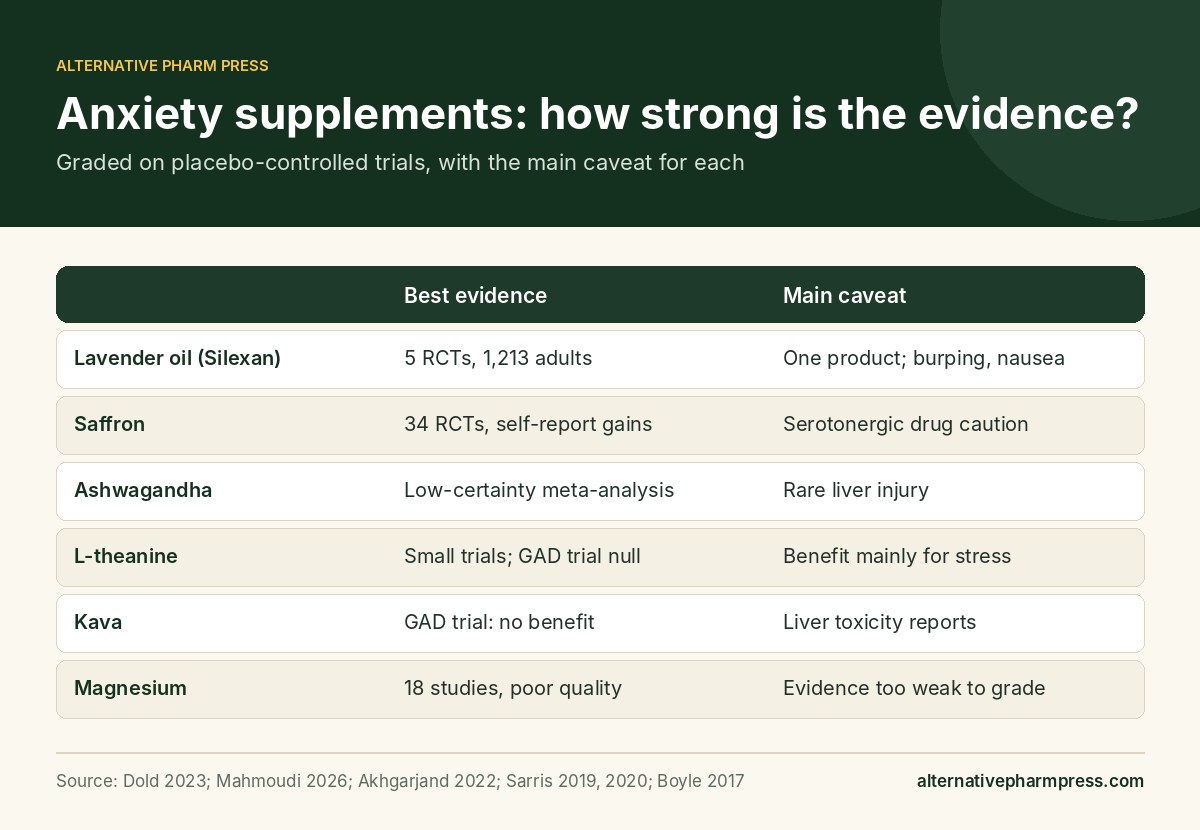
Supplements for anxiety at a glance: evidence-graded table
| Supplement | Best evidence | What it found | Main safety issue | Our grade |
|---|---|---|---|---|
| Lavender oil (Silexan) | Meta-analysis of 5 RCTs, 1,213 adults1 | Beat placebo on clinician and self-rated anxiety at 10 weeks | Burping, nausea, diarrhoea; possible sedative interactions2 | Moderate |
| Saffron | Meta-analysis of 34 RCTs3 | Lower self-rated anxiety; no effect on a clinician-rated anxiety scale | Caution with serotonergic drugs19 | Low to moderate |
| Ashwagandha | Meta-analyses of 12 and 14 RCTs7,8 | Lower anxiety and stress; certainty low | Rare liver injury; banned in Danish supplements9,11 | Low |
| L-theanine | Small RCTs5,6 | Stress benefits in healthy adults; no benefit in a GAD trial | Few problems reported in trials | Low |
| Chamomile | One long-term RCT16 | Lower GAD symptoms; relapse not significantly reduced | Low adverse event rate in trial | Low |
| Magnesium | Systematic review of 18 studies13 | Suggestive benefit in anxiety-prone groups | Evidence quality poor | Very low |
| Kava | 16-week RCT in 171 people with GAD14 | No better than placebo | Liver toxicity reports15 | Not supported for GAD |
Our grade reflects the number, size, independence and consistency of placebo-controlled trials. It is an editorial judgement, not a formal GRADE rating, and it says nothing about whether a supplement suits you.
Lavender oil (Silexan): the strongest trial evidence
Silexan is a proprietary oral preparation made from Lavandula angustifolia oil, studied as a once-daily capsule. A 2023 meta-analysis in European Archives of Psychiatry and Clinical Neuroscience pooled all five completed double-blind, placebo-controlled trials, covering 1,213 adult outpatients with subthreshold anxiety, mixed anxiety and depression, or generalised anxiety disorder (GAD). After ten weeks, Silexan was significantly better than placebo on the Hamilton Anxiety Rating Scale and on self-rated anxiety, with a responder rate ratio of 1.34. Adverse events did not differ significantly between groups.1
The caveats matter. Every trial tested the same commercial product, and the NIH’s complementary health centre points to a lack of independent funding and testing and limited participant diversity. It lists diarrhoea, headache, nausea and burping as possible side effects of oral lavender products, and notes that lavender might theoretically interact with sedative drugs or herbs.2 Results for this extract do not transfer to aromatherapy or to lavender oils not made to be swallowed.
Saffron for anxiety: promising, but mostly self-reported
A 2026 GRADE-assessed meta-analysis of 34 randomised trials (1,769 participants) found saffron reduced scores on the self-rated Beck Anxiety Inventory across six trials. It found no significant effect on the clinician-rated Hamilton anxiety scale, and heterogeneity between studies was very high. The authors rated certainty as moderate but said the lack of clinician-rated effects underlined the need for better trials.3
A 2025 meta-analysis of head-to-head trials found no significant difference between saffron and SSRIs in four anxiety studies, with fewer adverse events on saffron.4 Small comparisons like these cannot show equivalence with confidence. A common forum observation is that saffron seems to help in social situations; we found no trial specifically in social anxiety disorder that could confirm it.
Ashwagandha: positive trials, real safety questions
A 2022 meta-analysis of 12 trials (1,002 participants) found ashwagandha reduced anxiety and stress compared with placebo, but heterogeneity was high and the authors rated certainty of the evidence as low.7 A 2025 review in BJPsych Open of 14 trials in people with diagnosed mental disorders also found an improvement in anxiety, while noting the small number of studies and outlier effects.8 The US National Center for Complementary and Integrative Health says evidence for anxiety is unclear, though some preparations may help stress and sleep.12
Liver injury. Case series from Iceland and the US Drug-Induced Liver Injury Network described jaundice after two to 12 weeks of ashwagandha use, usually resolving within one to five months.9 An Indian series of eight single-ingredient cases included three people with pre-existing liver disease who developed acute-on-chronic liver failure and died.10 NCCIH describes liver injury as rare, but people with existing liver disease appear to be at greatest risk.10,12
Regulation. Denmark banned ashwagandha in food supplements in 2023, after a 2020 Technical University of Denmark risk assessment flagged possible effects on sex hormones, the thyroid and other systems. The Netherlands advised against use in 2024, and the UK Food Standards Agency launched a call for evidence the same year.11 NCCIH advises avoiding it in pregnancy and says it is not recommended for people with thyroid or autoimmune disorders.12
Forums also discuss “ashwagandha withdrawal” and emotional blunting. The trials were short and did not measure what happens after stopping, so we found no controlled data either way. Our ashwagandha vs rhodiola comparison covers both herbs in more detail.
L-theanine for anxiety: modest, and mainly for stress
L-theanine, an amino acid from tea leaves, has small trials. In a four-week crossover trial in 30 healthy adults, L-theanine reduced depression, trait anxiety and sleep-quality scores compared with placebo.5 In a 2019 trial of 46 people with GAD who added L-theanine to their antidepressant, it did not outperform placebo on the Hamilton anxiety scale, though participants reported better sleep satisfaction.6
That pattern, some benefit for everyday stress and none shown in a diagnosed disorder, is a fair summary. People asking whether any supplement measurably helped their social anxiety will not find a trial of L-theanine in social anxiety disorder.
Chamomile, magnesium and kava
Chamomile. In a US trial, 179 people with moderate-to-severe GAD took a pharmaceutical-grade chamomile extract for 12 weeks; the 93 who responded were randomised to continue or switch to placebo. Relapse was lower on chamomile, but not significantly (hazard ratio 0.52), while symptoms stayed lower on chamomile during follow-up.16
Magnesium. A systematic review of 18 studies found evidence “suggestive” of a benefit for subjective anxiety in anxiety-prone groups, such as people with premenstrual syndrome, but rated the quality of the evidence as poor.13
Kava. Earlier short trials were encouraging, but a 16-week Australian trial in 171 people with GAD found no benefit over placebo: 17.4% on kava remitted versus 23.8% on placebo. Liver function abnormalities, memory problems and tremor were more common on kava.14 In 2002 the CDC reported liver failure cases linked to kava products, 11 of which led to liver transplants worldwide, and several countries restricted kava sales.15 Our kava vs kanna comparison covers the plant’s evidence and risks.
CBD, peptides and “nootropics” sold for anxiety
CBD is the most heavily marketed calming product, and its evidence deserves separate treatment. Our review of what the human CBD trials actually found covers the sleep and anxiety-related studies, and our explainer on whether CBD is addictive covers dependence questions. CBD can also interact with prescription medicines; see CBD and blood pressure medication.
Microdosing psychedelics is another self-treatment people ask about, but a 2026 meta-analysis found no clear effect on anxiety in healthy adults in randomised trials.23 Our microdosing psilocybin evidence review covers those trials and the interaction risks.
Peptides such as Selank are also promoted online for anxiety; our Selank vs Semax comparison looks at that evidence. Be wary of products sold as anxiety “nootropics” in gas stations and vape shops. Tianeptine, which some people have used to self-treat anxiety, is not an approved drug in the US and is linked to overdoses and opioid-like withdrawal.22 Our guide to tianeptine withdrawal and the DEA’s ban proposal explains why.
Interactions with SSRIs, benzodiazepines and other medicines
- St John’s wort. Taken with certain antidepressants, it may increase serotonin-related side effects, which can be serious, and it weakens many medicines, including birth control pills, warfarin and some heart and seizure drugs.17
- 5-HTP. People on SSRIs, MAOIs, tricyclic antidepressants or other serotonin-affecting drugs should not take 5-HTP without medical supervision, according to Memorial Sloan Kettering. The serotonin syndrome risk is described as theoretical, and older reports found contaminants in some 5-HTP products.18
- Saffron. A 2026 review of herbal anxiolytics that included saffron listed serotonergic activity among their proposed mechanisms and serotonin syndrome and drug interactions among the clinically relevant risks.19 Check with a prescriber before adding it to an antidepressant.
- Benzodiazepines and other sedatives. Lavender and ashwagandha may interact with sedatives.2,12 Stacking calming herbs on top of a benzodiazepine, sleep medicine or alcohol can add to drowsiness.
- Thyroid, diabetes and blood pressure medicines. Ashwagandha may interact with all three, as well as with immunosuppressants and anti-seizure drugs.12
The simplest safeguard is to take the actual bottle to a pharmacist and ask them to check it against everything else you take.
Quality and testing: what a USP or NSF seal means
Supplements do not need FDA approval before they are sold, and the FDA does not judge whether they work before they reach the market. According to the NIH Office of Dietary Supplements, seals from USP, NSF International and ConsumerLab.com indicate that a product was properly manufactured and contains the listed ingredients, but “do not guarantee that a product is safe or effective”.20
Trial results also apply to specific extracts. The Silexan data describe one standardised lavender preparation, and ashwagandha trials used different preparations and doses.1,8 A generic product with the same plant name may not match what was tested. Our guide to signs a supplement brand is genuinely third-party tested explains what to look for on a certificate of analysis.
When anxiety needs clinical care
The US National Institute of Mental Health says a provider may examine you to make sure an unrelated physical problem is not causing your symptoms. Panic attacks can feel like a heart attack, and panic disorder often occurs alongside heart disease, breathing problems or thyroid problems.21 New or worsening panic attacks, chest pain, fainting or a racing heartbeat should be assessed by a doctor, urgently if symptoms are severe.
NIMH describes cognitive behavioural therapy as the “gold standard” psychotherapy for panic disorder. SSRIs can take several weeks to work, and benzodiazepines act quickly but carry tolerance and dependence risks, so they are usually prescribed only for short periods.21 If you are waiting for blood tests or an appointment, it is reasonable to ask your doctor whether a particular supplement is safe in the meantime, but do not stop or change prescribed medication on your own.
If you are in crisis or thinking about suicide, call or text 988 in the US. The SAMHSA National Helpline (1-800-662-4357) offers free, confidential treatment referrals 24 hours a day.
Frequently asked questions
What is the best supplement for anxiety?
On trial evidence, Silexan, an oral lavender oil capsule, has the strongest case: a meta-analysis of five placebo-controlled trials in 1,213 adults found it reduced anxiety over ten weeks.1 Saffron and ashwagandha have positive but lower-quality evidence.3,7 None replaces assessment, therapy or prescribed treatment for an anxiety disorder, and all can interact with medicines.
Is L-theanine good for anxiety?
The evidence is modest. A small four-week trial in 30 healthy adults found lower stress-related, anxiety and sleep scores than placebo.5 But in a trial of 46 people with generalised anxiety disorder, adding L-theanine to an antidepressant did not reduce anxiety more than placebo, although sleep satisfaction improved.6 It may help everyday stress more than a diagnosed disorder.
Can you take saffron or ashwagandha with an SSRI?
Ask your prescriber first. A 2026 review of herbal anxiolytics, including saffron, listed serotonin syndrome and drug interactions among the class’s clinically relevant risks.19 Ashwagandha may interact with sedatives, thyroid, diabetes and blood pressure medicines.12 St John’s wort and 5-HTP carry clearer warnings with antidepressants.17,18 A pharmacist can check the actual product against your medicines.
Is ashwagandha safe for your liver?
Liver injury appears rare but is well documented. Case series describe jaundice developing after two to 12 weeks of use, usually resolving within months, and three Indian patients with existing liver disease died.9,10 Denmark banned ashwagandha in food supplements in 2023.11 People with liver disease appear most at risk, and NCCIH advises against use in pregnancy and with thyroid or autoimmune disorders.12
Can supplements help with panic attacks?
No supplement has good trial evidence for panic disorder specifically. New panic attacks should be checked by a doctor, because heart and thyroid problems can occur alongside them and panic can feel like a heart attack.21 Cognitive behavioural therapy is the standard psychotherapy, and SSRIs are a common medication option.21 Ask a clinician before adding supplements while you wait for tests.
Sources
- Dold M, Bartova L, Volz HP, Seifritz E, Möller HJ, Schläfke S, et al. Efficacy of Silexan in patients with anxiety disorders: a meta-analysis of randomized, placebo-controlled trials. Eur Arch Psychiatry Clin Neurosci. 2023;273(7):1615-1628. DOI: 10.1007/s00406-022-01547-w. PMID: 36717399. pubmed.ncbi.nlm.nih.gov
- National Center for Complementary and Integrative Health. Lavender. Updated February 2025. nccih.nih.gov
- Mahmoudi R, Mohammadi-Sartang M, Servatyari K, Rafieipour N. Effect of saffron on depression, anxiety and mood disorder: a GRADE assessed systematic review and meta-analysis of 34 randomized controlled trials. Nutr Neurosci. 2026;29(7):816-837. DOI: 10.1080/1028415X.2025.2602153. PMID: 41693488. pubmed.ncbi.nlm.nih.gov
- Shafiee A, Jafarabady K, Seighali N, Mohammadi I, Rajai Firouz Abadi S, Abhari FS, et al. Effect of Saffron Versus Selective Serotonin Reuptake Inhibitors (SSRIs) in Treatment of Depression and Anxiety: A Meta-analysis of Randomized Controlled Trials. Nutr Rev. 2025;83(3):e751-e761. DOI: 10.1093/nutrit/nuae076. PMID: 38913392. pubmed.ncbi.nlm.nih.gov
- Hidese S, Ogawa S, Ota M, Ishida I, Yasukawa Z, Ozeki M, et al. Effects of L-Theanine Administration on Stress-Related Symptoms and Cognitive Functions in Healthy Adults: A Randomized Controlled Trial. Nutrients. 2019;11(10):2362. DOI: 10.3390/nu11102362. PMID: 31623400. pubmed.ncbi.nlm.nih.gov
- Sarris J, Byrne GJ, Cribb L, Oliver G, Murphy J, Macdonald P, et al. L-theanine in the adjunctive treatment of generalized anxiety disorder: A double-blind, randomised, placebo-controlled trial. J Psychiatr Res. 2019;110:31-37. DOI: 10.1016/j.jpsychires.2018.12.014. PMID: 30580081. pubmed.ncbi.nlm.nih.gov
- Akhgarjand C, Asoudeh F, Bagheri A, Kalantar Z, Vahabi Z, Shab-Bidar S, et al. Does Ashwagandha supplementation have a beneficial effect on the management of anxiety and stress? A systematic review and meta-analysis of randomized controlled trials. Phytother Res. 2022;36(11):4115-4124. DOI: 10.1002/ptr.7598. PMID: 36017529. pubmed.ncbi.nlm.nih.gov
- Marchi M, Grenzi P, Travascio A, Uberti D, De Micheli E, Quartaroli F, et al. The effect of Withania somnifera (Ashwagandha) on mental health symptoms in individuals with mental disorders: systematic review and meta-analysis. BJPsych Open. 2025;11(6):e260. DOI: 10.1192/bjo.2025.10885. PMID: 41140145. pubmed.ncbi.nlm.nih.gov
- Björnsson HK, Björnsson ES, Avula B, Khan IA, Jonasson JG, Ghabril M, et al. Ashwagandha-induced liver injury: A case series from Iceland and the US Drug-Induced Liver Injury Network. Liver Int. 2020;40(4):825-829. DOI: 10.1111/liv.14393. PMID: 31991029. pubmed.ncbi.nlm.nih.gov
- Philips CA, Valsan A, Theruvath AH, Ravindran R, Oommen TT, Rajesh S, et al. Ashwagandha-induced liver injury: A case series from India and literature review. Hepatol Commun. 2023;7(10):e0270. DOI: 10.1097/HC9.0000000000000270. PMID: 37756041. pubmed.ncbi.nlm.nih.gov
- NutraIngredients. Timeline: Will authorities de-throne the king of herbs? 6 July 2026. nutraingredients.com
- National Center for Complementary and Integrative Health. Ashwagandha. Updated March 2023. nccih.nih.gov
- Boyle NB, Lawton C, Dye L. The Effects of Magnesium Supplementation on Subjective Anxiety and Stress: A Systematic Review. Nutrients. 2017;9(5):429. DOI: 10.3390/nu9050429. PMID: 28445426. pubmed.ncbi.nlm.nih.gov
- Sarris J, Byrne GJ, Bousman CA, Cribb L, Savage KM, Holmes O, et al. Kava for generalised anxiety disorder: A 16-week double-blind, randomised, placebo-controlled study. Aust N Z J Psychiatry. 2020;54(3):288-297. DOI: 10.1177/0004867419891246. PMID: 31813230. pubmed.ncbi.nlm.nih.gov
- Centers for Disease Control and Prevention. Hepatic Toxicity Possibly Associated with Kava-Containing Products: United States, Germany, and Switzerland, 1999-2002. MMWR. 2002;51(47):1065-1067. cdc.gov
- Mao JJ, Xie SX, Keefe JR, Soeller I, Li QS, Amsterdam JD. Long-term chamomile (Matricaria chamomilla L.) treatment for generalized anxiety disorder: A randomized clinical trial. Phytomedicine. 2016;23(14):1735-1742. DOI: 10.1016/j.phymed.2016.10.012. PMID: 27912875. pubmed.ncbi.nlm.nih.gov
- National Center for Complementary and Integrative Health. St. John’s Wort. Updated May 2025. nccih.nih.gov
- Memorial Sloan Kettering Cancer Center. About Herbs: 5-HTP. Updated 2 June 2022. mskcc.org
- Căuș MN, Lupoae M, Chițescu CL. Efficacy and Safety of Herbal Supplements with Anxiolytic, Antidepressant, and Sedative Action: A Review of Clinical Data and Toxicological Risks. Pharmaceuticals (Basel). 2026;19(3):399. DOI: 10.3390/ph19030399. PMID: 41901246. pubmed.ncbi.nlm.nih.gov
- NIH Office of Dietary Supplements. Dietary Supplements: What You Need to Know. Accessed October 2026. ods.od.nih.gov
- National Institute of Mental Health. Panic Disorder: When Fear Overwhelms. Accessed October 2026. nimh.nih.gov
- US Food and Drug Administration. Tianeptine Products Linked to Serious Harm, Overdoses, Death. 9 May 2025. fda.gov
- Meshkat S, Leung M, Meshkat S, Lin Q, Wijendran D, Reichelt AC, et al. Efficacy and Safety of Psychedelic Microdosing on Psychological Outcomes in Healthy Adults: A Systematic Review and Meta-analysis. CNS Drugs. 2026;40(10):1369-1393. DOI: 10.1007/s40263-026-01325-5. PMID: 42593636. pubmed.ncbi.nlm.nih.gov
Featured image: Macro of german chamomile by Takashi(aes256), CC BY-SA 2.0. Cropped.
This article is for educational purposes only and is not medical or legal advice. Products discussed here are not intended to diagnose, treat, cure or prevent any disease. Laws vary by location and change often, so verify the rules that apply where you are. Always talk to a licensed healthcare provider before use, especially if you are under 21, pregnant or nursing, taking medication, or managing a health condition.