Editorial cover card: 7-OH tolerance research overview

7-OH Tolerance: Research-Based Overview

This article is for educational purposes only and does not constitute medical advice. The information is a summary of current scientific knowledge and is not to be taken as advice for the use of any substance. Research on 7-hydroxymitragynine (7-OH) is still ongoing, and many questions about its long-term effects, tolerance development, and potential for dependence remain unanswered.   A familiar phenomenon in pharmacology is tolerance. This happens when you have been exposed to a substance many times and your response to it decreases over time. Then the same amount of a compound will be less effective than when you first experienced it. Many medications, recreational substances, and naturally occurring plant alkaloids have been observed to develop tolerance. 7-hydroxymitragynine (7-OH) is often given special attention in discussions of compounds derived from kratom due to its pharmacological activity and interaction with opioid receptors. It is naturally present in kratom leaves in very small amounts, but concentrated 7-OH products have become increasingly common. This raises questions about tolerance development and long-term use patterns. There is a lack of scientific research that directly examines tolerance to isolated 7-OH. But further understanding can be gained from receptor pharmacology, animal studies, kratom studies, and broader opioid receptor science. Learning how tolerance develops may help explain why repeated exposure to receptor-active compounds can result in changes in responsiveness over time. This article reviews the current literature on tolerance mechanisms, reported time frames, possible cross-tolerance with kratom products, concepts of tolerance management, and when professional help might be beneficial.
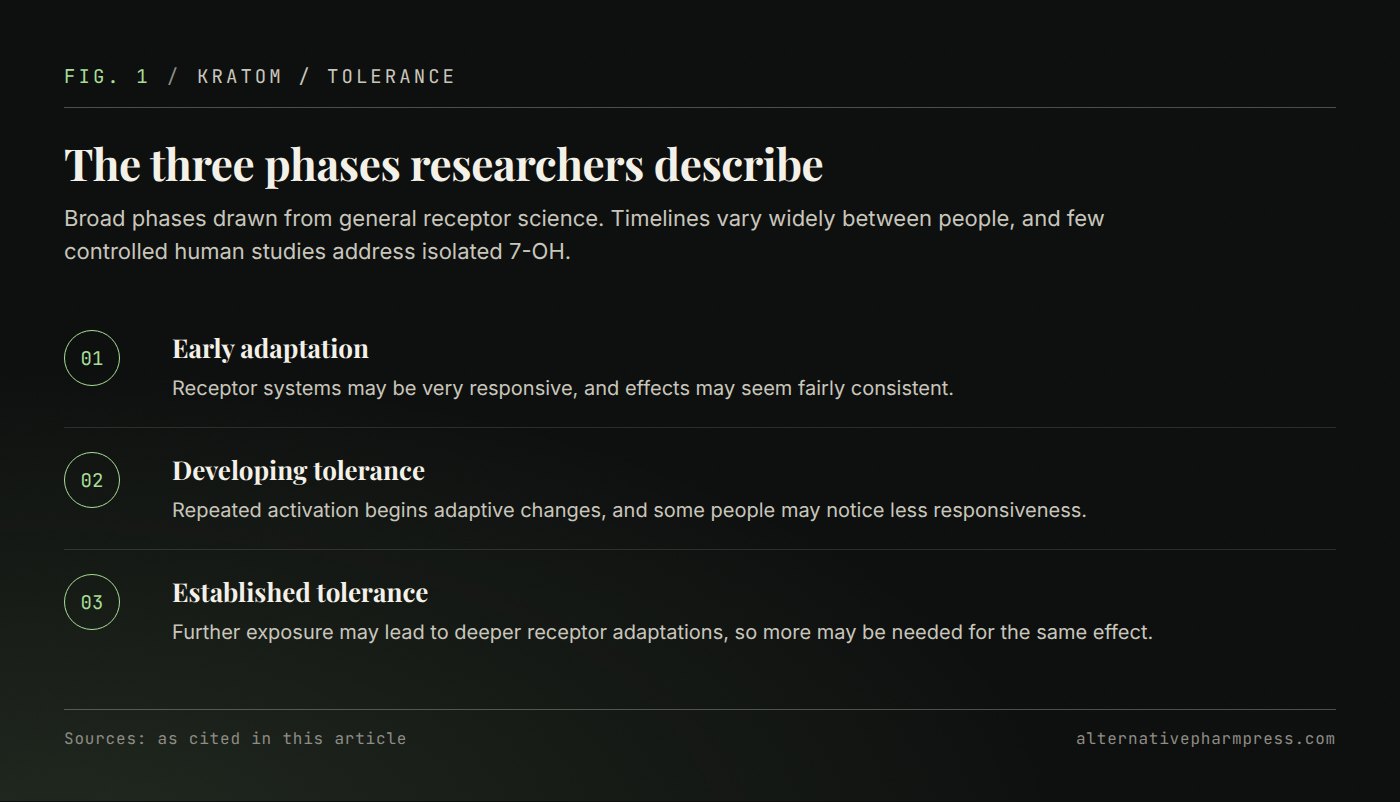
Three-step sequence describing early adaptation, developing tolerance and established tolerance.
Figure 1. Three broad phases, described without fixed durations.

How Tolerance Develops: Understanding Receptor Theory

In order to understand tolerance, you need to understand how receptors work. Receptors are specialized proteins found on cells all over the body. “These are communication points that respond to certain molecules. The compound then attaches to the receptor and can initiate biological responses that cause different physiological effects. 7-OH is known to interact with opioid receptors, especially the mu-opioid receptor. Researchers believe that this interaction is significant in the pharmacological profile of the compound. The body might try to compensate for repeated activation of receptors by adapting. This process is commonly known as homeostasis. Several changes can take place:
  • Receptor Desensitization

Receptors may become less responsive with repeated stimulation. The receptor is still there but doesn’t respond as vigorously to activation.
  • Receptor Internalization

In some cases, receptors may be removed from the cell surface temporarily, reducing the number of receptors available for activation.
  • Cellular Adaptation

Repeated stimulation of receptors may result in changes in the signaling pathways in cells.
  • Neurochemical Adjustments

The nervous system can modify how neurotransmitters are produced and the signaling patterns in response to ongoing exposure. These changes are not specific for 7-OH. Many receptor-active substances have been described to have similar mechanisms. Tolerance develops at a different speed in different people. Factors that might affect tolerance include:
  • Frequency of exposure
  • Duration of use
  • Individual genetics
  • Metabolic differences
  • Overall health status
  • Concurrent medication use
  • Product potency
Researchers are still investigating how these variables influence long-term receptor responses and the development of tolerance. Detailed explanations of opioid receptor regulation and desensitization can be found through resources published by the National Center for Biotechnology Information (NCBI). 

Reported Tolerance Timelines

The question of how fast tolerance develops is one of the most frequent ones. The answer is complicated because there is a limited amount of available scientific data specifically looking at isolated 7-OH. Most of the evidence is based on studies of opioid receptors in general or animal studies and observational reports of products derived from kratom. Tolerance does not usually develop instantaneously. Instead, it is gradual, the result of biological adaptations accumulating over time. Researchers typically distinguish three broad phases:
  • Early Adaptation

Receptor systems may be very responsive during the initial exposure periods. At this stage effects may seem fairly consistent.
  • Developing Tolerance

Repeated activation leads to the initiation of adaptive changes. Some people may experience less responsiveness than before.
  • Established Tolerance

Additional exposure may lead to more profound receptor adaptations. It is possible that at this point, you might need more to get the same effects you used to have. Importantly, timelines for tolerance vary widely. Some may change rather slowly; a few may develop apparent tolerance fairly quickly. This variability is probably due to differences in metabolism, genetics, and exposure patterns. Researchers emphasize that there is no one-size-fits-all timeline. There are few controlled human studies to date, addressing specifically isolated 7-OH tolerance; thus, definitive conclusions are difficult to make. Therefore, the majority of the tolerance timescales discussed should be considered as theoretical interpretations drawn from more general receptor science rather than being precise predictions.

Cross-Tolerance With Kratom

Cross-tolerance is another important topic. Cross-tolerance is a decreased responsiveness to one compound following exposure to another compound that acts on similar biological systems. Since mitragynine and 7-OH both act on the opioid receptors, studies on the potential of cross-tolerance between the two compounds have been conducted. There are theoretical reasons for possible cross-tolerance, e.g.,
  • Shared Receptor Activity

Both compounds act on the same receptor systems. Repeated activation of those receptors can affect responsiveness regardless of the compound that caused the activation.
  • Similar Pharmacological Pathways

Although mitragynine and 7-OH have different pharmacological profiles, both compounds are implicated in receptor systems related to the effects of kratom.
  • Metabolic Relationships

Mitragynine is metabolized to 7-OH. This relationship further links the pharmacology of the two compounds. Biologically plausible, if not clear as to exactly what degree, cross-tolerance. When comparing, the situation is more complicated:
  • Traditional kratom leaf products
  • Standardized extracts
  • High-mitragynine formulations
  • Concentrated 7-OH products
Each category can generate different patterns of receptor exposure. Therefore, researchers continue to investigate how tolerance to one type of product may affect responses to another. Existing evidence suggests receptor-based adaptations probably have some role in cross-tolerance, but more work is needed to see how much.” Several studies discussing kratom alkaloids and their pharmacological activity are available through the PubMed Central (PMC) research database. 

Tolerance Management Strategies

Researchers and health care providers often discuss ways to reduce the chances that tolerance develops quickly. Note that no approach can guarantee to prevent tolerance. But there are a number of ideas that are regularly raised in scientific debates.
  • Avoiding Frequent Exposure

Repeated activation of the same receptor is a major factor underlying the development of tolerance. Limiting the frequency of exposure may assist in limiting continuous stimulation of receptors.
  • Maintaining Consistent Patterns

Large swings in exposure can make it hard to see individual responses. “The consistency of evaluating pharmacological effects is often stressed by the researchers.
  • Monitoring Changes Over Time

Following changes in responsiveness may help in detecting developing patterns of tolerance. Clinical research and pharmacological studies are often based on observation and documentation.
  • Understanding Product Composition

The active compounds may occur in different products at different concentrations. Accurate labeling and lab testing can assist consumers in knowing what is in a product.
  • Avoiding Product Confusion

Some similarly named products can be very different in composition. When you talk about tolerance, it is important to understand the differences between traditional kratom products and concentrated alkaloid formulations.
  • Professional Consultation

“People who are concerned about tolerance, dependency, or changing patterns of response may want to seek guidance from qualified health care professionals. But whenever the question of substance-related effects arises, researchers repeatedly stress that seeking professional help is better than going it alone.

Seeking Professional Support

Sometimes tolerance gets confused with other issues. For instance, a decrease in responsiveness may be caused by the following:
  • Physiological adaptation
  • Changes in health status
  • Medication interactions
  • Product variability
  • Psychological factors
  • Measurement errors
But healthcare professionals can help weigh these possibilities and offer evidence-based recommendations. Professional support can be especially important when:
  • Effects Change Unexpectedly

If the response suddenly changes, a medical evaluation may be needed.
  • Dependence Concerns Arise

Tolerance and dependence are two related but separate concepts. Dependence is a physical adjustment that may result in withdrawal symptoms when use stops.
  • Other Medications Are Involved

Possible interactions may affect how well a drug works and its safety.
  • Health Conditions Are Present

Metabolism, receptor function, and general pharmacological responses may vary in individuals with underlying medical conditions.
  • Questions About Safety Develop

Professionals can interpret the available research and offer individualized advice. Researchers say tolerance should be seen as a biological process, not a personal failure. Science of adaptation Knowledge of the science of adaptation can help enable informed discussion and evidence-based decision-making.
Table of five evidence gaps in 7-OH tolerance research and their effect on conclusions.
Figure 2. Five gaps that keep tolerance conclusions preliminary.

Current Research Limitations

However, scientific interest in 7-OH has increased dramatically, but important gaps in knowledge remain.
  • Limited Human Studies

Much of the information is based on laboratory research, animal studies, and the broader science of opioid receptors. But large-scale human studies are still scarce.
  • Product Variability

Commercial products have very different compositions, which makes it hard to compare them.
  • Evolving Regulatory Environment

Research and study design may be affected by regulatory changes.
  • Long-Term Data Gaps

Long-term effects of repeated exposure are still being studied by researchers.
  • Individual Differences

There is a lot of variance between people. Genetics, metabolism, environmental influences. These limitations underscore the need for future studies before firm conclusions can be drawn about long-term patterns of tolerance.

Conclusion

Tolerance is a complex biological process representing the ability of the body to adapt to repeated receptor stimulation. As for 7-hydroxymitragynine, researchers believe that tolerance is most likely related to desensitization of the receptor, cellular adaptation, and more widespread neurochemical changes in a similar way to other compounds active at receptors. There is little human research in this area but some evidence that repeated exposure may result in decreased responsiveness over time. 7-OH shares receptor pathways with other kratom alkaloids, which also supports the possibility of cross-tolerance, but further studies are needed to determine the degree of this relationship. Tolerance cannot be understood without understanding the role played by individual variability, product composition, patterns of exposure, and underlying biology. As the scientific body of knowledge continues to grow, researchers will be able to better understand the development of tolerance and the factors that play a role in its progression. I think we should treat current discussions as part of a growing body of research rather than hard conclusions, for now. Further investigation will help to increase understanding of tolerance, dependence, receptor adaptation, and long-term pharmacology.

Key Takeaways

  • Reduced response to repeated drug administration is tolerance.
  • 7-OH binds to opioid receptors, and the adaptation of these receptors is under active investigation.
  • Tolerance is associated with mechanisms such as receptor desensitization and cellular adaptation.
  • How long you can tolerate them varies from person to person.
  • Tolerance development may depend on genetics, metabolism, how often one is exposed, and general health.
  • It is biologically plausible for kratom alkaloids and 7-OH to be cross-tolerant given the shared receptor pathways.
  • There are still only a few human studies, and many questions remain to be answered.
  • Discussions of tolerance may be affected by differences in product composition.
  • When there are concerns about tolerance or dependence, professional medical advice may be helpful.
  • Additional studies are needed for evaluation of long-term effects and tolerance.

Leave a Comment

Your email address will not be published. Required fields are marked *

Scroll to Top

Disclaimer: Alternative Pharm Press is an independent editorial publication and brand directory; we do not sell, manufacture, or ship any products. The statements and products referenced on this site have not been evaluated by the U.S. Food and Drug Administration and are not intended to diagnose, treat, cure, or prevent any disease. Content is provided for general informational and educational purposes only and is not medical, legal, or professional advice. Always consult a licensed healthcare provider before using kratom, cannabis, CBD, hemp, nootropic, peptide, or any related product, especially if you are under 21, pregnant or nursing, taking medication, or managing a health condition. The legal status of these products varies by country, state, and locality; you are solely responsible for verifying and complying with the laws that apply to you. Some listings, reviews, and coupons may be paid placements or affiliate relationships, which do not influence our editorial standards.