


This article is for educational purposes only and does not constitute medical advice.
Last updated: October 15, 2026. Added how to check 7-OH against the DEA’s 2026 threshold, a worked example, lab accreditation and units.
Quick answer: To read a kratom COA, first confirm the batch number matches your package and the lab is independent and ISO/IEC 17025-accredited. Then check the mitragynine and 7-OH results, and divide mitragynine by 7-OH: natural leaf should show 7-OH well under 1 mg/g and a ratio well above 100. Finally, confirm passing results for heavy metals and microbes.
As kratom gains popularity, the issues of product quality, safety and transparency are becoming increasingly critical. A Certificate of Analysis (COA) is one of the most important tools for verifying the quality of kratom. A COA is a lab report that provides detailed information on a product’s composition — alkaloid content, heavy metals, microbial testing, and more. In this article, we’ll cover what a COA is, the tests it includes, how to read the important values, and how to spot red flags.
What is a COA?
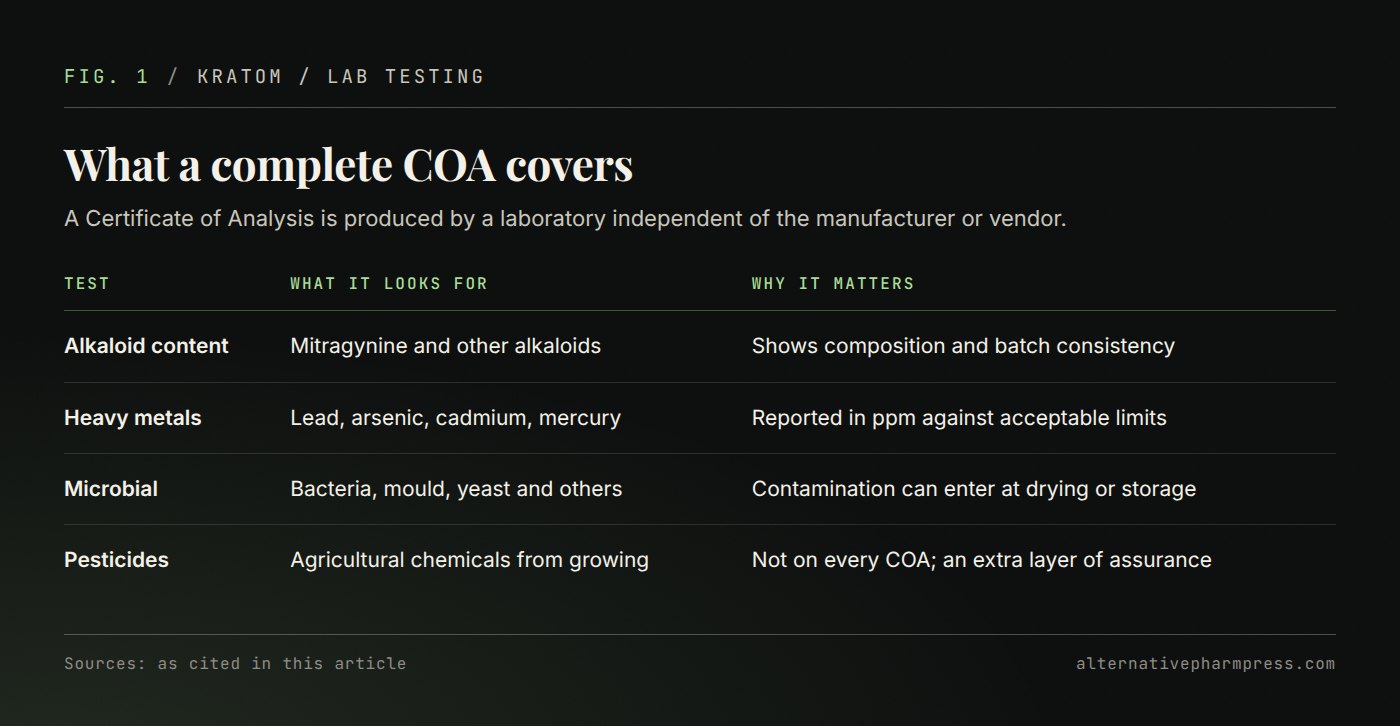
A Certificate of Analysis is a document produced by a laboratory showing the results of analysis of a specific batch of a product. COAs are generally performed by third-party laboratories that are independent from the manufacturer or vendor. This independence is essential in helping to ensure the results are unbiased and trustworthy. Transparency is the primary goal of a COA — it allows consumers to see exactly what is in a product rather than having to rely on marketing claims.
What Tests a Good COA Includes
Alkaloid Content: The most important element — shows the percentage of mitragynine and other alkaloids. This indicates the composition and consistency of the product between batches. For context on what these alkaloids do, see our Mitragynine vs 7-OH guide.
Heavy Metals Testing: Tests for lead, arsenic, cadmium, and mercury — reported in parts per million (ppm) with acceptable limits for comparison. Many labs compare results against the limits in USP chapter <2232> for dietary supplements or against state requirements; the report should state which limit it uses.
Microbial Testing: Checks for bacteria, mold, yeast, and other microorganisms that may enter during harvesting, drying, or storage.
Pesticide Screening: Ensures the product is free of harmful agricultural chemicals used in the growing process. Not all COAs include this test, but it adds another layer of quality assurance.
How to Read Alkaloid Percentages
Mitragynine is usually reported as a percentage of product weight or in milligrams per gram (mg/g). To convert, 1% equals 10 mg/g. Plain leaf powder typically tests at roughly 0.5% to 2% mitragynine; much higher figures usually mean an extract or an enhanced product. Higher percentages indicate greater concentration of that compound — but a higher percentage doesn’t automatically mean it’s better. Other alkaloids also influence the overall product profile.
Good vendors will usually provide a COA for each batch, so consumers can see whether alkaloid levels are consistent over time. Scientific research has examined kratom’s alkaloid composition and variability across samples via PubMed.
Check the 7-OH Line (New for 2026)
On October 14, 2026, the DEA published notice that it will temporarily place 7-hydroxymitragynine (7-OH) and mitragynine pseudoindoxyl in Schedule I when either exceeds 1 mg per gram (0.1%) of a solid product, or when the ratio of mitragynine to those compounds is below 100. The order can take effect on or after November 13, 2026. That makes the 7-OH result one of the most important lines on a kratom COA.
Here is how two hypothetical products would compare:
| Plain leaf powder | “Enhanced” product | |
|---|---|---|
| Mitragynine | 1.4% (14 mg/g) | 1.5% (15 mg/g) |
| 7-OH | 0.01% (0.1 mg/g) | 0.3% (3 mg/g) |
| Above 1 mg/g 7-OH? | No | Yes |
| Mitragynine ÷ 7-OH | 140 (above 100) | 5 (below 100) |
| Likely status under the DEA order | Not covered | Schedule I |
If 7-OH is reported as “ND” (not detected) or “<LOQ” (below the limit of quantitation), that is normal for leaf. Be cautious with any product that does not report 7-OH at all, especially one marketed as extra-strong. This is general information, not legal advice.
Red Flags in COAs
Batch mismatch: The batch or lot number on the COA should match the number printed on your package. A COA without a batch number cannot be tied to what you bought.
No 7-OH result: After the DEA’s 2026 notice, a kratom COA that omits 7-OH is incomplete.
Missing tests: A COA that only lists alkaloid content but skips contaminant testing doesn’t give a complete picture.
Old reports: COAs should be current and relevant to the batch being sold. Using old reports on new products suggests inadequate testing.
Incomplete lab information: A credible COA clearly identifies the testing laboratory’s name and contact information.
Unclear data presentation: Results should be easy to read, with clearly defined units and reference limits.
Promotional language: Reliable COAs focus on factual data. Regulatory authorities such as the FDA have emphasized concerns about contamination and labeling accuracy.
Which Labs Are Credible
The strongest signal is accreditation to ISO/IEC 17025, the international standard for testing laboratories; the accreditation should cover the specific tests on the report. The lab should be independent of the vendor, named on the report with contact details, and ideally offer a way to verify the report, such as a QR code or report ID on the lab’s own website. Transparency is key — reputable labs provide documentation outlining their methods, equipment, and quality control procedures. When reviewing a COA, look for detailed reporting, clear formatting, and comprehensive data. The American Kratom Association’s GMP Standards Program is one framework for identifying vendors committed to quality testing practices.
How to Request a COA from a Vendor
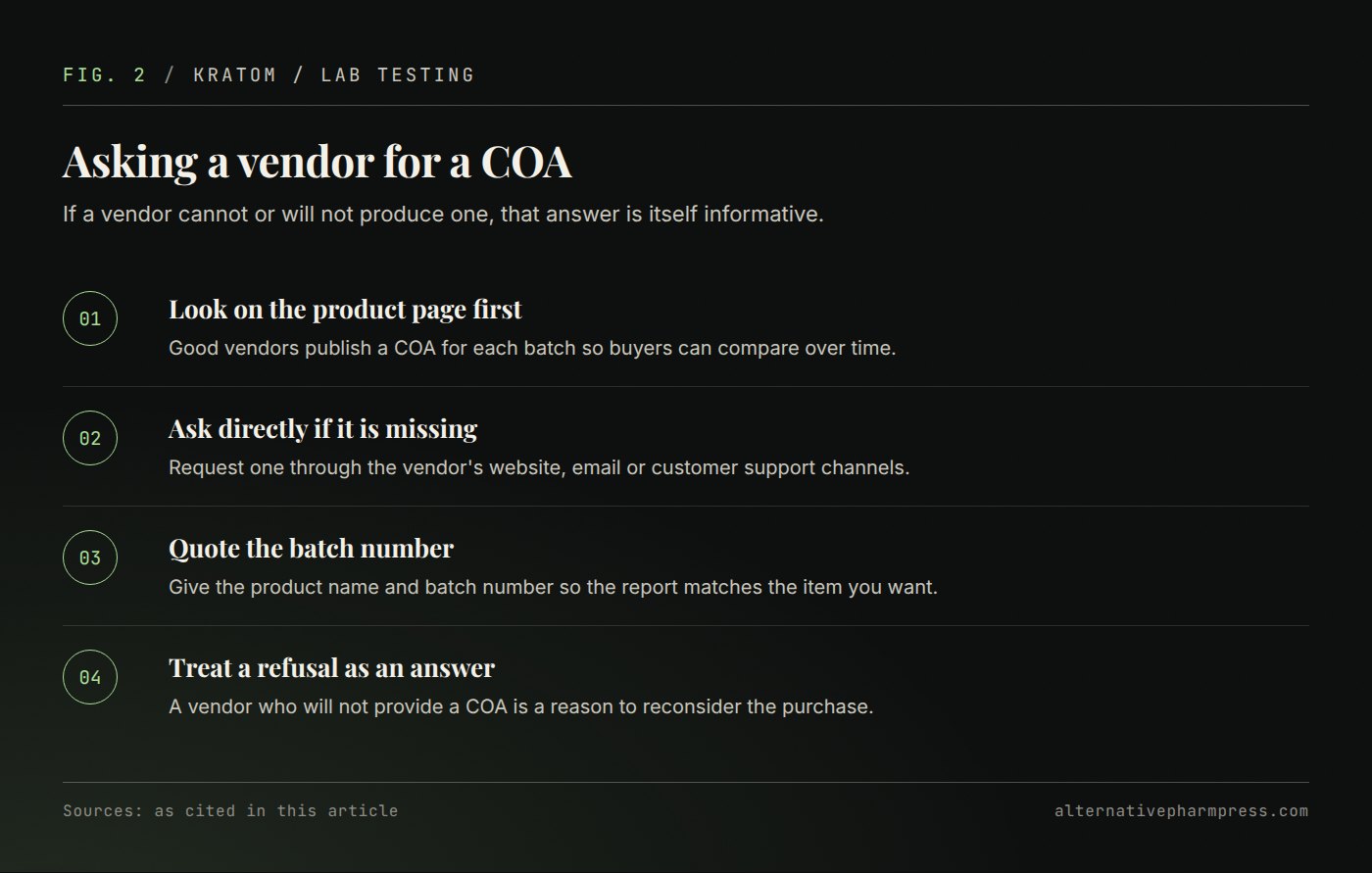
If a COA is not readily available, consumers may request one directly from the vendor via their website, email, or customer support channels. Provide the product name and batch number you’re interested in so the report matches the right item. If a vendor can’t or won’t provide a COA, that’s a sign to reconsider the purchase. For a practical example of what to look for when buying, see our Best Kratom Powder buying guide.
Frequently Asked Questions
Q: What does “ND” mean on a kratom COA?
Not detected. The compound was below the level the lab’s method can find. For 7-OH in plain leaf, ND or a very low value is normal.
Q: How do I convert percent to mg per gram?
Multiply by 10. For example, 1.2% mitragynine equals 12 mg/g, and 0.1% 7-OH equals 1 mg/g, the DEA threshold.
Q: Can a vendor test its own products?
An in-house test is better than nothing, but an independent, ISO/IEC 17025-accredited lab is far more trustworthy.
Q: How recent should a COA be?
It should match the batch you are buying. A recent date on a report for a different batch does not count.
For a quick checklist, see our 7 red flags on a kratom COA.
Conclusion
Certificates of Analysis are invaluable tools for getting insight into kratom product quality and safety. COAs provide a level of transparency that is critical in an unregulated market. By reading and understanding these reports — from alkaloid percentages to red flags — consumers can make more informed decisions. Anyone who wants to verify product quality should be requesting and reviewing COAs routinely.
Key Takeaways
A COA is a lab report that confirms a product’s composition and safety.
Good COAs test for alkaloids, heavy metals, microbial content, and pesticides.
Alkaloid percentages indicate composition and should be interpreted with context.
Check 7-OH: natural leaf should be well under 1 mg/g, with a mitragynine-to-7-OH ratio well above 100.
Incomplete tests, old reports, and vague lab information are red flags.
Credible labs use standard procedures and issue transparent reports.
Consumers can request COAs directly from vendors if not publicly available.