

 This article is for educational purposes only and does not constitute medical advice.
Pharmacological research is largely concerned with understanding how compounds interact with the brain. The ability of a substance to cross the blood-brain barrier (BBB) is critical for this process. The BBB is a highly selective protective system that controls access to the central nervous system (CNS). Kratom alkaloids have been studied extensively by researchers, especially 7-hydroxymitragynine (7-OH), a naturally occurring alkaloid present in small amounts in kratom and a metabolite of mitragynine.
Given that many of the effects associated with kratom alkaloids are related to the central nervous system, knowledge of BBB penetration is important for the interpretation of research findings. Scientists have been investigating the activity of 7-OH in the body, how it crosses into the brain, and how its CNS activity compares to mitragynine.
This article examines the current research on the blood-brain barrier, the importance of CNS penetration for alkaloids, the potential for 7-OH to cross the blood-brain barrier, how it compares to mitragynine, and the gaps that remain in the literature.
What Is the Blood-Brain Barrier?
The blood brain barrier is a specialized cellular network that separates the blood stream from the brain tissue. It is one of the body’s most important protective mechanisms. The BBB consists primarily of tightly joined endothelial cells that line the blood vessels of the brain. They form a barrier that prevents many substances from passing to the brain but allows in vital nutrients and oxygen. The barrier helps protect the central nervous system from toxins, pathogens, and possibly harmful chemicals in the bloodstream. Without this protective system the brain would be much more susceptible to injury. But the BBB is not entirely impervious. The permeability of the barrier for some substances depends on the following:- Molecular size
- Lipid solubility
- Chemical structure
- Transport mechanisms
- Protein binding characteristics
Why CNS Penetration Matters for Alkaloids
Many plants contain natural substances known as alkaloids. Some alkaloids have effects that are mostly peripheral to the brain, and others act directly on receptors in the central nervous system. CNS penetration is particularly important for compounds like mitragynine and 7-hydroxymitragynine, as many of the explored mechanisms involve opioid receptor activity in the brain and spinal cord. If a compound does not pass through the blood brain barrier very well, it may not be able to act on receptors in the central nervous system. In contrast, compounds that cross the brain readily may have more pronounced CNS effects. Thus, researchers study BBB penetration to better understand:- Pharmacological activity
- Receptor interactions
- Distribution throughout the body
- Duration of effects
- Relative potency
What Research Says About 7-OH and the Blood-Brain Barrier
7-hydroxymitragynine is believed by current research to be able to pass through the blood brain barrier and to the central nervous system. Most of the evidence is based on animal studies and pharmacokinetic studies on the distribution of alkaloids after administration. 7-OH has been detected in brain tissue by researchers, showing that the compound can cross into the CNS from the blood. This ability may be related to several properties of 7-OH.- First, the compound possesses physicochemical properties that allow it to cross the BBB. Depending on the molecular size, lipophilicity, and other factors, compounds can efficiently cross biological membranes.
- Second, experimental studies have shown central nervous system activity compatible with interaction with brain receptors. Researchers often interpret the findings as indirect evidence that the compound hits relevant targets in the CNS.
- Third, metabolism is a key aspect of 7-OH research. Mitragynine can be metabolically converted to 7-hydroxymitragynine in the body. Some scientists believe that this conversion may be responsible for the observed pharmacological effects.
Comparison to Mitrahynine
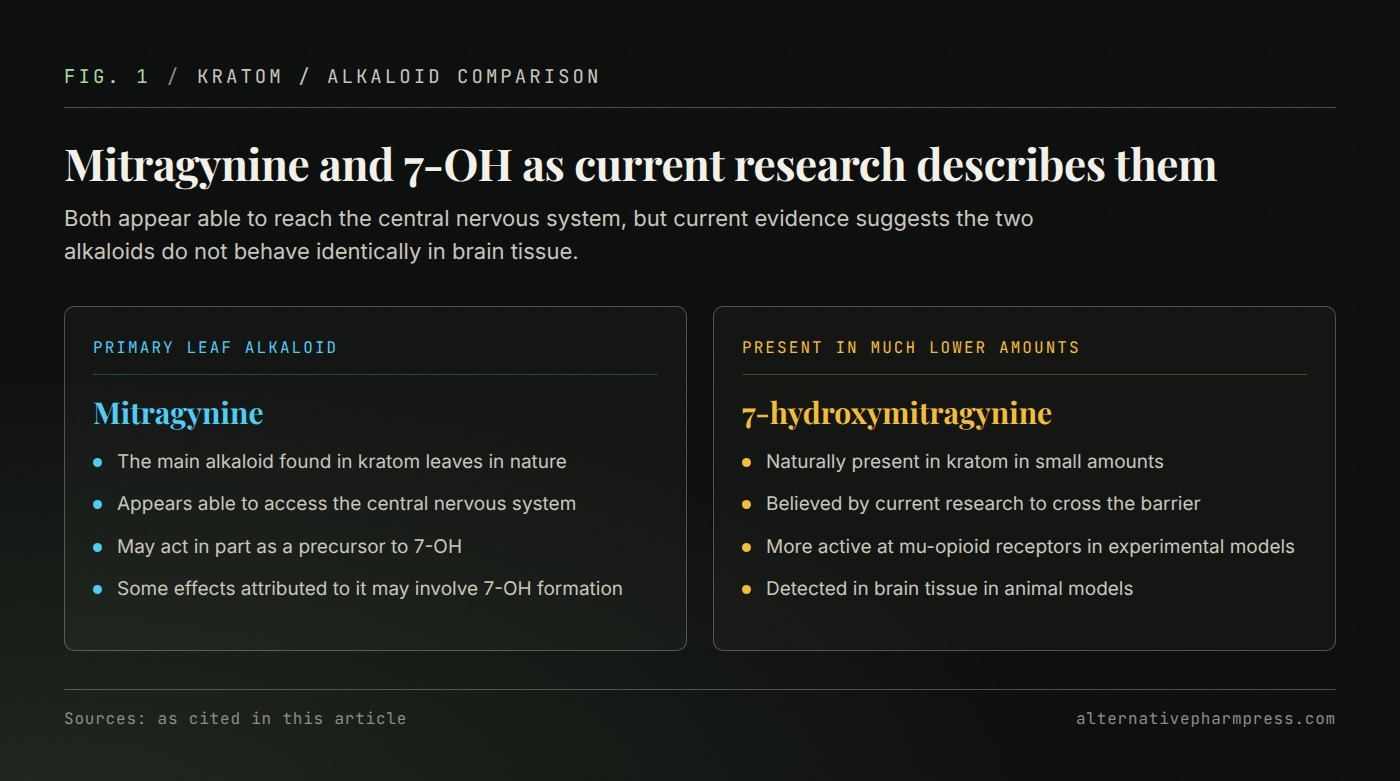
Although both 7-OH and mitragynine are derived from kratom, their pharmacological properties differ, and the study of their relationship is of interest. Mitragynine is the primary alkaloid found in kratom leaves in nature. 7-Hydroxymitragynine, on the other hand, is naturally present in much lower amounts. Both compounds seem to be able to cross into the central nervous system, but research shows differences in receptor activity and potency. The experimental models have demonstrated that 7-OH is more active at the mu-opioid receptors than mitragynine. The BBB penetration is pertinent to understanding these findings because these receptors are found within the central nervous system. Another difference is metabolic rate. Some studies have shown that mitragynine might act in part as a precursor to 7-OH. A portion of mitragynine can be converted to 7-hydroxymitragynine by metabolic processes after administration. This has made researchers wonder whether some of the effects attributed to mitragynine are actually due to the formation of 7-OH in the body. Researchers continued to examine differences in, from a pharmacokinetic perspective:- Absorption
- Distribution
- Metabolism
- Elimination
- Brain concentrations
Implications (Research Context Only)
The fact that 7-hydroxymitragynine is able to cross the blood-brain barrier has several implications for pharmacological research. First, the BBB penetration allows further investigations of receptor interactions in the central nervous system. CNS exposure is usually a key component in the interpretation of experimental results in research on opioid receptor signaling. Second, knowledge of the distribution of the brain may help scientists explain the differences seen between different kratom alkaloids. The CNS exposure of compounds with higher CNS exposure may exhibit different receptor occupancy patterns from compounds that are largely outside the brain. Third, BBB research feeds into wider pharmacokinetic modeling efforts. Scientists are interested in understanding how compounds travel through the body over time, including how fast they make it into the brain and how long they stay. These studies also could allow researchers to compare naturally occurring alkaloids to synthetic compounds that work on similar receptor systems. Importantly, BBB penetration alone is not a determinant of the overall safety profile or clinical relevance of a compound. When we talk about the interaction of substances with biological systems, there are many things to consider. Therefore, researchers interpret BBB findings in the context of receptor pharmacology, metabolism, toxicology, and clinical evidence. The majority of the current conclusions are based on laboratory and animal studies, rather than large-scale clinical investigations, because human research is still limited. Therefore, BBB penetration should be considered as one piece of a bigger scientific puzzle rather than an encompassing explanation of all the observed effects.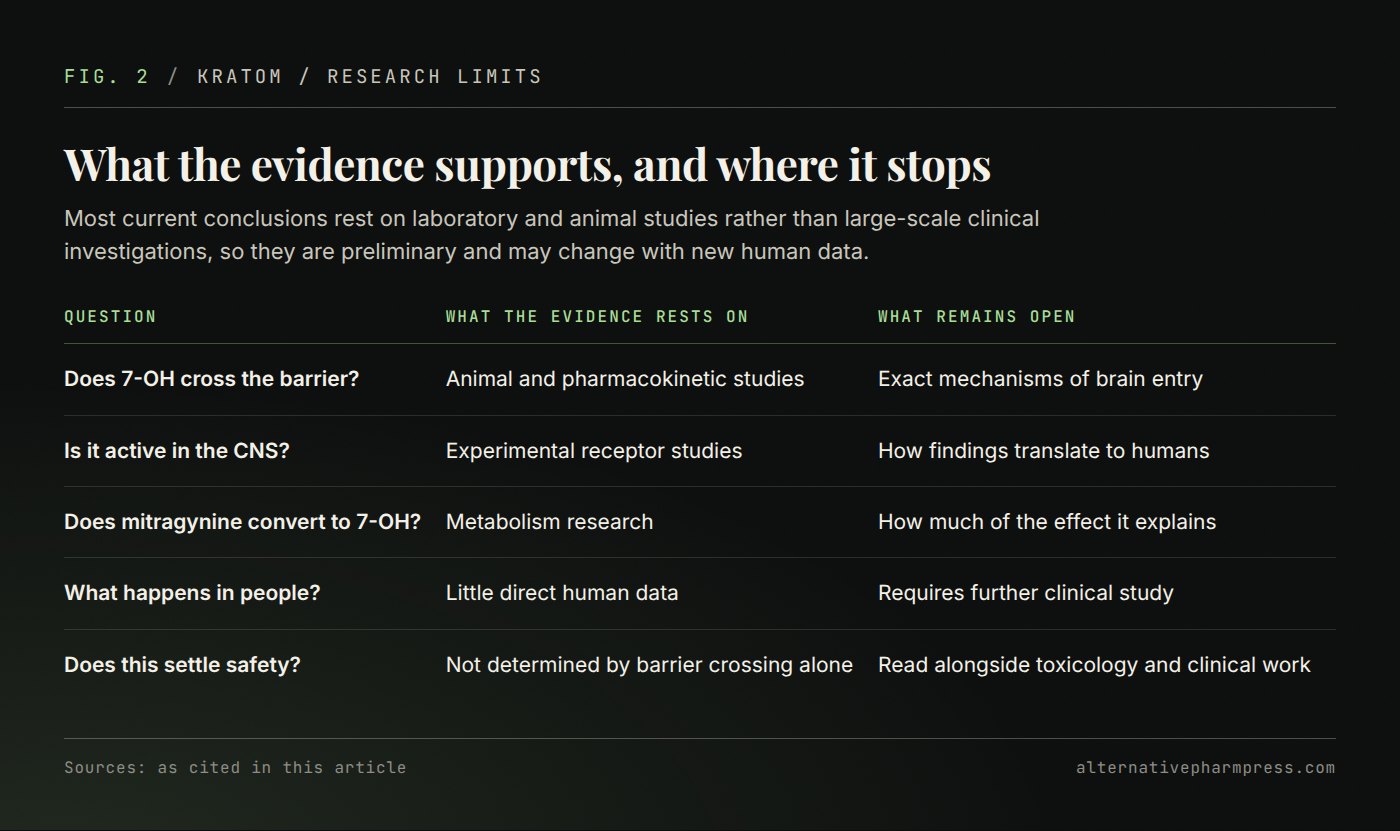
Study Limitations
Research on 7-hydroxymitragynine has grown substantially in recent years, but there are still some important limitations. A major limitation concerns the availability of human data. Much of the existing knowledge about BBB penetration is based on animal models and lab experiments. Animal studies can provide important data, but the results may not always translate directly to human physiology. Metabolism, brain structure, enzyme activity, and pharmacokinetics can all vary and have an impact on outcomes. Another limitation is the heterogeneity across study designs. The drug can be given to researchers in different ways, in different doses, and analyzed using different techniques and experimental conditions. This makes comparison difficult. The chemistry of kratom is complex, and this complexity also presents challenges. It is difficult to separate the effects of 7-OH from the effects of multiple alkaloids that may interact at the same time. Researchers are still studying:- Brain distribution patterns
- Human pharmacokinetics
- Long-term exposure effects
- Metabolic pathways
- Receptor interactions
Conclusion
The blood-brain barrier is an important determinant for the ability of compounds to enter the central nervous system. Current research indicates that 7-hydroxymitragynine can cross the BBB and enter brain tissue, which is primarily supported by animal studies and pharmacokinetic studies. The ability of it to cross the blood brain barrier is an important scientific interest due to the 7-OH activity at central opioid receptors. Furthermore, CNS activity of 7-hydroxymitragynine has been investigated in comparison to mitragynine, including the possibility of the metabolic conversion playing a role in the pharmacological effects observed. However, despite the growing evidence, the scientific literature still lacks important information. Human studies are limited, and researchers are continuing to study the exact mechanisms regulating BBB penetration, brain distribution, and receptor interactions. As research continues, a better understanding of how 7-hydroxymitragynine interacts with the blood-brain barrier will help scientists better understand its pharmacology and role in the larger context of kratom alkaloids.Key Takeaways
- The blood brain barrier (BBB) is a protective mechanism of the brain that controls what can get into the central nervous system.
- BBB penetration is significant when investigating compounds that bind with brain receptors.
- Recent studies have suggested that 7-hydroxymitragynine can cross the blood-brain barrier and enter the brain tissue.
- Most of the evidence of BBB penetration comes from animal and pharmacokinetic studies.
- Both mitragynine and 7-OH appear able to access the CNS and have different pharmacological characteristics.
- Some research has indicated that mitragynine can be converted to 7-hydroxymitragynine inside the body.
- BBB penetration can give an indication of receptor interactions but alone does not determine safety or efficacy.
- Human research is still scarce, and many conclusions are based on preclinical studies.
- Further clinical studies are necessary to better characterize the behavior of 7-OH in humans.
- The results should be interpreted in the context of ongoing pharmacological research.