
“Lab tested” is the most overused claim in the supplement business. You’ll see it on kratom pouches, CBD tinctures, nootropic capsules, and mushroom extracts, usually in friendly green text next to a checkmark. On its own, that phrase means almost nothing. Any brand can write it. What separates a transparent company from a marketing exercise is whether you can actually see the document that backs the claim, and whether that document holds up when you look closely.
This applies across every category we cover. Whether you’re buying kratom powder, a CBD oil, a racetam stack, or a lion’s mane extract, the test is the same: can you put your hands on a real certificate of analysis, and does it check out? Here are five signs a brand is genuinely third-party tested, what good and bad look like for each, and a 60-second routine to verify any product yourself.
1. A named, independent lab
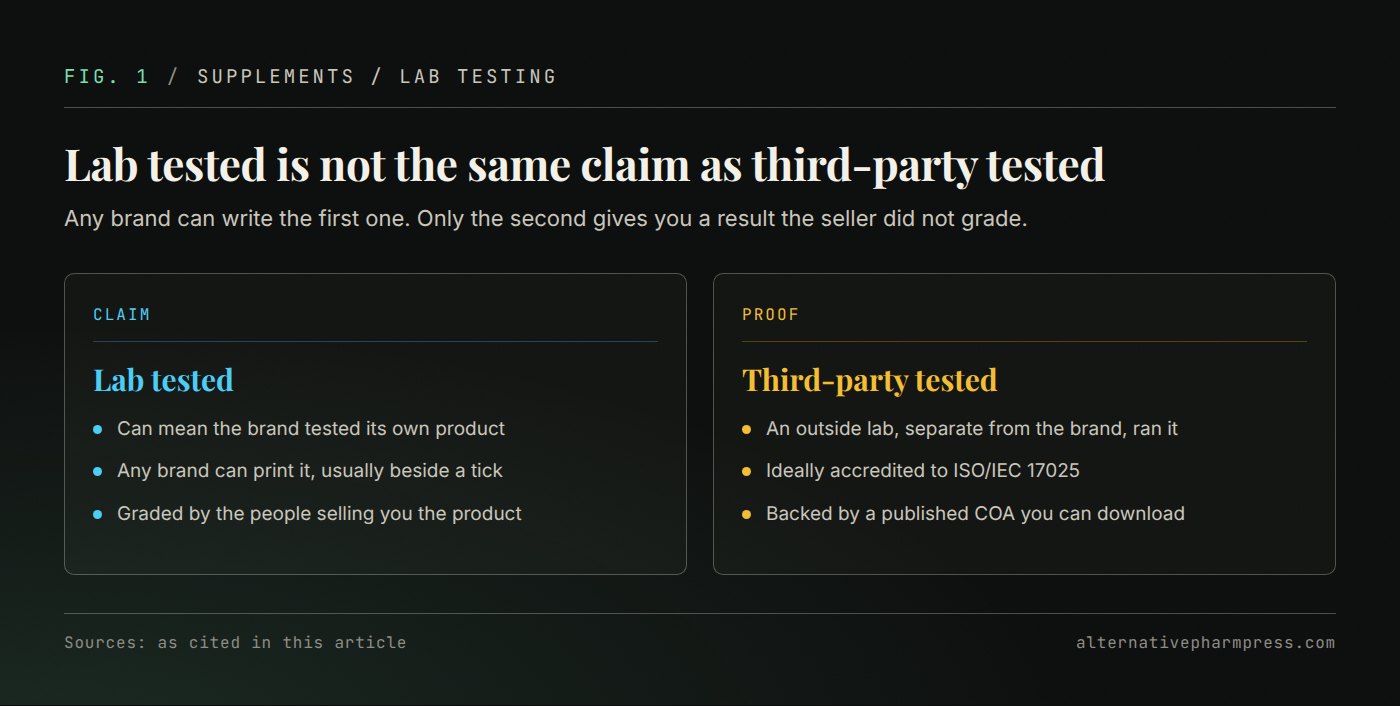
The first thing to look for is who actually ran the test. A real third-party result names an outside laboratory, one the brand doesn’t own. Ideally that lab is accredited to ISO/IEC 17025, the international standard for testing competence, which tells you the lab has been audited against a recognized benchmark rather than just calling itself a lab.
Good: the report carries a specific lab name and contact details, and that lab is a separate company from the brand. Bad: “tested in our own facility,” no lab named at all, or a vague reference to “our lab partners” with nothing you can verify. If the testing party is the same entity selling you the product, it isn’t third-party, no matter what the label says.
2. The COA is published, not “available on request”
A certificate of analysis, or COA, is the actual lab document. The honest move is to publish it where anyone can download it: linked from the product page, reachable by a QR code on the package, or sitting in a searchable lab library on the site. If it’s right there, the brand is confident in it.
“Available on request” is the phrase to distrust. Sometimes it’s genuine friction, but often it’s a stall, and the COA either doesn’t exist, doesn’t match, or doesn’t look good. We’ve seen plenty of cases where a request goes unanswered or returns a document for a different batch entirely. Our guide to kratom COA red flags covers the dodges in detail, and most of them apply to CBD and nootropics just as well.
Good: a downloadable PDF you can open before you spend a cent. Bad: a contact form, an email gate, or a homepage badge that links to nothing.
3. The batch or lot number matches the product
This is the step most people skip, and it’s where a lot of fake transparency falls apart. A COA is tied to a specific batch. The lot or batch number printed on the report should match the number on the product in your hand. If a brand shows you one generic COA for every product it has ever sold, that document isn’t telling you about your bottle.
Good: the lot number on the package matches the lot number on the COA, so you know the test describes what you’re actually consuming. Bad: a single “sample” COA reused across the whole catalog, or a report with no batch identifier at all. Learning to find and match that number is a core skill, and our guide to reading a lab report walks through exactly where to look.
4. The report is recent and dated
Lab results have a shelf life. Ingredients change as suppliers and harvests change, and a test from three years ago tells you little about the current batch. A trustworthy COA carries a clear test date, and that date should be reasonably close to when the product was made.
Good: a visible, recent date that lines up with the product’s production run. Bad: no date, a date you can’t read, or a years-old report being passed off as current. An undated COA is barely better than no COA, because you can’t tell whether it describes today’s product or a formulation that’s long gone.
5. The panels are complete
A real test checks more than just the active ingredient. Potency or active-compound percentage is the part everyone wants to see, the mitragynine level in kratom or the CBD content in a tincture, but a complete report also screens for the things that can hurt you. That means heavy metals, microbials, pesticides, and, where relevant, residual solvents left over from extraction.
Good: a full panel showing potency plus contaminant screens, each with a pass or fail and a measured value. Bad: a potency-only report that conveniently skips the safety tests. A brand that shows you the active percentage but hides the heavy-metals screen is showing you the flattering half of the story. For botanical and extracted products in particular, the contaminant panels are where the real safety information lives.
Green flags vs red flags at a glance
| Signal | Green flag | Red flag |
|---|---|---|
| Lab | Named, independent, ISO/IEC 17025 accredited | Brand’s own lab, or no lab named |
| COA access | Published and downloadable | “Available on request” or missing |
| Batch match | Lot number matches the product | One generic COA for everything |
| Date | Recent and clearly shown | Undated or years old |
| Panels | Potency plus contaminant screens | Potency only, safety tests hidden |
The 60-second verification checklist
Before you buy anything, run this quick pass. It takes about a minute and weeds out most of the pretenders.
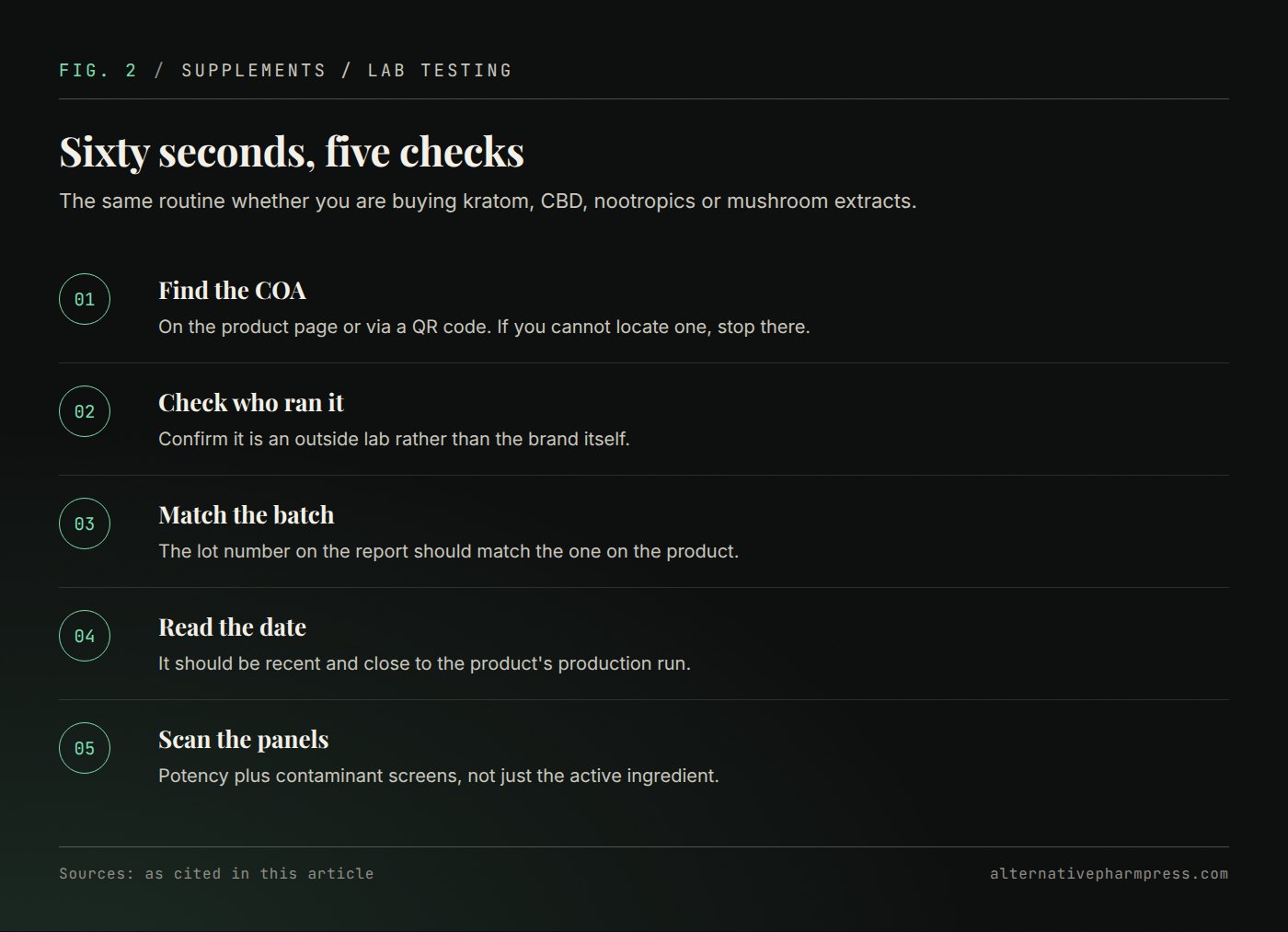
First, find the COA. If you can’t locate one on the product page or via a QR code, stop there. Second, check who ran it, and confirm it’s an outside lab, not the brand itself. Third, match the batch or lot number on the report to the one on the product. Fourth, read the date and make sure it’s recent. Fifth, scan the panels for both potency and contaminant screens, not just the active ingredient. If all five hold up, the “lab tested” claim is real. If any of them fail, treat the claim as decoration.
That five-step routine is the same whether you’re shopping for kratom, CBD, nootropics, or mushrooms. The categories differ, but transparency looks identical across all of them.
Where to apply this
We use these exact criteria when we vet vendors for our brand directory and our category shortlists. You can see the kratom version in our best kratom brands of 2026 guide, the CBD version in our best CBD brands of 2026 roundup, and the nootropics version in our best nootropic brands of 2026 list. Each one applies the same testing bar.
For external benchmarks, ISO/IEC 17025 is the accreditation standard worth knowing when you evaluate a lab’s credibility. In the hemp space, the US Hemp Authority runs a certification program that signals a brand has agreed to a set of quality and transparency practices. Neither is a guarantee on its own, but both are useful signals to stack alongside the five signs above.
Frequently asked questions
What’s the difference between “lab tested” and third-party tested?
“Lab tested” can mean a brand tested its own product in its own facility, which isn’t independent. Third-party tested means an outside lab, separate from the brand, ran the analysis. Only the second one gives you a result that isn’t graded by the people trying to sell you something.
Why does the batch number matter so much?
A COA describes one specific batch, not the brand’s products in general. If the lot number on the report doesn’t match the one on your package, the document isn’t telling you about what you’re actually buying. Matching that number is the difference between real verification and a reused sample sheet.
What should a complete lab panel include?
Beyond potency or active-compound percentage, a full panel screens for heavy metals, microbials, and pesticides, plus residual solvents where extraction is involved. A potency-only report skips the safety information that matters most for botanical and extracted products. If the contaminant screens are missing, the report is incomplete.
Is an ISO/IEC 17025 lab always trustworthy?
Accreditation is a strong signal because the lab has been audited against an international competence standard, but it’s one factor among several. You still want a recent, batch-matched, complete report that’s actually published. Accreditation plus a verifiable COA is the combination worth trusting.
What if a brand only offers a COA “on request”?
Treat it with caution. Sometimes it’s harmless, but it’s also a common way to stall when the document doesn’t exist or doesn’t match. A brand confident in its testing usually publishes the COA outright, so a request-only policy is a reason to ask harder questions before buying.
Editorial note: This article is for general information only and is not medical or legal advice. These products have not been evaluated by the FDA to diagnose, treat, cure, or prevent any disease. Laws vary by location and change often, so verify the rules that apply to you. Always talk to a licensed healthcare provider before use, especially if you are under 21, pregnant or nursing, taking medication, or managing a health condition.
Third party testing verifies potency and purity, not dependence risk. For that question, see Is CBD Addictive?