
This article is for educational purposes only and does not constitute medical advice.
Last updated: October 15, 2026. Added 2025 research on how drying and withering change kratom alkaloids, Indonesia’s export standards, and contamination data.
Quick answer: Kratom powder is made by hand-harvesting Mitragyna speciosa leaves, usually in Indonesia, then withering, drying, grinding and packing them. Research published in 2025 found that these post-harvest steps measurably change the alkaloid profile: short withering raised mitragynine content and low drying temperatures preserved key alkaloids. Processing and hygiene matter more to the final product than the strain name.
Kratom, a tropical plant native to Southeast Asia, has gained significant global attention in recent years. Derived from the leaves of the Mitragyna speciosa tree, kratom has traditionally been used in countries like Indonesia and Thailand for its natural properties. It is now commonly available as a powder and is sold in different parts of the world for a variety of purposes.
However, what a lot of people don’t realize is that the quality and characteristics of kratom are heavily influenced by how it is grown and processed. From the region it is cultivated in to the drying techniques used, every step plays a crucial role in shaping the final product.
This understanding of the journey from leaf to powder not only helps consumers make informed choices, but also helps explain the wide variation in color, texture, and overall quality between different kratom products. In this article, we will explore kratom farming regions, harvesting practices, processing techniques, and what defines high-quality kratom powder.
Key Takeaways
Kratom is primarily grown in Southeast Asian regions like Borneo, Sumatra, and Bali, where climate and soil conditions support its cultivation.
Leaves are harvested by hand. Farmers often prefer mature leaves, although published data on how leaf age affects alkaloid content is limited.alkaloid development and overall quality.
Drying methods—indoor vs. outdoor—play a major role in determining the color, consistency, and characteristics of kratom powder.
Grinding transforms dried leaves into fine powder, and proper hygiene during this stage is essential to maintain product safety.
Processing changes alkaloids: a 2025 University of Florida study found withering raised mitragynine by up to 65% in one cultivar, and drying below 40°C best preserved mitragynine and related alkaloids.
Fermentation techniques, such as those used for dark or Bentuangie kratom, can alter the appearance and chemical profile of the final product.
High-quality kratom powder is typically fresh, finely ground, consistently colored, and sourced from vendors who follow proper testing and packaging standards.
Kratom Farming Region
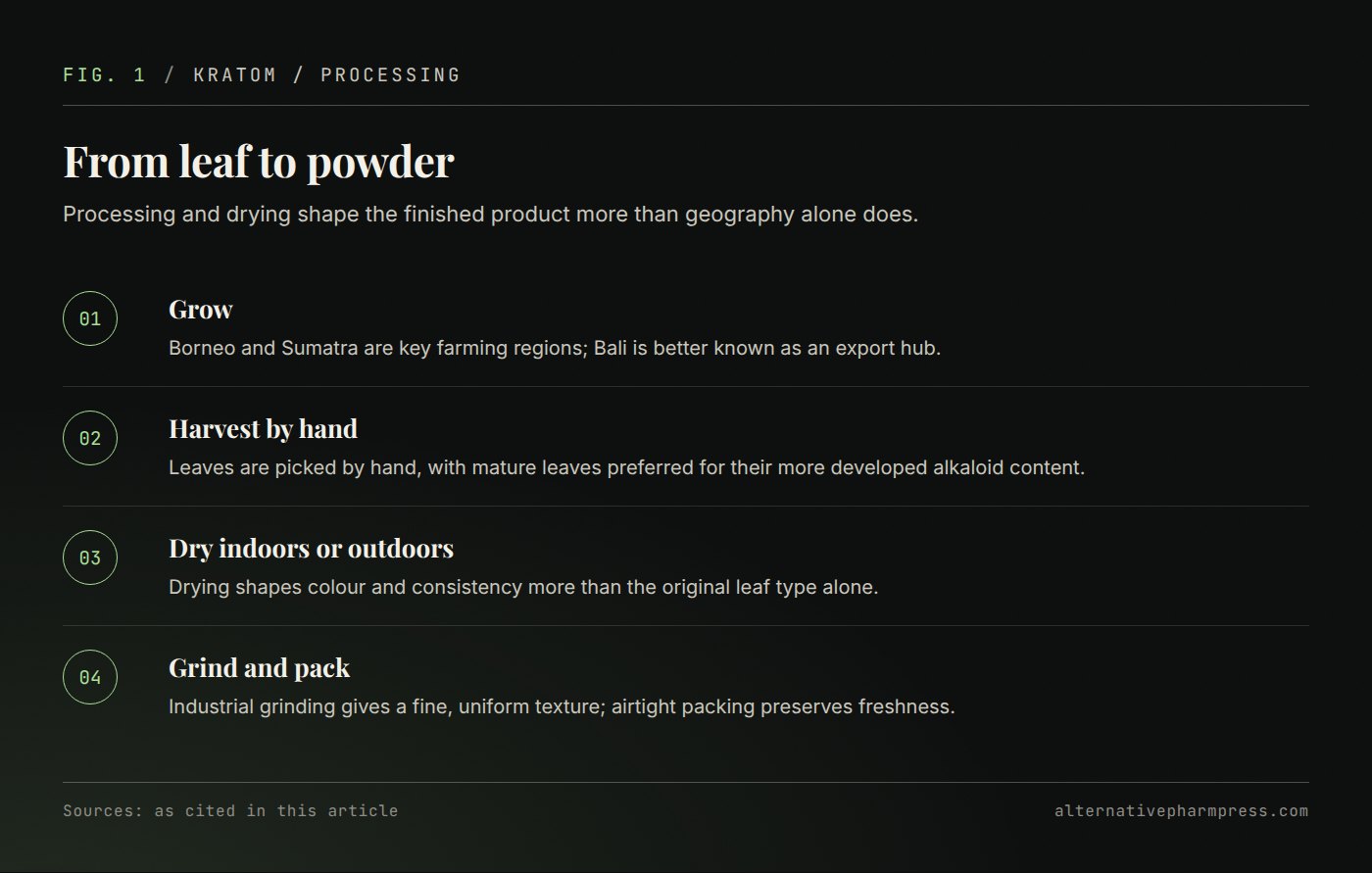
Kratom is mainly grown in the tropical climates of Southeast Asia, which are the perfect conditions for the plant to thrive. The most notable regions are Borneo, Sumatra, and Bali. Learn how these regional differences affect the final product in our Kratom Strains Explained guide.
Borneo is one of the largest producers of kratom. Kratom trees thrive in the island’s humid climate and nutrient-rich soil. The thick rainforests and constant rainfall help develop strong leaves, making Borneo a major contributor to the global kratom market.
Sumatra is another important area, noted for its fertile volcanic soil. This nutrient-rich ground supports healthy plant growth and contributes to subtle differences in leaf composition. Many kratom products are marketed as “Sumatra strains,” but these names are more marketing than anything else and do not identify true botanical differences.
Bali is more famous as an export hub than a primary farming region. While some kratom may be sourced nearby, much of what is labeled as “Bali kratom” is processed and shipped from this central location.
It’s important to note that while regions do influence growing conditions, the idea of distinct “strains” based solely on geography is often misunderstood. The product processing and drying method is much more significant in determining what the final product will be.
Harvesting Process
The process of harvesting is very important, as it determines the quality of the kratom. Kratom leaves are harvested by hand, not like large-scale mechanized agriculture. This helps farmers to carefully select leaves as per their maturity and condition.
Farmers often prefer mature leaves, believing they give a stronger, more consistent product, although published data on how leaf age affects alkaloid content is limited. Farmers climb on tall kratom trees or use tools to collect these leaves and make sure that they do not damage the plant.
Vein color (red, green or white) is also noted at harvest. Vendors link vein color to different effects, but a 2023 study found no significant alkaloid differences between red, green and white products, so color is only one small part of the process (see kratom strains explained).
However, timing also plays an important role. Leaves may be harvested too early and sometimes too late, which may not provide the desired consistency. Farmers who are experienced rely on traditional knowledge to determine the best time for harvesting. If the farming is not done properly, it can negatively impact the final powder quality. This is why careful selection remains essential.
Drying Methods: Indoor vs Outdoor
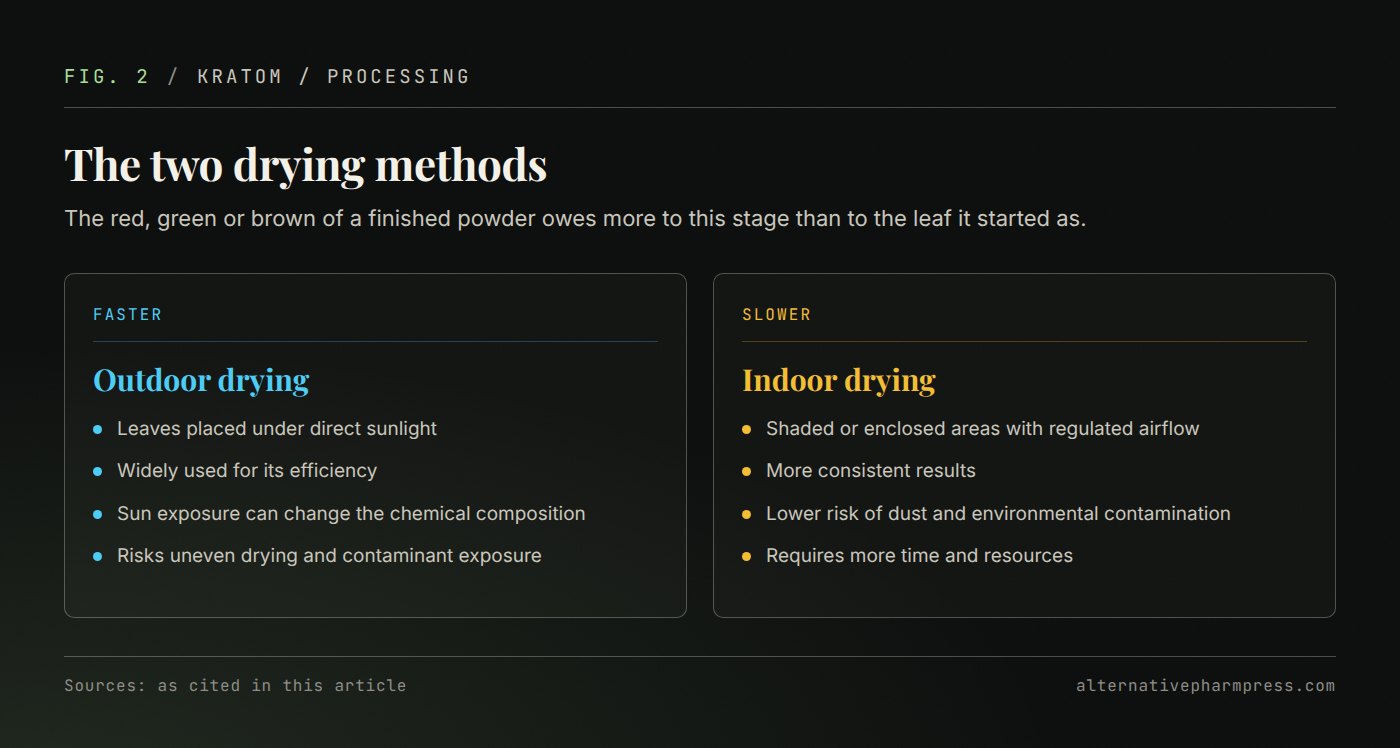
Once kratom leaves are harvested, they must be dried to prevent spoilage and prepare them for further processing. The outdoor process of drying involves placing leaves under the sunlight directly. This method is faster and used widely due to its efficiency. Sunlight exposure can lead to changes in the chemical composition of the leaves, which results in lighter or darker shades depending on duration and intensity.
Indoor drying takes place in a controlled environment. In this method, leaves are spread out in shaded or enclosed areas with regulated airflow. This method is slow but allows more consistency and reduces the risk of contamination from dust or environmental substances.
The difference between these two methods is crucial. The outdoor drying process gives quick results but carries risks such as uneven drying or exposure to contaminants. While the indoor drying process offers better control, it requires more time and resources. The color variation often seen as red, green, or brown powder is influenced by these drying techniques rather than the original leaf type alone.
Grinding & Powder Production
After drying, the leaves are processed into the fine powder, which is available in the market. At this stage, the leaves are crushed and milled by industrial grinders. The aim is to gain a consistent, fine texture that can be packed easily and used. The mesh size of the grinding process determines how smooth the final powder feels. High-quality kratom is typically finely ground, resulting in a soft and uniform texture.
Hygiene is also important during this stage. The proper facilities make sure that the powder remains free from contaminants. Reputable producers adhere to strict cleanliness standards and often test their products before distribution. After grinding, powder is packed in airtight containers or bags to preserve freshness and prevent exposure to moisture. Packaging plays a significant role in maintaining quality during storage and transportation.
How Processing Affects Alkaloid Content
Kratom’s main alkaloids are mitragynine and, in much smaller amounts, 7-hydroxymitragynine (7-OH). Both form in the living plant, but what happens after harvest changes how much survives into the powder.
The best evidence comes from a 2025 study in Frontiers in Plant Science by University of Florida researchers (Zhang et al.), who tested different withering times (0 to 72 hours) and drying temperatures (−40°C to 80°C) on two kratom cultivars across two seasons:
- Withering helps mitragynine. Letting leaves wilt before drying raised mitragynine concentrations by 14% to 65% in one cultivar and 3% to 8% in the other.
- Lower drying temperatures preserve alkaloids. Drying at lower temperatures preserved mitragynine, speciogynine and paynantheine. A 12-hour wither followed by drying below 40°C boosted speciogynine and paynantheine in one cultivar by roughly 35% to 67%.
- 7-OH stays very low. 7-OH averaged only 0.02% to 0.04% of the leaf alkaloid extract and was detected only in some seasons.
- Genetics and season matter too. Cultivar and harvest season changed alkaloid profiles as much as processing did.
Lab stability work points the same way. A 2020 study in the Journal of Analytical Toxicology (Basiliere and Kerrigan) found that all the kratom alkaloids it tested break down faster in acidic conditions, and that 7-OH was the least stable, with significant losses at 40°C and above. Hot, prolonged sun-drying and poor storage are therefore likely to lower alkaloid content, while careful, cooler drying keeps more of it.
The practical lesson: two powders sold under the same strain name can differ widely depending on the farm, season and handling. Only a batch-specific lab report tells you what is actually in the bag. Our COA guide explains how to read one.
Fermentation (Dark/Bentuangie)
Fermentation is a special technique used to create darker kratom varieties, which are referred to as “Bentuangie,” or dark kratom. In this process, dried leaves are stored in controlled conditions and sometimes sealed in bags, which allows natural fermentation. This changes the color, aroma, and overall profile of the final powder.
Fermented kratom typically has a darker appearance and a distinct smell as compared to non-fermented varieties. This process also influences the alkaloid composition, although results can vary depending on how fermentation is carried out. No peer-reviewed study has yet measured how commercial “bentuangie” fermentation changes alkaloid levels, so claims about its effects are based on vendor and user reports. It is crucial to note that fermentation is not the same as simple drying. It involves controlled environmental conditions and careful monitoring to achieve the desired outcome.
Export Standards and Contamination Risks
Most of the world’s kratom comes from Indonesia, especially West Kalimantan on Borneo. In September 2024 Indonesia introduced formal export rules (Trade Ministry Regulations No. 20 and 21 of 2024). Exporters must register, obtain export approval and a surveyor report, and shipments must be free of microbial contamination, heavy metals and other leaf material.
These standards respond to real problems. In 2018 a multistate Salmonella outbreak linked to kratom led to dozens of hospitalizations and multiple recalls in the United States, and FDA testing in 2019 found heavy metals such as lead and nickel in a number of kratom products. Contamination can enter at any stage, from drying leaves on open ground to grinding in poorly cleaned mills, which is why testing for microbes and metals matters as much as testing alkaloids.
What to Look For in Quality Kratom Powder
It might be challenging for consumers to identify high-quality kratom powder. There are several ways to consider.
First: Appearance matters in kratom powder, as high-quality kratom powder usually has a consistent color and fine texture. Clumpy or uneven powder may indicate poor processing or moisture exposure.
Second: Freshness plays a crucial role in quality. Fresh kratom tends to have a more vibrant color and a natural earthy fragrance. Stale or degraded powder may appear dull and lack consistency.
Third: Sourcing and testing are important when it comes to quality. Reputable vendors provide lab testing to ensure their products are free from contaminants and meet quality standards.
Fourth: Good packaging is a positive sign. A well-sealed packaging helps to maintain freshness and protect the powder from environmental factors.
Customers can avoid low-quality products and make better decisions by being aware of these factors.
Conclusion
The transformation of kratom from leaf to powder is a multi-step process where each step has an impact on the final product. Every step, from the tropical regions where it grows to the drying, grinding, and packaging methods used, plays a very large part in determining quality.
The base comes from farming regions like Borneo and Sumatra; it’s the processing techniques that really define the characteristics of kratom powder. Its composition can be greatly influenced by drying methods, fermentation, and storage conditions. For consumers, it is essential to understand these processes. This helps in identifying the quality of the products and also underscores the importance of responsible sourcing and production practices.
- Kratom Alkaloid Biosynthesis — Frontiers in Plant Science (2025)
- Zhang M, et al. Alkaloid biosynthesis in kratom varies with postharvest, genetic, and seasonal factors. Front Plant Sci. 2025
- Basiliere S, Kerrigan S. Temperature and pH-dependent stability of Mitragyna alkaloids. J Anal Toxicol. 2020
- Tempo — Indonesia implements regulations for kratom export trade (2024)
- Kratom Pharmacology — PMC
- FDA and Kratom